

EN 16253:2013
(Main)Air quality - Atmospheric measurements near ground with active Differential Optical Absorption Spectroscopy (DOAS) - Ambient air and diffuse emission measurements
- Abstract
This European Standard describes the operation of active DOAS measuring systems with continuous radiation source, the calibration procedures and applications in determining gaseous constituents (e.g. NO2, SO2, O3, BTX, Hg) in ambient air or in diffuse emissions.
- Status
- Published
- Publication Date
- 09-Jul-2013
- Withdrawal Date
- 30-Jan-2014
- Technical Committee
- CEN/TC 264 - Air quality
- Current Stage
- 9093 - Decision to confirm - Review Enquiry
- Start Date
- 20-Sep-2024
- Completion Date
- 07-Oct-2026

Overview
EN 16253:2013 (EN 16253:2013) is the European standard for active Differential Optical Absorption Spectroscopy (DOAS) applied to near‑ground atmospheric measurements. It defines the operation, calibration and quality assurance procedures for open‑path DOAS systems using a continuous radiation source to quantify gaseous constituents in ambient air and diffuse emissions. Typical target species include NO2, SO2, O3, BTX (benzene, toluene, xylenes) and Hg.
Key topics and technical requirements
- Scope and technique: Covers active (artificial source) DOAS measuring systems that measure absorption over an extended monitoring path (open‑path measurements).
- Measurement principle: Based on the Beer–Lambert law and differential optical absorption; spectral analysis typically in the UV/VIS to near‑IR range (approx. 250–2 500 nm) with high spectral resolution (~0.1–1 nm).
- System configurations: Describes bistatic (separate transmitter and receiver) and monostatic (transmitter/receiver with retroreflector) arrangements, including components such as radiation source, spectrometer, telescopes and retroreflectors.
- Measurement planning & field procedure: Guidance on defining measurement tasks, selecting DOAS parameters, instrument installation, start‑up checks, verification of optical properties and visibility checks for reliable path measurements.
- Calibration methods: Includes gas cell calibration and complete spectral modelling (synthetic spectra fitting) to derive traceable concentration path‑integrated values.
- Data processing & quality assurance: Procedures for reference spectra, background/dark/electronic offset handling, instrument line shape considerations, and performance characteristics to assure detection limits and measurement validity.
- Annexes: Informative annexes cover system components, influence of scattered solar radiation, implementation examples, performance characteristics and measurement record templates.
Practical applications and users
- Ambient air monitoring: Fixed‑site or mobile path monitoring to characterise urban/remote air quality and track pollutants over streets, valleys or across industrial zones.
- Diffuse emissions and area sources: Monitoring emissions from landfills, wastewater treatment plants, traffic corridors, industrial sites and agriculture where point sampling is not representative.
- Leak detection and process monitoring: Rapid screening for fugitive emissions in production areas, pipelines and equipment zones.
- Who uses it: Environmental laboratories, air quality networks, regulatory agencies, consultants, industrial hygiene teams, research organisations and instrument manufacturers.
Related standards and context
- EN 16253 complements other CEN air quality guidance and national measurement standards by providing method‑specific requirements for open‑path DOAS. Users should align DOAS implementations with national regulatory frameworks and broader air quality monitoring standards.
Relations
- Effective Date
- 28-Jan-2026
- Effective Date
- 28-Jan-2026
- Effective Date
- 28-Jan-2026
Get Certified
Connect with accredited certification bodies for this standard

CIS Institut d.o.o.
Personal Protective Equipment (PPE) certification body. Notified Body NB-2890 for EU Regulation 2016/425 PPE.

Kiwa BDA Testing
Building and construction product certification.
Kmetijski inštitut Slovenije
Agricultural Institute of Slovenia. Soil testing, plant health, agricultural product analysis.
Sponsored listings
Frequently Asked Questions
EN 16253:2013 is a standard published by the European Committee for Standardization (CEN). Its full title is "Air quality - Atmospheric measurements near ground with active Differential Optical Absorption Spectroscopy (DOAS) - Ambient air and diffuse emission measurements". This standard covers: This European Standard describes the operation of active DOAS measuring systems with continuous radiation source, the calibration procedures and applications in determining gaseous constituents (e.g. NO2, SO2, O3, BTX, Hg) in ambient air or in diffuse emissions.
This European Standard describes the operation of active DOAS measuring systems with continuous radiation source, the calibration procedures and applications in determining gaseous constituents (e.g. NO2, SO2, O3, BTX, Hg) in ambient air or in diffuse emissions.
EN 16253:2013 is classified under the following ICS (International Classification for Standards) categories: 13.040.20 - Ambient atmospheres. The ICS classification helps identify the subject area and facilitates finding related standards.
EN 16253:2013 has the following relationships with other standards: It is inter standard links to EN ISO 10472-1:2008, EN ISO 8230-1:2008, EN ISO 11111-1:2009. Understanding these relationships helps ensure you are using the most current and applicable version of the standard.
EN 16253:2013 is available in PDF format for immediate download after purchase. The document can be added to your cart and obtained through the secure checkout process. Digital delivery ensures instant access to the complete standard document.
Standards Content (Sample)
2003-01.Slovenski inštitut za standardizacijo. Razmnoževanje celote ali delov tega standarda ni dovoljeno.Luftqualität - Messungen in der bodennahen Atmosphäre mit der Differentiellen Optischen Absorptionsspektroskopie (DOAS) - Immissionsmessungen und Messungen von diffusen EmissionenQualité de l'air - Mesurages atmosphériques à proximité du sol par Spectroscopie d'Absorption Optique Différentielle (DOAS) - Mesurages de l'air ambiant et des émissions diffusesAir quality - Atmospheric measurements near ground with Differential Optical Absorption Spectroscopy (DOAS) - Ambient air and diffuse emission measurements13.040.20Kakovost okoljskega zrakaAmbient atmospheresICS:Ta slovenski standard je istoveten z:EN 16253:2013SIST EN 16253:2013en,de01-december-2013SIST EN 16253:2013SLOVENSKI
STANDARD
EUROPEAN STANDARD NORME EUROPÉENNE EUROPÄISCHE NORM
EN 16253
July 2013 ICS 13.040.20 English Version
Air quality - Atmospheric measurements near ground with active Differential Optical Absorption Spectroscopy (DOAS) - Ambient air and diffuse emission measurements
Qualité de l'air - Mesurages atmosphériques à proximité du sol par Spectroscopie d'Absorption Optique Différentielle (DOAS) - Mesurages de l'air ambiant et des émissions diffuses
Luftqualität - Messungen in der bodennahen Atmosphäre mit der aktiven Differentiellen Optischen Absorptionsspektroskopie (DOAS) - Immissionsmessungen und Messungen von diffusen Emissionen This European Standard was approved by CEN on 15 May 2013.
CEN members are bound to comply with the CEN/CENELEC Internal Regulations which stipulate the conditions for giving this European Standard the status of a national standard without any alteration. Up-to-date lists and bibliographical references concerning such national standards may be obtained on application to the CEN-CENELEC Management Centre or to any CEN member.
This European Standard exists in three official versions (English, French, German). A version in any other language made by translation under the responsibility of a CEN member into its own language and notified to the CEN-CENELEC Management Centre has the same status as the official versions.
CEN members are the national standards bodies of Austria, Belgium, Bulgaria, Croatia, Cyprus, Czech Republic, Denmark, Estonia, Finland, Former Yugoslav Republic of Macedonia, France, Germany, Greece, Hungary, Iceland, Ireland, Italy, Latvia, Lithuania, Luxembourg, Malta, Netherlands, Norway, Poland, Portugal, Romania, Slovakia, Slovenia, Spain, Sweden, Switzerland, Turkey and United Kingdom.
EUROPEAN COMMITTEE FOR STANDARDIZATION
COMITÉ EUROPÉEN DE NORMALISATION EUROPÄISCHES KOMITEE FÜR NORMUNG
Management Centre:
Avenue Marnix 17,
B-1000 Brussels © 2013 CEN All rights of exploitation in any form and by any means reserved worldwide for CEN national Members. Ref. No. EN 16253:2013: ESIST EN 16253:2013
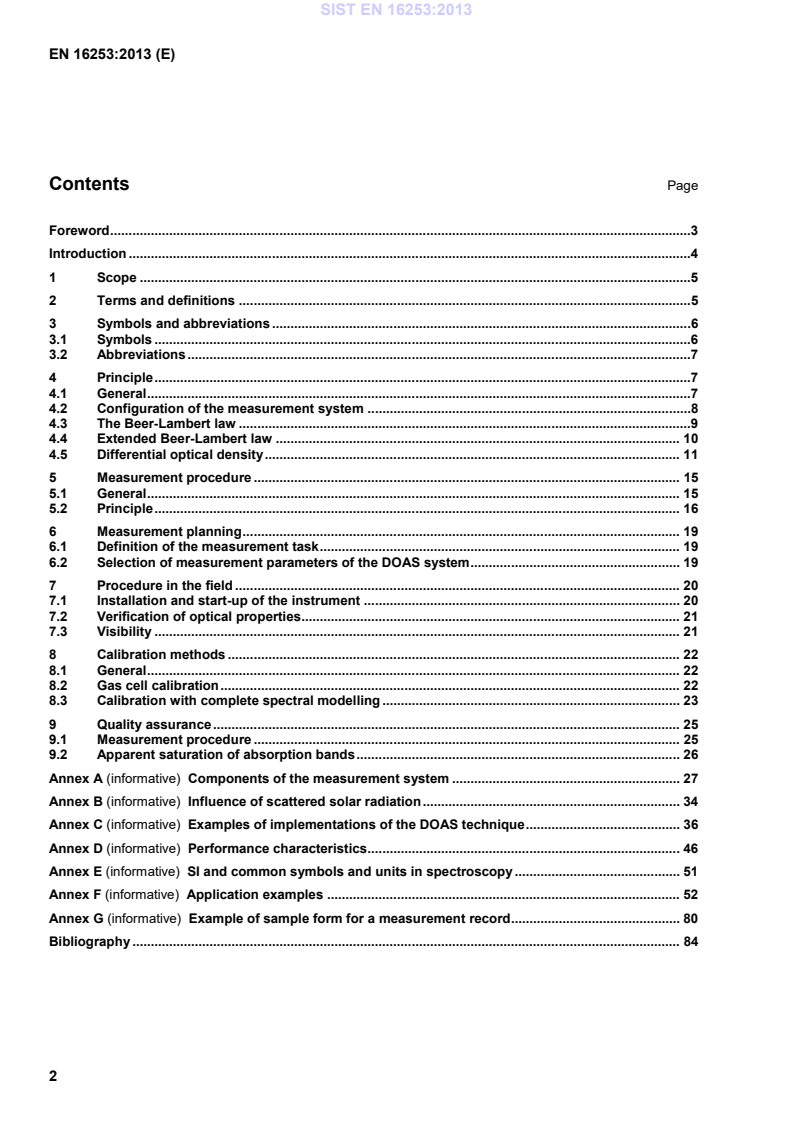
Components of the measurement system . 27 Annex B (informative)
Influence of scattered solar radiation . 34 Annex C (informative)
Examples of implementations of the DOAS technique . 36 Annex D (informative)
Performance characteristics . 46 Annex E (informative)
SI and common symbols and units in spectroscopy . 51 Annex F (informative)
Application examples . 52 Annex G (informative)
Example of sample form for a measurement record. 80 Bibliography . 84
ILS mathematical function which describes the effect of the instrument's response on a monochromatic line 2.7 intensity radiant power per unit solid angle (non-collimated beam) or per unit area (collimated beam) 2.8 lamp spectrum spectrum which is achieved by admitting direct light from the lamp to the spectrometer 2.9 monitoring path actual path in space over which the pollutant concentration is measured and averaged 2.10 open-path measurement measurement which is performed in the open atmosphere 2.11 path length distance that the radiation travels in the open atmosphere SIST EN 16253:2013
coefficient j of a polynomial D(λ) optical density D'(λ) differential optical density i index number I(λ, l) intensity of received radiation of wavelength λ after a path-length l I0(λ) intensity of emitted radiation of wavelength λ )(0l,I'λ differential initial intensity Imod(λ) modelled intensity l length of the monitoring path Mi molar mass of component i SIST EN 16253:2013
Key 1 DOAS spectrometer 2 Telescope for radiation collection 3 Ambient air 4 Monitoring path 5 Radiation source with collimating optics Figure 1
Bistatic arrangement for DOAS remote sensing SIST EN 16253:2013
Key 3 Ambient air 4 Monitoring path 6 DOAS spectrometer including radiation source 7 Telescope for transmission and collection of radiation 8 Retro-reflector Figure 2
Monostatic arrangement for DOAS remote sensing In the bistatic measurement set-up, the radiation source (5) and the DOAS spectrometer (1) are spatially separated. The two instrumental parts are oriented in such a way that the radiation emitted from the radiation source and collimated by a parabolic mirror is collected by the DOAS spectrometer telescope (2). The monitoring path length is the distance between collimating and receiving optics. For a monostatic measurement set-up, transmitting and receiving optics are an integral part of the DOAS spectrometer (6), which also includes the radiation source and a beam splitter serving to separate the received and transmitted beams. By means of a retroreflector (8) the radiation beam passes twice through the measurement volume. The monitoring path length in this case is twice the distance between the transmitter/receiver and the retroreflector optics. 4.3 The Beer-Lambert law When radiation passes through a medium, e.g. the atmosphere, it undergoes a change in intensity that can be expressed by means of the Beer-Lambert law: (ΦlcaIl,I⋅⋅−⋅=)(exp)()(0λλλ (1) where I(λ, l) is the intensity of the radiation of wavelength λ incident on the receiver after passing the atmosphere along the monitoring path l; I0(λ) is the intensity of the radiation of wavelength λ emitted by the radiation source; a(λ) is the specific absorption coefficient of the medium at wavelength λ in (µg/m3)–1·m–1; c is the concentration of the measured constituent in µg/m3; l is the length of the monitoring path in m. SIST EN 16253:2013
(3) NOTE The term extinction is also widely used for D(λ). The quotient )()(0λλIIis defined as the transmittance. 4.4 Extended Beer-Lambert law In atmospheric measurements, radiation is attenuated not merely by molecular absorption effects. It also disappears from the monitoring path due to scattering by air molecules (Rayleigh scattering) and to absorption and scattering by aerosol particles (Mie scattering). Apart from these attenuation effects, Rayleigh scattering of solar radiation leads to an increase in the radiation intensity incident on the detector. This additional contribution shall be determined and taken into account, as appropriate (see Annex B). Considering all these effects the absorption law (1) takes the following form: (Φ(Φ(Φ(Φ(Φ(Φ(ΦλλλλλλSlcalcacaexpIl,Iiii+⋅⋅−+⋅⋅−⋅−⋅=∑AEMLMR0 (4) where I(λ, l) is the intensity of the radiation of wavelength λ incident on the receiver after passing the atmosphere along the monitoring path l; I0(λ) is the intensity of the radiation of wavelength λ emitted by the radiation source; aR(λ) is the Rayleigh scattering coefficient in (µg/m3)-1·m-1; cLM is the density of the ambient air in µg/m3; aM(λ) is the Mie scattering coefficient in (µg/m3)-1·m-1; cAE is the aerosol concentration in µg/m3; l is the length of the monitoring path in m; ai(λ) is the specific absorption coefficient of constituent i at wavelength λ in (µg/m3)-1·m-1; ci is the concentration of constituent i in µg/m3; S(λ) is the intensity of scattered solar radiation. SIST EN 16253:2013
(7) where )(0λI′ is the differential initial intensity; 2(λ) is the attenuation factor of the optical system. The optical density determined on the basis of the differential initial intensity )(0λI′is referred to as the differential optical density D'(λ): (Φ∑⋅⋅′=′=lcaII'Diiλλλλ)()(ln)(0 (8) This procedure ensures that DOAS spectra can be properly analysed, as the optical density definition is expanded by taking into account the influence of the continuous absorption structures, i.e. those which do not vary much with the wavelength. By relying on the concept of differential initial intensity )(0λI′, DOAS solves the problem that the intensity of initial radiation I0(λ) emitted by a radiation source is impossible to determined from a measured spectrum due to absorption and scattering effects. Figure 3 illustrates the difference between the intensities I(λ), I0(λ), )(0λI′. SIST EN 16253:2013
Key 1 Mie extinction 2 Rayleigh extinction 3 Continuous absorption component X Wavelength Y1 Intensity Y2 Absorption coefficient Figure 3
Intensities I(λ), I0(λ) and I0’(λ) in an absorption spectrum (upper panel) and associated absorption coefficients a(λ), a0(λ) and a’(λ) (lower panel) )(0λI′can be determined by interpolation between the shoulder values I(λ1) and I(λ2). D(λ) is then obtained from the quotient of the intensities )(0λI′ (centre of band) and I(λ) according to Formula (9). (Φ)(ln)()()(ln)()(ln)(012101210λλλλλλλλλλλIIIIII'D−−−⋅−+=′= (9) SIST EN 16253:2013
Key X Wavelength
in nm Y1 Intensity I in relative units Y2 log I1/I2 Figure 4
Top: Measured raw spectrum and fitted fifth degree polynomial (smoothed line). Bottom: Quotient of raw spectrum and fitted polynomial produces the high-pass filtered spectrum, fitted SO2 reference spectrum for comparison (smoother line) 5 Measurement procedure 5.1 General DOAS measurements are based on the principle of recording and analysing absorption bands of the constituents of interest (see Clause 4). In addition, the following parameters shall be measured or recorded: monitoring path length, determined, e.g. using a geographical map, a range finder, GPS data or a tape measure (short distances); SIST EN 16253:2013
Figure 5 — Flow chart of a DOAS measurement and its evaluation The true optical density D'(k) is achieved by processing the following spectra: the atmospheric raw spectrum I (k), i.e. the spectrum of the lamp with trace gas features and aerosol absorption plus solar scattered light. The standard procedure is to add several (NM) individual spectra having the integration time (tM) in each case; NOTE k numbers the spectral interval covered by an individual detector pixel. SIST EN 16253:2013
(13) (NB and NL, respectively, indicate the number of background and lamp spectra added up). As ID1(k) is an averaged dark spectrum, the factors NM, NB, NL are introduced, in order to correlate the correct intensities within this algorithm for the raw atmospheric spectrum, the lamp spectrum, the dark spectrum and the background spectrum. For the same reason the ratio tM/tB is introduced, as IM and IB might have been recorded with different measurement times. The true optical density D'(k) can be processed as follows: a) A least-squares fit is carried out with a series of reference spectra according to 4.5. b) The resulting fit parameters indicating the optical densities of the respective trace gas are used to calculate the column density of this trace gas (as well as its standard deviation). c) Dividing the column density by the length of the monitoring path gives the trace gas concentration, which can be converted into mixing ratios by using the pressure and temperature of the air column (see Note in 4.4). d) In some cases it is necessary to fit additional parameters describing wavelength shift and/or stretch of the wavelength scale. These are not immediately necessary to calculate the trace gas concentration, but can be used to judge the quality of the spectrometer and provide an indication of error margins ([5], [6]). In this case also a non-linear fit procedure is necessary. Background spectra need not be recorded in daytime when operating at wavelengths below 290 nm, due to the additionally recorded scattered solar radiation in IM(k) under these conditions. The lamp spectra shall be determined regularly since they may change due to ageing (i.e. over a span of several days/weeks) depending on instrument design. The use of current lamp spectra improves the data quality as the changes in lamp and also detector characteristics are compensated. Reference spectra of the respective components can be recorded with the same spectrometer that is used for the atmospheric measurement. An alternative process is to convolute an available high-resolution spectrum ( from the literature) with the instrument line shape function of the current spectrometer, which in turn can be obtained in high quality by recording an atomic line spectrum (usually a Hg vapour line spectrum). Commercial implementations of the DOAS technique are presented in Annex C. SIST EN 16253:2013
NOTE New optical monostatic setups [7] do not require an adjustment at night. They are also simple to adjust at daylight. The adjustment of the light beam and focal point does not require the visibility of the emitting light. f) Fibres for the deep UV range (solarisation stabilised) should be used, if working with light sources emitting below 280 nm, to avoid degradation of light transmittance. g) If ozone-producing radiation sources are employed, suitable steps shall be taken (e.g. ventilation) to prevent any effects on the measurement and direct exposure to people. h) Whenever the system is installed from scratch, its wavelength accuracy shall be re-checked. This can be done, for instance, with the aid of a mercury vapour spectral lamp. i) A functional check of the DOAS measuring system shall be carried out before measurements are begun. j) Beam alignment and blocking or optical path deflection systems may be necessary, especially for automatic operation. These systems shall be controlled as appropriate. k) Once the monitoring path is set up and the optical adjustments have been made, all parameters of the DOAS measuring system which have been set or achieved for this specific monitoring path shall be duly documented so that any drift or de-adjustments can be identified. Where different monitoring paths are SIST EN 16253:2013
...