

EN 15288-1:2008
(Main)Swimming pools - Part 1: Safety requirements for design
- Abstract
This European Standard specifies safety requirements relevant to certain aspects of design and construction of classified pools according to Clause 4. It is intended for those who are concerned with construction, plan-ning and operation of classified swimming pools. It provides guidance about the risks associated by identifying the design characteristics required for a safe environment.
The requirements of this European Standard are applicable to all new classified pools and, as appropriate, to specific refurbishments of classified existing pools.
This European Standard has limited application to classified pools which consist of segregated areas of rivers, lakes or the sea but should be followed where relevant.
- Status
- Withdrawn
- Publication Date
- 02-Sep-2008
- Withdrawal Date
- 14-Sep-2010
- Technical Committee
- CEN/TC 136 - Sports, playground and other recreational equipment
- Drafting Committee
- CEN/TC 136/WG 8 - Swimming pool equipment
- Current Stage
- 9960 - Withdrawal effective - Withdrawal
- Start Date
- 15-Sep-2010
- Completion Date
- 15-Sep-2010

Relations
- Effective Date
- 19-Jan-2023
- Effective Date
- 28-Jan-2026
- Effective Date
- 28-Jan-2026
- Effective Date
- 16-Jan-2010
Frequently Asked Questions
EN 15288-1:2008 is a standard published by the European Committee for Standardization (CEN). Its full title is "Swimming pools - Part 1: Safety requirements for design". This standard covers: This European Standard specifies safety requirements relevant to certain aspects of design and construction of classified pools according to Clause 4. It is intended for those who are concerned with construction, plan-ning and operation of classified swimming pools. It provides guidance about the risks associated by identifying the design characteristics required for a safe environment. The requirements of this European Standard are applicable to all new classified pools and, as appropriate, to specific refurbishments of classified existing pools. This European Standard has limited application to classified pools which consist of segregated areas of rivers, lakes or the sea but should be followed where relevant.
This European Standard specifies safety requirements relevant to certain aspects of design and construction of classified pools according to Clause 4. It is intended for those who are concerned with construction, plan-ning and operation of classified swimming pools. It provides guidance about the risks associated by identifying the design characteristics required for a safe environment. The requirements of this European Standard are applicable to all new classified pools and, as appropriate, to specific refurbishments of classified existing pools. This European Standard has limited application to classified pools which consist of segregated areas of rivers, lakes or the sea but should be followed where relevant.
EN 15288-1:2008 is classified under the following ICS (International Classification for Standards) categories: 97.220.10 - Sports facilities. The ICS classification helps identify the subject area and facilitates finding related standards.
EN 15288-1:2008 has the following relationships with other standards: It is inter standard links to EN 15288-1:2008+A1:2010, EN 15288-2:2008, EN 1069-1:2010, EN 15288-1:2008/FprA1. Understanding these relationships helps ensure you are using the most current and applicable version of the standard.
EN 15288-1:2008 is available in PDF format for immediate download after purchase. The document can be added to your cart and obtained through the secure checkout process. Digital delivery ensures instant access to the complete standard document.
Standards Content (Sample)
2003-01.Slovenski inštitut za standardizacijo. Razmnoževanje celote ali delov tega standarda ni dovoljeno.Schwimmbäder - Teil 1: Sicherheitstechnische Anforderungen an die KonstruktionPiscines - Partie 1 : Exigences de sécurité pour la conceptionSwimming pools - Part 1: Safety requirements for design97.220.10Športni objektiSports facilitiesICS:Ta slovenski standard je istoveten z:EN 15288-1:2008SIST EN 15288-1:2008en,fr,de01-november-2008SIST EN 15288-1:2008SLOVENSKI
STANDARD
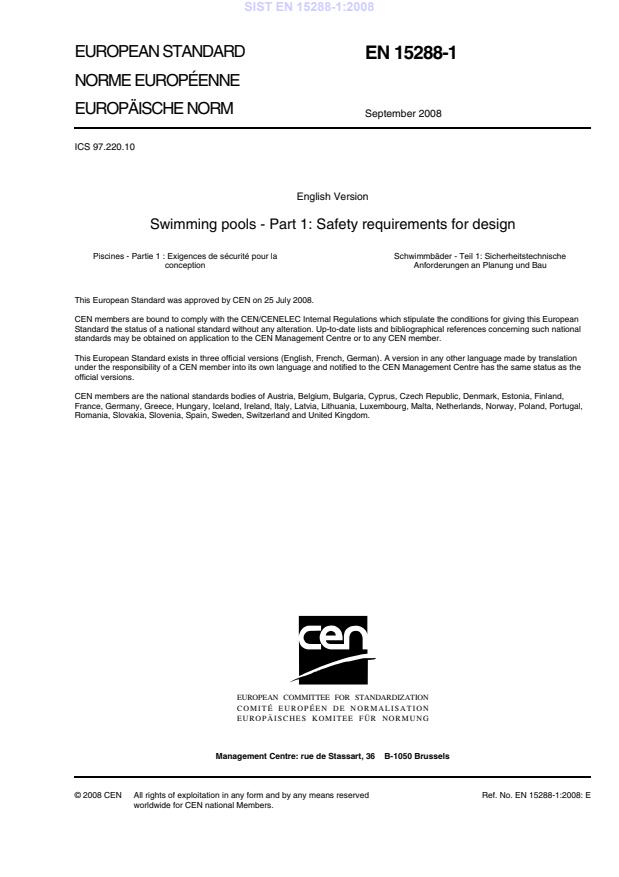
EUROPEAN STANDARDNORME EUROPÉENNEEUROPÄISCHE NORMEN 15288-1September 2008ICS 97.220.10 English VersionSwimming pools - Part 1: Safety requirements for designPiscines - Partie 1 : Exigences de sécurité pour laconceptionSchwimmbäder - Teil 1: SicherheitstechnischeAnforderungen an Planung und BauThis European Standard was approved by CEN on 25 July 2008.CEN members are bound to comply with the CEN/CENELEC Internal Regulations which stipulate the conditions for giving this EuropeanStandard the status of a national standard without any alteration. Up-to-date lists and bibliographical references concerning such nationalstandards may be obtained on application to the CEN Management Centre or to any CEN member.This European Standard exists in three official versions (English, French, German). A version in any other language made by translationunder the responsibility of a CEN member into its own language and notified to the CEN Management Centre has the same status as theofficial versions.CEN members are the national standards bodies of Austria, Belgium, Bulgaria, Cyprus, Czech Republic, Denmark, Estonia, Finland,France, Germany, Greece, Hungary, Iceland, Ireland, Italy, Latvia, Lithuania, Luxembourg, Malta, Netherlands, Norway, Poland, Portugal,Romania, Slovakia, Slovenia, Spain, Sweden, Switzerland and United Kingdom.EUROPEAN COMMITTEE FOR STANDARDIZATIONCOMITÉ EUROPÉEN DE NORMALISATIONEUROPÄISCHES KOMITEE FÜR NORMUNGManagement Centre: rue de Stassart, 36
B-1050 Brussels© 2008 CENAll rights of exploitation in any form and by any means reservedworldwide for CEN national Members.Ref. No. EN 15288-1:2008: ESIST EN 15288-1:2008
Introduction To provide a swimming pool which can be managed as safely as possible, considerations have to start with careful design. All of those involved in designing new pools or upgrading existing ones will need to give the highest priority to ensuring that they provide users and staff with a facility that is safe. Four steps need to be developed in order to achieve this: a) the layout of the pool hall (if any) and the pool basin (including its dimensions, profile and any water fea-tures) should be designed so as to make the safe use and supervision of the pool to achieve without complex or costly management arrangements; b) the layout of the ancillary areas, including the changing, clothes storage, shower and toilet areas, should be similarly designed for safe use; c) the structural elements, materials, finishes and details, including the pool hall enclosure (if any), basin and equipment and the way they are assembled should be those which are the most appropriate to achieving a safe-to-use physical environment; d) criteria relevant for the planning of the safe and functionally correct maintenance. There are specific sources of information from which the technical design and planning standards that are rec-ommended in the design of swimming pools can be obtained. Everyone who is involved in the process of specifying, designing and constructing pools should be familiar with these design and planning standards and should ensure that they are given careful consideration in all pool projects. It is also important to draw the attention of all of those involved in the design process to the implications of their work for the pool operator. What might be thought a small change in the layout of the pool or in the fin-ishes specified could have a significant impact on the ability of the pool to be used safely. If that change is ill-considered and creates a serious design flaw, the result might be an increase in accidents. More likely it will be an increase in the cost of operating the pool (perhaps through the employment of additional staff) in order to compensate for the resulting problems. One way of anticipating the management consequences of design decisions is to include a quali-fied/competent person on the design team. The person should give advice and guidance during the various development stages of the project. This standard includes requirements, recommendations and notes. While compliance with requirements is mandatory, recommendations indicate best practices and notes give additional information and/or explana-tions. SIST EN 15288-1:2008
This European Standard has limited application to classified pools which consist of segregated areas of rivers, lakes or the sea but should be followed where relevant. 2 Normative references The following referenced documents are indispensable for the application of this document. For dated refer-ences, only the edition cited applies. For undated references, the latest edition of the referenced document (including any amendments) applies. EN 1838, Lighting applications — Emergency lighting EN 13451-1:2001, Swimming pool equipment — Part 1: General safety requirements and test methods EN 13451-2, Swimming pool equipment — Part 2: Additional specific safety requirements and test methods for ladders, stepladders and handle bends EN 13451-8:2001, Swimming pool equipment — Part 8: Additional specific safety requirements and test methods for leisure water features ISO 7010, Graphical symbols — Safety colours and safety signs — Safety signs used in workplaces and pub-lic areas
HD 384.7.702 S2, Electrical installations of buildings — Part 7: Requirements for special installations or loca-tions; Section 702: Swimming pools and other basins (IEC 60364-7-702:1997, modified) 3 Terms and definitions For the purposes of this document, the following terms and definitions apply. 3.1 pool/swimming pool facility, with one or more water areas, intended for swimming, leisure or other water based physical activities 3.2 indoor swimming pool one or more constructed water areas for bathing enclosed in a building, covered by a roof (fixed or moveable) 3.3 outdoor swimming pool one or more constructed open-air water areas for bathing 3.4 private use use of an installation designated solely for the owner's/proprietor's/operator's family and guests including the use connected with renting houses for family use SIST EN 15288-1:2008
pools Type 2; pools of private use according to 3.4. 5 Safety related design factors and requirements 5.1 General
The requirements of clause 5 refer to pools which are intended for public use within a defined classification. Optional application of requirements to specific types is explained in the related paragraphs. The requirements apply as far as the selected items are present in the swimming pool. As safe operation is influenced by safe design, the design shall take into account the facility’s use, the activity, planned occupancy and its control. Where minimum requirements are given for different types, the designer shall consider the kind of activity foreseen and, should it be more similar to those of another type, refer to the most severe requirements. The occupancy ratio shall be defined at the design stage as the sum of the number of users: a) generated by the water related areas/activities; b) plus the number of users generated by other areas/activities. NOTE 1 A typical occupancy ratio according to a) for swimming pools Type 1, mainly used for swimming and teaching swimming, would be a minimum of 3 m² of water area per bather. As swimming and water-related activities carry an inherent risk (e. g. users have bare feet and wear only bath-ing costumes), the need for specific design requirements shall always be considered. Facilities designed to meet specific needs or programmes (e. g. competitions, special activities, events) re-quire special consideration. Also at the design stage, the needs of the following shall be considered: c) special users (see Bibliography, e. g. with disabilities); d) special installations (e. g. technologies to detect users in a potential risk of drowning video supervision of pool surrounds and/or other areas). Design construction and operation risk assessment shall be conducted for any refurbishment or alteration work. The assessments have to be developed, updated and implemented as and when required to suit the work stages and any relevant occurrences. NOTE 2 A review at fixed intervals has proved to be effective. Requirements and advice of the following chapters should be tested for relevance during the analysis. 5.2 Layout The layout of a facility shall be considered in terms of interaction between its components and between com-ponents and users. Particular attention shall be paid to the intended circulation routes and to the likely behaviour of users. SIST EN 15288-1:2008
Wherever possible, abrupt changes in floor level shall be avoided, particularly in barefoot areas. Single steps on the circulation routes shall a) have a height ≤ 250 mm, with the riser not open; a height ≤ 180 mm is recommended; b) have the edge marked by contrasting colour; c) have a slip-resistant finish complying with relevant standards/regulations. Staircases shall comply with relevant standards. Where ramps on the circulation routes are used, they shall: d) have an inclination ≤ 8 %; an inclination 5 % to 6 % is recommended; e) have a slip-resistant finish complying with relevant standards/regulations; f) be obviously marked at the beginning and end. Circulation routes shall be designed to ensure a free flow of users, avoiding congestion points, constrictions and obstructions. Service accesses should be provided separately to general circulation routes (e. g. direct access from the out-side). To prevent ponding in the barefoot areas, floors shall have a suitable and effective draining system. The incli-nation in direction of the drains shall be between 2 % and 5 %. With an inclination > 3 % particular attention shall be paid to the slip-resistance and to the opportunity to foresee handrails especially for long ramps. 5.5.3 Emergency routes Design of emergency routes shall comply with relevant regulations, but taking into account also the presence of barefoot users. SIST EN 15288-1:2008
100 1) Lux b) Plant rooms
Lux c) Changing rooms, showers, toilets 100
Lux d) Water areas 1)
200 1) Lux
e) Emergency light
in accordance with EN 1838 Where necessary for special illumination effects, lower illumination levels shall be allowed in the circulation routes and above the water areas by provision of supplementary lighting in the event of an emergency and provided suitably increased supervision is ensured.
To increase visibility and improve safety, underwater illumination is recommended for pools with deep water. NOTE Diving pools and facilities for competition as well as special events purposes, may need different illumination. For water areas the uniformity ratio of illumination at the water level shall be 0,7. For other areas, illumination shall be reasonably uniform, to avoid shadows and other effects that disturb visibility. The design of the illumination system shall consider maintenance and repair activitie
...