


FprEN ISO 9202
(Main)Jewellery and precious metals - Fineness of precious metal alloys (ISO/FDIS 9202:2026)
Jewellery and precious metals - Fineness of precious metal alloys (ISO/FDIS 9202:2026)
This document specifies a range of fineness of precious metal alloys (excluding solders) recommended for use in the field of jewellery.
NOTE There is a possibility that national legal requirements for the designation, marking, and stamping of finished articles exist in the respective countries.
Schmuck und Edelmetalle - Feingehalt von Edelmetalllegierungen (ISO/FDIS 9202:2026)
Joaillerie, bijouterie et métaux précieux - Titre des alliages de métaux précieux (ISO/FDIS 9202:2026)
Le présent document spécifie les titres des alliages de métaux précieux (à l'exception des soudures) d'usage recommandé en joaillerie.
NOTE Il peut exister des exigences légales nationales relatives à la désignation, au marquage et au poinçonnage des articles finis dans les pays en question.
Nakit in plemenite kovine - Čistine zlitin plemenitih kovin (ISO/FDIS 9202:2026)
General Information
- Status
- Not Published
- Publication Date
- 19-Jul-2026
- Current Stage
- 5060 - Closure of Vote - Formal Approval
- Start Date
- 17-Apr-2026
- Completion Date
- 17-Apr-2026
Relations
- Effective Date
- 12-Feb-2026
- Revises
EN ISO 9202:2019 - Jewellery and precious metals - Fineness of precious metal alloys (ISO 9202:2019) - Effective Date
- 06-Nov-2024
Overview
FprEN ISO 9202:2026, developed by CEN and ISO (ISO/TC 174), specifies the recommended range of fineness for precious metal alloys used in the field of jewellery. This international standard outlines the minimum allowable content of gold, platinum, palladium, and silver in jewellery alloys, expressed in parts per thousand (‰) by weight, excluding solders. Fineness determination and standardized values are critical for quality, consumer trust, trade, and legal compliance globally.
Key Topics
- Definition of Fineness: Fineness refers to the minimum content of a named precious metal in an alloy, measured in parts per thousand by weight.
- Applicable Precious Metals: Gold, platinum, palladium, and silver, with specified minimum fineness values for each.
- Analytical Methods: The standard references ISO analytical methods such as cupellation for gold and potentiometry for silver to ensure the accuracy of fineness determinations.
- Minimum Fineness Values: The standard lists allowed minimum fineness values for each metal, such as 750, 916, and 999 for gold, and 850, 950, and 999 for platinum.
- No Minus Tolerance: Fineness values are minimums with no allowed negative deviation, ensuring consistent precious metal quality.
Applications
Implementing FprEN ISO 9202 delivers significant benefits for the jewellery and precious metals industry:
- Quality Assurance: Manufacturers can guarantee minimum standards for product composition, enhancing consumer confidence and brand reputation.
- Trade Facilitation: Consistent fineness levels simplify international trade by harmonizing product requirements and reducing disputes over metal content.
- Legal Compliance: The standard provides a recognized reference for authorities responsible for the designation, marking, and stamping of jewellery, supporting legal conformity with national regulations.
- Laboratory Testing: Accredited laboratories utilize the specified test methods for gold, silver, platinum, and palladium to verify fineness, supporting both quality control and certification processes.
- Consumer Protection: Clearly marked fineness values enable consumers to make informed purchasing decisions, helping prevent fraud and misrepresentation in the jewellery market.
Related Standards
FprEN ISO 9202 refers to and aligns with several companion standards for the determination of precious metal content:
- ISO 11210 - Determination of platinum by gravimetry
- ISO 11426 - Determination of gold by cupellation (fire assay)
- ISO 11427 - Determination of silver by potentiometry
- ISO 11490 / ISO 11495 - Determination of palladium in alloys
- ISO 11494 / ISO 13756 - Platinum and silver determination methods
- ISO 15093 / ISO 15096 - High-purity gold, platinum, palladium, and silver testing
- ISO 18214 - Determination of high-purity precious metals by SPARK-OES
National legal requirements may supplement or specify additional rules for the marking or stamping of jewellery, and reference to local legislation is advised when applying the standard in specific countries.
Keywords: FprEN ISO 9202, jewellery, precious metals, fineness, gold, platinum, palladium, silver, alloy fineness, ISO/TC 174, jewellery standard, analytical methods, quality assurance, legal compliance, standardization, precious metal testing


Frequently Asked Questions
FprEN ISO 9202 is a draft published by the European Committee for Standardization (CEN). Its full title is "Jewellery and precious metals - Fineness of precious metal alloys (ISO/FDIS 9202:2026)". This standard covers: This document specifies a range of fineness of precious metal alloys (excluding solders) recommended for use in the field of jewellery. NOTE There is a possibility that national legal requirements for the designation, marking, and stamping of finished articles exist in the respective countries.
This document specifies a range of fineness of precious metal alloys (excluding solders) recommended for use in the field of jewellery. NOTE There is a possibility that national legal requirements for the designation, marking, and stamping of finished articles exist in the respective countries.
FprEN ISO 9202 is classified under the following ICS (International Classification for Standards) categories: 39.060 - Jewellery. The ICS classification helps identify the subject area and facilitates finding related standards.
FprEN ISO 9202 has the following relationships with other standards: It is inter standard links to ISO 9202, EN ISO 9202:2019. Understanding these relationships helps ensure you are using the most current and applicable version of the standard.
FprEN ISO 9202 is available in PDF format for immediate download after purchase. The document can be added to your cart and obtained through the secure checkout process. Digital delivery ensures instant access to the complete standard document.
Standards Content (Sample)
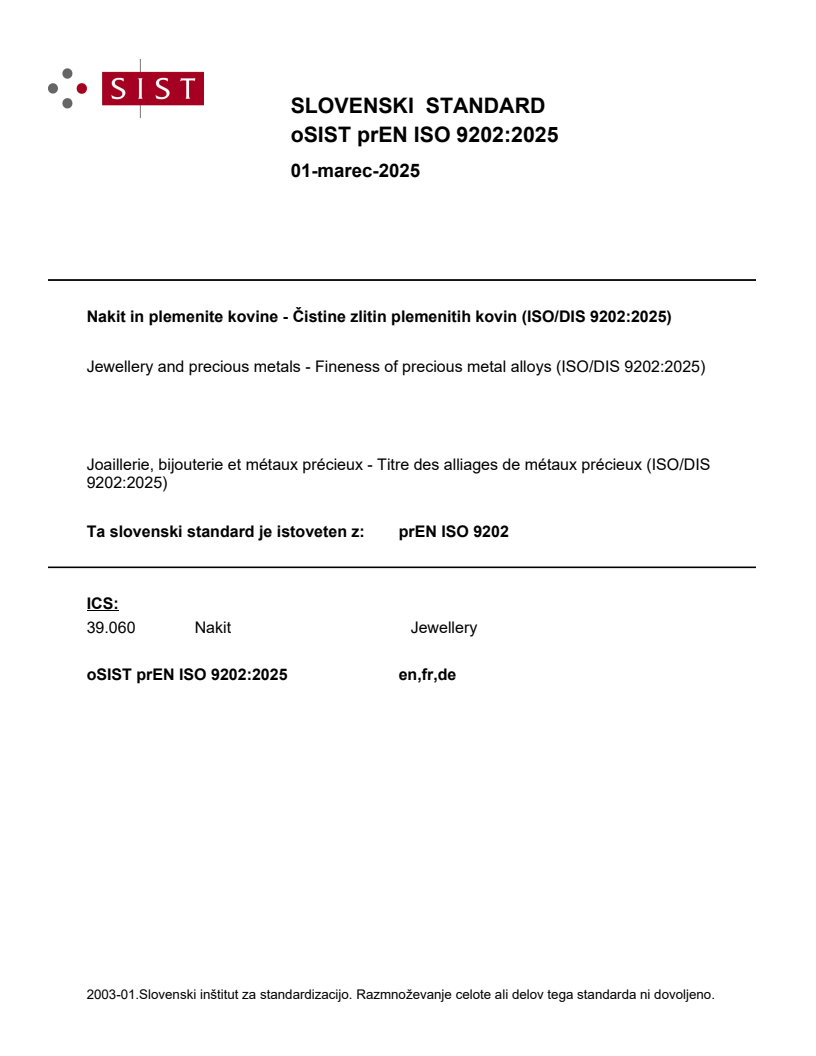
SLOVENSKI STANDARD
oSIST prEN ISO 9202:2025
01-marec-2025
Nakit in plemenite kovine - Čistine zlitin plemenitih kovin (ISO/DIS 9202:2025)
Jewellery and precious metals - Fineness of precious metal alloys (ISO/DIS 9202:2025)
Joaillerie, bijouterie et métaux précieux - Titre des alliages de métaux précieux (ISO/DIS
9202:2025)
Ta slovenski standard je istoveten z: prEN ISO 9202
ICS:
39.060 Nakit Jewellery
oSIST prEN ISO 9202:2025 en,fr,de
2003-01.Slovenski inštitut za standardizacijo. Razmnoževanje celote ali delov tega standarda ni dovoljeno.
oSIST prEN ISO 9202:2025
oSIST prEN ISO 9202:2025
DRAFT
International
Standard
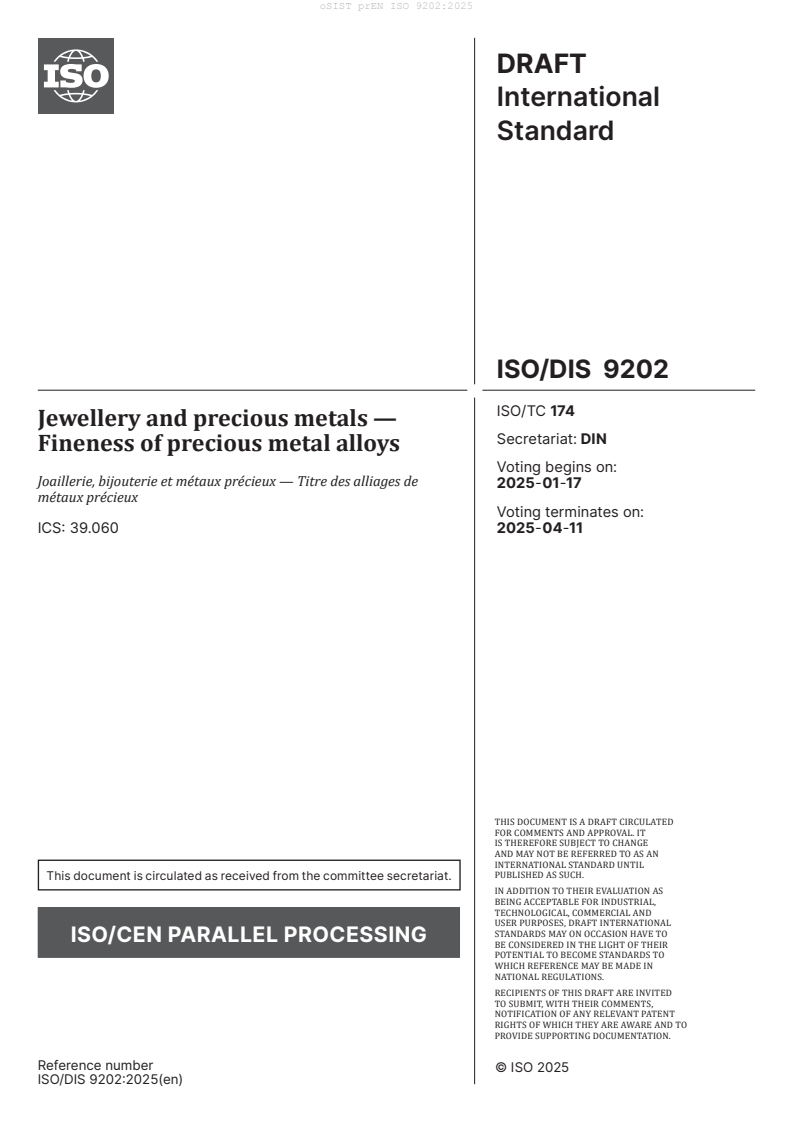
ISO/DIS 9202
ISO/TC 174
Jewellery and precious metals —
Secretariat: DIN
Fineness of precious metal alloys
Voting begins on:
Joaillerie, bijouterie et métaux précieux — Titre des alliages de
2025-01-17
métaux précieux
Voting terminates on:
ICS: 39.060 2025-04-11
THIS DOCUMENT IS A DRAFT CIRCULATED
FOR COMMENTS AND APPROVAL. IT
IS THEREFORE SUBJECT TO CHANGE
AND MAY NOT BE REFERRED TO AS AN
INTERNATIONAL STANDARD UNTIL
PUBLISHED AS SUCH.
This document is circulated as received from the committee secretariat.
IN ADDITION TO THEIR EVALUATION AS
BEING ACCEPTABLE FOR INDUSTRIAL,
TECHNOLOGICAL, COMMERCIAL AND
USER PURPOSES, DRAFT INTERNATIONAL
STANDARDS MAY ON OCCASION HAVE TO
ISO/CEN PARALLEL PROCESSING
BE CONSIDERED IN THE LIGHT OF THEIR
POTENTIAL TO BECOME STANDARDS TO
WHICH REFERENCE MAY BE MADE IN
NATIONAL REGULATIONS.
RECIPIENTS OF THIS DRAFT ARE INVITED
TO SUBMIT, WITH THEIR COMMENTS,
NOTIFICATION OF ANY RELEVANT PATENT
RIGHTS OF WHICH THEY ARE AWARE AND TO
PROVIDE SUPPORTING DOCUMENTATION.
Reference number
ISO/DIS 9202:2025(en)
oSIST prEN ISO 9202:2025
DRAFT
ISO/DIS 9202:2025(en)
International
Standard
ISO/DIS 9202
ISO/TC 174
Jewellery and precious metals —
Secretariat: DIN
Fineness of precious metal alloys
Voting begins on:
Joaillerie, bijouterie et métaux précieux — Titre des alliages de
métaux précieux
Voting terminates on:
ICS: 39.060
THIS DOCUMENT IS A DRAFT CIRCULATED
FOR COMMENTS AND APPROVAL. IT
IS THEREFORE SUBJECT TO CHANGE
AND MAY NOT BE REFERRED TO AS AN
INTERNATIONAL STANDARD UNTIL
PUBLISHED AS SUCH.
This document is circulated as received from the committee secretariat.
IN ADDITION TO THEIR EVALUATION AS
BEING ACCEPTABLE FOR INDUSTRIAL,
© ISO 2025
TECHNOLOGICAL, COMMERCIAL AND
USER PURPOSES, DRAFT INTERNATIONAL
All rights reserved. Unless otherwise specified, or required in the context of its implementation, no part of this publication may
STANDARDS MAY ON OCCASION HAVE TO
ISO/CEN PARALLEL PROCESSING
be reproduced or utilized otherwise in any form or by any means, electronic or mechanical, including photocopying, or posting on
BE CONSIDERED IN THE LIGHT OF THEIR
the internet or an intranet, without prior written permission. Permission can be requested from either ISO at the address below
POTENTIAL TO BECOME STANDARDS TO
WHICH REFERENCE MAY BE MADE IN
or ISO’s member body in the country of the requester.
NATIONAL REGULATIONS.
ISO copyright office
RECIPIENTS OF THIS DRAFT ARE INVITED
CP 401 • Ch. de Blandonnet 8
TO SUBMIT, WITH THEIR COMMENTS,
CH-1214 Vernier, Geneva
NOTIFICATION OF ANY RELEVANT PATENT
Phone: +41 22 749 01 11
RIGHTS OF WHICH THEY ARE AWARE AND TO
PROVIDE SUPPORTING DOCUMENTATION.
Email: copyright@iso.org
Website: www.iso.org
Published in Switzerland Reference number
ISO/DIS 9202:2025(en)
ii
oSIST prEN ISO 9202:2025
ISO/DIS 9202:2025(en)
Contents Page
Foreword .iv
1 Scope . 1
2 Normative references . 1
3 Terms and definitions . 1
4 Analytical methods for determining fineness . 2
5 Range of fineness . 2
iii
oSIST prEN ISO 9202:2025
ISO/DIS 9202:2025(en)
Foreword
ISO (the International Organization for Standardization) is a worldwide federation of national standards
bodies (ISO member bodies). The work of preparing International Standards is normally carried out through
ISO technical committees. Each member body interested in a subject for which a technical committee
has been established has the right to be represented on that committee. International organizations,
governmental and
...
Questions, Comments and Discussion
Ask us and Technical Secretary will try to provide an answer. You can facilitate discussion about the standard in here.
Loading comments...