


ISO 9202
(Main)Jewellery and precious metals — Fineness of precious metal alloys
Jewellery and precious metals — Fineness of precious metal alloys
This document specifies a range of fineness of precious metal alloys (excluding solders) recommended for use in the field of jewellery. NOTE There is a possibility that national legal requirements for the designation, marking, and stamping of finished articles exist in the respective countries.
Joaillerie, bijouterie et métaux précieux — Titre des alliages de métaux précieux
Le présent document spécifie les titres des alliages de métaux précieux (à l'exception des soudures) d'usage recommandé en joaillerie. NOTE Il peut exister des exigences légales nationales relatives à la désignation, au marquage et au poinçonnage des articles finis dans les pays en question.
General Information
- Status
- Not Published
- Technical Committee
- ISO/TC 174 - Jewellery and precious metals
- Current Stage
- 6000 - International Standard under publication
- Start Date
- 18-Apr-2026
- Completion Date
- 25-Apr-2026
Relations
- Consolidates
FprEN ISO 9202 - Jewellery and precious metals - Fineness of precious metal alloys (ISO/FDIS 9202:2026) - Effective Date
- 12-Feb-2026
- Consolidates
ISO 16147:2020 - Small craft — Inboard diesel engines — Engine-mounted fuel, oil and electrical components - Effective Date
- 07-Jan-2025
- Effective Date
- 07-Jan-2025
Overview
ISO 9202: Jewellery and Precious Metals - Fineness of Precious Metal Alloys sets internationally recognized guidelines for the fineness (purity) of precious metal alloys intended for use in jewellery. This standard, developed by ISO Technical Committee 174, provides a harmonized range of minimum fineness values for gold, platinum, palladium, and silver alloys, helping ensure quality, consistency, and transparency within the jewellery industry. ISO 9202 does not apply to solders and recognizes the possibility of additional national requirements for marking and stamping of finished articles.
Key Topics
- Fineness Definition: Fineness refers to the content of the named precious metal, expressed in parts per thousand (‰) by mass within an alloy.
- Range of Fineness Values: ISO 9202 lists recommended minimum fineness values for major precious metals used in jewellery:
- Gold: 333, 375, 417, 585, 750, 916, 990, 995, 999 (‰)
- Platinum: 850, 900, 950, 990, 999 (‰)
- Palladium: 500, 950, 990, 999 (‰)
- Silver: 800, 925, 958, 990, 999 (‰)
- Analytical Methods: The standard references a range of recognized ISO test methods for the determination of precious metal content, ensuring accuracy and comparability. These analytical techniques include gravimetry, cupellation, potentiometry, ICP-OES, and SPARK-OES.
- No Minus Tolerance: The selected fineness values represent minimum requirements - negative tolerance is not permitted.
Applications
- Jewellery Manufacturing: ISO 9202 supports jewellers and manufacturers by specifying acceptable fineness grades for common precious metals, aiding in procurement, production, and quality assurance.
- International Trade: With standardized fineness values, buyers and sellers across different countries can more easily understand the quality of precious metal jewellery, facilitating international trade, reducing disputes, and supporting export processes.
- Product Marking and Stamping: The document guides producers in selecting correct fineness levels, supporting compliance with legal requirements for marking and stamping. However, all users must also consider national legislation, which may mandate additional or alternative criteria.
- Assay Offices and Laboratories: The referenced analytical test methods ensure that independent verification of precious metal content aligns with global standards, increasing consumer confidence and enabling clear communication throughout the supply chain.
- Consumers: By relying on industry-standard definitions and values, consumers benefit from increased transparency and trust when purchasing precious metal jewellery.
Related Standards
Several key related ISO standards support the implementation and verification of ISO 9202:
- ISO 11210: Determination of platinum by gravimetry
- ISO 11426: Determination of gold by the cupellation (fire assay) method
- ISO 11427: Determination of silver by potentiometry
- ISO 11490 & ISO 11495: Determination of palladium by gravimetry and ICP-OES
- ISO 11494 & ISO 15093: Determination of platinum by ICP-OES and difference methods
- ISO 13756: Silver determination by potentiometry
- ISO 15096: High purity silver determination via difference method
- ISO 18214: Determination of high purity gold, silver, platinum, and palladium by SPARK-OES
- ISO 19376-1: Jewellery and precious metals vocabulary
Referencing these standards ensures robust, reliable testing and accurate description of precious metal fineness in jewellery production and trading environments.
Keywords: ISO 9202, jewellery fineness, precious metal alloys, gold fineness, platinum fineness, palladium purity, silver fineness, ISO jewellery standards, marking and stamping, analytical precious metal testing, quality assurance in jewellery, international jewellery regulations.
Buy Documents


ISO/FDIS 9202 - Jewellery and precious metals — Fineness of precious metal alloys Released:6. 02. 2026
REDLINE ISO/FDIS 9202 - Jewellery and precious metals — Fineness of precious metal alloys Released:6. 02. 2026

ISO/FDIS 9202 - Joaillerie, bijouterie et métaux précieux — Titre des alliages de métaux précieux
Frequently Asked Questions
ISO 9202 is a draft published by the International Organization for Standardization (ISO). Its full title is "Jewellery and precious metals — Fineness of precious metal alloys". This standard covers: This document specifies a range of fineness of precious metal alloys (excluding solders) recommended for use in the field of jewellery. NOTE There is a possibility that national legal requirements for the designation, marking, and stamping of finished articles exist in the respective countries.
This document specifies a range of fineness of precious metal alloys (excluding solders) recommended for use in the field of jewellery. NOTE There is a possibility that national legal requirements for the designation, marking, and stamping of finished articles exist in the respective countries.
ISO 9202 is classified under the following ICS (International Classification for Standards) categories: 39.060 - Jewellery. The ICS classification helps identify the subject area and facilitates finding related standards.
ISO 9202 has the following relationships with other standards: It is inter standard links to FprEN ISO 9202, ISO 16147:2020, ISO 9202:2019. Understanding these relationships helps ensure you are using the most current and applicable version of the standard.
ISO 9202 is available in PDF format for immediate download after purchase. The document can be added to your cart and obtained through the secure checkout process. Digital delivery ensures instant access to the complete standard document.
Standards Content (Sample)
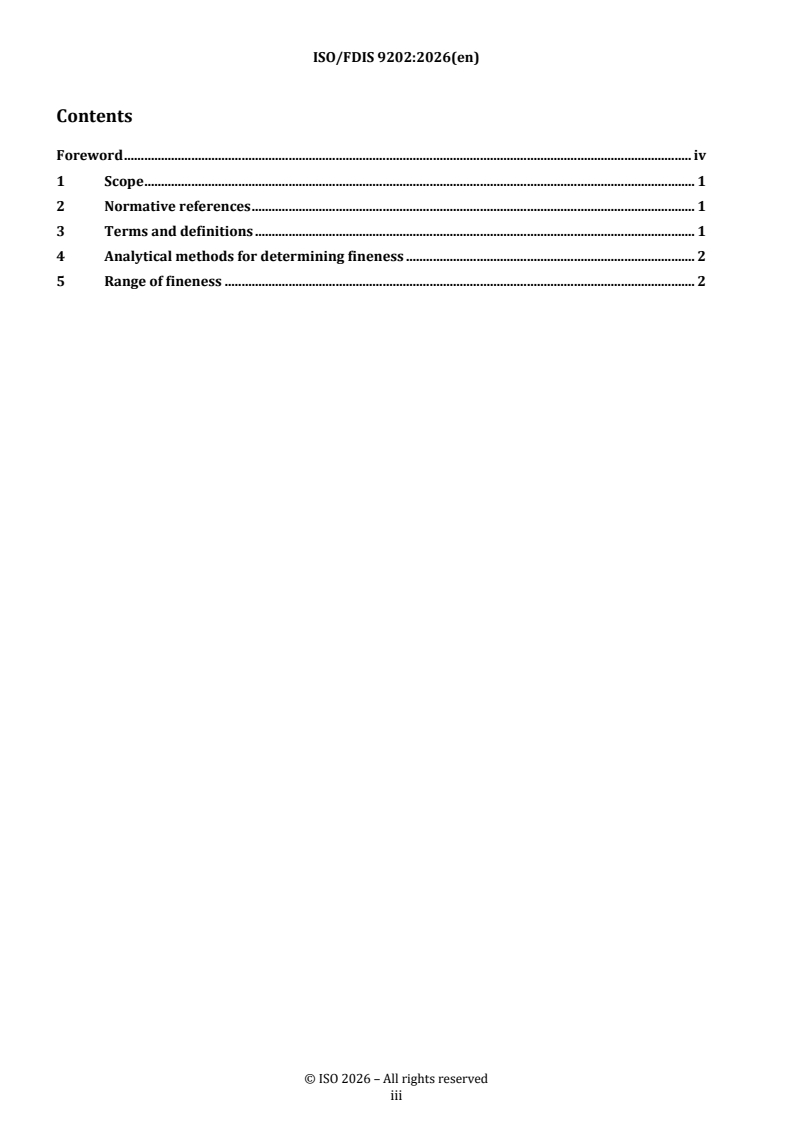
FINAL DRAFT
International
Standard
ISO/FDIS 9202
ISO/TC 174
Jewellery and precious metals —
Secretariat: DIN
Fineness of precious metal alloys
Voting begins on:
Joaillerie, bijouterie et métaux précieux — Titre des alliages de 2026-02-20
métaux précieux
Voting terminates on:
2026-04-17
RECIPIENTS OF THIS DRAFT ARE INVITED TO SUBMIT,
WITH THEIR COMMENTS, NOTIFICATION OF ANY
RELEVANT PATENT RIGHTS OF WHICH THEY ARE AWARE
AND TO PROVIDE SUPPOR TING DOCUMENTATION.
IN ADDITION TO THEIR EVALUATION AS
BEING ACCEPTABLE FOR INDUSTRIAL, TECHNO
ISO/CEN PARALLEL PROCESSING LOGICAL, COMMERCIAL AND USER PURPOSES, DRAFT
INTERNATIONAL STANDARDS MAY ON OCCASION HAVE
TO BE CONSIDERED IN THE LIGHT OF THEIR POTENTIAL
TO BECOME STAN DARDS TO WHICH REFERENCE MAY BE
MADE IN NATIONAL REGULATIONS.
Reference number
ISO/FDIS 9202:2026(en) © ISO 2026
FINAL DRAFT
ISO/FDIS 9202:2026(en)
International
Standard
ISO/FDIS 9202
ISO/TC 174
Jewellery and precious metals —
Secretariat: DIN
Fineness of precious metal alloys
Voting begins on:
Joaillerie, bijouterie et métaux précieux — Titre des alliages de
métaux précieux
Voting terminates on:
RECIPIENTS OF THIS DRAFT ARE INVITED TO SUBMIT,
WITH THEIR COMMENTS, NOTIFICATION OF ANY
RELEVANT PATENT RIGHTS OF WHICH THEY ARE AWARE
AND TO PROVIDE SUPPOR TING DOCUMENTATION.
© ISO 2026
IN ADDITION TO THEIR EVALUATION AS
All rights reserved. Unless otherwise specified, or required in the context of its implementation, no part of this publication may
BEING ACCEPTABLE FOR INDUSTRIAL, TECHNO
ISO/CEN PARALLEL PROCESSING
LOGICAL, COMMERCIAL AND USER PURPOSES, DRAFT
be reproduced or utilized otherwise in any form or by any means, electronic or mechanical, including photocopying, or posting on
INTERNATIONAL STANDARDS MAY ON OCCASION HAVE
the internet or an intranet, without prior written permission. Permission can be requested from either ISO at the address below
TO BE CONSIDERED IN THE LIGHT OF THEIR POTENTIAL
or ISO’s member body in the country of the requester.
TO BECOME STAN DARDS TO WHICH REFERENCE MAY BE
MADE IN NATIONAL REGULATIONS.
ISO copyright office
CP 401 • Ch. de Blandonnet 8
CH-1214 Vernier, Geneva
Phone: +41 22 749 01 11
Email: copyright@iso.org
Website: www.iso.org
Published in Switzerland Reference number
ISO/FDIS 9202:2026(en) © ISO 2026
ii
ISO/FDIS 9202:2026(en)
Contents Page
Foreword .iv
1 Scope . 1
2 Normative references . 1
3 Terms and definitions . 1
4 Analytical methods for determining fineness . 2
5 Range of fineness . 2
iii
ISO/FDIS 9202:2026(en)
Foreword
ISO (the International Organization for Standardization) is a worldwide federation of national standards
bodies (ISO member bodies). The work of preparing International Standards is normally carried out through
ISO technical committees. Each member body interested in a subject for which a technical committee
has been established has the right to be represented on that committee. International organizations,
governmental and non-governmental, in liaison with ISO, also take part in the work. ISO collaborates closely
with the International Electrotechnical Commission (IEC) on all matters of electrotechnical standardization.
The procedures used to develop this document and those intended for its further maintenance are described
in the ISO/IEC Directives, Part 1. In particular, the different approval criteria needed for the different types
of ISO documents should be noted. This document was drafted in accordance with the editorial rules of the
ISO/IEC Directives, Part 2 (see www.iso.org/directives).
ISO draws attention to the possibility that the implementation of this document may involve the use of (a)
patent(s). ISO takes no position concerning the evidence, validity or applicability of any claimed patent
rights in respect thereof. As of the date of
...
ISO/FDIS 9202:2026(en)
ISO/TC 174
Secretariat: DIN
Date: 2026-01-20xx
Jewellery and precious metals — Fineness of precious metal alloys
Joaillerie, bijouterie et métaux précieux — Titre des alliages de métaux précieux
FDIS stage
TThhiis drs draafftt i is s susubbmmiitttteed d ttoo aa ppaarraallellel l vvoottee i inn IISSOO,, CCEEN.N.
ISO/FDIS 9202:2026(en)
All rights reserved. Unless otherwise specified, or required in the context of its implementation, no part of this publication
may be reproduced or utilized otherwise in any form or by any means, electronic or mechanical, including photocopying,
or posting on the internet or an intranet, without prior written permission. Permission can be requested from either ISO
at the address below or ISO’s member body in the country of the requester.
ISO copyright office
CP 401 • Ch. de Blandonnet 8
CH-1214 Vernier, Geneva
Phone: + 41 22 749 01 11
E-mail: copyright@iso.org
Website: www.iso.org
Published in Switzerland
ii
ISO/FDIS 9202:2026(en)
Contents
Foreword . iv
1 Scope . 1
2 Normative references . 1
3 Terms and definitions . 1
4 Analytical methods for determining fineness . 2
5 Range of fineness . 2
iii
ISO/FDIS 9202:2026(en)
Foreword
ISO (the International Organization for Standardization) is a worldwide federation of national standards
bodies (ISO member bodies). The work of preparing International Standards is normally carried out through
ISO technical committees. Each member body interested in a subject for which a technical committee has been
established has the right to be represented on that committee. International organizations, governmental and
non-governmental, in liaison with ISO, also take part in the work. ISO collaborates closely with the
International Electrotechnical Commission (IEC) on all matters of electrotechnical standardization.
The procedures used to develop this document and those intended for its further maintenance are described
in the ISO/IEC Directives, Part 1. In particular, the different approval criteria needed for the different types of
ISO documents should be noted. This document was drafted in accordance with the editorial rules of the
ISO/IEC Directives, Part 2 (see www.iso.org/directives).
ISO draws attention to the possibility that the implementation of this document may involve the use of (a)
patent(s). ISO takes no position concerning the evidence, validity or applicability of any claimed patent rights
in respect thereof. As of the date of publication of this document, ISO had not received notice of (a) patent(s)
which may be required to implement this document. However, implementers are cautioned that this may not
represent the latest information, which may be obtained from the patent database available at
www.iso.org/patents. ISO shall not be held responsible for identifying any or all such patent rights.
Any trade name used in this document is information given for the convenience of users and does not
constitute an endorsement.
For an explanation of the voluntary nature of standards, the meaning of ISO specific terms and expressions
related to conformity assessment, as well as information about ISO's adherence to the World Trade
Organization (WTO) principles in the Technical Barriers to Trade (TBT), see www.iso.org/iso/foreword.html.
This document was pr
...
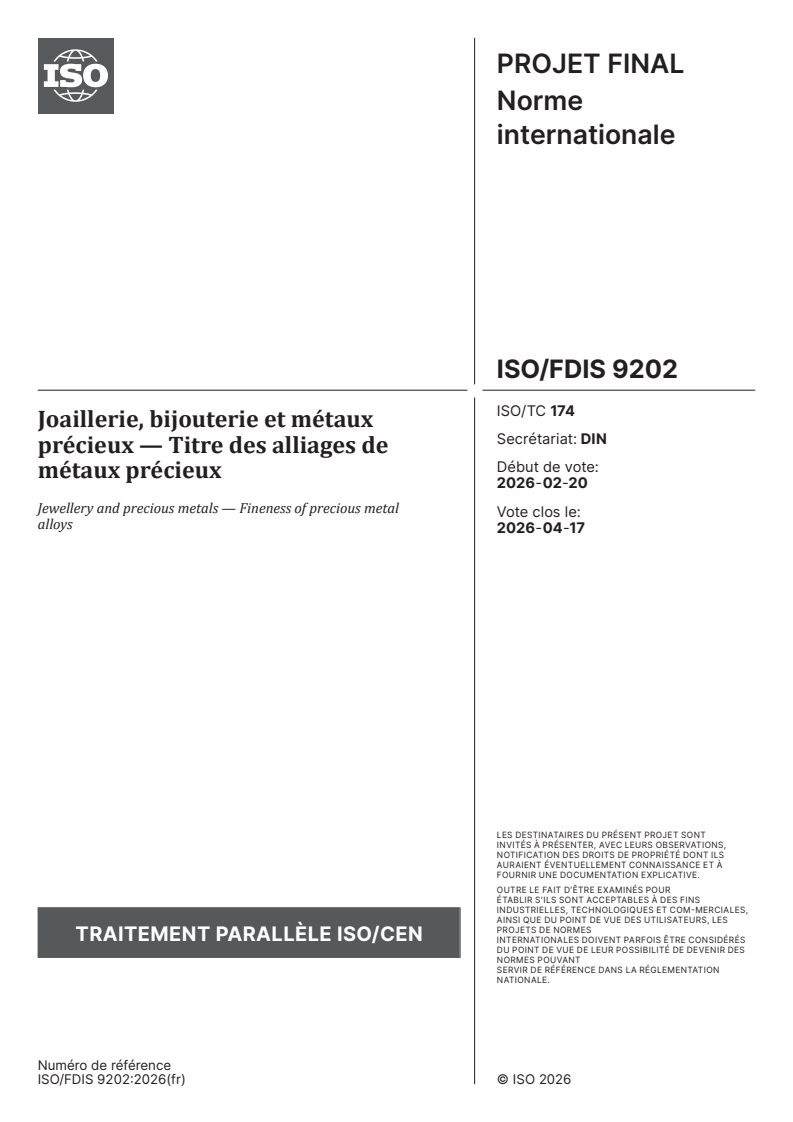
PROJET FINAL
Norme
internationale
ISO/FDIS 9202
ISO/TC 174
Joaillerie, bijouterie et métaux
Secrétariat: DIN
précieux — Titre des alliages de
Début de vote:
métaux précieux
2026-02-20
Jewellery and precious metals — Fineness of precious metal
Vote clos le:
alloys
2026-04-17
LES DESTINATAIRES DU PRÉSENT PROJET SONT
INVITÉS À PRÉSENTER, AVEC LEURS OBSERVATIONS,
NOTIFICATION DES DROITS DE PROPRIÉTÉ DONT ILS
AURAIENT ÉVENTUELLEMENT CONNAISSANCE ET À
FOURNIR UNE DOCUMENTATION EXPLICATIVE.
OUTRE LE FAIT D’ÊTRE EXAMINÉS POUR
ÉTABLIR S’ILS SONT ACCEPTABLES À DES FINS
INDUSTRIELLES, TECHNOLOGIQUES ET COM-MERCIALES,
AINSI QUE DU POINT DE VUE DES UTILISATEURS, LES
PROJETS DE NORMES
TRAITEMENT PARALLÈLE ISO/CEN
INTERNATIONALES DOIVENT PARFOIS ÊTRE CONSIDÉRÉS
DU POINT DE VUE DE LEUR POSSI BILITÉ DE DEVENIR DES
NORMES POUVANT
SERVIR DE RÉFÉRENCE DANS LA RÉGLEMENTATION
NATIONALE.
Numéro de référence
ISO/FDIS 9202:2026(fr) © ISO 2026
PROJET FINAL
ISO/FDIS 9202:2026(fr)
Norme
internationale
ISO/FDIS 9202
ISO/TC 174
Joaillerie, bijouterie et métaux
Secrétariat: DIN
précieux — Titre des alliages de
Début de vote:
métaux précieux
2026-02-20
Jewellery and precious metals — Fineness of precious metal
Vote clos le:
alloys
2026-04-17
LES DESTINATAIRES DU PRÉSENT PROJET SONT
INVITÉS À PRÉSENTER, AVEC LEURS OBSERVATIONS,
NOTIFICATION DES DROITS DE PROPRIÉTÉ DONT ILS
AURAIENT ÉVENTUELLEMENT CONNAISSANCE ET À
FOURNIR UNE DOCUMENTATION EXPLICATIVE.
DOCUMENT PROTÉGÉ PAR COPYRIGHT
OUTRE LE FAIT D’ÊTRE EXAMINÉS POUR
ÉTABLIR S’ILS SONT ACCEPTABLES À DES FINS
© ISO 2026 INDUSTRIELLES, TECHNOLOGIQUES ET COM-MERCIALES,
AINSI QUE DU POINT DE VUE DES UTILISATEURS, LES
Tous droits réservés. Sauf prescription différente ou nécessité dans le contexte de sa mise en œuvre, aucune partie de cette
PROJETS DE NORMES
TRAITEMENT PARALLÈLE ISO/CEN
INTERNATIONALES DOIVENT PARFOIS ÊTRE CONSIDÉRÉS
publication ne peut être reproduite ni utilisée sous quelque forme que ce soit et par aucun procédé, électronique ou mécanique,
DU POINT DE VUE DE LEUR POSSI BILITÉ DE DEVENIR DES
y compris la photocopie, ou la diffusion sur l’internet ou sur un intranet, sans autorisation écrite préalable. Une autorisation peut
NORMES POUVANT
être demandée à l’ISO à l’adresse ci-après ou au comité membre de l’ISO dans le pays du demandeur.
SERVIR DE RÉFÉRENCE DANS LA RÉGLEMENTATION
NATIONALE.
ISO copyright office
Case postale 401 • Ch. de Blandonnet 8
CH-1214 Vernier, Genève
Tél.: +41 22 749 01 11
E-mail: copyright@iso.org
Web: www.iso.org
Publié en Suisse Numéro de référence
ISO/FDIS 9202:2026(fr) © ISO 2026
ii
ISO/FDIS 9202:2026(fr)
Sommaire Page
Avant-propos .iv
1 Domaine d’application . 1
2 Références normatives . 1
3 Termes et définitions . 1
4 Méthodes d’analyse pour déterminer le titre . 2
5 Gamme de titre . 2
iii
ISO/FDIS 9202:2026(fr)
Avant-propos
L’ISO (Organisation internationale de normalisation) est une fédération mondiale d’organismes nationaux
de normalisation (comités membres de l’ISO). L’élaboration des Normes internationales est en général
confiée aux comités techniques de l’ISO. Chaque comité membre intéressé par une étude a le droit de faire
partie du comité technique créé à cet effet. Les organisations internationales, gouvernementales et non
gouvernementales, en liaison avec l’ISO participent également aux travaux. L’ISO collabore étroitement avec
la Commission électrotechnique internationale (IEC) en ce qui concerne la normalisation électrotechnique.
Les procédures utilisées pour élaborer le présent document et celles destinées à sa mise à jour sont
décrites dans les Directives ISO/IEC, Partie 1. Il convient, en particulier, de prendre note des différents
critères d’approbation requis pour les différents types de documents ISO. Le présent document
a été rédigé conformément aux règles de rédaction données dans les Directives ISO/IEC, Partie 2
(voir www.iso.org/directives).
L’ISO attire l’attention sur le fait que la mise en application du présent document peut entraîner l’utilisation
d’un ou de plusieurs brevets. L’ISO ne prend pas position quant à la preuve, à la validité et à l’applicabilité de
tout droit de propriété revendiqué à cet égard. À la date de publication du présent document, l’ISO n’avait pas
reçu notification qu’un ou plusieurs brevets pouvaient être nécessaires à sa mise en application. Toutefois,
il y a lieu d’avertir les responsables de la mise en application du présent document que des
...
Questions, Comments and Discussion
Ask us and Technical Secretary will try to provide an answer. You can facilitate discussion about the standard in here.
Loading comments...