

EN 14127:2004
(Main)Non-destructive testing - Ultrasonic thickness measurement
- Abstract
This document specifies the principles for ultrasonic thickness measurement of metallic and non-metallic materials by direct contact, based on measurement of time-of-flight of ultrasonic pulses only.
- Status
- Withdrawn
- Publication Date
- 17-Aug-2004
- Withdrawal Date
- 01-Feb-2011
- Technical Committee
- CEN/TC 138 - Non-destructive testing
- Drafting Committee
- CEN/TC 138/WG 2 - Ultrasonic testing
- Current Stage
- 9960 - Withdrawal effective - Withdrawal
- Start Date
- 02-Feb-2011
- Completion Date
- 02-Feb-2011
- Directive
- 97/23/EC - Pressure equipment

Relations
- Effective Date
- 05-Feb-2011
Get Certified
Connect with accredited certification bodies for this standard

IMP NDT d.o.o.
Non-destructive testing services. Radiography, ultrasonic, magnetic particle, penetrant, visual inspection.
Inštitut za kovinske materiale in tehnologije
Institute of Metals and Technology. Materials testing, metallurgical analysis, NDT.
Q Techna d.o.o.
NDT and quality assurance specialist. 30+ years experience. NDT personnel certification per ISO 9712, nuclear and thermal power plant inspections, QA/
Sponsored listings
Frequently Asked Questions
EN 14127:2004 is a standard published by the European Committee for Standardization (CEN). Its full title is "Non-destructive testing - Ultrasonic thickness measurement". This standard covers: This document specifies the principles for ultrasonic thickness measurement of metallic and non-metallic materials by direct contact, based on measurement of time-of-flight of ultrasonic pulses only.
This document specifies the principles for ultrasonic thickness measurement of metallic and non-metallic materials by direct contact, based on measurement of time-of-flight of ultrasonic pulses only.
EN 14127:2004 is classified under the following ICS (International Classification for Standards) categories: 19.100 - Non-destructive testing. The ICS classification helps identify the subject area and facilitates finding related standards.
EN 14127:2004 has the following relationships with other standards: It is inter standard links to EN 14127:2011. Understanding these relationships helps ensure you are using the most current and applicable version of the standard.
EN 14127:2004 is associated with the following European legislation: EU Directives/Regulations: 97/23/EC; Standardization Mandates: M/071. When a standard is cited in the Official Journal of the European Union, products manufactured in conformity with it benefit from a presumption of conformity with the essential requirements of the corresponding EU directive or regulation.
EN 14127:2004 is available in PDF format for immediate download after purchase. The document can be added to your cart and obtained through the secure checkout process. Digital delivery ensures instant access to the complete standard document.
Standards Content (Sample)
2003-01.Slovenski inštitut za standardizacijo. Razmnoževanje celote ali delov tega standarda ni dovoljeno.Zerstörungsfreie Prüfung - Dickenmessung mit UltraschallEssais non destructifs - Mesurage de l'épaisseur par ultrasonsNon-destructive testing - Ultrasonic thickness measurement19.100Neporušitveno preskušanjeNon-destructive testingICS:Ta slovenski standard je istoveten z:EN 14127:2004SIST EN 14127:2004en01-november-2004SIST EN 14127:2004SLOVENSKI
STANDARD
EUROPEAN STANDARDNORME EUROPÉENNEEUROPÄISCHE NORMEN 14127August 2004ICS 19.100English versionNon-destructive testing - Ultrasonic thickness measurementEssais non destructifs - Mesurage de l'épaisseur parultrasonsZerstörungsfreie Prüfung - Dickenmessung mit UltraschallThis European Standard was approved by CEN on 16 February 2004.CEN members are bound to comply with the CEN/CENELEC Internal Regulations which stipulate the conditions for giving this EuropeanStandard the status of a national standard without any alteration. Up-to-date lists and bibliographical references concerning such nationalstandards may be obtained on application to the Central Secretariat or to any CEN member.This European Standard exists in three official versions (English, French, German). A version in any other language made by translationunder the responsibility of a CEN member into its own language and notified to the Central Secretariat has the same status as the officialversions.CEN members are the national standards bodies of Austria, Belgium, Cyprus, Czech Republic, Denmark, Estonia, Finland, France,Germany, Greece, Hungary, Iceland, Ireland, Italy, Latvia, Lithuania, Luxembourg, Malta, Netherlands, Norway, Poland, Portugal, Slovakia,Slovenia, Spain, Sweden, Switzerland and United Kingdom.EUROPEAN COMMITTEE FOR STANDARDIZATIONCOMITÉ EUROPÉEN DE NORMALISATIONEUROPÄISCHES KOMITEE FÜR NORMUNGManagement Centre: rue de Stassart, 36
B-1050 Brussels© 2004 CENAll rights of exploitation in any form and by any means reservedworldwide for CEN national Members.Ref. No. EN 14127:2004: ESIST EN 14127:2004
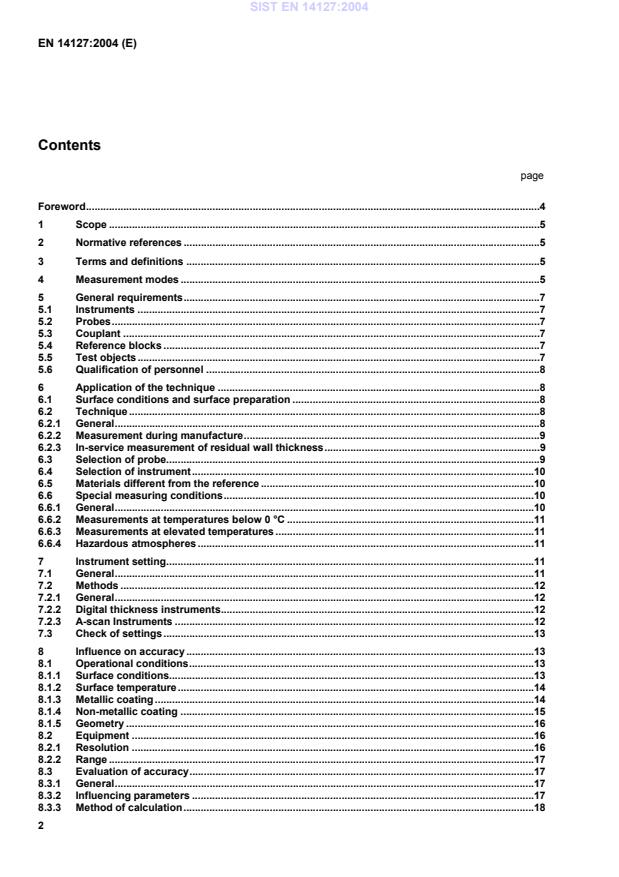
Corrosion in vessels and piping.22 A.1 General.22 A.2 Measurement of general corrosion.22 A.2.1 Instrument.22 A.2.2 Probes.22 A.2.3 Setting of the instrument.22 A.2.4 Measuring.23 A.3 Measurement of corrosion with pitting.23 A.3.1 Instrument.23 A.3.2 Probes.23 A.3.3 Setting of the instrument.23 A.3.4 Measuring.23 Annex B (informative)
Instrument settings.27 Annex C (informative)
Parameters influencing accuracy.29 C.1 Parameters influencing accuracy.29 C.2 Methods of calculation.31 Annex D
(informative)
Measuring technique selection.34
General principles. EN 583-2, Non-destructive testing Ultrasonic examination Part 2: Sensitivity and range setting. EN 1330-4:2000, Non-destructive testing Terminology Part 4: Terms used in ultrasonic testing. 3 Terms and definitions For the purposes of this document, the terms and definitions given in EN 1330-4:2000 apply. 4 Measurement modes The thickness of a part or structure is determined by accurately measuring the time required for a short ultrasonic pulse generated by a transducer to travel through the thickness of the material once, twice or several times. The material thickness is calculated by multiplying the known sound velocity of the material with the transit time and dividing by the number of times the pulse transits the material wall. This principle can be accomplished by applying one of the following modes, see Figure 1: Mode 1: Measure the transit time from an initial excitation pulse to a first returning echo, minus a zero correction to account for the thickness of the transducer wear surface and the couplant layer (single echo mode). Mode 2: Measure the transit time from the end of a delay line to the first backwall echo (single echo delay line mode). Mode 3: Measure the transit time between backwall echoes (multiple echoes). Mode 4: Measure the transit time for a pulse travelling from the transmitter to a receiver in contact with the backwall (through transmission mode). SIST EN 14127:2004
Mode 1 Mode 2
Mode 3
Mode 4 Key A Transmit/Receive probeDTransmission pulse indication A1 Transmit probe E1 to E3Backwall echoesA2 Receive probe FInterface echoA3 Double transducer probeGDelay pathB Test object HReceived pulseC Sound path travel time Figure 1 — Measurement modes SIST EN 14127:2004
are used then compensation for V-path error is required; c) on curved objects the diameter of the probe contact area shall be significantly smaller than the diameter of the test object; SIST EN 14127:2004
t/n (1) where
d = thickness; v = sound velocity; t = measured time;
n = number of transits through the test object (see Figure 1). SIST EN 14127:2004
...