

EN 14811:2006
(Main)Railway applications - Track - Special purpose rail - Grooved and associated construction
- Abstract
This European Standard specifies requirements for grooved rails and associated construction rail profiles for grooved rail facilities with a linear mass of 42 kg/m and upwards for use in tram transport systems.
NOTE Grooved rails are also used for harbour and industrial tracks.
Six pearlitic steel grades are specified in a hardness range between 200 HBW and 390 HBW. The rails are either non-heat-treated or heat-treated and are made from non-alloyed (C-Mn) steel in both cases.
This standard specifies 18 specific grooved rail profiles and 7 specific construction rail profiles. The grooved rail profiles can also be used as construction elements in switches and crossings.
Two grooved rail classes are specified differing in requirements for profile tolerances.
- Status
- Withdrawn
- Publication Date
- 08-Aug-2006
- Withdrawal Date
- 03-Nov-2009
- Technical Committee
- CEN/TC 256 - Railway applications
- Drafting Committee
- CEN/TC 256/SC 1/WG 4 - Rails
- Current Stage
- 9960 - Withdrawal effective - Withdrawal
- Start Date
- 04-Nov-2009
- Completion Date
- 04-Nov-2009

Relations
- Effective Date
- 29-Aug-2009
Get Certified
Connect with accredited certification bodies for this standard

IRIS Certification (UNIFE)
International Railway Industry Standard certification.

TÜV SÜD Rail GmbH
TÜV SÜD railway certification services.

Bureau Veritas Railway Certification
Railway and transportation certification.
Sponsored listings
Frequently Asked Questions
EN 14811:2006 is a standard published by the European Committee for Standardization (CEN). Its full title is "Railway applications - Track - Special purpose rail - Grooved and associated construction". This standard covers: This European Standard specifies requirements for grooved rails and associated construction rail profiles for grooved rail facilities with a linear mass of 42 kg/m and upwards for use in tram transport systems. NOTE Grooved rails are also used for harbour and industrial tracks. Six pearlitic steel grades are specified in a hardness range between 200 HBW and 390 HBW. The rails are either non-heat-treated or heat-treated and are made from non-alloyed (C-Mn) steel in both cases. This standard specifies 18 specific grooved rail profiles and 7 specific construction rail profiles. The grooved rail profiles can also be used as construction elements in switches and crossings. Two grooved rail classes are specified differing in requirements for profile tolerances.
This European Standard specifies requirements for grooved rails and associated construction rail profiles for grooved rail facilities with a linear mass of 42 kg/m and upwards for use in tram transport systems. NOTE Grooved rails are also used for harbour and industrial tracks. Six pearlitic steel grades are specified in a hardness range between 200 HBW and 390 HBW. The rails are either non-heat-treated or heat-treated and are made from non-alloyed (C-Mn) steel in both cases. This standard specifies 18 specific grooved rail profiles and 7 specific construction rail profiles. The grooved rail profiles can also be used as construction elements in switches and crossings. Two grooved rail classes are specified differing in requirements for profile tolerances.
EN 14811:2006 is classified under the following ICS (International Classification for Standards) categories: 45.080 - Rails and railway components. The ICS classification helps identify the subject area and facilitates finding related standards.
EN 14811:2006 has the following relationships with other standards: It is inter standard links to EN 14811:2006+A1:2009. Understanding these relationships helps ensure you are using the most current and applicable version of the standard.
EN 14811:2006 is associated with the following European legislation: EU Directives/Regulations: 93/38/EEC; Standardization Mandates: M/024. When a standard is cited in the Official Journal of the European Union, products manufactured in conformity with it benefit from a presumption of conformity with the essential requirements of the corresponding EU directive or regulation.
EN 14811:2006 is available in PDF format for immediate download after purchase. The document can be added to your cart and obtained through the secure checkout process. Digital delivery ensures instant access to the complete standard document.
Standards Content (Sample)
2003-01.Slovenski inštitut za standardizacijo. Razmnoževanje celote ali delov tega standarda ni dovoljeno.Railway applications - Track - Special purpose rail - Grooved and associated constructionApplications ferroviaires - Voie - Rails spéciaux - Rails a gorge et profils de construction associésBahnanwendungen - Oberbau - Spezialschienen - Rillenschienen und zugehörige KonstruktionsprofileTa slovenski standard je istoveten z:EN 14811:2006SIST EN 14811:2007en45.080Rails and railway componentsICS:SLOVENSKI
STANDARDSIST EN 14811:200701-januar-2007
EUROPEAN STANDARDNORME EUROPÉENNEEUROPÄISCHE NORMEN 14811August 2006ICS 45.080 English VersionRailway applications - Track - Special purpose rail - Groovedand associated constructionApplications ferroviaires - Voie - Rails spéciaux - Rails àgorge et profils de construction associésBahnanwendungen - Oberbau - Spezialschienen -Rillenschienen und zugehörige KonstruktionsprofileThis European Standard was approved by CEN on 2 June 2006.CEN members are bound to comply with the CEN/CENELEC Internal Regulations which stipulate the conditions for giving this EuropeanStandard the status of a national standard without any alteration. Up-to-date lists and bibliographical references concerning such nationalstandards may be obtained on application to the Central Secretariat or to any CEN member.This European Standard exists in three official versions (English, French, German). A version in any other language made by translationunder the responsibility of a CEN member into its own language and notified to the Central Secretariat has the same status as the officialversions.CEN members are the national standards bodies of Austria, Belgium, Cyprus, Czech Republic, Denmark, Estonia, Finland, France,Germany, Greece, Hungary, Iceland, Ireland, Italy, Latvia, Lithuania, Luxembourg, Malta, Netherlands, Norway, Poland, Portugal, Romania,Slovakia, Slovenia, Spain, Sweden, Switzerland and United Kingdom.EUROPEAN COMMITTEE FOR STANDARDIZATIONCOMITÉ EUROPÉEN DE NORMALISATIONEUROPÄISCHES KOMITEE FÜR NORMUNGManagement Centre: rue de Stassart, 36
B-1050 Brussels© 2006 CENAll rights of exploitation in any form and by any means reservedworldwide for CEN national Members.Ref. No. EN 14811:2006: E
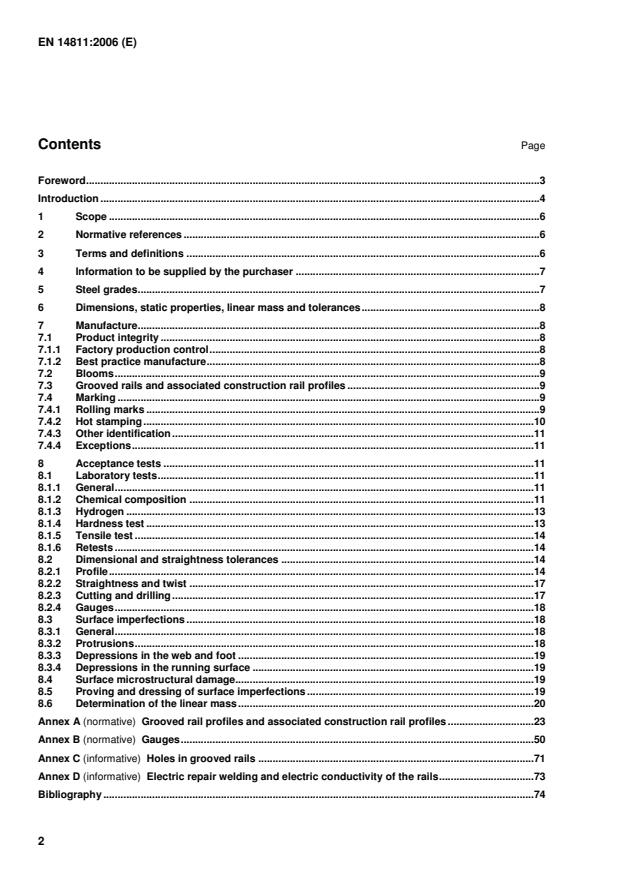
Grooved rail profiles and associated construction rail profiles.23 Annex B (normative)
Gauges.50 Annex C (informative)
Holes in grooved rails.71 Annex D (informative)
Electric repair welding and electric conductivity of the rails.73 Bibliography.74
¾ Part 3: Check rails ¾ Part 4: Vignole railway rails from 27 kg/m to 46 kg/m. According to the CEN/CENELEC Internal Regulations, the national standards organizations of the following countries are bound to implement this European Standard: Austria, Belgium, Cyprus, Czech Republic, Denmark, Estonia, Finland, France, Germany, Greece, Hungary, Iceland, Ireland, Italy, Latvia, Lithuania, Luxembourg, Malta, Netherlands, Norway, Poland, Portugal, Slovakia, Slovenia, Spain, Sweden, Switzerland and the United Kingdom.
Introduction This introduction provides an explanation of the concept and reasoning for preparing this standard. Its description ensures that, during any future revisions, restrictions will be removed if technical progress has been made or will be kept if this is not the case in order that safety is maintained if new manufacturers, products and technologies appear. The most commonly used delivery conditions in Europe for the supply of grooved rails and associated construction rail profiles have been reviewed during the preparation of this standard. Modern rail production technology and the requirements of commuter railways within the European Union have demanded that the technical requirements for the products specified in EN 14811 be reconsidered. Whenever possible, this EN 14811 is performance-based. It recognizes the European quality management standard EN ISO 9001 and requires manufacturers to offer the latest proven technology consistently to satisfy the demanding quality of the required product. The steels are classified according to hardness and not to tensile strength. The acceptance tests were developed in order to monitor the properties of the grooved rail steels and grooved rails and associated construction rail profiles that are of importance for the production of grooved rails and associated construction rail profiles and which comply with the demands of commuter railways. The steel grades covered by EN 14811 reflect trends in commuter railway usage and heat-treated rails as well as associated construction rail profiles. This standard contains profiles for grooved rails and associated construction rail profiles for grooved rail facilities having a linear mass of 42 kg/m and above. To ensure the supply of high quality rails, some restrictions on production processes have been imposed. This standard is applicable to all procurements covered by the European Procurement Directive (93/38/EEC of 14 June 1993). Additionally, CEN has requested a performance-based standard taking into account safety requirements and the application of the most recent technologies. With respect to the Directive, it is acknowledged that there are (and with respect to safety requirements also shall be) options to deviate from the standard upon agreement between purchaser and manufacturer.
This standard reflects the change in philosophy compared with the traditional content of delivery conditions for grooved rails and associated construction rail profiles. The most frequently used delivery conditions in Europe for the supply of grooved rails and construction rail profiles have been reviewed. All the aspects that are important for the purchasers and manufacturers have been analysed to ensure that the overall contents are particularly appropriate and relevant for the European Standard. For example, the classification of the steel grades of grooved rails and associated construction rail profiles and also other aspects of the European Standard has been based on hardness, not on tensile testing. Whilst the two are directly related, hardness testing is very quick and inexpensive to carry out and provides more relevant guidance to the user, particularly where properties vary in different parts of the profile. One new aspect of the European Standard is the integration of a clause on quality management and testing in order to assure the product integrity. In order to ensure that the quality management systems are consistent for all manufacturers and that all purchasers can be sure about the consistency of the product quality of these safety-related components, this standard recommends that the manufacturer operates a quality management system at least equivalent to the requirements of EN ISO 9001. This makes it possible to dispense with detailed requirements on tests and comprehensive testing.
This European Standard specifies requirements for grooved rails and associated construction rail profiles for grooved rail facilities with a linear mass of 42 kg/m and upwards for use in tram transport systems. NOTE Grooved rails are also used for harbour and industrial tracks. Six pearlitic steel grades are specified in a hardness range between 200 HBW and 390 HBW. The rails are either non-heat-treated or heat-treated and are made from non-alloyed (C-Mn) steel in both cases. This standard specifies 18 specific grooved rail profiles and 7 specific construction rail profiles. The grooved rail profiles can also be used as construction elements in switches and crossings. Two grooved rail classes are specified differing in requirements for profile tolerances. 2 Normative references The following referenced documents are indispensable for the application of this document. For dated references, only the edition cited applies. For undated references, the latest edition of the referenced document (including any amendments) applies. EN 10002-1, Metallic materials — Tensile testing — Part 1: Method of testing at ambient temperature EN 10027-1, Designation systems for steel — Part 1: Steel names EN 10027-2, Designation systems for steel — Part 2: Steel numbers EN ISO 6506-1, Metallic materials — Brinell hardness test — Part 1: Test method (ISO 6506-1:2005) 3 Terms and definitions For the purposes of this document, the following terms and definitions apply. 3.1 heat liquid steel melt tapped out of a converter or electric arc furnace which after continuous casting includes a given number of blooms relating to the weight of the heat and the extent of the mixing zone. In the case of sequence casting, the blooms belonging to the mixing zone are to be clearly defined 3.2 sequence number of heats of the same steel grade which undergo continuous casting in a new or repaired tundish. Tundishes may be used in parallel if the caster has many strands 3.3 heat-treated rail rail that has undergone accelerated cooling from austenitizing temperature during the metallurgical transformation period 3.4 head-hardened grooved rail grooved rail where the rail head and/or the grooved head has been heat-treated
——— ——— a See Tables 3a and 3b for the chemical composition and the mechanical properties.
6 Dimensions, static properties, linear mass and tolerances The requirements for the profile drawings, their dimensions, static properties and linear mass are given in Annex A. The tolerances of certain dimensions shall be as given in Tables 5a and 5b. All other quantities are informative only. NOTE Linear masses have been calculated based on a density of steel of 7,85 kg/dm3. 7 Manufacture 7.1 Product integrity 7.1.1 Factory production control All grooved rails and associated construction rail profiles shall be produced under a comprehensive system of production control in order to ensure confidence in the conformity of the finished product. The system shall address this European Standard to ensure that the finished products consistently comply with requirements to achieve the product integrity necessary to provide assurance of product safety in track. The manufacturer shall demonstrate by documented evidence continuing compliance with the factory production control system required. Manufacturers having a factory production control system which complies with EN ISO 9001 shall be recognized as satisfying the minimum requirements specified by this clause. 7.1.2 Best practice manufacture The product shall be manufactured to the best practices as defined in 7.1.1. NOTE This is to ensure that the rail attributes, described in the introduction, which are not known in an exact manner or are not practically measurable, achieve the required high level of product integrity in track.
continuously-cast bloom shall be at least 8 times greater than that of the rail profile to be rolled. An exception applies for the profile 105C1 where the original cross-section of the continuously-cast bloom shall be at least 7,5 times greater than that of the rail profile to be rolled. For heavier profiles (construction rails), the original cross-section shall be at least 2,5 times greater than that of the rail profile to be rolled. NOTE In this case, suitability for a heat treatment may be limited. 7.3.4 The straightening of the rails shall be done in a two-step roller-straightening process that straightens the rails about the axes x-x and y-y described in Annex A. Straightening presses may be used for end straightening or for correcting locally limited deviations from straightness. The rolled marking shall be protected from the effect of the straightening rolls. 7.3.5 Dividing into finished lengths shall be carried out by cold-sawing. Other cutting methods may be applied, provided that the microstructure remains unchanged. Any burr shall be removed without resulting in any noticeable bevelling of the profile. 7.3.6 Fishplate holes in the web of the rail shall be made round with smooth walls and be deburred. 7.3.7 Tie bar holes shall be round or oval. Round holes shall be stamped or drilled, oval holes stamped or milled. The edges of tie bar holes shall not have any dangerous burrs. 7.3.8 Fundamentally, no rolling beads shall be present at the rail head, grooved head or outer edges of the foot. Exceptions may be agreed between the purchaser and the manufacturer, but the inside edge of the grooved head shall not be sharp. 7.4 Marking 7.4.1 Rolling marks The following rolling marks shall be rolled on the outside of the web (running head side) in relief at least 0,8 mm high and in characters that are clearly legible of between 15 mm and 20 mm: ¾ the identification of the mill; ¾ the last two figures of the year of manufacture;
in mm 52R1, 56R1, 61C1 68 51R1, 53R1 53 59R1, 59R2, 60R1, 60R2, 75C1, 76C1 78 57R1, 67R1 63 62R1, 62R2 78 55G1, 55G2 55 46G1 52 68G1 71 60R3, 63R1 81 105C1 65
7.4.2 Hot stamping Each rail shall be identified by a stamped mark consisting of a numerical and/or alphabetical code. The code shall allow the following information to be identified: ¾ the number of the heat from which the rail has been rolled; ¾ the number of the strand and the position of the bloom within this strand; ¾ the position of the rail in the bloom (A, B…. Y). The identification mark of the rail shall be stamped at least once by the manufacturer on one of the two sides of the web of the hot-rolled rail. The figures and letters shall be clearly legible and 16 mm high. The stamped characters shall have a flat or radius (1 mm to 1,5 mm radius) face with bevels at the side. The marks shall be on a 10° angle from the vertical and shall have rounded corners. The stamping shall be not greater than 1,0 mm deep along the centre of the web. The design of the characters shall be as shown in Figure 2. If the rail does not have any stamped mark, it shall be identified by means of a code made by rotary burr. NOTE The following division of the rails can result in more than one rail having the same identity.
% (ppm) Steel designation
Chemical composition for C Si Mn P max.
S max.
H max. Tensile strength Rm MPa min. Elongation after fracture a A % min. Centre line running surface hardness HBW Liquid 0,40 to 0,60 0,15 to 0,58 0,70 to 1,20 0,035 0,035 3,0 R200
Solid 0,38 to 0,62 0,13 to 0,60 0,65 to 1,25 0,040 0,040 3,0 680 14 200 to 240 Liquid 0,50 to 0,65 0,15 to 0,58 1,00 to 1,25 0,025 0,025 3,0 R220G1 Solid 0,48 to 0,67 0,13 to 0,60 0,95 to 1,30 0,030 0,030 3,0 780 12 220 to 260 Liquid 0,62 to 0,80 0,15 to 0,58 0,70 to 1,20 0,025 0,025 2,5 R260 Solid 0,60 to 0,82 0,13 to 0,60 0,65 to 1,25 0,030 0,030 2,5 880 10 260 to 300 Liquid 0,40 to 0,60 0,15 to 0,58 0,70 to 1,20 0,035 0,035 2,5 R260GHT Solid 0,38 to 0,62 0,13 to 0,60 0,65 to 1,25 0,040 0,040 2,5 880 12 260 to 300 Liquid 0,50 to 0,65 0,15 to 0,58 1,00 to 1,25 0,025 0,025 2,5 R290GHT Solid 0,48 to 0,67 0,13 to 0,60 0,95 to 1,30 0,030 0,030 2,5 960 10 290 to 330 Liquid 0,62 to 0,80 0,15 to 0,58 0,70 to 1,20 0,025 0,025 2,5 R340GHT Solid 0,60 to 0,82 0,13 to 0,60 0,65 to 1,25 0,030 0,030 2,5 1175 9 340 to 390 a The limiting values for elongation after fracture do not apply for heavy construction rails 310C1 and 338C1.
Table 3b — Maximum residual elements content in % by mass Cr Mo Al Cu Cu + 10Sn Cr + Mo + Ni + Cu + V 0,15 0,02 0,004 0,15 0,35 0,35
tungsten carbide ball; ¾ ball diameter 2,5 mm; ¾ load of 1,839 kN; ¾ period of application 15 s. Other measurement techniques, for example Rockwell or Vickers hardness testing, may be used, but in cases of dispute, Brinell hardness testing in accordance with EN ISO 6506-1 shall be used. No hardness test is carried out for the heavy construction rails 310C1 and 338C1. The hardness values measured shall meet the requirements given in Table 4 for the relevant grade. Material shall be ground from the running surface to a depth of 0,5 mm before the hardness impression is made. T
...