

prEN 12444
(Main)Industrial, commercial and garage doors and gates - Resistance to wind load - Testing and calculation
- Abstract
This document specifies the test method and/or calculation of resistance to wind load for industrial, commercial and garage doors and gates according prEN 13241:2020 in a closed position.
For the purposes of this document the term ‘door’ is used as a general term for ‘industrial, commercial and garage doors and gates’ unless clearly stated.
- Status
- Not Published
- Publication Date
- 13-Jul-2023
- Technical Committee
- CEN/TC 33 - Doors, windows, shutters and building hardware
- Drafting Committee
- CEN/TC 33/WG 5 - Industrial, commercial and garage doors and gates
- Current Stage
- 4598 - Decision to abandon - Finalization for Vote
- Start Date
- 15-Jul-2024
- Completion Date
- 07-Oct-2026


Overview
prEN 12444 - "Industrial, commercial and garage doors and gates - Resistance to wind load - Testing and calculation" (CEN draft) specifies how to test and/or calculate a door or gate’s resistance to wind load in the closed position. It covers full-size testing and elemental testing (parts of assemblies) and gives the principles for preparing specimens, applying differential pressure loads, recording results and producing a test report. The standard is intended to support product classification and performance verification in accordance with prEN 13241:2020.
Key topics and technical requirements
- Scope and terminology: Applies to industrial, commercial and garage doors and gates (the term “door” is used generally). Uses definitions from EN 12433‑1/‑2 and EN ISO 7345.
- Principle of test: Apply a pressure differential across the specimen to determine failure; full-size specimens are preferred; elemental tests are allowed where full-size testing is impractical.
- Apparatus and preparation: Test surround must resist applied pressures without harmful deflection; specimens must reflect production quality and be mounted per manufacturer instructions.
- Test procedures:
- Testing of complete doors using uniformly distributed loads (see Annex B, Table B.1 and Figures B.1–B.3).
- Testing of individual or collective elements with gradual loading and recording of deflection, permanent deformation and failure modes (see Annex A for elemental methods).
- Multiple tests (including at least one alternative dimension) to allow extrapolation to other sizes.
- Calculation methods: Calculation allowed using normal engineering practice (including finite-element methods); simplified elemental summation method illustrated in informative Annex A.
- Failure criteria: No component breakage or permanent deformation that affects function/safety; prevent disengagement from tracks/frames and maintain seals (thermal/water/acoustic performance).
- Test report requirements: Must document specimen, test equipment, procedures, climates, results and classification per prEN 13241:2020.
Applications and who uses it
- Manufacturers: design verification, factory control and to demonstrate compliance for product classification.
- Independent test laboratories: perform wind load testing and issue standardized test reports.
- Specifiers, architects and consultants: select door systems suitable for site wind exposure and classification groups.
- Installers and building owners: verify product suitability and safety for exposed locations.
- Regulators and procurement bodies: reference for performance requirements in contracts and regulations.
Related standards
- prEN 13241:2020 - product standard and classification for doors and gates (linked classification requirements).
- EN 12433‑1 / EN 12433‑2 - terminology for doors and parts.
- EN 12604 - mechanical aspects: requirements and test methods.
- EN ISO 7345 - thermal performance: definitions.
Keywords: prEN 12444, resistance to wind load, wind load testing, industrial doors, garage doors, testing and calculation, door classification.
Relations
- Effective Date
- 08-Jul-2020
Get Certified
Connect with accredited certification bodies for this standard

DIBt (Deutsches Institut für Bautechnik)
German Institute for Building Technology.
DIN CERTCO
DIN Group product certification.

Aboma Certification B.V.
Specialized in construction, metal, and transport sectors.
Sponsored listings
Frequently Asked Questions
prEN 12444 is a draft published by the European Committee for Standardization (CEN). Its full title is "Industrial, commercial and garage doors and gates - Resistance to wind load - Testing and calculation". This standard covers: This document specifies the test method and/or calculation of resistance to wind load for industrial, commercial and garage doors and gates according prEN 13241:2020 in a closed position. For the purposes of this document the term ‘door’ is used as a general term for ‘industrial, commercial and garage doors and gates’ unless clearly stated.
This document specifies the test method and/or calculation of resistance to wind load for industrial, commercial and garage doors and gates according prEN 13241:2020 in a closed position. For the purposes of this document the term ‘door’ is used as a general term for ‘industrial, commercial and garage doors and gates’ unless clearly stated.
prEN 12444 is classified under the following ICS (International Classification for Standards) categories: 91.060.50 - Doors and windows. The ICS classification helps identify the subject area and facilitates finding related standards.
prEN 12444 has the following relationships with other standards: It is inter standard links to EN 12444:2000. Understanding these relationships helps ensure you are using the most current and applicable version of the standard.
prEN 12444 is available in PDF format for immediate download after purchase. The document can be added to your cart and obtained through the secure checkout process. Digital delivery ensures instant access to the complete standard document.
Standards Content (Sample)
SLOVENSKI STANDARD
01-januar-2021
Vrata v industrijske in javne prostore ter garažna vrata - Odpornost proti
obremenitvi z vetrom - Preskušanje in izračun
Industrial, commercial and garage doors and gates - Resistance to wind load - Testing
and calculation
Tore - Widerstand gegen Windlast - Prüfung und Berechnung
Portes et portails industriels, commerciaux et de garage - Résistance à la charge due au
vent - Essais et calculs
Ta slovenski standard je istoveten z: prEN 12444
ICS:
91.060.50 Vrata in okna Doors and windows
91.090 Konstrukcije zunaj stavb External structures
2003-01.Slovenski inštitut za standardizacijo. Razmnoževanje celote ali delov tega standarda ni dovoljeno.
DRAFT
EUROPEAN STANDARD
NORME EUROPÉENNE
EUROPÄISCHE NORM
November 2020
ICS 91.060.50 Will supersede EN 12444:2000
English Version
Industrial, commercial and garage doors and gates -
Resistance to wind load - Testing and calculation
Portes et portails industriels, commerciaux et de Tore - Widerstand gegen Windlast - Prüfung und
garage - Résistance à la charge due au vent - Essais et Berechnung
calculs
This draft European Standard is submitted to CEN members for enquiry. It has been drawn up by the Technical Committee
CEN/TC 33.
If this draft becomes a European Standard, CEN members are bound to comply with the CEN/CENELEC Internal Regulations
which stipulate the conditions for giving this European Standard the status of a national standard without any alteration.
This draft European Standard was established by CEN in three official versions (English, French, German). A version in any other
language made by translation under the responsibility of a CEN member into its own language and notified to the CEN-CENELEC
Management Centre has the same status as the official versions.
CEN members are the national standards bodies of Austria, Belgium, Bulgaria, Croatia, Cyprus, Czech Republic, Denmark, Estonia,
Finland, France, Germany, Greece, Hungary, Iceland, Ireland, Italy, Latvia, Lithuania, Luxembourg, Malta, Netherlands, Norway,
Poland, Portugal, Republic of North Macedonia, Romania, Serbia, Slovakia, Slovenia, Spain, Sweden, Switzerland, Turkey and
United Kingdom.
Recipients of this draft are invited to submit, with their comments, notification of any relevant patent rights of which they are
aware and to provide supporting documentation.
Warning : This document is not a European Standard. It is distributed for review and comments. It is subject to change without
notice and shall not be referred to as a European Standard.
EUROPEAN COMMITTEE FOR STANDARDIZATION
COMITÉ EUROPÉEN DE NORMALISATION
EUROPÄISCHES KOMITEE FÜR NORMUNG
CEN-CENELEC Management Centre: Rue de la Science 23, B-1040 Brussels
© 2020 CEN All rights of exploitation in any form and by any means reserved Ref. No. prEN 12444:2020 E
worldwide for CEN national Members.
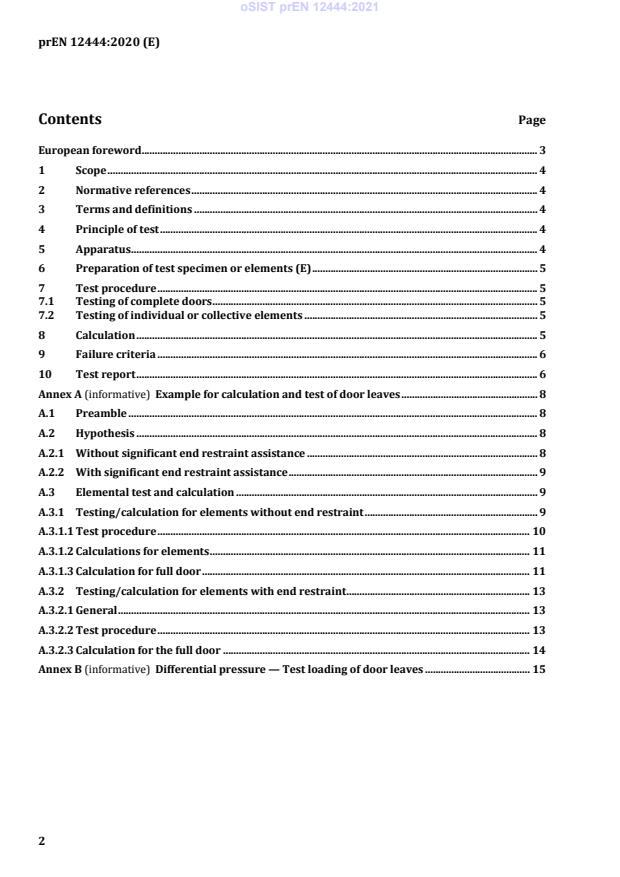
Contents Page
European foreword . 3
1 Scope . 4
2 Normative references . 4
3 Terms and definitions . 4
4 Principle of test . 4
5 Apparatus . 4
6 Preparation of test specimen or elements (E) . 5
7 Test procedure . 5
7.1 Testing of complete doors . 5
7.2 Testing of individual or collective elements . 5
8 Calculation . 5
9 Failure criteria . 6
10 Test report . 6
Annex A (informative) Example for calculation and test of door leaves . 8
A.1 Preamble . 8
A.2 Hypothesis . 8
A.2.1 Without significant end restraint assistance . 8
A.2.2 With significant end restraint assistance . 9
A.3 Elemental test and calculation . 9
A.3.1 Testing/calculation for elements without end restraint . 9
A.3.1.1 Test procedure . 10
A.3.1.2 Calculations for elements . 11
A.3.1.3 Calculation for full door . 11
A.3.2 Testing/calculation for elements with end restraint . 13
A.3.2.1 General . 13
A.3.2.2 Test procedure . 13
A.3.2.3 Calculation for the full door . 14
Annex B (informative) Differential pressure — Test loading of door leaves . 15
European foreword
This document (prEN 12444:2020) has been prepared by Technical Committee CEN/TC 33 “Doors,
windows, shutters, building hardware and curtain walling”, the secretariat of which is held by AFNOR.
This document is currently submitted to the CEN Enquiry.
This document will supersede EN 12444:2000.
Compared with EN 12444:2000, the following changes have been made:
— normative references were updated;
— references to the classification standard EN 12424:2000 were deleted as the classification of the
characteristic resistance to wind load has been transferred to prEN 13241:2020, and references to
prEN 13241:2020 have been added accordingly.
This document is one of a series of performance standards identified within the product standard
prEN 13421:2020.
This document as well as relevant national regulations and standards will enable the actual exposure
levels to be determined for the individual locations of the products.
As during the revision of this document the test procedures haven’t been changed, existing test results
remain valid (historical data).
1 Scope
This document specifies the test method and/or calculation of resistance to wind load for industrial,
commercial and garage doors and gates according prEN 13241:2020 in a closed position.
For the purposes of this document the term ‘door’ is used as a general term for ‘industrial, commercial
and garage doors and gates’ unless clearly stated.
2 Normative references
The following documents are referred to in the text in such a way that some or all of their content
constitutes requirements of this document. For dated references, only the edition cited applies. For
undated references, the latest edition of the referenced document (including any amendments) applies.
EN 12433-1, Industrial, commercial and garage doors and gates — Terminology — Part 1: Types of doors
EN 12433-2, Industrial, commercial and garage doors and gates — Terminology — Part 2: Parts of doors
EN 12604, Industrial, commercial and garage doors and gates — Mechanical aspects — Requirements
and test methods
prEN 13241:2020, Industrial, commercial and garage doors and gates — Product standard, performance
characteristics
EN ISO 7345, Thermal performance of buildings and building components — Physical quantities and
definitions (ISO 7345)
3 Terms and definitions
For the purposes of this document, the terms and definitions given in in EN 12433-1 and EN 12433-2 as
well as EN ISO 7345 apply.
ISO and IEC maintain terminological databases for use in standardization at the following addresses:
— ISO Online browsing platform: available at https://www.iso.org/obp
— IEC Electropedia: available at http://www.electropedia.org/
4 Principle of test
The principle of test is to apply a pressure differential across the test specimen, to determine failure.
Full size specimen shall be tested. If it is impossible or uneconomical to achieve full scale testing, parts
of door assemblies (elements E) shall be tested for calculating a result for a full door calculation.
Whether testing full door assemblies or elements of doors the maximum height/width dimension which
is critical to the wind load resistance (e.g. width for vertically operating doors) shall be tested for each
design criteria.
In order to provide information for the extrapolation of results for smaller sizes, at least one additional
test shall be completed on an alternative dimension for each design criterium.
5 Apparatus
A surround for the test specimen or elements shall be prepared, it shall be able to withstand the
pressures applied during the test without deflecting to an extent, likely to impair jointing or to impose
bending stresses, that might effect the performances of test specimen.
6 Preparation of test specimen or elements (E)
6.1 The test specimen or elements shall be installed in the test position as advised by the
manufacturer, taking into account the frame tracks and any wind resisting devices.
6.2 The test specimen or elements shall consist of parts that in detail conform to the production level
of quality. Whenever possible the test specimen should be newly made. Doors and parts in stock are to
be regarded as newly made if they fully comply with the specification of the running production.
7 Test procedure
7.1 Testing of complete doors
7.1.1 Loads applied to the sample should be in accordance with Annex B, Table B.1 and Figures B.1 to
B.3.
7.1.2 An evenly distributed load or pressure may be applied to the surface. This can be achieved in
various ways, for example, but not restricted to:
a) Air — pressurized chamber, in which case steps shall be taken to eliminate all air leakage on the
product and its attachment to the supporting construction;
b) Bags filled with sand or water distributed over the surface of the test sample, see Annex B;
c) Air — pressurized bags applied across the whole surface between a fixed rigid surface, for example
the floor and the surface of the test sample.
7.2 Testing of individual or collective elements
7.2.1 Uniformly distributed loads shall be applied in the same manner as described in 7.1.2 in gradual
steps and the effect upon deflection of the product, permanent distortion, engagement within the door
frame and ultimate failure shall be recorded after removing the loading when considered necessary
(see Annex A). The original sub-assembly mass and self-deflection shall be taken into account.
NOTE For elements which contain only completely homogenous material a central point loading can be used
as an alternative to uniformly distributed loading.
7.2.2 To calculate the resistance for the whole door assembly, according to the example in Annex A
the strength of components may be individually tested to failure by applying a load in the same
direction as will result from an applied windload.
NOTE The whole door can contain elements incorporating features such as windows or pass doors.
7.2.3 To ensure that production methods and material consi
...