

EN 16510-2-6:2022
(Main)Residential solid fuel burning appliances - Part 2-6: Mechanically by wood pellets fed roomheaters, inset appliances and cookers
- Abstract
This document is applicable to mechanical by wood pellets fed roomheaters, inset appliances and cookers up to 50 kW nominal heat output.
The intended use of the appliances is space heating in residential buildings and can be cooking. They can be fitted with a boiler (integral part of the appliance containing water to be heated up) for the supply of hot water for central heating systems.
These appliances typically use auxiliary energy which is measured in this document as well. They can be operated with either natural draught or fan-assisted combustion air.
NOTE A fan-assisted appliance does still operate under negative pressure in the flue gas system.
These appliances burn wood pellets only as specified. They only operate with the firedoors closed.
This document is not applicable to appliances:
- with boiler intended for water systems having water temperatures above 110 °C and 3 bar;
- with boiler intended for water systems having direct contact with sanitary hot water;
- intended to be used with a pure horizontal exhaust (through the building wall);
- with flue gas condensation in the appliance;
- switching on/off for part load operation.
This document specifies procedures for assessment and verification of constancy of performance (AVCP) of characteristics of mechanical by wood pellets fed roomheaters, inset appliances and cookers.
- Status
- Published
- Publication Date
- 20-Dec-2022
- Technical Committee
- CEN/TC 295 - Residential solid fuel burning appliances
- Drafting Committee
- CEN/TC 295/WG 2 - Roomheaters
- Current Stage
- 6060 - Definitive text made available (DAV) - Publishing
- Start Date
- 21-Dec-2022
- Due Date
- 26-Feb-2023
- Completion Date
- 21-Dec-2022
305/2011 - Regulation (eu) No 305/2011 of the European Parliament and of the Council of 9 march 2011 laying down harmonised conditions for the marketing of construction products and repealing council directive 89/106/eecOJ Ref: 2023/2461, OJ L, OJ L, 2023/2461 OJ Date: 09-Nov-2023


Overview
EN 16510-2-6:2022 is a CEN standard for residential solid fuel burning appliances specifically covering mechanically by wood pellets fed roomheaters, inset appliances and cookers with a nominal heat output up to 50 kW. It defines the scope, test methods and requirements for performance, safety and environmental characteristics of pellet-fired appliances intended for space heating and optional cooking, including models fitted with an integral boiler for central heating hot water.
Key boundaries:
- Applies only to wood pellet fuel and appliances operating with firedoors closed.
- Covers both natural draught and fan-assisted combustion air systems (fan-assisted appliances still operate under negative flue pressure).
- Not applicable to appliances with boilers for water systems above 110 °C / 3 bar, direct contact with sanitary hot water, pure horizontal exhausts, appliances with flue gas condensation, or those that switch on/off for part-load operation.
Key topics and requirements
EN 16510-2-6:2022 sets out procedures and measurable characteristics including:
- Emissions testing: carbon monoxide (CO), nitrogen oxides (NOx), organic gaseous compounds (OGC/hydrocarbons), and particulate matter (PM).
- Energy performance: space and water heat outputs, efficiency at nominal and part-load, seasonal space heating efficiency, and electric auxiliary energy consumption (nominal, part-load, standby).
- Safety and operation: flue gas outlet temperatures, minimum flue draught and mass flow, spillage tests, cleanability, temperature rise in fuel storage and operating components, and protection of combustible materials.
- Descriptive data: appliance tightness, mass, materials, construction elements, and risk of fuel fall-out.
- Assessment and Verification of Constancy of Performance (AVCP): test sampling, compliance criteria and factory production control (FPC) requirements to demonstrate consistent product performance.
- Annexes: normative test methods and measurement positions; informative Annex ZA relates the standard to EU Regulation 305/2011.
Applications and users
This standard is essential for:
- Manufacturers of pellet stoves, inset pellet appliances and pellet cookers to design, test and declare performance and safety.
- Test laboratories and certification bodies performing type testing, emissions and AVCP procedures.
- Regulatory authorities and product compliance teams aligning products with EU market requirements.
- Installers, specifiers and building professionals selecting compliant appliances for residential heating and combined heating/cooking installations.
Adopting EN 16510-2-6 helps ensure appliance safety, reliable emissions data, energy labeling and alignment with product declaration requirements.
Related standards
- EN 16510-1:2022 - General requirements and test methods (Part 1)
- EN 16510 series Parts 2-1 to 2-5 (roomheaters, inset appliances, cookers, independent boilers, slow heat release appliances)
- Supersedes EN 14785:2006
- References include EN 15456 and EN 15804 for related measurement and environmental declaration rules
Keywords: EN 16510-2-6:2022, pellet stoves, mechanically by wood pellets fed roomheaters, residential solid fuel burning appliances, AVCP, emissions testing, energy efficiency, CEN.
Relations
- Effective Date
- 23-Feb-2022
- Effective Date
- 28-Jan-2026
- Effective Date
- 28-Jan-2026
- Effective Date
- 28-Jan-2026
- Effective Date
- 28-Jan-2026
- Effective Date
- 28-Jan-2026
- Effective Date
- 28-Jan-2026
- Effective Date
- 28-Jan-2026
- Effective Date
- 17-Feb-2021
- Revised
EN 13240:2001/A2:2004/AC:2007 - Roomheaters fired by solid fuel - Requirements and test methods - Effective Date
- 17-Feb-2021
- Effective Date
- 17-Feb-2021
Frequently Asked Questions
EN 16510-2-6:2022 is a standard published by the European Committee for Standardization (CEN). Its full title is "Residential solid fuel burning appliances - Part 2-6: Mechanically by wood pellets fed roomheaters, inset appliances and cookers". This standard covers: This document is applicable to mechanical by wood pellets fed roomheaters, inset appliances and cookers up to 50 kW nominal heat output. The intended use of the appliances is space heating in residential buildings and can be cooking. They can be fitted with a boiler (integral part of the appliance containing water to be heated up) for the supply of hot water for central heating systems. These appliances typically use auxiliary energy which is measured in this document as well. They can be operated with either natural draught or fan-assisted combustion air. NOTE A fan-assisted appliance does still operate under negative pressure in the flue gas system. These appliances burn wood pellets only as specified. They only operate with the firedoors closed. This document is not applicable to appliances: - with boiler intended for water systems having water temperatures above 110 °C and 3 bar; - with boiler intended for water systems having direct contact with sanitary hot water; - intended to be used with a pure horizontal exhaust (through the building wall); - with flue gas condensation in the appliance; - switching on/off for part load operation. This document specifies procedures for assessment and verification of constancy of performance (AVCP) of characteristics of mechanical by wood pellets fed roomheaters, inset appliances and cookers.
This document is applicable to mechanical by wood pellets fed roomheaters, inset appliances and cookers up to 50 kW nominal heat output. The intended use of the appliances is space heating in residential buildings and can be cooking. They can be fitted with a boiler (integral part of the appliance containing water to be heated up) for the supply of hot water for central heating systems. These appliances typically use auxiliary energy which is measured in this document as well. They can be operated with either natural draught or fan-assisted combustion air. NOTE A fan-assisted appliance does still operate under negative pressure in the flue gas system. These appliances burn wood pellets only as specified. They only operate with the firedoors closed. This document is not applicable to appliances: - with boiler intended for water systems having water temperatures above 110 °C and 3 bar; - with boiler intended for water systems having direct contact with sanitary hot water; - intended to be used with a pure horizontal exhaust (through the building wall); - with flue gas condensation in the appliance; - switching on/off for part load operation. This document specifies procedures for assessment and verification of constancy of performance (AVCP) of characteristics of mechanical by wood pellets fed roomheaters, inset appliances and cookers.
EN 16510-2-6:2022 is classified under the following ICS (International Classification for Standards) categories: 97.100.30 - Solid fuel heaters. The ICS classification helps identify the subject area and facilitates finding related standards.
EN 16510-2-6:2022 has the following relationships with other standards: It is inter standard links to EN 14785:2006, EN 16510-2-3:2022, EN 16510-2-2:2022, EN 15804:2012+A2:2019, EN 16510-1:2022, EN 15456:2008, EN 16510-2-7:2025, EN 15316-4-8:2017, EN 13240:2001/A2:2004, EN 13240:2001/A2:2004/AC:2007, EN 13240:2001/AC:2006. Understanding these relationships helps ensure you are using the most current and applicable version of the standard.
EN 16510-2-6:2022 is associated with the following European legislation: EU Directives/Regulations: 2009/125/EC, 305/2011; Standardization Mandates: M/129, M/577. When a standard is cited in the Official Journal of the European Union, products manufactured in conformity with it benefit from a presumption of conformity with the essential requirements of the corresponding EU directive or regulation.
EN 16510-2-6:2022 is available in PDF format for immediate download after purchase. The document can be added to your cart and obtained through the secure checkout process. Digital delivery ensures instant access to the complete standard document.
Standards Content (Sample)
SLOVENSKI STANDARD
01-marec-2023
Nadomešča:
SIST EN 13240:2003
SIST EN 13240:2003/A2:2005
SIST EN 13240:2003/A2:2005/AC:2008
SIST EN 13240:2003/AC:2006
SIST EN 14785:2006
Grelne naprave na trdna goriva za stanovanjske stavbe - 2-6. del: Grelniki
prostorov, kaminski vložki in štedilniki z mehanskim dodajanjem lesnih peletov
Residential solid fuel burning appliances - Part 2-6: Mechanically by wood pellets fed
roomheaters, inset appliances and cookers
Häusliche Feuerstätten für feste Brennstoffe - Teil 2-6: Mechanisch mit Holzpellets
beschickte Raumheizer, Einsätze und Herde
Équipement de chauffage domestique - Partie 2-6 : Poêles, inserts et cuisinières à
granulés de bois et à alimentation mécanique
Ta slovenski standard je istoveten z: EN 16510-2-6:2022
ICS:
97.100.30 Grelniki na trdo gorivo Solid fuel heaters
2003-01.Slovenski inštitut za standardizacijo. Razmnoževanje celote ali delov tega standarda ni dovoljeno.
EN 16510-2-6
EUROPEAN STANDARD
NORME EUROPÉENNE
December 2022
EUROPÄISCHE NORM
ICS 97.100.30 Supersedes EN 14785:2006
English Version
Residential solid fuel burning appliances - Part 2-6:
Mechanically by wood pellets fed roomheaters, inset
appliances and cookers
Appareils de chauffage domestiques à combustible Häusliche Feuerstätten für feste Brennstoffe - Teil 2-6:
solide - Partie 2-6 : Poêles, inserts et cuisinières à Mechanisch mit Holzpellets beschickte Raumheizer,
granulés de bois et à alimentation mécanique Einsätze und Herde
This European Standard was approved by CEN on 23 October 2022.
CEN members are bound to comply with the CEN/CENELEC Internal Regulations which stipulate the conditions for giving this
European Standard the status of a national standard without any alteration. Up-to-date lists and bibliographical references
concerning such national standards may be obtained on application to the CEN-CENELEC Management Centre or to any CEN
member.
This European Standard exists in three official versions (English, French, German). A version in any other language made by
translation under the responsibility of a CEN member into its own language and notified to the CEN-CENELEC Management
Centre has the same status as the official versions.
CEN members are the national standards bodies of Austria, Belgium, Bulgaria, Croatia, Cyprus, Czech Republic, Denmark, Estonia,
Finland, France, Germany, Greece, Hungary, Iceland, Ireland, Italy, Latvia, Lithuania, Luxembourg, Malta, Netherlands, Norway,
Poland, Portugal, Republic of North Macedonia, Romania, Serbia, Slovakia, Slovenia, Spain, Sweden, Switzerland, Türkiye and
United Kingdom.
EUROPEAN COMMITTEE FOR STANDARDIZATION
COMITÉ EUROPÉEN DE NORMALISATION
EUROPÄISCHES KOMITEE FÜR NORMUNG
CEN-CENELEC Management Centre: Rue de la Science 23, B-1040 Brussels
© 2022 CEN All rights of exploitation in any form and by any means reserved Ref. No. EN 16510-2-6:2022 E
worldwide for CEN national Members.
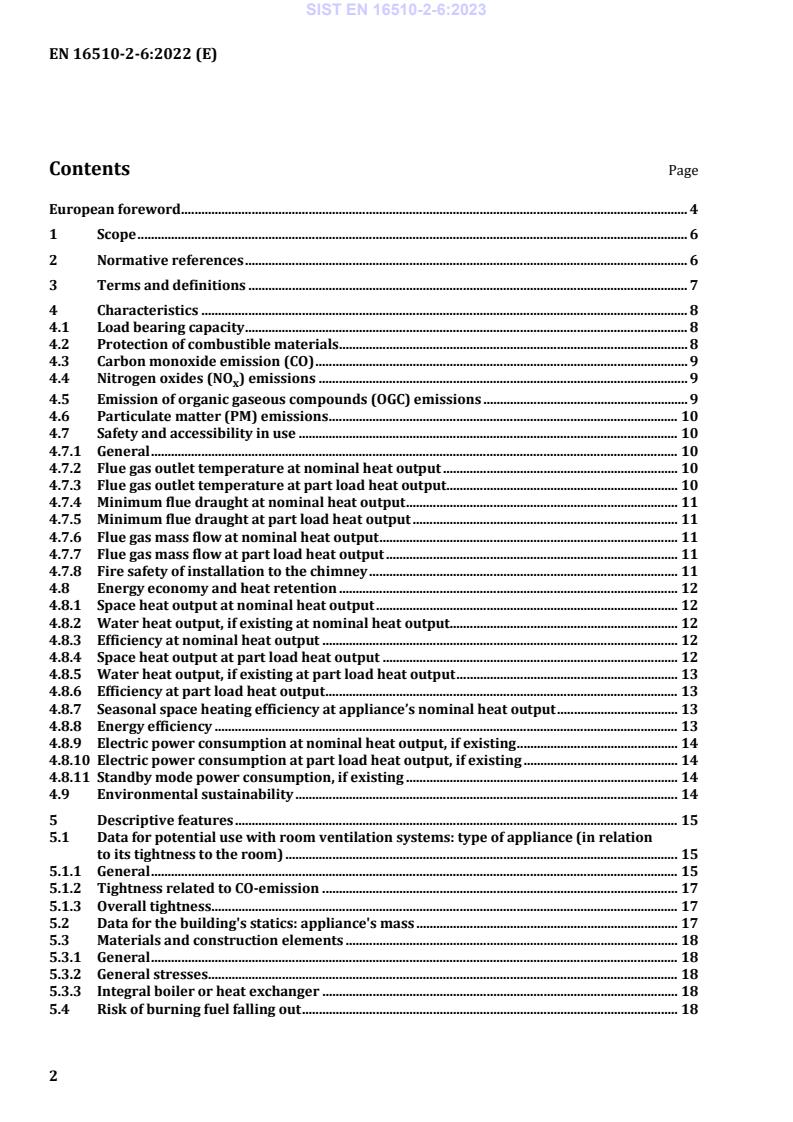
Contents Page
European foreword . 4
1 Scope . 6
2 Normative references . 6
3 Terms and definitions . 7
4 Characteristics . 8
4.1 Load bearing capacity . 8
4.2 Protection of combustible materials . 8
4.3 Carbon monoxide emission (CO) . 9
4.4 Nitrogen oxides (NO ) emissions . 9
x
4.5 Emission of organic gaseous compounds (OGC) emissions . 9
4.6 Particulate matter (PM) emissions . 10
4.7 Safety and accessibility in use . 10
4.7.1 General . 10
4.7.2 Flue gas outlet temperature at nominal heat output . 10
4.7.3 Flue gas outlet temperature at part load heat output. 10
4.7.4 Minimum flue draught at nominal heat output . 11
4.7.5 Minimum flue draught at part load heat output . 11
4.7.6 Flue gas mass flow at nominal heat output . 11
4.7.7 Flue gas mass flow at part load heat output . 11
4.7.8 Fire safety of installation to the chimney . 11
4.8 Energy economy and heat retention . 12
4.8.1 Space heat output at nominal heat output . 12
4.8.2 Water heat output, if existing at nominal heat output. 12
4.8.3 Efficiency at nominal heat output . 12
4.8.4 Space heat output at part load heat output . 12
4.8.5 Water heat output, if existing at part load heat output . 13
4.8.6 Efficiency at part load heat output . 13
4.8.7 Seasonal space heating efficiency at appliance’s nominal heat output . 13
4.8.8 Energy efficiency . 13
4.8.9 Electric power consumption at nominal heat output, if existing . 14
4.8.10 Electric power consumption at part load heat output, if existing . 14
4.8.11 Standby mode power consumption, if existing . 14
4.9 Environmental sustainability . 14
5 Descriptive features . 15
5.1 Data for potential use with room ventilation systems: type of appliance (in relation
to its tightness to the room) . 15
5.1.1 General . 15
5.1.2 Tightness related to CO-emission . 17
5.1.3 Overall tightness . 17
5.2 Data for the building's statics: appliance's mass . 17
5.3 Materials and construction elements . 18
5.3.1 General . 18
5.3.2 General stresses . 18
5.3.3 Integral boiler or heat exchanger . 18
5.4 Risk of burning fuel falling out . 18
5.5 Temperature rise in the fuel storage . 18
5.5.1 Temperature rise in the fuel hopper . 18
5.5.2 Safety against back burning through the fuel conveyor system . 18
5.6 Temperature rise of the operating components . 18
5.7 Spillage of flue gases into the room. 19
5.7.1 Possible spillage of CO, if relevant for the fuel type . 19
5.7.2 Safety test for spillage of combustion gas and discharge of embers . 19
5.7.3 Open operation . 19
5.8 Cleanability . 19
5.8.1 Heating surfaces . 19
5.8.2 Flueways . 19
5.8.3 Ashpan . 19
5.8.4 Bottomgrate . 19
5.8.5 Damper . 19
5.8.6 Fan-cut-out-device . 20
5.9 Strength and leak tightness of boiler shells . 20
6 Assessment and verification of constancy of performance - AVCP . 20
6.1 General . 20
6.2 Assessment of performance . 20
6.2.1 General . 20
6.2.2 Test samples, testing and compliance criteria . 21
6.3 Verification of constancy of performance . 22
6.3.1 Factory production control (FPC) . 22
Annex A (normative) Test methods . 27
Annex FA (normative) Measurement positions for conveyor systems . 34
Annex ZA (informative) Relationship of this European Standard with Regulation (EU) No.
305/2011 . 38
ZA.1 Scope and relevant characteristics . 38
ZA.2 System of Assessment and Verification of Constancy of Performance (AVCP) . 41
ZA.3 Assignment of AVCP tasks . 42
European foreword
This document (EN 16510-2-6:2022) has been prepared by Technical Committee CEN/TC 295
“Residential solid fuel burning appliances”, the secretariat of which is held by BSI.
This European Standard shall be given the status of a national standard, either by publication of an
identical text or by endorsement, at the latest by June 2023, and conflicting national standards shall be
withdrawn at the latest by November 2025.
Attention is drawn to the possibility that some of the elements of this document may be the subject of
patent rights. CEN shall not be held responsible for identifying any or all such patent rights.
This document supersedes EN 14785:2006 as amended and corrected. In relation to EN 14785:2006 as
amended and corrected the following changes have been made:
— measurement methods for NO , hydrocarbon and particulate matter emissions for solid fuel burning
x
appliances;
— specifications for classification of solid fuel burning appliances and system boundaries for room
sealed appliances;
— requirements for the safety of solid fuel burning appliances with water-bearing components added;
— Annex ZA updated according to requirements of M/577;
— energy efficiency and energy class labelling and seasonal space heating efficiency added;
— requirements for environmental sustainability added.
This document has been prepared under a standardization request given to CEN by the European
Commission and the European Free Trade Association.
For relationship with (EU) Regulation 305/2011, see informative Annex ZA, which is an integral part of
this document.
The structure of EN 16510, Residential solid fuel burning appliances, is as follows:
— Part 1: General requirements and test methods;
— Part 2-1: Roomheaters;
— Part 2-2: Inset appliances including open fires;
— Part 2-3: Cookers;
— Part 2-4: Independent boilers — Nominal heat output up to 50 kW;
— Part 2-5: Slow heat release appliances;
— Part 2-6: Mechanically by wood pellets fed roomheaters, inset appliances and cookers.
Other sections of Part 2 will be added to cover residential solid fuel burning appliances not included in
parts 2-1 to 2-6.
Subclauses and Figures which are additional to those in EN 16510-1:2022 are numbered starting with
601. Annexes which are additional to those in EN 16510-1:2022 are numbered starting with FA.
For inset pellet appliances and especially their testing, additional information from EN 16510-2-2:2022
is relevant.
For pellet cookers and especially their testing, additional information from EN 16510-2-3:2022 is
relevant.
Any feedback and questions on this document should be directed to the users’ national standards body.
A complete listing of these bodies can be found on the CEN website.
According to the CEN-CENELEC Internal Regulations, the national standards organisations of the
following countries are bound to implement this European Standard: Austria, Belgium, Bulgaria, Croatia,
Cyprus, Czech Republic, Denmark, Estonia, Finland, France, Germany, Greece, Hungary, Iceland, Ireland,
Italy, Latvia, Lithuania, Luxembourg, Malta, Netherlands, Norway, Poland, Portugal, Republic of North
Macedonia, Romania, Serbia, Slovakia, Slovenia, Spain, Sweden, Switzerland, Türkiye and the United
Kingdom.
1 Scope
This document is applicable to mechanical by wood pellets fed roomheaters, inset appliances and cookers
up to 50 kW nominal heat output.
The intended use of the appliances is space heating in residential buildings and can be cooking. They can
be fitted with a boiler (integral part of the appliance containing water to be heated up) for the supply of
hot water for central heating systems.
These appliances typically use auxiliary energy which is measured in this document as well. They can be
operated with either natural draught or fan-assisted combustion air.
NOTE A fan-assisted appliance does still operate under negative pressure in the flue gas system.
These appliances burn wood pellets only as specified. They only operate with the firedoors closed.
This document is not applicable to appliances:
— with boiler intended for water systems having water temperatures above 110 °C and 3 bar;
— with boiler intended for water systems having direct contact with sanitary hot water;
— intended to be used with a pure horizontal exhaust (through the building wall);
— with flue gas condensation in the appliance;
— switching on/off for part load operation.
This document specifies procedures for assessment and verification of constancy of performance (AVCP)
of characteristics of mechanical by wood pellets fed roomheaters, inset appliances and cookers.
2 Normative references
The following documents are referred to in the text in such a way that some or all of their content
constitutes requirements of this document.
EN 15456:2008, Heating boilers — Electrical power consumption for heat generators — System boundaries
— Measurements
EN 15804:2012+A2:2019, Sustainability of construction works — Environmental product declarations —
Core rules for the product category of construction products
EN 16510-1:2022, Residential solid fuel burning appliances — Part 1: General requirements and test
methods
EN 16510-2-2:2022, Residential solid fuel burning appliances — Part 2-2: Inset appliances including open
fires
EN 16510-2-3:2022, Residential solid fuel burning appliances — Part 2-3: Cookers
3 Terms and definitions
For the purposes of this document, the terms and definitions given in EN 16510-1:2022, EN 16510-2-
2:2022, EN 16510-2-3:2022 and the following apply.
ISO and IEC maintain terminology databases for use in standardization at the following addresses:
• ISO Online browsing platform: available at https://www.iso.org/obp
• IEC Electropedia: available at https://www.electropedia.org/
Add the following new clauses:
3.601
heat output control device
device to control the heat output of the appliance
3.602
ignition system
device used to ignite the fuel in the retort of the combustion chamber
Note 1 to entry: Ignition could be performed manually, automatically and by using, for example, a hot air blower,
an electrical resistor or an electrical resistance for ignition.
3.603
standby operation
operation mode without heat demand, in which the system is launched immediately in the required mode
as soon as the heat demand is required
3.604
back burning
state in which the fuel ignites in direction to the fuel line and the burning spreads to the fuel storage or
the integral hopper
Note 1 to entry: Back burning can be caused by three driving forces:
a) fuel ignition in direction to the fuel line or the integral hopper;
b) spreading and ignition of hot and ignitable gases into the fuel line or the integral hopper;
c) thermal conduction to the fuel line or the integral hopper.
3.605
back burning safety device
one or more self-acting certificated devices to avoid back burning, including extinguishing installations
3.606
safety shut-down
process by which the fuel supply and/or combustion air supply is stopped immediately as a response of
a safety device or the detection of a fault in a safety device
4 Characteristics
4.1 Load bearing capacity
The performance of the appliance in relation to the ability to carry a chimney shall be determined in
accordance with EN 16510-1:2022, 4.6.
If for an appliance with an upper outlet the ability to carry a chimney is specified the value of the
maximum load is to be given in [kg] as an integer according to EN 16510-1:2022, Table 22, no. 57 (m ).
chim
4.2 Protection of combustible materials
The performance of the appliance in relation to protection of combustible materials shall be determined
in accordance with EN 16510-1:2022, 5.6.
When tested in accordance with EN 16510-1:2022, 5.6, the protection measure(s) as specified according
to Table 1 shall be given as minimum distance to combustible materials and if appropriate as material
type and thickness of protective insulation material.
The protection measures as specified shall be given in [mm] as an integer according to EN 16510-1:2022,
Table 22, no. 33, 34, 35, 36, 37, 38, 39 and 41 (d , d , d , d , d , d , d , s).
R S C P F L B
Table 1 — Protection of combustible materials
Protection measure Declared clearance distance to Protective
combustible material or insulation material
thickness of protective if any
insulation material
[mm]
Minimum distance to –
combustible materials – bottom
(d )
B
Minimum distance to –
combustible materials – floor in
front (d )
F
Minimum distance to –
combustible materials – ceiling
(d )
C
Minimum distance to –
combustible materials – rear (d )
R
Minimum distance to –
combustible materials – side (d )
S
Minimum distance to –
combustible materials – side
radiation area (d )
L
Minimum distance to adjacent –
combustible materials (e.g.
furniture) (d )
P
Protective insulation material (s)
4.3 Carbon monoxide emission (CO)
The performance of the appliance in relation to carbon monoxide emission at nominal heat output and at
part load heat output (if part load is specified) shall be determined in accordance with EN 16510-1:2022,
6.3.1 and 6.3.2.
The CO value if specified at nominal heat output and at part load heat output (if part load is specified) is
to be given in [mg/m ] as an integer according to EN 16510-1:2022, Table 22, no. 17 (CO (13 % O )).
nom 2
When tested in accordance with EN 16510-1:2022, 6.3.2 the CO emission at nominal heat output shall not
exceed the threshold levels as given in Table 2.
Table 2 — Threshold levels for CO emission
Appliance type Threshold level at 13 % O
closed fronted solid fuel local space heaters using
compressed wood in form of pellets including 300 mg/m
cookers
4.4 Nitrogen oxides (NO ) emissions
x
The performance of the appliance in relation to nitrogen oxides emissions at nominal heat output and at
part load heat output (if part load is specified) shall be determined in accordance with EN 16510-1:2022,
6.3.1 and 6.3.3.
The NO value if specified at nominal heat output and at part load heat output (if part load is specified) is
x
to be given in [mg/m ] as an integer according to EN 16510-1:2022, Table 22, no. 20 (NO (13 % O )).
xnom 2
When tested in accordance with EN 16510-1:2022, 6.3.3 the NO emission at nominal heat output shall
x
not exceed the threshold levels as given in Table 3.
Table 3 — Threshold levels for NOx emission (expressed as NO )
Appliance type Threshold level at 13 % O
open fronted solid fuel local space heaters, closed
fronted solid fuel local space heaters and cookers 200 mg/m
using biomass
4.5 Emission of organic gaseous compounds (OGC) emissions
The performance of the appliance in relation to organic gaseous compounds emission at nominal heat
output and at part load heat output (if part load is specified) shall be determined in accordance with
EN 16510-1:2022, 6.3.1 and 6.3.4.
The OGC value if specified at nominal heat output and at part load heat output (if part load is specified)
is to be given in [mg/m ] as an integer according to EN 16510-1:2022, Table 22, no. 23 (OGC
nom
(13 % O )).
When tested in accordance with EN 16510-1:2022, 6.3.4 the OGC emission at nominal heat output shall
not exceed the threshold levels as given in Table 4.
Table 4 — Threshold levels for OGC emission (expressed as C)
Appliance type Threshold level at 13 % O
closed fronted solid fuel local space heaters using
compressed wood in form of pellets including
60 mg C/m
cookers
4.6 Particulate matter (PM) emissions
The performance of the appliance in relation to particulate matter emission at nominal heat output and
at part load heat output (if part load is specified) shall be determined in accordance with
EN 16510-1:2022, 6.3.1 and 6.3.5.
The particulate matter value if specified at nominal heat output and at part load heat output (if part load
is specified) is to be given in [mg/m ] as an integer according to EN 16510-1:2022, Table 22, no. 26
(PM (13 % O )).
nom 2
When tested in accordance with EN 16510-1:2022, 6.3.5 the particulate matter (PM) emissions at
nominal heat output shall not exceed the threshold levels as given in Table 5.
Table 5 — Threshold levels for PM emission
Appliance type Threshold level at 13 % O
closed fronted solid fuel local space heaters using
20 mg/m
compressed wood in form of pellets
4.7 Safety and accessibility in use
4.7.1 General
The data for the installation to a chimney are to be evaluated at nominal heat output. Specific data are to
be evaluated at safety test heat output. Additional data are to be evaluated at part load heat output, if part
load is specified.
4.7.2 Flue gas outlet temperature at nominal heat output
The performance of the appliance in relation to flue gas outlet temperature at nominal heat output shall
be determined in accordance with EN 16510-1:2022, 6.2.1.
The value of the flue gas outlet temperature if specified for the installation of the appliance to a chimney
is to be given in [°C] as an integer according to EN 16510-1:2022, Table 22, no. 47 (T ).
snom
4.7.3 Flue gas outlet temperature at part load heat output
The performance of the appliance in relation to flue gas outlet temperature at part load heat output (if
part load is specified) shall be determined in accordance with EN 16510-1:2022, 6.2.1.
The value of the flue gas outlet temperature at part load heat output (if part load is specified) for the
installation of the appliance to a chimney if specified is to be given in [°C] as an integer according to
EN 16510-1:2022, Table 22, no. 48 (T ).
spart
4.7.4 Minimum flue draught at nominal heat output
The performance of the appliance in relation to the minimum flue draught at nominal heat output shall
be determined in accordance with EN 16510-1:2022, 6.5.
The value of the minimum flue draught if specified at nominal heat output for the installation of the
appliance to a chimney is to be given in [Pa] as an integer according to EN 16510-1:2022, Table 22, no.
29 (p ).
nom
Appliances with a nominal heat output less than or equal to 25 kW shall be tested at a flue draught of
(12 ± 2) Pa or at the flue draught specified for the nominal heat output test. The temperature safety test
shall be carried out at the same draught.
Appliances having a nominal heat output greater than 25 kW shall be tested during the nominal heat
output test at such flue draught specified in the appliance instructions.
4.7.5 Minimum flue draught at part load heat output
The performance of the appliance in relation to the minimum flue draught at part load heat output (if part
load is specified) shall be determined in accordance with EN 16510-1:2022, 6.5.
The minimum value of the flue draught if specified at part load heat output (if part load is specified) for
the installation of the appliance to a chimney is to be given in [Pa] as an integer according to
EN 16510-1:2022, Table 22, no. 30 (p ).
part
For the partial load test all appliances shall be tested either at a flue draught of (10 ± 2) Pa or at the flue
draught specified for the part load heat output test.
4.7.6 Flue gas mass flow at nominal heat output
The performance of the appliance in relation to the flue gas mass flow at nominal heat output shall be
determined in accordance with EN 16510-1:2022, 6.12.
The flue gas mass flow value if specified at nominal heat output for the installation of the appliance to a
chimney is to be given in [g/s] with 1 decimal according to EN 16510-1:2022, Table 22, no. 50 (ϕ ).
f,g nom
4.7.7 Flue gas mass flow at part load heat output
The performance of the appliance in relation to the flue gas mass flow at part load heat output (if part
load is specified) shall be determined in accordance with EN 16510-1:2022, 6.12.
The flue gas mass flow value if specified at part load heat output (if part load is specified) for the
installation of the appliance to a chimney is to be given in [g/s] with 1 decimal according to
EN 16510-1:2022, Table 22, no. 51 (ϕ ).
f,g part
4.7.8 Fire safety of installation to the chimney
The performance of the appliance in relation to the flue gas temperature (mean value) of the last 30 min
at safety test shall be determined in accordance with EN 16510-1:2022, A.4.10.4.
The data for installation of the appliance to a chimney with regards to the fire safety if specified is to be
given as the Tclass of the chimney required according to EN 16510-1:2022, 6.2.2 and EN 16510-1:2022,
Table 22, no. 49. Deviating from 6.2.2 of EN 16510-1:2022 the chimney designation shall be at least
T200 G.
4.8 Energy economy and heat retention
4.8.1 Space heat output at nominal heat output
The performance of the appliance in relation to space heat output at nominal heat output shall be
determined in accordance with EN 16510-1:2022, 6.8.
The space heat output of the appliance if specified at nominal heat output is to be given in [kW] with 1
decimal according to EN 16510-1:2022, Table 22, no. 2 (P ).
SHnom
For the proper performance of the appliance the following shall be considered as well for those essential
characteristics and descriptive features assessed during the nominal heat output test (A.4.7).
Additional devices, such as flue gas outlet components, components built-in the flue ways, flue bypass
devices, internal flue gas diverters draught regulators, air inlets, retorts, heat output control devices,
and/or hoppers for the safety or function of the appliance may be present.
Some of these devices are optional, but if present their influence on the performance of the appliance
shall be checked according to EN 16510-1:2022, 4.4.4, 4.4.6, 4.4.9, 4.4.12, 4.4.13, 4.4.16, 4.4.24, 4.4.25,
4.4.26, and 4.4.27.
4.8.2 Water heat output, if existing at nominal heat output
The performance of the appliance in relation to water heat output (where appropriate) at nominal heat
output shall be determined in accordance with EN 16510-1:2022, 6.9.
The water heat output of the appliance if specified at nominal heat output is to be given in [kW] with 1
decimal according to EN 16510-1:2022, Table 22, no. 3 (P ).
Wnom
4.8.3 Efficiency at nominal heat output
The performance of the appliance in relation to efficiency at nominal heat output shall be determined in
accordance with EN 16510-1:2022, 6.4.
The efficiency of the appliance if specified at nominal heat output is to be given in [%] as an integer
according to EN 16510-1:2022, Table 22, no. 13 (η ).
nom
4.8.4 Space heat output at part load heat output
The performance of the appliance in relation to space heat output at part load heat output (if part load is
specified) shall be determined in accordance with EN 16510-1:2022, 6.8.
The space heat output of the appliance if specified at part load heat output (if part load is specified) is to
be given in [kW] with 1 decimal according to EN 16510-1:2022, Table 22, no 5 (P ).
SHpart
For the proper performance of the appliance the following shall be considered as well for those essential
characteristics and descriptive features assessed during the part load heat output test (A.4.8).
Additional devices, such as flue gas outlet components, components built-in the flue ways, flue bypass
devices, internal flue gas diverters draught regulators, air inlets, retorts, heat output control devices,
and/or hoppers for the safety or function of the appliance may be present.
Some of these devices are optional, but if present their influence on the performance of the appliance
shall be considered according to EN 16510-1:2022, 4.4.4, 4.4.6, 4.4.9, 4.4.12, 4.4.13, 4.4.16, 4.4.24, 4.4.25,
4.4.26, and 4.4.27.
4.8.5 Water heat output, if existing at part load heat output
The performance of the appliance in relation to water heat output (where appropriate) at part load heat
output (if part load is specified) shall be determined in accordance with EN 16510-1:2022, 6.9.
The water heat output of the appliance if specified at part load heat output (if part load is specified) is to
be given in [kW] with 1 decimal according to EN 16510-1:2022, Table 22, no. 6 (P ).
Wpart
4.8.6 Efficiency at part load heat output
The performance of the appliance in relation to efficiency at part load heat output (if part load is specified)
shall be determined in accordance with EN 16510-1:2022, 6.4.
The efficiency of the appliance if specified at part load heat output (if part load is specified) is to be given
in [%] as an integer according to EN 16510-1:2022, Table 22, no 14 (η ).
part
4.8.7 Seasonal space heating efficiency at appliance’s nominal heat output
The performance of the appliance in relation to seasonal space heating efficiency at nominal heat output
shall be determined in accordance with EN 16510-1:2022, 6.4.2.
The seasonal space heating efficiency of the appliance if specified at nominal heat output is to be given in
[%] as an integer according to EN 16510-1:2022, Table 22, no. 15 (η ).
S
When tested in accordance with EN 16510-1:2022, 6.4.2, the seasonal space heating efficiency at nominal
heat output shall not underrun the threshold levels as given in Table 6.
Table 6 — Threshold level of seasonal space heating energy efficiency
Appliance type Threshold Level
closed fronted solid fuel local space heaters using
79 %
compressed wood in the form of pellets
4.8.8 Energy efficiency
The performance of the appliance in relation to energy efficiency classification shall be determined in
accordance with EN 16510-1:2022, 6.4.3.
The energy efficiency classification of the appliance if specified shall be given according to
EN 16510-1:2022, Table 22, no. 16 (EEI) and shall be determined according to Table 7.
Table 7 — Energy efficiency classification based on the energy efficiency index (EEI)
Energy efficiency class Energy efficiency index (EEI)
A++ EEI ≥ 130
A+ 107 ≤ EEI < 130
A 88 ≤ EEI < 107
B 82 ≤ EEI < 88
C 77 ≤ EEI < 82
D 72 ≤ EEI < 77
E 62 ≤ EEI < 72
F 42 ≤ EEI < 62
G EEI < 42
4.8.9 Electric power consumption at nominal heat output, if existing
The performance of the appliance in relation to electric power consumption at nominal heat output shall
be determined in accordance with EN 16510-1:2022, 6.11.
The electric power consumption of the appliance if specified at nominal heat output is to be given in [kW]
with 3 decimals according to EN 16510-1:2022, Table 22, no. 43 (el ).
max
4.8.10 Electric power consumption at part load heat output, if existing
The performance of the appliance in relation to electric power consumption at part load heat output (if
part load is specified) shall be determined in accordance with EN 16510-1:2022, 6.11.
The electric power consumption of the appliance if specified at part load heat output (if part load is
specified) is to be given in [kW] with 3 decimals according to EN 16510-1:2022, Table 22, no. 44 (el ).
min
4.8.11 Standby mode power consumption, if existing
The performance of the appliance in relation to standby mode power consumption at standby mode
(where appropriate) shall be determined in accordance with EN 16510-1:2022, 6.11.
The standby mode power consumption of the appliance if specified is to be given in [kW] with 3 decimals
according to EN 16510-1:2022, Table 22, no. 42 (el ).
SB
4.9 Environmental sustainability
All relevant elements of the performance related to the whole life cycle of the appliance shall be identified
and enumerated on the basis on the information modules of EN 15804:2012+A2:2019.
The necessary environmental sustainability information shall be determined to enable the life cycle
analysis of the appliance concerned and the declaration of its performance in relation to the essential
characteristic environmental sustainability. This shall comprise in particular the definition of the
scenarios required for this complete period, including the reference service life, where appropriate.
The performance of the appliance in relation to the environmental sustainability shall be determined in
accordance with EN 16510-1:2022, Clause 8.
The environmental sustainability elements are given in Table 8.
Table 8 — Elements for the environmental sustainability
Environmental sustainability elements to be given in
Global Warming Potential total (GWP-total) kg CO equivalent
Global Warming Potential (GWP-fossil) kg CO equivalent
Global Warming Potential (GWP-biogenic) kg CO equivalent
Global Warming Potential land use and land use change (GWP-luluc) kg CO equivalent
Depletion potential of the stratospheric ozone layer (ODP) kg CFC 11 equivalent
+
Acidification potential, Accumulated Exceedance (AP)
mol H equivalent
Eutrophication potential, Fraction of nutrients reaching freshwater kg P equivalent
end compartment (EP-freshwater)
Eutrophication potential, Fraction of nutrients reaching freshwater kg N equivalent
end compartment (EP-marine)
Eutrophication potential, Accumulated Exceedance (EP-terrestrial) mol N equivalent
Environmental sustainability elements to be given in
Formation potential of tropospheric ozone (POCP) kg NMVOC equivalent
Abiotic depletion potential for non-fossil resources (ADP-minerals kg Sb equivalent
and metals)
Abiotic depletion potential for fossil resources (ADP-fossil) MJ, net calorific value
Water (user) deprivation potential, deprivation-weighted water
m world equivalent deprived
consumption (WDP)
Hazardous waste disposed kg
Non-hazardous waste disposed kg
Radioactive waste disposed kg
Use of renewable primary energy excluding renewable primary MJ, net calorific value
energy resources used as raw materials
Total use of renewable primary energy resources (primary energy MJ, net calorific value
and primary energy resources used as raw materials)
Use of non-renewable primary energy excluding non-renewable MJ, net calorific value
primary energy resources used as raw materials
Use of non-renewable primary energy resources used as raw MJ, net calorific value
materials
Total use of non-renewable primary energy resources (primary MJ, net calorific value
energy and primary energy resources used as raw materials)
Use of secondary material kg
Use of renewable secondary fuels MJ, net calorific value
Use of non-renewable secondary fuels MJ, net calorific value
Use of net fresh water
m
Components for re-use kg
Materials for recycling kg
Materials for energy recovery kg
Exported energy MJ per energy carrier
5 Descriptive features
5.1 Data for potential use with room ventilation systems: type of appliance (in relation
to its tightness to the room)
5.1.1 General
The designation of the appliance in relation to the potential use with ventilation systems is to be given in
accordance with Table 9.
Table 9 — Types of appliances
Type Room- Leakage Combustion Door closure Tightness
declaration air supply requirement
Sealed
connection
Type B - No No specific No specific No specific requirement
requirement requirement
Type - No Yes No specific Appliance intended to
BE requirement be supplied with
combustion air via a
combustion air duct. No
specific requirements
for tightness
Type - Yes Yes No specific The leakage is tested in
BF requirement accordance with
EN 16510-1:2022, 5.9
on delivery only.
A leakage is measured
and given in the
instructions, no further
requirement on the
tightness.
Type Yes Yes Yes Mechanism to close the In accordance with
CA doors automatically EN 16510-1:2022, 5.9
after closing the door
without further action
of the user, tested at
10 Pa
Type Yes Yes Yes Manually closed and In accordance with
CM locked door EN 16510-1:2022, 5.9
after closing the door,
tested at 10 Pa
Type Yes Yes Yes Manually closed and In accordance with
CC locked door controlled EN 16510-1:2022, 5.9
by an alarm or fail-safe after closing the door,
system tested at 10 Pa
Type Yes Yes Yes Manually closed and In accordance with
CM50 locked door EN 16510-1:2022, 5.9
after closing the door,
tested at 50 Pa
Type Yes Yes Yes Manually closed and In accordance with
CC50 locked door controlled EN 16510-1:2022, 5.9
by an alarm or fail-safe after closing the door,
system tested at 50 Pa
Type Room- Leakage Combustion Door closure Tightness
declaration air supply requirement
Sealed
connection
Type Yes Yes Yes Appliance with In accordance with
CC50+ overpressure in EN 16510-1:2022, 5.9
combustion chamber after closing the door,
tested at 50 Pa
Manually closed and
locked door controlled
by an alarm or fail-safe
system
5.1.2 Tightness related to CO-emission
For appliances of type CA, CM and CC (see Table 9) the test according to A.4.11.2.2 is carried out at an
overpressure of 10 Pa.
For appliances of type CA, CM and CC (see Table 9) the following requirements shall be met.
The mean
...