

EN 15530:2008
(Main)Aluminium and aluminium alloys - Environmental aspects of aluminium products - General guidelines for their inclusion in standards
- Abstract
This European Standard gives guidelines for standard writers who draft standards dealing with aluminium products or dealing with semi finished products which are intended to be used for aluminium products. It applies to all applications of aluminium products
It provides a structure on how to identify and consider environmental aspects and potential environmental impacts of aluminium products throughout their life cycle, when writing standards taking into account the specific properties of aluminium and specific aspects of the life cycle of aluminium products.
It gives guidance on how the life cycle of aluminium products should be taken into account, considering the provisions given in EN ISO 14044.
It also explains cases where restrictions on aluminium products, which are motivated by environmental considerations, are not appropriate and gives guidance on how to avoid unnecessary requirements.
This European Standard does not include health and safety aspects related to the production, use or recycling of aluminium products.
- Status
- Withdrawn
- Publication Date
- 29-Jan-2008
- Withdrawal Date
- 06-Oct-2026
- Technical Committee
- CEN/TC 132 - Aluminium and aluminium alloys
- Drafting Committee
- CEN/TC 132/WG 14 - General support
- Current Stage
- 9960 - Withdrawal effective - Withdrawal
- Start Date
- 30-Nov-2022
- Completion Date
- 07-Oct-2026


Relations
- Refers
EN 12258-1:1998 - Aluminium and aluminium alloys - Terms and definitions - Part 1: General terms - Effective Date
- 28-Jan-2026
- Effective Date
- 28-Jan-2026
Get Certified
Connect with accredited certification bodies for this standard

Element Materials Technology
Materials testing and product certification.

Inštitut za kovinske materiale in tehnologije
Institute of Metals and Technology. Materials testing, metallurgical analysis, NDT.
Sponsored listings
Frequently Asked Questions
EN 15530:2008 is a standard published by the European Committee for Standardization (CEN). Its full title is "Aluminium and aluminium alloys - Environmental aspects of aluminium products - General guidelines for their inclusion in standards". This standard covers: This European Standard gives guidelines for standard writers who draft standards dealing with aluminium products or dealing with semi finished products which are intended to be used for aluminium products. It applies to all applications of aluminium products It provides a structure on how to identify and consider environmental aspects and potential environmental impacts of aluminium products throughout their life cycle, when writing standards taking into account the specific properties of aluminium and specific aspects of the life cycle of aluminium products. It gives guidance on how the life cycle of aluminium products should be taken into account, considering the provisions given in EN ISO 14044. It also explains cases where restrictions on aluminium products, which are motivated by environmental considerations, are not appropriate and gives guidance on how to avoid unnecessary requirements. This European Standard does not include health and safety aspects related to the production, use or recycling of aluminium products.
This European Standard gives guidelines for standard writers who draft standards dealing with aluminium products or dealing with semi finished products which are intended to be used for aluminium products. It applies to all applications of aluminium products It provides a structure on how to identify and consider environmental aspects and potential environmental impacts of aluminium products throughout their life cycle, when writing standards taking into account the specific properties of aluminium and specific aspects of the life cycle of aluminium products. It gives guidance on how the life cycle of aluminium products should be taken into account, considering the provisions given in EN ISO 14044. It also explains cases where restrictions on aluminium products, which are motivated by environmental considerations, are not appropriate and gives guidance on how to avoid unnecessary requirements. This European Standard does not include health and safety aspects related to the production, use or recycling of aluminium products.
EN 15530:2008 is classified under the following ICS (International Classification for Standards) categories: 77.150.10 - Aluminium products. The ICS classification helps identify the subject area and facilitates finding related standards.
EN 15530:2008 has the following relationships with other standards: It is inter standard links to EN 12258-1:1998, EN ISO 14044:2006. Understanding these relationships helps ensure you are using the most current and applicable version of the standard.
EN 15530:2008 is available in PDF format for immediate download after purchase. The document can be added to your cart and obtained through the secure checkout process. Digital delivery ensures instant access to the complete standard document.
Standards Content (Sample)
2003-01.Slovenski inštitut za standardizacijo. Razmnoževanje celote ali delov tega standarda ni dovoljeno.Aluminium and aluminium alloys - Environmental aspects of aluminium products - General guidelines for their inclusion in standardsAluminium et alliages d'aluminium - Aspects environnementaux des produits d'aluminium - Lignes directrices générales pour leur intégration dans les normesAluminium und Aluminiumlegierungen - Umweltaspekte von Aluminiumerzeugnissen - Allgemeine Leitlinien für ihre Berücksichtigung in NormenTa slovenski standard je istoveten z:EN 15530:2008SIST EN 15530:2008en,fr77.120.1013.020.0101.120ICS:SLOVENSKI
STANDARDSIST EN 15530:200801-april-2008
EUROPEAN STANDARDNORME EUROPÉENNEEUROPÄISCHE NORMEN 15530January 2008ICS 77.150.10 English VersionAluminium and aluminium alloys - Environmental aspects ofaluminium products - General guidelines for their inclusion instandardsAluminium et alliages d'aluminium - Aspectsenvironnementaux des produits d'aluminium - Lignesdirectrices générales pour leur intégration dans les normesAluminium und Aluminiumlegierungen - Umweltaspekte vonAluminiumerzeugnissen - Allgemeine Leitlinien für ihreBerücksichtigung in NormenThis European Standard was approved by CEN on 21 December 2007.CEN members are bound to comply with the CEN/CENELEC Internal Regulations which stipulate the conditions for giving this EuropeanStandard the status of a national standard without any alteration. Up-to-date lists and bibliographical references concerning such nationalstandards may be obtained on application to the CEN Management Centre or to any CEN member.This European Standard exists in three official versions (English, French, German). A version in any other language made by translationunder the responsibility of a CEN member into its own language and notified to the CEN Management Centre has the same status as theofficial versions.CEN members are the national standards bodies of Austria, Belgium, Bulgaria, Cyprus, Czech Republic, Denmark, Estonia, Finland,France, Germany, Greece, Hungary, Iceland, Ireland, Italy, Latvia, Lithuania, Luxembourg, Malta, Netherlands, Norway, Poland, Portugal,Romania, Slovakia, Slovenia, Spain, Sweden, Switzerland and United Kingdom.EUROPEAN COMMITTEE FOR STANDARDIZATIONCOMITÉ EUROPÉEN DE NORMALISATIONEUROPÄISCHES KOMITEE FÜR NORMUNGManagement Centre: rue de Stassart, 36
B-1050 Brussels© 2008 CENAll rights of exploitation in any form and by any means reservedworldwide for CEN national Members.Ref. No. EN 15530:2008: E
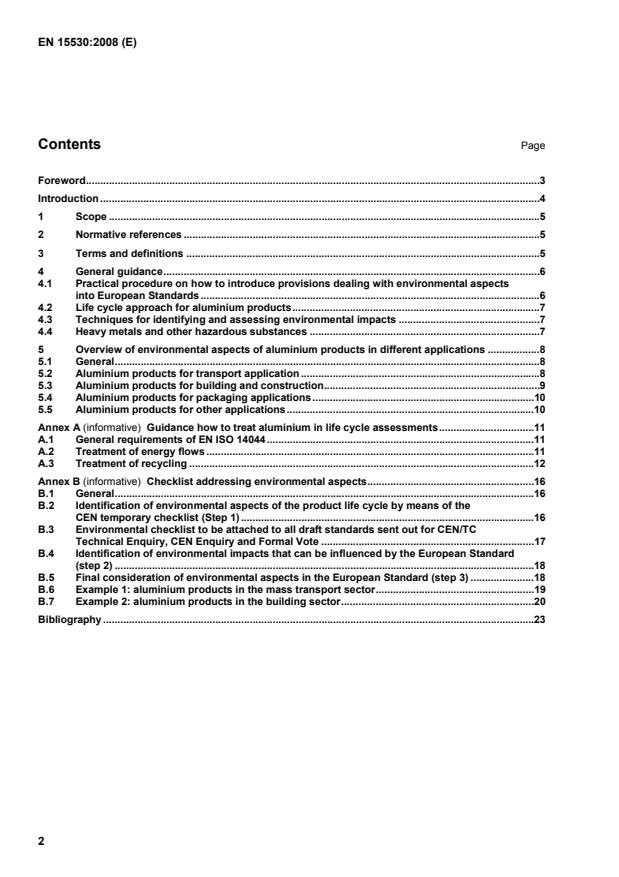
Guidance how to treat aluminium in life cycle assessments.11 A.1 General requirements of EN ISO 14044.11 A.2 Treatment of energy flows.11 A.3 Treatment of recycling.12 Annex B (informative)
Checklist addressing environmental aspects.16 B.1 General.16 B.2 Identification of environmental aspects of the product life cycle by means of the CEN temporary checklist (Step 1).16 B.3 Environmental checklist to be attached to all draft standards sent out for CEN/TC Technical Enquiry, CEN Enquiry and Formal Vote.17 B.4 Identification of environmental impacts that can be influenced by the European Standard (step 2).18 B.5 Final consideration of environmental aspects in the European Standard (step 3).18 B.6 Example 1: aluminium products in the mass transport sector.19 B.7 Example 2: aluminium products in the building sector.20 Bibliography.23
Within its program of work, Technical Committee CEN/TC 132 entrusted CEN/TC 132/WG 14 “General support” to prepare this document. This European Standard shall be given the status of a national standard, either by publication of an identical text or by endorsement, at the latest by July 2008, and conflicting national standards shall be withdrawn at the latest by July 2008. Attention is drawn to the possibility that some of the elements of this document may be the subject of patent rights. CEN [and/or CENELEC] shall not be held responsible for identifying any or all such patent rights. According to the CEN/CENELEC Internal Regulations, the national standards organizations of the following countries are bound to implement this European Standard: Austria, Belgium, Bulgaria, Cyprus, Czech Republic, Denmark, Estonia, Finland, France, Germany, Greece, Hungary, Iceland, Ireland, Italy, Latvia, Lithuania, Luxembourg, Malta, Netherlands, Norway, Poland, Portugal, Romania, Slovakia, Slovenia, Spain, Sweden, Switzerland and the United Kingdom.
[EN ISO 14001:2004] 3.5 life cycle consecutive and interlinked stages of a product system, from raw material acquisition or generation from natural resources to their final disposal
[EN ISO 14044:2006] 4 General guidance 4.1 Practical procedure on how to introduce provisions dealing with environmental aspects into European Standards 4.1.1 Many European Standards about aluminium products exist without any provisions to make the user aware of environmental aspects and potential environmental impacts. This need not lead directly to products which are less environmentally friendly, because the designer has other incentives to consider environmental aspects, such as economic considerations, legal requirements etc. However, the inclusion of environmental provisions encourages the consideration of environmental aspects in cases where such incentives do not exist. 4.1.2 In many cases it is sufficient to include the necessary provisions when revising European Standards about aluminium products by the inclusion of a new clause or subclause where the relevant environmental aspects are formulated.
EXAMPLE In EN 13981-1:2003 requirements and guidance on aluminium profiles for railway application are formulated, without mentioning possible environmental aspects. For the next revision of this European Standard it would be advisable to include an additional clause stating that mass savings generate savings of electricity or diesel during the whole use stage of the railway car of about 30 years. Each weight reduction of 1 kg in a railway car saves about 60 kg to 80 kg CO2 equivalents of green-house gas for long distance trains and 100 kg to 150 kg CO2 equivalents of green-house gas for short distance trains, trams and subway trains [1], [2]
4.1.3 Environmental impacts related to a product can be affected due to product standardization. This aspect should be balanced against other factors, such as: product function; performance; safety and health; cost; marketability; quality; legal and regulatory requirements.
NOTE Aluminium is not considered as a hazardous substance by European legislation. 4.4.2 Standard writers should consider that too strict limitations of impurities can hamper the recycling of aluminium. EXAMPLE Mixed shredded scrap can easily be recycled into foundry alloys when the lead limit for such alloys is 0,35 % by mass: see EN 1676. With lower limits, aluminium recycling is hampered. 4.4.3 Hexavalent chromium is a hazardous substance which can be used for the pre-treatment of aluminium surfaces before coating. Standard writers should consider that for higher intended life times of the aluminium product, substitutes according to the state of the art can compromise the total life time of the product.
5.3.1.3 When specifying the choice of alloys and surface treatment including pre-treatment, standard writers should consider the intended location of the building, e.g. a location at the sea-shore or in humid tropical areas, and the intended use. 5.3.1.4 For anodised products special care is necessary when specifying the thickness of oxide layers. The environmental aspects of the electricity consumption and waste formation of the anodising process and the metal loss by oxidation depend on the oxide layer thickness and should be considered. Yet, the environmental view should not overrule the fitness for use.
possible environmental aspects of production and disposal of the materials which are added to the aluminium surface and/or the resulting multilayer structures. 5.4.2 Recycling Standard writers should consider that strip and foil as used for packaging or laminated cardboard is usually recovered in accordance with EN 13430 or EN 13431 by recycling or incineration. In case of incineration, combustion energy and, depending on the kind of processing, aluminium oxide are valorised. For specification of the calorific value and the energy recovery by incineration of different aluminium foils, see EN 13431:2004, Table B.1. For cans and rigid containers the recycling rate can vary widely between different products and different countries. 5.5 Aluminium products for other applications 5.5.1 Standard writers should consider that energy saving by light-weighting also applies to moving parts of machines. 5.5.2 Standard writers should consider similar rules for design of recycling as shown in 5.2.2.
Guidance how to treat aluminium in life cycle assessments A.1 General requirements of EN ISO 14044 A.1.1 The LCA study includes four different phases: Goal and Scope Definition; Life Cycle Inventory Analysis; Life Cycle Impact Assessment; Interpretation. A.1.2 LCA deals with product systems which comprise the full life cycle of a product, including raw material acquisition, fabrication, transportation, use, recycling/disposal and the operations of energy supply, ancillary material supply and transports. Ideally, such a product system should only have input and output which are elementary flows, i.e. material or energy which is drawn from the environment or is discarded to the environment without subsequent human transformation. A.1.3 In LCA studies where aluminium is compared with other materials, this comparison should be based on the same functional unit, e.g. 1 kg of aluminium in a car may in a specific case correspond to 1,8 kg of conventional steel, in order to fulfil the same function. A.1.4 Quantitative aggregation over different impact categories, e.g. the calculation of a single score, is not permitted by EN ISO 14044 for studies to be used for comparative assertions made available to the public, where the overall environmental superiority or equivalence of one product versus a competing product which performs the same func
...