

EN 13329:2023
(Main)Laminate floor coverings - Specifications, requirements and test methods
- Abstract
This document specifies characteristics, requirements and test methods for laminate floor coverings with a surface layer as defined in 3.2 to 3.5. It also specifies requirements for marking and packaging.
It includes a classification system, based on EN ISO 10874, giving practical requirements for areas of use and levels of use, to indicate where laminate floor coverings will give satisfactory service and to encourage the consumer to make an informed choice.
Laminate floor coverings are generally designed for floating installations and are considered for domestic and commercial levels of use, including domestic kitchens. This document does not specify requirements relating to the use in areas which are subjected to frequent wetting, such as bathrooms, laundry rooms or saunas. In general, laminate floor coverings can only be used in those areas when authorized by the manufacturer and under conditions described in the manufacturer's installation guidelines.
- Status
- Published
- Publication Date
- 19-Dec-2023
- Technical Committee
- CEN/TC 134 - Resilient and textile floor coverings
- Drafting Committee
- CEN/TC 134/WG 9 - Laminate floor coverings
- Current Stage
- 6060 - Definitive text made available (DAV) - Publishing
- Start Date
- 20-Dec-2023
- Due Date
- 17-Dec-2024
- Completion Date
- 20-Dec-2023

Overview
EN 13329:2023 - Laminate floor coverings - Specifications, requirements and test methods (CEN) defines the characteristics, requirements and test methods for laminate flooring with aminoplastic, resin- or acrylic-based surface layers. It covers dimensional tolerances, mechanical and optical performance, marking and packaging, and a classification system (based on EN ISO 10874) to indicate suitable areas and levels of use. The standard applies primarily to floating installations for domestic and commercial use (including kitchens) and excludes frequent-wetting areas (bathrooms, laundries, saunas) unless the manufacturer explicitly authorizes use and installation conditions.
Key Topics
- Scope and definitions - Clear definitions for surface layers (aminoplastic, resin-based, acrylic/EPL), substrate, backer and pre-attached underlay.
- General requirements - Dimensional tolerances and flatness, e.g. element thickness variation Δt ≤ 0.50 mm (without underlay), length/width and squareness limits, surface flatness and joint opening limits. Light fastness and static indentation requirements are also specified.
- Classification and performance - A classification scheme (domestic and commercial classes 21–34) based on practical use levels. Key tests include:
- Abrasion resistance (ISO 24338) and AC class designations
- Impact resistance (large and small ball tests, EN 17368)
- Castor chair testing (EN ISO 4918) and furniture-leg simulation (EN ISO 16581)
- Indentation and residual indentation (EN ISO 24343-1)
- Water/topical moisture resistance (ISO 4760) listed as an additional characteristic
- Underlay and system testing - Tests requiring a pre-attached or manufacturer-specified underlay; if none provided, a standard EPS foam (≈1.6 mm, CS ≥ 60 kPa, PC ≈ 0.9 mm) is used for system tests.
- Marking, packaging and test reports - Requirements for product labeling, packaging information, and the content of test reports.
- Annexes and references - Normative annexes for humidity-related dimensional change, surface soundness, large ball impact, and guidance on recycling and waste legislation.
Applications
Who uses EN 13329:2023:
- Manufacturers - product design, quality control, CE marking and technical data sheets
- Test laboratories - standardized test methods and acceptance criteria
- Architects, specifiers and distributors - selecting appropriate classes for intended use (domestic/commercial)
- Installers and retailers - guidance on underlay selection, installation limitations (wet areas) and consumer information
- Regulators and procurement teams - specifying compliant laminate flooring for projects
Related Standards
- EN ISO 10874 (classification)
- EN 17539 (geometrical characteristics)
- ISO 24338 (abrasion)
- EN ISO 4918 (castor chair)
- ISO 4760 (topical moisture resistance)
- EN 16354 (underlay specification)
By following EN 13329:2023, stakeholders ensure consistent performance, reliable testing and clearer consumer guidance when selecting and installing laminate floor coverings.
Relations
- Effective Date
- 15-Feb-2023
- Effective Date
- 15-Feb-2023
- Effective Date
- 18-Jan-2023
- Effective Date
- 28-Jan-2026
- Effective Date
- 28-Jan-2026
- Referred By
EN 16354:2018 - Laminate floor coverings - Underlays - Specification, requirements and test methods - Effective Date
- 28-Jan-2026
- Effective Date
- 28-Jan-2026
- Effective Date
- 28-Jan-2026
- Effective Date
- 28-Jan-2026
- Effective Date
- 28-Jan-2026
- Effective Date
- 28-Jan-2026
- Effective Date
- 28-Jan-2026
- Effective Date
- 28-Jan-2026
- Referred By
EN 14041:2004 - Resilient, textile and laminate floor coverings - Essential characteristics - Effective Date
- 28-Jan-2026
- Effective Date
- 28-Jan-2026
Frequently Asked Questions
EN 13329:2023 is a standard published by the European Committee for Standardization (CEN). Its full title is "Laminate floor coverings - Specifications, requirements and test methods". This standard covers: This document specifies characteristics, requirements and test methods for laminate floor coverings with a surface layer as defined in 3.2 to 3.5. It also specifies requirements for marking and packaging. It includes a classification system, based on EN ISO 10874, giving practical requirements for areas of use and levels of use, to indicate where laminate floor coverings will give satisfactory service and to encourage the consumer to make an informed choice. Laminate floor coverings are generally designed for floating installations and are considered for domestic and commercial levels of use, including domestic kitchens. This document does not specify requirements relating to the use in areas which are subjected to frequent wetting, such as bathrooms, laundry rooms or saunas. In general, laminate floor coverings can only be used in those areas when authorized by the manufacturer and under conditions described in the manufacturer's installation guidelines.
This document specifies characteristics, requirements and test methods for laminate floor coverings with a surface layer as defined in 3.2 to 3.5. It also specifies requirements for marking and packaging. It includes a classification system, based on EN ISO 10874, giving practical requirements for areas of use and levels of use, to indicate where laminate floor coverings will give satisfactory service and to encourage the consumer to make an informed choice. Laminate floor coverings are generally designed for floating installations and are considered for domestic and commercial levels of use, including domestic kitchens. This document does not specify requirements relating to the use in areas which are subjected to frequent wetting, such as bathrooms, laundry rooms or saunas. In general, laminate floor coverings can only be used in those areas when authorized by the manufacturer and under conditions described in the manufacturer's installation guidelines.
EN 13329:2023 is classified under the following ICS (International Classification for Standards) categories: 97.150 - Floor coverings. The ICS classification helps identify the subject area and facilitates finding related standards.
EN 13329:2023 has the following relationships with other standards: It is inter standard links to EN 15468:2016+A1:2021, EN 14978:2016+A1:2021, EN 13329:2016+A2:2021, EN 15398:2020, CEN/TS 16354:2013, EN 16354:2018, CEN/TS 14472-3:2003, EN 438-5:2016, EN 438-1:2016, EN 438-1:2005, EN 16511:2023+A1:2025, EN 438-5:2005, CEN/TS 15398:2016, EN 14041:2004, EN 14041:2018. Understanding these relationships helps ensure you are using the most current and applicable version of the standard.
EN 13329:2023 is available in PDF format for immediate download after purchase. The document can be added to your cart and obtained through the secure checkout process. Digital delivery ensures instant access to the complete standard document.
Standards Content (Sample)
SLOVENSKI STANDARD
01-februar-2024
Laminatne talne obloge - Specifikacije, zahteve in preskusne metode
Laminate floor coverings - Specifications, requirements and test methods
Laminatböden - Spezifikationen, Anforderungen und Prüfverfahren
Revêtements de sol stratifiés - Spécifications, exigences et méthodes d'essai
Ta slovenski standard je istoveten z: EN 13329:2023
ICS:
97.150 Talne obloge Floor coverings
2003-01.Slovenski inštitut za standardizacijo. Razmnoževanje celote ali delov tega standarda ni dovoljeno.
EN 13329
EUROPEAN STANDARD
NORME EUROPÉENNE
December 2023
EUROPÄISCHE NORM
ICS 97.150 Supersedes EN 13329:2016+A2:2021,
EN 14978:2016+A1:2021, EN 15468:2016+A1:2021
English Version
Laminate floor coverings - Specifications, requirements
and test methods
Revêtements de sol stratifiés - Spécifications, exigences Laminatböden - Spezifikationen, Anforderungen und
et méthodes d'essai Prüfverfahren
This European Standard was approved by CEN on 27 November 2023.
CEN members are bound to comply with the CEN/CENELEC Internal Regulations which stipulate the conditions for giving this
European Standard the status of a national standard without any alteration. Up-to-date lists and bibliographical references
concerning such national standards may be obtained on application to the CEN-CENELEC Management Centre or to any CEN
member.
This European Standard exists in three official versions (English, French, German). A version in any other language made by
translation under the responsibility of a CEN member into its own language and notified to the CEN-CENELEC Management
Centre has the same status as the official versions.
CEN members are the national standards bodies of Austria, Belgium, Bulgaria, Croatia, Cyprus, Czech Republic, Denmark, Estonia,
Finland, France, Germany, Greece, Hungary, Iceland, Ireland, Italy, Latvia, Lithuania, Luxembourg, Malta, Netherlands, Norway,
Poland, Portugal, Republic of North Macedonia, Romania, Serbia, Slovakia, Slovenia, Spain, Sweden, Switzerland, Türkiye and
United Kingdom.
EUROPEAN COMMITTEE FOR STANDARDIZATION
COMITÉ EUROPÉEN DE NORMALISATIO N
EUROPÄISCHES KOMITEE FÜR NORMUN G
CEN-CENELEC Management Centre: Rue de la Science 23, B-1040 Brussels
© 2023 CEN All rights of exploitation in any form and by any means reserved Ref. No. EN 13329:2023 E
worldwide for CEN national Members.
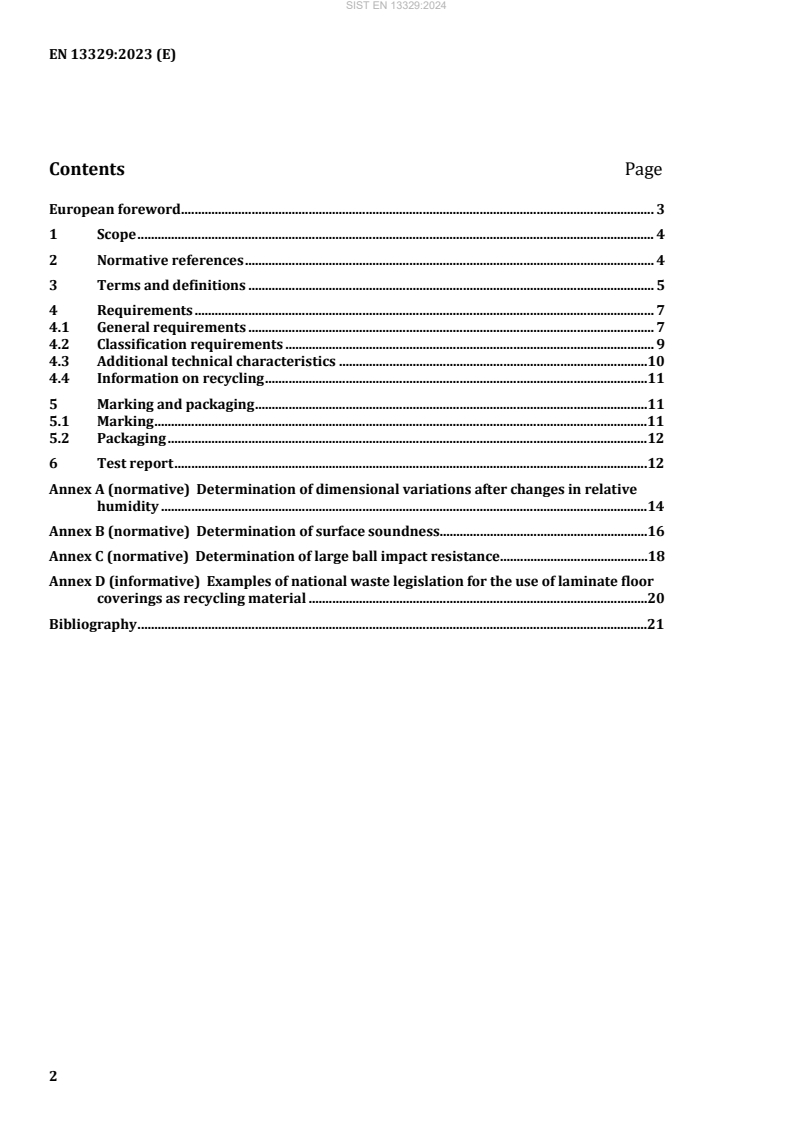
Contents Page
European foreword . 3
1 Scope . 4
2 Normative references . 4
3 Terms and definitions . 5
4 Requirements . 7
4.1 General requirements . 7
4.2 Classification requirements . 9
4.3 Additional technical characteristics .10
4.4 Information on recycling .11
5 Marking and packaging .11
5.1 Marking .11
5.2 Packaging .12
6 Test report .12
Annex A (normative) Determination of dimensional variations after changes in relative
humidity .14
Annex B (normative) Determination of surface soundness.16
Annex C (normative) Determination of large ball impact resistance .18
Annex D (informative) Examples of national waste legislation for the use of laminate floor
coverings as recycling material .20
Bibliography .21
European foreword
This document (EN 13329:2023) has been prepared by Technical Committee CEN/TC 134 “Resilient,
textile and laminate floor coverings”, the secretariat of which is held by NBN.
This European Standard shall be given the status of a national standard, either by publication of an
identical text or by endorsement, at the latest by June 2024, and conflicting national standards shall be
withdrawn at the latest by June 2024.
Attention is drawn to the possibility that some of the elements of this document may be the subject of
patent rights. CEN shall not be held responsible for identifying any or all such patent rights.
This document supersedes EN 13329:2016+A2:2021, EN 14978:2016+A1:2021 and
EN 15468:2016+A1:2021.
The main changes compared to EN 13329:2016+A2:2021, EN 14978:2016+A1:2021 and
EN 15468:2016+A1:2021 are listed below:
— EN 13329, EN 14978 and EN 15468 merged;
— Annex A and Annex B on determination of geometrical characteristics replaced by reference to
EN 17539 in Table 1;
— Annex E, Annex F and Annex G on determination of abrasion resistance replaced by reference to
ISO 24338 in Table 2;
— specification of underlay in 4.2 modified;
— in Table 2 requirements for impact resistance with large ball reduced due to modified underlay;
— in Table 2 castor chair test according to EN 425 replaced by test according to EN ISO 4918 with
adjusted requirements;
— in Table 3 water resistance according to ISO 4760 introduced as additional technical characteristic;
— information on recycling added as 4.4 and Annex D.
Any feedback and questions on this document should be directed to the users’ national standards body.
A complete listing of these bodies can be found on the CEN website.
According to the CEN-CENELEC Internal Regulations, the national standards organisations of the
following countries are bound to implement this European Standard: Austria, Belgium, Bulgaria, Croatia,
Cyprus, Czech Republic, Denmark, Estonia, Finland, France, Germany, Greece, Hungary, Iceland, Ireland,
Italy, Latvia, Lithuania, Luxembourg, Malta, Netherlands, Norway, Poland, Portugal, Republic of North
Macedonia, Romania, Serbia, Slovakia, Slovenia, Spain, Sweden, Switzerland, Türkiye and the United
Kingdom.
1 Scope
This document specifies characteristics, requirements and test methods for laminate floor coverings with
a surface layer as defined in 3.2 to 3.5. It also specifies requirements for marking and packaging.
It includes a classification system, based on EN ISO 10874, giving practical requirements for areas of use
and levels of use, to indicate where laminate floor coverings will give satisfactory service and to
encourage the consumer to make an informed choice.
Laminate floor coverings are generally designed for floating installations and are considered for domestic
and commercial levels of use, including domestic kitchens. This document does not specify requirements
relating to the use in areas which are subjected to frequent wetting, such as bathrooms, laundry rooms
or saunas. In general, laminate floor coverings can only be used in those areas when authorized by the
manufacturer and under conditions described in the manufacturer's installation guidelines.
2 Normative references
The following documents are referred to in the text in such a way that some or all of their content
constitutes requirements of this document. For dated references, only the edition cited applies. For
undated references, the latest edition of the referenced document (including any amendments) applies.
EN 311, Wood-based panels — Surface soundness — Test method
EN 318, Wood based panels — Determination of dimensional changes associated with changes in relative
humidity
EN 322, Wood-based panels — Determination of moisture content
EN 438-2, High-pressure decorative laminates (HPL) — Sheets based on thermosetting resins (usually
called laminates) — Part 2: Determination of properties
EN 16094, Laminate floor coverings — Test method for the determination of micro-scratch resistance
EN 16354, Laminate floor coverings — Underlays — Specification, requirements and test methods
EN 17368, Laminate floor coverings — Determination of impact resistance with small ball
EN 17539, Modular mechanical locked floor coverings (MMF) — Determination of geometrical
characteristics
EN 20105-A02, Textiles — Tests for colour fastness — Part A02: Grey scale for assessing change in colour
(ISO 105-A02)
EN ISO 105-B02, Textiles — Tests for colour fastness — Part B02: Colour fastness to artificial light: Xenon
arc fading lamp test (ISO 105-B02)
EN ISO 2813, Paints and varnishes — Determination of gloss value at 20°, 60° and 85° (ISO 2813)
EN ISO 4892-2:2013, Plastics — Methods of exposure to laboratory light sources — Part 2: Xenon-arc
lamps (ISO 4892-2:2013)
EN ISO 4918, Resilient, textile and laminate floor coverings — Castor chair test (ISO 4918)
As impacted by EN ISO 4892-2:2013/A1:2021.
EN ISO 10874, Resilient, textile and laminate floor coverings — Classification (ISO 10874)
EN ISO 16581, Resilient and laminate floor coverings — Determination of the effect of simulated movement
of a furniture leg (ISO 16581)
EN ISO 24343-1, Resilient and laminate floor coverings — Determination of indentation and residual
indentation — Part 1: Residual indentation (ISO 24343-1)
ISO 4760:2022, Laminate flooring — Topical moisture resistance — Assembled joint
ISO 24334, Laminate floor coverings — Determination of locking strength for mechanically assembled
panels
ISO 24336, Laminate floor coverings — Determination of thickness swelling after partial immersion in
water
ISO 24338, Laminate floor coverings — Determination of abrasion resistance
ISO 24339, Laminate and textile floor coverings — Determination of dimensional variations after exposure
to humid and dry climate conditions
3 Terms and definitions
For the purposes of this document, the following terms and definitions apply.
ISO and IEC maintain terminology databases for use in standardization at the following addresses:
— ISO Online browsing platform: available at https://www.iso.org/obp/
— IEC Electropedia: available at https://www.electropedia.org/
3.1
laminate floor covering
rigid floor covering, typically in a plank or tile format, with a multiple layer structure: e.g. backer,
substrate, décor and worked edges that allow the product to be joined together to form a larger integral
unit
Note 1 to entry: Laminate flooring does not include products having a resilient, stone, textile, wood, leather or
metal top surfacing material(s).
3.2
surface layer based on aminoplastic thermosetting resins
upper decorative layer, which may vary in surface texture and gloss level, consisting of one or more thin
sheets of a fibrous material (usually paper), impregnated with aminoplastic, thermosetting resins
(usually melamine)
Note 1 to entry: By the simultaneous action of heat and pressure, these sheets are either pressed as such (HPL,
CPL, Compact), and in the case of HPL and CPL bonded on a substrate (usually wood-based panels), or in the case
of DPL directly pressed on a substrate (usually wood-based panels). The product is usually finished with a backer
(e.g. HPL, CPL, impregnated papers), primarily used as a balancing material.
3.3
resin based surface layer
upper decorative layer intended to be the visible side when the floor is installed, consisting of resins
(usually acrylate, methacrylate or similar) which are cured using UV radiation or other curing methods
Note 1 to entry: It can exhibit impregnated and coated materials (generally décor paper), or at least one paint or
varnish layer applied direct on the board using indirect printing, direct printing or digital printing. The combination
of the multi-layered surface produced with this technique is called Printed Décor Laminate (PDL).
3.4
acrylic based surface layer
upper decorative layer intended to be the visible side when the floor is installed consisting of resins
(normally acrylate, methacrylate or similar) which are hardened using beams and impregnated and
surfaced decorative materials (normally paper), which all together are hardened through the application
of a sufficient dose of electron beams and constant pressure
Note 1 to entry: The surface layer produced with this technique is called Electron-beam Pressed Laminate (EPL).
The surface layer is bonded to a substrate.
3.5
acrylic based surface layer with a high gloss level
upper decorative layer as defined in 3.4 with a specular gloss level ≥ 85 units determined in accordance
with EN ISO 2813 with a detection angle of 60°
3.6
substrate
core material of the laminate floor covering containing wood for at least 65 % in mass
Note 1 to entry: It is generally a particleboard, as defined in EN 309, or a dry process fibreboard (MDF) as defined
in EN 316 or a so-called High-Density Fibreboard (HDF), which is an MDF-board with a density ≥ 800 kg/m .
3.7
backer
layer opposite to the surface layer used to balance and stabilize the product
Note 1 to entry: The backer is generally made of impregnated papers.
3.8
pre-attached underlay
layer of resilient material pre-attached directly to the backer (3.7) to impart specific properties
Note 1 to entry: For laminate floor coverings without a pre-attached underlay, a separate underlay is generally
laid between the laminate flooring and the subfloor during installation. For reasons of realistic system testing,
separate underlays can be required for some tests according to this document.
3.9
laminate floor covering element
piece of the floor covering with profiled edges to facilitate assembly at installation
Note 1 to entry: See Figure 1.
Key
1 surface layer
2 substrate
3 backer
4 pre-attached underlay (optional)
Figure 1— Laminate floorcovering element
4 Requirements
4.1 General requirements
All laminate floor coverings shall conform to the general requirements given in Table 1, when tested by
the methods specified therein.
Table 1 — General requirements
Characteristic Requirement Test method
Thickness of the element, (t) Δt ≤ 0,50 mm, relative to nominal value EN 17539
average
without pre-attached underlay
t - t ≤ 0,50 mm
max. min.
Thickness of the element, (t) Δt ≤ 0,50 mm, relative to nominal value EN 17539
average
with pre-attached underlay
t - t ≤ 0,80 mm
max. min.
Length of the surface layer, (l) For the nominal values given, no measured EN 17539
value shall exceed:
l ≤ 1 500 mm: Δl ≤ 0,5 mm
l > 1 500 mm: Δl ≤ 0,3 mm/m
Width of the surface layer, (w) Δw ≤ 0,10 mm, relative to nominal value EN 17539
average
w – w ≤ 0,20 mm
max. min.
Length and width of squared Δl ≤ 0,10 mm relative to nominal value EN 17539
average
elements,
Δw ≤ 0,10 mm, relative to nominal value
average
(l = w)
l – l ≤ 0,20 mm
max. min.
w – w ≤ 0,20 mm
max. min.
Squareness of the element, (q) q ≤ 0,20 mm EN 17539
max.
Straightness of the surface s ≤ 0,30 mm/m EN 17539
max.
layer, (s)
Flatness of the element, (f) Maximum single values: EN 17539
f ≤ 0,15 % f ≤ 0,20 %
w, concave w, convex
f ≤ 0,50 % f ≤ 1,00 %
l, concave l, convex
Openings between elements, o ≤ 0,15 mm EN 17539
average
(o)
≤ 0,20 mm
o
max.
Height difference between h ≤ 0,10 mm EN 17539
average
elements, (h)
h ≤ 0,15 mm
max.
Dimensional variations after δl ≤ 0,9 mm Annex (A)
average
changes in relative humidity,
δw ≤ 0,9 mm
average
(δl, δw)
Light fastness Colour contrast between unexposed and EN ISO 4892-2: 2013
exposed sample pa
...