

EN 18135:2026
(Main)Resilient, textile, laminate and modular mechanical locked floor coverings - Circular Economy - Floor coverings and underlays product passport
- Abstract
This document specifies the minimum and optional content of the product passport and the unified code relating to the identification of resilient, textile, laminate and modular mechanical locked floor coverings and their underlay necessary for the implementation of a circular economy. Packaging is excluded. The intended use of this standard is to provide information that allows different stakeholders to assess floor coverings and underlays on product content, environmental information, reuse, and/or recycling potential.
- Status
- Published
- Publication Date
- 17-Mar-2026
- Technical Committee
- CEN/TC 134 - Resilient and textile floor coverings
- Drafting Committee
- CEN/TC 134/WG 10 - Harmonization
- Current Stage
- 6060 - Definitive text made available (DAV) - Publishing
- Start Date
- 18-Mar-2026
- Due Date
- 02-Feb-2026
- Completion Date
- 18-Mar-2026

Overview
EN 18135:2026 is a European standard developed by CEN specifying the structure and content of a product passport for resilient, textile, laminate, and modular mechanical locked floor coverings and their underlays. This standard supports the implementation of a circular economy in the flooring sector by detailing the information necessary for product identification, assessment of environmental impacts, and facilitating the reuse and recycling of flooring materials. Packaging requirements are not included within this standard.
The information provided by the product passport enables stakeholders to easily access key data about the material composition, environmental attributes, and end-of-life management options of flooring products and underlays. The passport helps manufacturers, designers, facility managers, contractors, installers, recyclers, and end-users make informed decisions that promote sustainability and resource efficiency.
Key Topics
Product Passport Content
EN 18135:2026 outlines minimum and optional information to be included in the product passport:- Product and supplier identification
- Details on constituents, structure, and composition
- Presence of hazardous substances, recycled and renewable material content
- Environmental performance data and environmental product declarations (EPDs)
- Guidance for installation, maintenance, and end-of-use scenarios
Unified Product Coding System
The standard prescribes a unified code system that allows for clear identification of flooring materials, including the main components, additives, and any relevant recycling or environmental data. This code can be physically linked to the product for traceability throughout its lifecycle.End-of-Life Information
Requirements include data on design for disassembly, recyclability, options for reuse, remanufacturing, and waste reduction measures. This is critical for promoting circular economy objectives by maximizing reuse and recycling while minimizing landfill.Third-Party Verification and Transparency
The standard supports the use of third-party verification for environmental claims, supporting trust and transparency in sustainability disclosures.
Applications
EN 18135:2026 is designed to be implemented by manufacturers and suppliers of floor coverings and underlays, helping them to:
Demonstrate Compliance and Sustainability
By following EN 18135:2026, companies can provide transparent product data to meet legal, commercial, and sustainability requirements in the European market.Enable Circular Economy Practices
The product passport facilitates recycling, refurbishment, and reuse of flooring products. This allows stakeholders such as facility managers, building owners, and recyclers to easily determine how to manage flooring at end of life.Enhance Market Trust
The availability of standardized, verifiable information improves buyers’ confidence in the environmental performance of flooring products.Support Lifecycle Management
Providing detailed installation, maintenance, and disassembly instructions ensures optimal product use and simplifies end-of-life processes, contributing to longer product lifespans and reduced environmental impact.
Related Standards
EN 18135:2026 aligns with other key standards and regulations aimed at promoting circular economy and sustainability in building materials:
- EN 17861: Circular Economy - Terms and definitions for resilient, textile, laminate, and modular mechanical locked floor coverings.
- CEN/TS 18075:2024: Recommendations/guidelines for the design of sustainable floor coverings.
- EN ISO 14021: Environmental labels and declarations.
- EN ISO 1043 series: Plastics - Symbols and abbreviated terms.
- Relevant EU Regulations:
- (EU) 2024/3110 (Construction Products Regulation)
- (EU) 2024/1781 (Ecodesign for Sustainable Products Regulation)
By implementing EN 18135:2026, the flooring industry can significantly advance circular economy initiatives, providing the transparency and technical documentation required for informed, responsible material choices across the supply chain.
Relations
- Effective Date
- 08-Apr-2026
- Effective Date
- 08-Apr-2026
- Effective Date
- 08-Apr-2026
- Effective Date
- 08-Apr-2026
Frequently Asked Questions
EN 18135:2026 is a standard published by the European Committee for Standardization (CEN). Its full title is "Resilient, textile, laminate and modular mechanical locked floor coverings - Circular Economy - Floor coverings and underlays product passport". This standard covers: This document specifies the minimum and optional content of the product passport and the unified code relating to the identification of resilient, textile, laminate and modular mechanical locked floor coverings and their underlay necessary for the implementation of a circular economy. Packaging is excluded. The intended use of this standard is to provide information that allows different stakeholders to assess floor coverings and underlays on product content, environmental information, reuse, and/or recycling potential.
This document specifies the minimum and optional content of the product passport and the unified code relating to the identification of resilient, textile, laminate and modular mechanical locked floor coverings and their underlay necessary for the implementation of a circular economy. Packaging is excluded. The intended use of this standard is to provide information that allows different stakeholders to assess floor coverings and underlays on product content, environmental information, reuse, and/or recycling potential.
EN 18135:2026 is classified under the following ICS (International Classification for Standards) categories: 97.150 - Floor coverings. The ICS classification helps identify the subject area and facilitates finding related standards.
EN 18135:2026 has the following relationships with other standards: It is inter standard links to EN 17861:2023, EN ISO 1043-3:2016, EN ISO 1043-1:2011, EN ISO 1043-4:2021. Understanding these relationships helps ensure you are using the most current and applicable version of the standard.
EN 18135:2026 is available in PDF format for immediate download after purchase. The document can be added to your cart and obtained through the secure checkout process. Digital delivery ensures instant access to the complete standard document.
Standards Content (Sample)
SLOVENSKI STANDARD
01-maj-2026
Netekstilne, tekstilne, laminirane in modularne mehansko spojene talne obloge -
Krožno gospodarstvo - Potni list izdelka za talne obloge in podloge
Resilient, textile, laminate and modular mechanical locked floor coverings - Circular
Economy - Floor coverings and underlays passport
Elastische, textile, Laminat- und modulare mechanisch verriegelnde Bodenbeläge -
Kreislaufwirtschaft - Pass für Bodenbelag und Verlegeunterlagen
Revêtements de sol résilients, textiles, stratifiés et modulaires à clipsage mécanique -
Économie circulaire - Passeport pour les revêtements de sol et les sous-couches
Ta slovenski standard je istoveten z: EN 18135:2026
ICS:
13.020.20 Okoljska ekonomija. Environmental economics.
Trajnostnost Sustainability
97.150 Talne obloge Floor coverings
2003-01.Slovenski inštitut za standardizacijo. Razmnoževanje celote ali delov tega standarda ni dovoljeno.
EN 18135
EUROPEAN STANDARD
NORME EUROPÉENNE
March 2026
EUROPÄISCHE NORM
ICS 97.150
English Version
Resilient, textile, laminate and modular mechanical locked
floor coverings - Circular Economy - Floor coverings and
underlays product passport
Revêtements de sol résilients, textiles, stratifiés et Elastische, textile, Laminat- und modulare mechanisch
modulaires à clipsage mécanique - Économie circulaire verriegelnde Bodenbeläge - Kreislaufwirtschaft -
- Passeport pour revêtements de sol et sous-couches Produktpass für Bodenbelag und Verlegeunterlagen
This European Standard was approved by CEN on 2 February 2026.
CEN members are bound to comply with the CEN/CENELEC Internal Regulations which stipulate the conditions for giving this
European Standard the status of a national standard without any alteration. Up-to-date lists and bibliographical references
concerning such national standards may be obtained on application to the CEN-CENELEC Management Centre or to any CEN
member.
This European Standard exists in three official versions (English, French, German). A version in any other language made by
translation under the responsibility of a CEN member into its own language and notified to the CEN-CENELEC Management
Centre has the same status as the official versions.
CEN members are the national standards bodies of Austria, Belgium, Bulgaria, Croatia, Cyprus, Czech Republic, Denmark, Estonia,
Finland, France, Germany, Greece, Hungary, Iceland, Ireland, Italy, Latvia, Lithuania, Luxembourg, Malta, Netherlands, Norway,
Poland, Portugal, Republic of North Macedonia, Romania, Serbia, Slovakia, Slovenia, Spain, Sweden, Switzerland, Türkiye and
United Kingdom.
EUROPEAN COMMITTEE FOR STANDARDIZATION
COMITÉ EUROPÉEN DE NORMALISATION
EUROPÄISCHES KOMITEE FÜR NORMUNG
CEN-CENELEC Management Centre: Rue de la Science 23, B-1040 Brussels
© 2026 CEN All rights of exploitation in any form and by any means reserved Ref. No. EN 18135:2026 E
worldwide for CEN national Members.
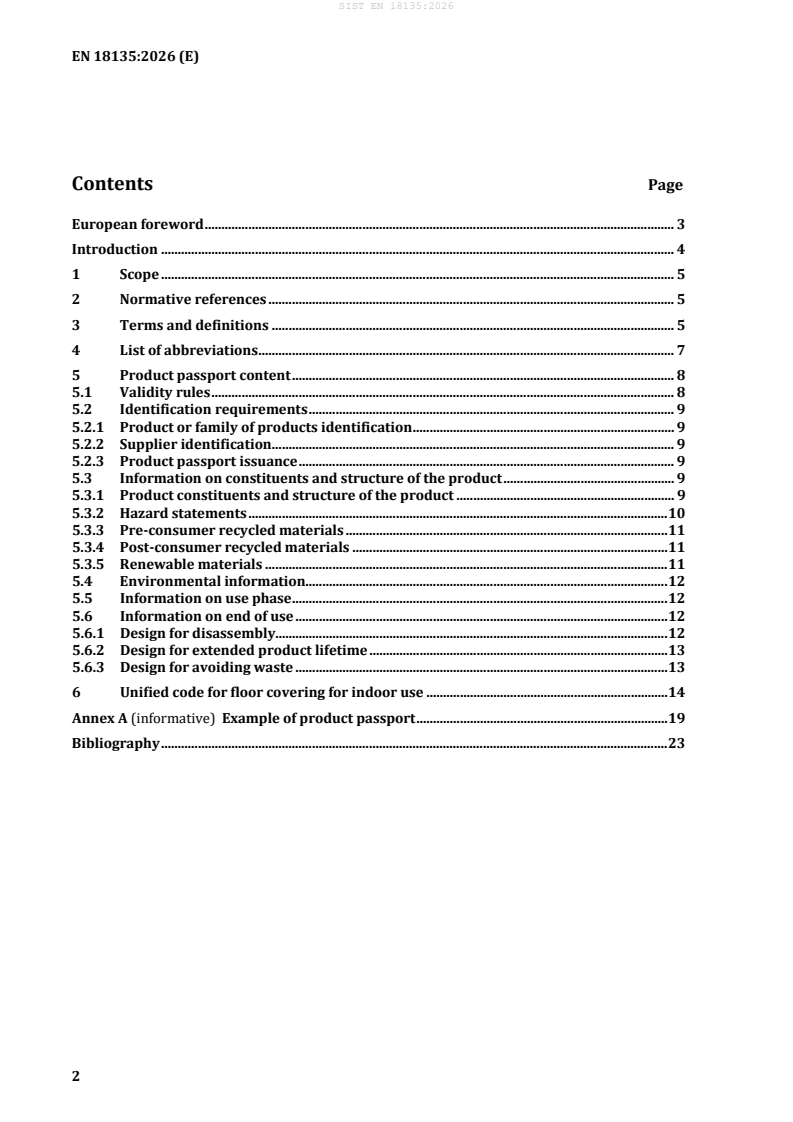
Contents Page
European foreword . 3
Introduction . 4
1 Scope . 5
2 Normative references . 5
3 Terms and definitions . 5
4 List of abbreviations . 7
5 Product passport content . 8
5.1 Validity rules . 8
5.2 Identification requirements . 9
5.2.1 Product or family of products identification . 9
5.2.2 Supplier identification . 9
5.2.3 Product passport issuance . 9
5.3 Information on constituents and structure of the product . 9
5.3.1 Product constituents and structure of the product . 9
5.3.2 Hazard statements . 10
5.3.3 Pre‑consumer recycled materials . 11
5.3.4 Post‑consumer recycled materials . 11
5.3.5 Renewable materials . 11
5.4 Environmental information. 12
5.5 Information on use phase . 12
5.6 Information on end of use . 12
5.6.1 Design for disassembly. 12
5.6.2 Design for extended product lifetime . 13
5.6.3 Design for avoiding waste . 13
6 Unified code for floor covering for indoor use . 14
Annex A (informative) Example of product passport . 19
Bibliography . 23
European foreword
This document (EN 18135:2026) has been prepared by Technical Committee CEN/TC 134
“Resilient, textile, laminate and modular mechanical locked floor coverings”, the secretariat of
which is held by NBN.
This European Standard shall be given the status of a national standard, either by publication of an
identical text or by endorsement, at the latest by September 2026, and conflicting national
standards shall be withdrawn at the latest by September 2026.
Attention is drawn to the possibility that some of the elements of this document may be the subject
of patent rights. CEN shall not be held responsible for identifying any or all such patent rights.
Any feedback and questions on this document should be directed to the users’ national standards
body. A complete listing of these bodies can be found on the CEN website.
According to the CEN-CENELEC Internal Regulations, the national standards organisations of the
following countries are bound to implement this European Standard: Austria, Belgium, Bulgaria,
Croatia, Cyprus, Czech Republic, Denmark, Estonia, Finland, France, Germany, Greece, Hungary,
Iceland, Ireland, Italy, Latvia, Lithuania, Luxembourg, Malta, Netherlands, Norway, Poland,
Portugal, Republic of North Macedonia, Romania, Serbia, Slovakia, Slovenia, Spain, Sweden,
Switzerland, Türkiye and the United Kingdom.
Introduction
The product passport according to this document is intended to provide stakeholders with
standardized information about a product throughout its life cycle.
This document also defines the standard information to be provided in transactions between
stakeholders throughout the value chain. It helps to facilitate a circular economy for floor coverings
by providing users with information on a product’s constituents and structure and on how to treat
the product at end of life. The document also describes a system for unified coding of products to
enable simple identification.
The stakeholders addressed by this document are:
— contractors;
— customers;
— demolition professionals;
— designers;
— developers;
— disassemblers – flooring removers;
— end users;
— facility managers;
— installers;
— manufacturers;
— recyclers;
— retailers.
This document only partially addresses the requirements of the Digital Product Passport (DPP) as
defined in the regulation (EU) 2024/3110 (CPR) [1] and regulation (EU) 2024/1781 (ESPR) [2],
for which CEN work is still in progress in CEN/CLC/JTC 24.
This document is linked to the following Circular Economy standardization documents for floor
coverings:
— EN 17861 Resilient, textile, laminate and modular mechanical locked floor coverings — Circular
Economy — Terms and definitions
— CEN/TS 18075:2024 Resilient, textile, laminate and modular mechanical locked floor coverings
— Circular economy and sustainability — Recommendations/guidelines for design [3]
This document followed the guidelines from ISO/IEC Guide 51:2014 Safety aspects — Guidelines for
their inclusion in standards [4].
1 Scope
This document specifies the minimum and optional content of the product passport and the unified
code relating to the identification of resilient, textile, laminate and modular mechanical locked floor
coverings and their underlay necessary for the implementation of a circular economy. Packaging is
excluded. The intended use of this standard is to provide information that allows different
stakeholders to assess floor coverings and underlays on product content, environmental
information, reuse, and/or recycling potential.
2 Normative references
The following documents are referred to in the text in such a way that some or all of their content
constitutes requirements of this document. For dated references, only the edition cited applies. For
undated references, the latest edition of the referenced document (including any amendments)
applies.
EN ISO 1043-1, Plastics — Symbols and abbreviated terms — Part 1: Basic polymers and their special
characteristics (ISO 1043-1)
EN ISO 1043-3, Plastics — Symbols and abbreviated terms — Part 3: Plasticizers (ISO 1043-3)
EN ISO 1043-4, Plastics — Symbols and abbreviated terms — Part 4: Flame retardants (ISO 1043-4)
EN 17861, Resilient, textile, laminate and modular mechanical locked floor coverings — Circular
Economy — Terms and definitions
3 Terms and definitions
For the purposes of this document, the terms and definitions given in EN 17861 and the following
apply.
ISO and IEC maintain terminology databases for use in standardization at the following addresses:
— ISO Online browsing platform: available at https://www.iso.org/obp
— IEC Electropedia: available at https://www.electropedia.org/
3.1
intended use
use of a product in accordance with the specifications, instructions and information provided by
the manufacturer
Note 1 to entry: This definition is consistent with the Regulation (EU) No 2024/3110 [1].
3.2
demounting
removing a product from its mounting or setting, without damaging the product or its performance
(e.g. static and mechanical functions) or contaminating other products or assemblies
EXAMPLE Modular loose laid floor covering uplifted from its installed location without incurring
damage.
3.3
dismantling
breaking a product down into smaller parts that can be reused or recycled
EXAMPLE Pieces of backing separated from the rest of the floor covering and re-processed to make a
new backing.
3.4
disassembling
Separating a product into its constituent parts or layers that can be reused or recycled
EXAMPLE Underlayer removed from a floor covering system while preserving its integrity and reused
as a new underlayer for a new floor covering.
3.5
refurbishment
renovation and restoration to intended use condition
[SOURCE: ISO 10785:2011, 3.27 [5]]
3.6
remanufacturing
industrial process by which a previously sold, worn or non-functional product is returned to the
original same as-new condition or better
[SOURCE: based on ISO 16714:2008 [6], modified — “process by which value is added to
component parts of end-of-life machines in order to return them to their original” has been
replaced by “industrial process by which a previously sold, worn or non-functional product is
returned to the original”.]
3.7
biomass cascading
biomass that has been processed into a bio-based end product is used at least once more, either as
a material or as an energy source. Biomass cascade use is differentiated into:
— single-stage cascade: the bio-based end product is used directly for energy after the material
use has taken place.
— multi-stage cascade: the bio-based end product is used at least once more for material use
[SOURCE: Umweltbundesamt – Germany:
https://www.umweltbundesamt.de/sites/default/files/medien/1410/publikationen/2017-06-
13_texte_53-2017_biokaskaden_summary.pdf [7]]
3.8
system
finished product which is a combination of the floor covering and underlays installed separately in
situ
3.9
third party
person or body that is recognized as being independent of the parties involved, as concerns the
issues in question. Conflict of interest should be avoided.
[SOURCE: ISO 14050:2020, 3.2.8 [8]]
4 List of abbreviations
The abbreviations are listed in the singular form. For the plural form an 's' is added in the end of
the abbreviation, for example the singular form EPD will be EPDs in its plural form. If an
abbreviation does not follow this general rule, the plural form will be provided with the respective
abbreviation.
For some abbreviations a context is provided. This is indicated by placing the context in italic text
and in brackets.
ADH Other adhesives
AdhHCHO Adhesive containing formaldehyde
ANL Animal fibre
BIT Bitumen
CAS Chemical Abstracts Service
CAO Castor oil-based plasticizer
CEN European Committee for Standardization
CLP Classification, labelling and packaging of substances and mixtures
(Regulation (EC) No 1272/2008 [9])
COT Cotton-based fibre
CPR Construction Products Regulation
(Regulation (EU) 2024/3110 [1])
DINCD Diisononyl cyclohexane dicarboxylate
DINP Diisononyl phthalate
(mixture of chemical compounds consisting of various isononyl esters of
phthalic acid, and is commonly used in a large variety of plastic products.)
DOTP Dioctyl terephthalate
DPP Digital Product Passport
EC European Commission
EPD Environmental Product Declaration
ESPR Ecodesign for sustainable products regulation
(Regulation (EU) 2024/1781 [2])
EU European Union
GTIN Global Trade Item Number
HDF High-Density Fiberboard
(a highly moisture resistant material which is stronger and harder than “MDF”)
ISO International Organization for Standardization
IEC International Electrotechnical Commission
LINO Linoleum
LF Cardboard
M Mineral based board
MDF Medium-Density Fiberboard
MMF Modular mechanical locked floor covering
NF Any other natural fibre
PA6 Polyamide 6
PE Polyethylene
PET Polyethylene terephthalate
PFA Perfluororalkyl and polyfluoroalkyl substances
Polyo Thermoplastic polyolefins not defined in EN ISO 1043-1
POP Regulation (EU) No. 2019/1021 on Persistent Organic Pollutants [10]
PS Polystyrene
PVC Polyvinyl chloride
REACH Regulation (EC) No 1907/2006 on the Registration, Evaluation, Authorisation
and Restriction of Chemicals [11]
SCIP Substances of Concern In articles as such or in complex objects (Products)
[12]
(The SCIP Database is established under the Waste Framework Directive, WFD
[13])
SVHC Substance of very high concern
(from the Candidate list published in accordance with Article 59 (10) of the
Regulation (EC) No 1907/2006 (REACH) [11])
VISC Viscose-based fibre
WKC Cork
WDF Other wood fibre board
WFD Waste framework directive
(Directive (EU) 2025/1892 of the European Parliament and of the Council of
10 September 2025 amending Directive 2008/98/EC on waste [13])
WV Wood veneer
5 Product passport content
5.1 Validity rules
The information contained in the product passport is valid from the time it was issued, i.e. on the
date mentioned in 5.2.3.
A new product passport is mandatory when the product (family) name(s) or product or product
family identification code(s) are changed or when there are changes occur concerning the
information on constituents and structure of the product (5.3), excluding the hazard statements
(5.3.2).
An update of the product passport is mandatory when changes occur to any of
(1) the product or family of products identification (other than changes to the product name or the
product or product family identification code (5.2.1) for which an update is mandatory);
(2) the supplier identification (5.2.2);
(3) the product passport issuance information (5.2.3).
5.2 Identification requirements
5.2.1 Product or family of products identification
— Product passport number/reference
— Product names: optional
— Product or product family Identification code: from suppliers
— Global Trade Item Number (GTIN): optional
— Description: corresponding specifications standard, for example “tufted tiles according to
EN 1307” [14]. If no specification standard is available then add a brief description (max. 8
words), for example “resilient PVC on foam”
5.2.2 Supplier identification
— Company name
— Unique Identification Code of Supplier: optional
— Address
— Email contact information
5.2.3 Product passport issuance
— Version number: e.g. 1, 2 … update with the last version
— Date of product passport version (DD/MM/YYYY)
5.3 Information on constituents and structure of the product
5.3.1 Product constituents and structure of the product
5.3.1.1 General
— The disclosure is third party validated: Yes/No
— Direct link to the product disclosure: optional
NOTE Concerning the third party validation the supplier can use recognized solutions such as
environmental labels or declarations. EN ISO 14021 [15] specifies requirements for self-declared
environmental claims (Type II environmental labelling). This document describes a general evaluation and
verification methodology for self-declared environmental claims and specific evaluation and verification
methods for the selected claims in this document.
5.3.1.2 Product constituents
The product passport shall indicate:
— Proprietary information is applicable: Yes/No
When no proprietary information is applicable the product passport shall also indicate:
— The substance threshold for disclosure: in % (ppm) of the final product for example “1 %”
(10 000 ppm)
— The weight fraction of all substances in %: value or value range for example “10 – 20 %”.
— The composition disclosure lists at least the function (for example “plasticizer”, “fibre”), and
content (%) as well as substances (for example “DINP”, “PA6”.) and CAS numbers (e.g. 28553-
12-0, 25038-54-4 …) when no proprietary information is applicable.
— The disclosure is under secrecy agreement: Yes/No
5.3.1.3 Product structure
The product passport shall indicate:
— Unified code for floor covering in indoor use: unified code according to the rules defined in
Clause 6.
— Total mass per unit area: g/m . Provide the nominal value or mass ranges where the product
passport relates to a product group.
— Overall thickness: mm. Provide the nominal value or thickness ranges where the product
passport relates to a product group.
— The composition disclosure defines the structure of the product: Yes/No
5.3.2 Hazard statements
— The product contains Substances of Very High Concern (SVHCs) from the Candidate list
published in accordance with Article 59 (10) of the Regulation (EC) No 1907/2006 (REACH)
[11] in concentrations above 0,1 % by weight: Yes/No
— The product contains restricted substances that could exceed limits defined in Annex XVII of
the Regulation (EC) No 1907/2006 (REACH) [11] related to the specific use which is relevant
for this product: Yes/No
— The product contains substances that have a harmonized classification as CMR 1A or 1B in
concentration above classification criteria for mixtures and/or specific concentration limits
related to a substance defined in the Regulation (EC) No 1272/2008 (CLP) [9]: Yes/No
— The product contains substances listed in Annex I, II and III of Regulation (EU) No. 2019/1021
on Persistent Organic Pollutants (POP) [10] above the allowed concentration: Yes/No
If yes was selected in one of the above questions:
— The composition disclosure defines substances for which yes was selected: Yes/No
NOTE Companies supplying articles containing substances of very high concern (SVHCs) from the
Candidate List of REACH [11] in a concentration above 0,1 % weight by weight (w/w) on the EU market
submit information on these articles to ECHA. The SCIP database [12] contains information on SVHCs in
articles as such or in complex objects (Products) established under Directive 2008/98/EC (Waste framework
directive, WFD) [13].
5.3.3 Pre‑consumer recycled materials
— Pre-consumer recycled content by weight of the product (%): value or value range, for example
“10 -20 %”;
— Any substance present in the pre-consumer recycled content by weight is disclosed at a level
above: value for example “0,1 %”;
— The pre-consumer recycled content contains hazardous substance(s) as defined in 5.3.2 in
concentration above 0,1 % by weight of pre-consumer recycled content: Yes/No;
— The information is third party verified: Yes/No;
— Link to the third party verification and/or evidence: optional.
NOTE Concerning the third party validation the supplier can use recognized solutions such as
environmental labels or declarations. EN ISO 14021 [15] specifies requirements for self-declared
environmental claims (type II environmental labelling). This document describes a general evaluation and
verification methodology for self-declared environmental claims and specific evaluation and verification
methods for the selected claims in this document.
5.3.4 Post‑consumer recycled materials
— Post-consumer recycled content by weight of the product (%): value or value range, for
example “10 - 20 %”;
— Any substance present in the post-consumer recycled content by weight is disclosed at a level
above: value, for example “0,1%”;
— The post-consumer recycled content contains hazardous substance(s) as defined in 5.3.2 in
concentration(s) above 0,1 % by weight of post-consumer recycled content:
Yes/No/Unknown;
— The information is third party verified: Yes/No;
— Link to the third party verification and/or evidence: optional.
NOTE Concerning the third party validation the supplier can use recognized solutions such as
environmental labels or declarations. EN ISO 14021 [15] specifies requirements for self-declared
environmental claims (type II environmental labelling). This document describes a general evaluation and
verification methodology for self-declared environmental claims and specific evaluation and verification
methods for the selected claims in this document.
5.3.5 Renewable materials
— The renewable materials, based on the biobased material content as a percentage of the total
mass of the product (% m) or the biobased carbon content as a percentage of the total mass of
the product (% c), are: value or value range, for example “10 - 20 % m";
— A certification is available showing that the renewable content is managed in a sustainable
way: Yes/No;
— The information is third party verified: Yes/No;
If Yes:
— Indicate the percentage of renewable materials that have a third party verification;
— Link to the third party verification and/or evidence: optional.
NOTE Concerning the third party validation the supplier can use recognized solutions such as
environmental labels or declarations. EN ISO 14021 [15] specifies requirements for self-declared
environmental claims (type II environmental labelling). This document describes a general evaluation and
verification methodology for self-declared environmental claims and specific evaluation and verification
methods for the selected claims in this document.
5.4 Environmental information
— Is an Environmental Product Declaration (EPD) available f
...