

CEN/TR 15508:2006
(Main)Key properties on solid recovered fuels to be used for establishing a classification system
- Abstract
This Technical Report gives background information on key properties to be used for establishing a classification system for solid recovered fuels (SRFs), and a proposal for the classification system and classes for SRF.
- Status
- Published
- Publication Date
- 17-Oct-2006
- Technical Committee
- CEN/TC 343 - Solid Recovered Fuels
- Drafting Committee
- CEN/TC 343/WG 2 - Fuel specifications and classes
- Current Stage
- 6060 - Definitive text made available (DAV) - Publishing
- Start Date
- 18-Oct-2006
- Due Date
- 25-Oct-2006
- Completion Date
- 18-Oct-2006

Overview
CEN/TR 15508:2006 - "Key properties on solid recovered fuels to be used for establishing a classification system" is a CEN Technical Report developed by CEN/TC 343. It provides background data, rationale and a proposed classification framework for Solid Recovered Fuels (SRF) produced from non‑hazardous waste. The report focuses on a limited set of key properties and practical measurements needed to create a harmonised SRF market across Europe and to support permitting, quality control and end‑user specifications.
Key topics and requirements
- Selected key properties: The working group reduced an initial list to three primary properties used for classification:
- Net calorific value (NCV) - important for economics and energy substitution, expressed in MJ/kg.
- Chlorine (Cl) - critical for process issues such as corrosion, slagging and fouling in boilers and cement kilns.
- Mercury (Hg) (with consideration of cadmium (Cd)) - key environmental/emission parameters affecting compliance with emission legislation.
- Classification approach: The Report proposes a system of classes with limit values and provides justification for boundaries (see Annex H), statistical treatment of measured data (Annex E) and recommended units (Annex C).
- Supporting analysis: Annexes include practical data overviews, heavy metal distributions, transfer factors and maximum possible concentrations in different technologies (cement, coal-fired power plants, fluidized bed combustion).
- Regulatory alignment: The classification is designed to ensure SRF use is compatible with emission limits (notably the Waste Incineration Directive) and to help authorities in permit drafting.
Practical applications and users
Who benefits from CEN/TR 15508:2006:
- SRF producers and waste processors - for producing standardized SRF streams and labelling fuel quality.
- Cement and lime kilns - major current end‑users; the report provides guidance on acceptable NCV and Cl ranges for dry/wet processes and bypass systems.
- Power plants and FBC operators - guidance on SRF suitability and heavy metal constraints for pulverized coal and fluidized bed boilers.
- Regulators and permitting authorities - use the classification to streamline permits, transboundary shipment rules and compliance checks.
- Consultants and environmental managers - apply Annex data and transfer factors for material flow analyses and emission assessments. Practical uses include fuel specification sheets, supplier–buyer contracts, permitting dossiers and supply chain quality control.
Related standards and references
- Produced by CEN/TC 343 (Solid recovered fuels) and intended to complement other SRF standards and technical specifications.
- Designed to support compliance with the EU Waste Incineration Directive (WID) and national permitting frameworks. For implementation, users should consult CEN/TC 343 deliverables and local regulatory requirements alongside this Technical Report.
Keywords: CEN/TR 15508:2006, solid recovered fuels, SRF classification, NCV, chlorine, mercury, cadmium, cement kiln, waste‑to‑energy, fluidized bed combustion, SRF specifications.
Get Certified
Connect with accredited certification bodies for this standard

Element Materials Technology
Materials testing and product certification.

ABS Group Brazil
ABS Group certification services in Brazil.

ABS Quality Evaluations Inc.
American Bureau of Shipping quality certification.
Sponsored listings
Frequently Asked Questions
CEN/TR 15508:2006 is a technical report published by the European Committee for Standardization (CEN). Its full title is "Key properties on solid recovered fuels to be used for establishing a classification system". This standard covers: This Technical Report gives background information on key properties to be used for establishing a classification system for solid recovered fuels (SRFs), and a proposal for the classification system and classes for SRF.
This Technical Report gives background information on key properties to be used for establishing a classification system for solid recovered fuels (SRFs), and a proposal for the classification system and classes for SRF.
CEN/TR 15508:2006 is classified under the following ICS (International Classification for Standards) categories: 75.160.10 - Solid fuels; 75.160.40 - Biofuels. The ICS classification helps identify the subject area and facilitates finding related standards.
CEN/TR 15508:2006 is associated with the following European legislation: Standardization Mandates: M/325. When a standard is cited in the Official Journal of the European Union, products manufactured in conformity with it benefit from a presumption of conformity with the essential requirements of the corresponding EU directive or regulation.
CEN/TR 15508:2006 is available in PDF format for immediate download after purchase. The document can be added to your cart and obtained through the secure checkout process. Digital delivery ensures instant access to the complete standard document.
Standards Content (Sample)
SLOVENSKI STANDARD
01-marec-2007
Glavne lastnosti trdnih alternativnih goriv za vzpostavitev sistema klasifikacije
Key properties on solid recovered fuels to be used for establishing a classification
system
Haupteigenschaften von festen Sekundärbrennstoffen als Grundlage zur Erstellung
eines Klassifizierungssystems
Propriétés clés des combustibles solides de récupération a utiliser pour établir un
systeme de classification
Ta slovenski standard je istoveten z: CEN/TR 15508:2006
ICS:
75.160.10 Trda goriva Solid fuels
2003-01.Slovenski inštitut za standardizacijo. Razmnoževanje celote ali delov tega standarda ni dovoljeno.
TECHNICAL REPORT
CEN/TR 15508
RAPPORT TECHNIQUE
TECHNISCHER BERICHT
October 2006
ICS 75.160.10
English Version
Key properties on solid recovered fuels to be used for
establishing a classification system
Propriétés clés des combustibles solides de récupération à Haupteigenschaften von festen Sekundärbrennstoffen als
utiliser pour établir un système de classification Grundlage zur Erstellung eines Klassifizierungssystems
This Technical Report was approved by CEN on 7 August 2006. It has been drawn up by the Technical Committee CEN/TC 343.
CEN members are the national standards bodies of Austria, Belgium, Cyprus, Czech Republic, Denmark, Estonia, Finland, France,
Germany, Greece, Hungary, Iceland, Ireland, Italy, Latvia, Lithuania, Luxembourg, Malta, Netherlands, Norway, Poland, Portugal, Romania,
Slovakia, Slovenia, Spain, Sweden, Switzerland and United Kingdom.
EUROPEAN COMMITTEE FOR STANDARDIZATION
COMITÉ EUROPÉEN DE NORMALISATION
EUROPÄISCHES KOMITEE FÜR NORMUNG
Management Centre: rue de Stassart, 36 B-1050 Brussels
© 2006 CEN All rights of exploitation in any form and by any means reserved Ref. No. CEN/TR 15508:2006: E
worldwide for CEN national Members.
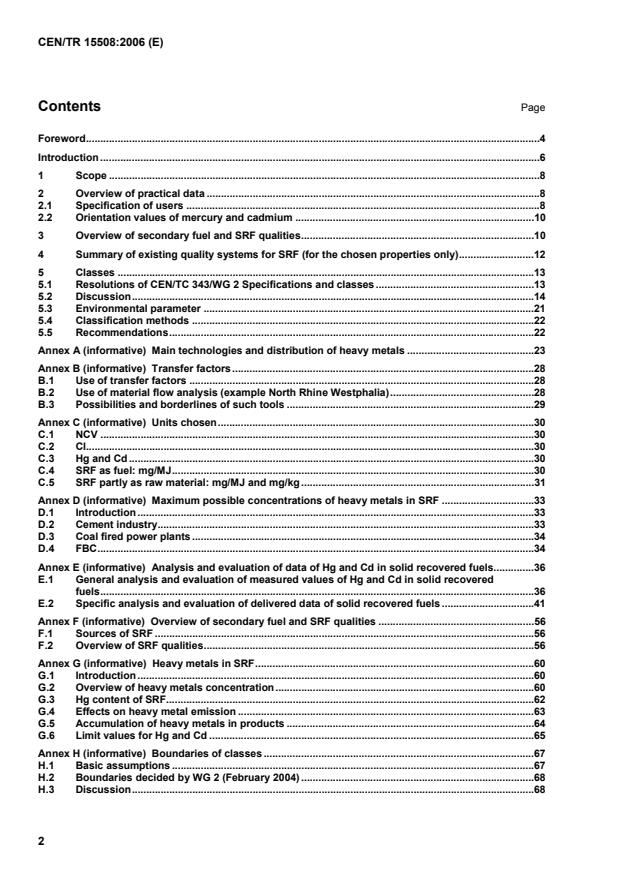
Contents Page
Foreword.4
Introduction .6
1 Scope .8
2 Overview of practical data .8
2.1 Specification of users .8
2.2 Orientation values of mercury and cadmium .10
3 Overview of secondary fuel and SRF qualities.10
4 Summary of existing quality systems for SRF (for the chosen properties only).12
5 Classes .13
5.1 Resolutions of CEN/TC 343/WG 2 Specifications and classes .13
5.2 Discussion.14
5.3 Environmental parameter .21
5.4 Classification methods .22
5.5 Recommendations.22
Annex A (informative) Main technologies and distribution of heavy metals .23
Annex B (informative) Transfer factors.28
B.1 Use of transfer factors .28
B.2 Use of material flow analysis (example North Rhine Westphalia).28
B.3 Possibilities and borderlines of such tools .29
Annex C (informative) Units chosen.30
C.1 NCV .30
C.2 Cl.30
C.3 Hg and Cd .30
C.4 SRF as fuel: mg/MJ.30
C.5 SRF partly as raw material: mg/MJ and mg/kg.31
Annex D (informative) Maximum possible concentrations of heavy metals in SRF .33
D.1 Introduction.33
D.2 Cement industry.33
D.3 Coal fired power plants .34
D.4 FBC.34
Annex E (informative) Analysis and evaluation of data of Hg and Cd in solid recovered fuels.36
E.1 General analysis and evaluation of measured values of Hg and Cd in solid recovered
fuels.36
E.2 Specific analysis and evaluation of delivered data of solid recovered fuels .41
Annex F (informative) Overview of secondary fuel and SRF qualities .56
F.1 Sources of SRF .56
F.2 Overview of SRF qualities.56
Annex G (informative) Heavy metals in SRF.60
G.1 Introduction.60
G.2 Overview of heavy metals concentration.60
G.3 Hg content of SRF.62
G.4 Effects on heavy metal emission .63
G.5 Accumulation of heavy metals in products .64
G.6 Limit values for Hg and Cd .65
Annex H (informative) Boundaries of classes .67
H.1 Basic assumptions .67
H.2 Boundaries decided by WG 2 (February 2004) .68
H.3 Discussion.68
Annex I (informative) Thallium in SRFs .72
Bibliography.73
Foreword
This document (CEN/TR 15508:2006) has been prepared by Technical Committee CEN/TC 343 “Solid
recovered fuels”, the secretariat of which is held by SFS.
This document has been drafted on request of CEN/TC 343 Working Group 2 “Fuel Specifications and
Classes”. The WG wanted to establish a classification system using practical data on Solid Recovered Fuel
(SRF) composition and use. Therefore some delegates involved in the production and use of SRF offered to
draft this document.
The WG decided on a classification system based on a limited number of properties. Originally the WG asked
for a document covering 7 key properties of SRF: NCV, moisture, ash, Cl, Hg, Cd + Tl and sum of heavy
metals. The first draft of the document was discussed at the WG meeting in Lyon on 15 and 16 September
2003. The properties of SRF and the experience with the different technologies were accounted for in the
proposed classification system. The emission limit values of the Waste Incineration Directive played a decisive
role in establishing the maximum possible content of heavy metals in SRF used as substitute fuel in different
technologies.
The WG decided at the meeting in Lyon to reduce the number of key properties from 7 to 3: NCV, Cl and Hg
content.
Topics were added covering the questions that had been raised at the Lyon meeting:
justification of units chosen (Annex C);
justification of the use of 50th/80th percentile values (Annex E);
evaluation of data and influence on boundaries of classes (Annex E);
justification of the boundaries of classes (Annex H).
The main adjustments were made in Clause 5. Annex E and Tables 18 and 20 of Clause 5 have been written
with support of Ms Sabine Flamme of INFA.
Concerning the questions raised at the Brussels meeting on 9 and 10 February 2004 and the meeting in
Obourg on 24 September 2004, the following modifications have been made:
the classification of Cd and Tl has been evaluated using practical data. A classification system for Cd has
been added if it comes to a need for that;
additional evaluation of proposed classes of Cl and NCV with practical data has been included.
In making acknowledgements, we would like to express appreciation to the members of CEN/TC 343/WG 2,
the members of ERFO and particularly to those companies for making available data and information from
their experience with the production and use of Solid Recovered Fuel.
Authors:
Joop van Tubergen, Essent Milieu,
Dr Thomas Glorius, Remondis (RWE Umwelt),
Eric Waeyenbergh, Scoribel
February 2005
Whilst every effort has been made to ensure the accuracy of information contained in this Technical Report,
neither the authors nor ERFO nor any of its members makes any warranty, expressed or implied, or assumes
any liability or responsibility for the accuracy, completeness or usefulness of any information, apparatus,
product or process disclosed, or represents that its use would not infringe privately-owned rights.
Introduction
Energy intensive industries are looking for alternative fuels in order to save primary fuels, and by doing so,
enforce the development of sustainable development.
The waste management sector industry has developed, for many years, ways to produce secondary fuels e.g.
SRFs with reliable qualities, which are used successfully regarding economic and environmental aspects.
However, this way of recovery is not optimized because of some practical uncertainties like:
obtaining permits to use SRF as an energy source;
transborder shipment regulation and problems in creating a European market for SRF;
unclear classification of the SRF in the EC waste list;
doubt about reliable qualities of some SRF;
doubt about effect on the processes and installations.
Therefore CEN has received the mandate to establish a set of standards for solid recovered fuel (SRF)
prepared from non hazardous waste. CEN/TC 343 has decided to separate the task in five different working
groups (WG 1 to 5).
WG 2 has received the task to prepare a proposition of classification system, classes and specifications.
The following Technical Report gives a technical approach based on the processes of final users that have
been identified as being (potentially) interested and qualified for the use of SRF on the one hand, and the
practical and actual experience of SRF produced in Europe on the other hand.
SRF may only be used by installations complying with the emission limit values set by the Waste Incineration
Directive (WID). This Technical Report is based on the characteristics that the SRF should present, in order to
fulfil the criteria of the WID and the technical request of the installations. That does not alter the fact that other
properties are also of interest considering the specific requirements for different users.
The classification system, the classes and the specifications that are proposed in this Technical Report should
help the authorities in writing the permits, be a help for the final user to understand easily what has to be taken
into account when dealing with SRF and should increase the positive perception of the public on the use of
SRF by saving of natural resources. For example about 50 % of the primary fuel consumption of cement kilns
and a substantial share of hard coal and lignite for power production could be substituted by waste. The
potential for European Solid Recovered Fuels in 2005 is estimated at more than 10 Mt/a [1], which
corresponds to a CO -reduction of more than 10 Million tpa. (In this figure only the biogenic fraction and C/H
ratio were considered. The reduction due to less emission of methane from landfills would be a factor ~3 of
this).
It is of importance to mention that the standardization concerns big SRF streams. It surely does not exclude
the possibility to use alternative fuels with other limits or specifications than those presented in this Technical
Report. In that case, the waste fuel will not be standardized.
Selection of properties for classes and specifications: a classification system is a system of classes with limit
values and valid for all kind of users. Specifications concern specific information related to potential risks for
different technologies and plants. Implementing such a system should facilitate trans-boundary shipments,
permitting and control for the user of standardized recovered fuels (SRF).
CEN/TC 343/WG 2 has agreed that key properties mentioned below will be used to establish the classification
and the specification system for SRF. These properties are significant for one or more of the following
aspects: economics (NCV), technology (Cl) and emission (Hg + Cd). Cl has to be mentioned because of the
great importance in corrosion, slagging and fouling of boilers. It has been suggested to consider both Cd and
Tl. However, the concentration of Tl in SRF is practically nil (see also Annex I), applying this element as part
of an environmental parameter would be meaningless.
Table 1 — Key combinations of properties and aspects
Properties Key aspect
NCV Economics
a
Cl Technology
Hg + Cd Emission
a
Cl may influence emissions of HCl and some heavy metals as chlorides. However,
the effect is estimated to be negligible. An influence on the formation of PCDD and PCDF
is unlikely under the process conditions in a coal fired power plant and a cement kiln.
1 Scope
This Technical Report gives background information on key properties to be used for establishing a
classification system for solid recovered fuels (SRFs), and a proposal for the classification system and classes
for SRF.
2 Overview of practical data
2.1 Specification of users
2.1.1 General
At present the main end-user is the cement industry. But also in lime kilns, SRF has successfully been used
for many years. As the technology of cement kilns and lime kilns is very similar in this Technical Report,
cement kiln also stands for lime kiln except for heavy metals. However, the market opportunities in the
potential bigger market of the power generation sector are increasing. The fourth sector that may become a
substantial outlet for SRF is cogeneration CHP (district heating) [1]. Main technologies involved are cement
kilns, pulverized coal fired power plants and FBC (fluidized bed combustion) plants. See also Annex A.
2.1.2 Cement industry
The cement industry has a broad experience in the use of waste derived fuels. Hazardous and non hazardous
wastes are processed and used as secondary fuel or a mixture of secondary fuel and raw material. Originally
the substitution of primary fuels was practised by wet processes, which have higher specific energy
consumption than the dominant dry process for the production of clinker. But the use of waste derived fuels,
including SRF, is also increasing in the dry process. Cl may cause substantial problems in the dry process in
blocking the pre-heater with condensed volatile chlorides. Using a so-called salt bypass increases the
tolerance for Cl in the input. Table 2 shows the requirements for SRF. Figures are based on specifications
from the end-users from e.g. Belgium, Germany and France.
Table 2 — Specifications [2]
Unit CK
a
NCV MJ/kg ar 5/10 to 12/22 (mean values)
b
Cl % ar 0,5 to 1,0 (mean)
1 to 3,0 (max.)
CK = cement kiln or clinker kiln
a
There is no maximum value for NCV. The combination of material and energy recovery
together in clinker kiln allows the use of poor calorific values, because the ash content in the
SRF does not contribute to the energy input.
b
Cl specification depends on the composition of the input. At high substitution rates, the
limits are in the range of 3 % for a cement kiln with a by-pass (depending on the K, Na
content) and for a kiln without this system 0,5 % to 1,0 %. For a cement kiln with a wet
process, the maximum for Cl is 6 %.
2.1.3 Coal fired power plants
The experience of the power generating plants with SRF is limited to a few plants in Germany and The
Netherlands that are using SRF since 2000 but still on a small scale. RWE Umwelt and RWE Power are
carrying out the demonstration project RECOFUEL within the 6th Framework programme of the EU to use
quality assured SRFs in lignite fired boilers.
Pulverized coal plants are dominant in the power generating sector. The technologies differ for brown coal and
hard coal, as these coals have widely divergent heating values and material properties. Hard coal fired power
plants using a dry bottom boiler (DBB) have less flexibility to the shape and dimensions of SRF than the wet
bottom boiler (WBB) molten slag systems with cyclones. Table 3 shows the requirements for SRF. The data
are based on specifications from end-users in The Netherlands and Germany.
Table 3 — Specifications [2]
Unit Hard coal Hard coal Brown coal
DBB WBB DBB
NCV MJ/kg ar 13,5 (mean) 17 (mean) 13,5 (mean)
11 to 18 (range) 13 to 22 (range) 11 to 18 (range)
a
Cl % dry 0,6 (mean) 1,1 (mean) 0,5 (mean)
b
1,3 (max.) 2,5 (max) 0,6 (max.)/1,0 (max.)
DBB = dry bottom boiler pulverized coal, dry ash
WBB = wet bottom boiler pulverized coal, molten slag
a
The Cl-concentration of the total fuel mix should be kept <0,2 % to 0,4% to prevent high temperature corrosion.
The maximum allowable Cl % depends on the design and materials chosen. In The Netherlands the maximum is
usually 0,2 %. In the UK the maximum is higher (0,4 %) as the plants are designed for coal with a high Cl content.
b
The maximum values vary for different companies. Mean and max.-values are close for a specific end-user.
2.1.4 FBC
Fluidized bed combustion plants (FBC) are used i.e. for district heating in Scandinavia and cogeneration
(CHP) using mainly biofuels. Table 4 shows the requirements for SRF. The data are based on specifications
of the end-users in Sweden, Italy and Germany.
Table 4 — Specifications [2]
Unit FBC
CV MJ/kg ar 13,5 (mean)
9 to 18 (range)
a
Cl % ar 0,4 (mean)
0,5 (max.)/0,8 (max.)/1,4 (max.)
a
The maximum allowable Cl-content depends on the design of the plant and composition of the input. The
mean and max values are close for a specific end-user.
2.1.5 Overview
Table 5 — Overview of specifications (end-users)
Unit Cement Hard Brown coal
coal
WBB DBB FBC FBC(AC)
a
DBB
NCV MJ/kg ar 5/11/22 13,5/18 17/22 13,5/18 13,5/18 13,5/18
mean/max. (mean)
Cl % ar mean/max. 0,5 to 1,0/3 0,5/1,0 1,0/2,0 0,4/0,5 to 0,7 0,4/1,4 0,4/1,4
a
AC: active coal used as absorbent.
2.2 Orientation values of mercury and cadmium
The emission of heavy metals is an important topic in the market development of SRF although concerning
the WID the heavy metal emissions by co-combustion plants are not considered any longer separately for
heavy metals originating from SRF at one hand and at the other hand primary fuels, because the mixing rule
has been deleted for these properties. The values derived in Annex D only have an orientation character. The
fuel mix, the raw material and the specific transfer factor of the plant involved together determine the actual
emissions. Specifications provided by potential producers and users are often influenced by local limit values.
This would not be a sound basis for a European classification system. But using the practical data on the
transfer factors (see Annex B for background information) and the values of the WID for the several
technologies the maximum concentration in the SRF may be calculated according to the equation mentioned
in Annex C.
Table 6 — Overview of calculated orientation values of Hg and Cd
Unit Cement Hard coal power plants Brown coal
power plants
a
FBC(AC)
DBB WBB FBC
DBB
Hg mg/MJ ar max. 0,08-0,33 0,065 0,034 0,085 0,028 0,26
Cd 6,90 1,21 0,25 0,42 0,63 85
a
AC: active coal used as absorbent.
The values for Hg and Cd have to be understood as maximum average (see also E.1.3) that can be used in a
process operation that comply with the transfer factor taken in the example above for the use of waste as a
fuel. It is of importance that each plant that wants to use secondary fuel first makes a study to determine what
are the transfer factors for each metal. The result shows significant differences between the processes and
technologies used. It means that some technologies are not able to use the same fuels as others due to
different transfer factors.
3 Overview of secondary fuel and SRF qualities
Tables 7 to 10 give an overview of the composition of secondary fuels. The data are based on analysis of
fuels produced in several EU Member States. See also Annex F.
SRFs derived from MSW have generally a lower NCV than the SRFs derived from selected commercial waste,
which have a range that corresponds to the NCV of a mixture of biomass and plastics. The maximum of Hg for
SRF derived from MSW is higher. However, the maximum for Hg is not substantially higher than for SRF
derived from commercial waste when Tunka is excluded. The SRFs produced for cement kilns show a great
range for all properties, indicating the flexibility of the cement kilns.
Secondary fuels may also contribute to the substitution of raw materials. This is often the case with secondary
fuels used by cement kilns. Therefore two SFR categories are presented, one low in ash and one high in ash.
The NCV value is low for the SRF types with a high ash content. This has a direct effect on the values for Hg
using the unit mg/MJ as can be seen in Table 7.
Table 7 — Overview of SRF with low and high ash content
a a
SRF low in ash SRF high in ash
th th
Unit Median range 80 Percentile Median range 80 Percentile
range range
NCV MJ/kg ar 11,7 to 25,5 12,8 to 25,8 3,2 to 10 3,4 to 12,0
Cl % ar 0,04 to 1,7 0,07 to 2,0 0,07 to 0,77 0,14 to 0,82
Hg mg/MJ ar 0,004 to 0,042 0,005 to 0,137 < 0,05 to 0,406 0,064 to 0,781
Cd + Tl mg/MJ ar 0,008 to 0,121 0,008 to 0,264 0,26 to <0,93 0,26 to 0,94
a
Boundary 20 % d. See also Annex G for the maximum values of heavy metals.
Table 8 — Overview of SRF derived from MSW
Unit Median range 80th Percentile range
NCV MJ/kg ar 9,8 to 19,9 11,4 to 22,2
Cl % ar 0,23 to 0,79 0,43 to 0,88
Hg mg/MJ ar 0,006 to 0,069 0,009 to 0,079
Cd + Tl mg/MJ ar 0,050 to 0,311 0,084 to 0,380
Table 9 — Overview of SRF derived from commercial waste
th
Unit Median range 80 Percentile range
NCV MJ/kg ar 13,0 to 31,0 14,0 to 31,6
Cl % ar 0,04 to 0,60 0,07 to 1,0
Hg mg/MJ ar 0,004 to 0,019 0,005 to 0,064
Cd + Tl mg/MJ ar 0,008 to 0,060 0,008 to 0,129
Table 10 — Overview of SRF produced for cement kilns
th
Unit Median range 80 Percentile range
NCV MJ/kg ar 3,2 to 25,5 3,4 to 25,8
Cl % ar 0,07 to 1,7 0,14 to 2,0
Hg mg/MJ ar <0,02 to 0,406 <0,02 to 0,781
Cd + Tl mg/MJ ar <0,12 to <0,93 <0,12 to 0,94
4 Summary of existing quality systems for SRF (for the chosen properties only)
Table 11 — Summary of existing national standards
Finland Germany Italy
th
Unit Class I Class II Class III median 80 Units standard High
percentile qual,
NCV MJ/kg ar >15 >19
Moisture % ar <25 <15
Ash % d <20 <15
Cl % d <0,15 <0,5 <1,5 % ar <0,9 <0,7
c
Hg mg/kg d <0,1 <0,2 <0,5 0,6 1,2 mg/kg d <7 <1
Cd + Tl mg/kg d <1,0 <4,0 <5,0 5 11 - <4
a b a
Sum HM mg/kg d 351 /1 049 1 080 /2 460 mg/kg d <1 040 <350
b
NOTE 1 Finland: Tl is not mentioned. NCV is not mentioned either. Use 20 MJ/kg d for the calculations and 15 % moisture.
a b th
NOTE 2 Germany: SRF produced from specific wastes, SRF produced from MSW. Actually, there exists no 80 percentile
value for Cu (SRF from production specific waste, class 1) and Pb + Cu (SRF from HCF of MSW, class 2). According to the
latest information received, these values will probably be 500 (Cu), 500 (Pb) and 1 000 (Cu) respectively.
The NCV values for heavy metals are up to 16 MJ/kg d. for class 2 derived fuels and 20 MJ/kg d. for class 1. Use 15 MJ/kg ar
and 15 % moisture for calculations for class 2 and 20 MJ/kg ar and 15 % moisture for class 1.
NOTE 3 Italy: The HM Sb, Co and V are not mentioned. The NCV is a minimum value. Value for Cu concerns soluble
components. Value for Pb concerns the volatile part. Use the minimum NCV (calculated for d) for the calculations. The value
c
for the standard quality in the table for the concentration of Hg is the sum of Cd + Hg.
NOTE 4 Preceding the implementation of national standards producers of SRF have developed their own quality systems [1].
Table 12 — Summary of existing standards, adapted and presented in uniform units
a
Finland Germany Italy
th
Unit Class I Class II Class Median 80 percentile standard High
III qual,
NCV MJ/kg >15 >19
Moisture ar <25 <15
Ash % <15 <13
Cl % ar <0,13 <0,42 <1,3 <0,9 <0,7
b
Hg mg/MJ ar <0,005 <0,01 <0,025 <0,026/0,034 <0,051/0,068 <0,35 <0,045
Cd + Tl mg/MJ ar <0,05 <0,2 <0,2 <0,17/0,23 <0,38/0,51 - <0,180
c c
Sum HM mg/MJ ar <14,9/59,4 <45,9/139,4 <52 <15,6
a
Different values for SRF derived from production specific waste (first figure) and SRF produced from MSW (second
figure).
b
Cd + Hg. There is no separate value for this quality in the Italian standard, see also Note 3 of Table 11.
c
The sum property does not include several HM, see also Note 3 of Table 11.
5 Classes
5.1 Resolutions of CEN/TC 343/WG 2 Specifications and classes
The WG defined classification as: “The grouping of SRF’s into classes defined by boundary values for chosen
fuel characteristics, to be used for trading as well as for information of permitting authorities and other
interested parties”. Initially the WG adopted in the 1st resolution 7 properties for the characterisation of SRF:
NCV, ash, moisture, Cl, Hg, Cd + Tl, sum of heavy metals. These properties were used in earlier drafts of this
classification report. However, in resolution 3 the number of key-properties was reduced from 7 to 3
(Table 13). The main argument being the complexity of the classification with so many. The properties chosen
represent the following aspects: economic value (NCV), technological restrictions (Cl) and environmental
impact (Hg).
After long discussion the WG adopted in its 3rd resolution the following structure for the characteristics of SRF
classes for each of the three selected fuel characteristics.
Table 13 — SRF classes
Classification Desig- Unit Classes
property nation 1 2 3 4 5
Net calorific value NCV MJ/kg ar <10 <15 <20 <25 >25
Classification 1 2 3 4 5
property
Chlorine Cl % d <0,3 <0,6 <0,9 < 3,0 >3,0
Classification 1 2 3 - -
property
Mercury Hg mg/kg
At the meeting in Brussels on 9 and 10 February 2004 the WG decided that closed classes shall be used
without overlapping between the classes. Lower limits of Cl and NCV as well as upper limits of Cl are still to
be discussed by the full WG 2. A proposal of the WG for new classification values to draft a TS on
Specifications and Classes was presented to CEN/TC 343 at the meeting on 11 February 2004 (Table 14).
Table 14 — SRF classes
Classification Desig- Unit Classes
property nation
1 2 3 4 5
Net calorific qp,net MJ/kg ar
25< x≤45 20
value (NCV)
mean
Classification 1 2 3 4 5
property
Chlorine Cl % ar
y≤0,1 0,1
median
Classification 1 2 3 4 5
property
Mercury Hg mg/MJ ar
median <0,02 <0,03 <0,08 <0,15 <0,5
80th <0,04 <0,06 <0,16 <0,30 <1,0
percentile
DG Environment raised doubts concerning the exclusion of cadmium and thallium as a property in the
classification system. The WG decided that the occurrence of these elements in SRF would be investigated
and evaluated. A proposal for an environmental property which may also include Cd and Tl, besides Hg, was
required to be elaborated in a new draft of the classification document.
5.2 Discussion
5.2.1 Units
For NCV and Cl the usual units are preferred for the classification. In Annex C it has been concluded that the
preferred unit for NCV is MJ/kg ar. In practice for Cl the unit maybe wt% ar or d. The unit wt% d has finally
been chosen for practical reasons as data are usually available on dry basis. However, for Hg the unit mg/MJ
over the usual mg/kg d is chosen with respect to comparability and environmental aspects.
th
5.2.2 Use of mean, median and 80 percentile
The statistical distribution of the data for NCV, Cl and Hg differs.
For NCV the distribution is normal. In this case the use of the mean value is appropriate (see also Annex H).
For Cl the distribution is usually normal but may be also skewed (see also Annex H). In the calculations for the
classification a normal distribution has been assumed. Therefore the unit for Cl in Table 14 is % d mean
instead of % median.
In most of the cases Hg has a right skewed distribution (see Annex E). This has consequences for the
determination of average and maximum values. The median is preferred as measure of location because of its
robustness and being independent from the type of distribution. For those cases where a maximum value is
th th
required the 80 percentile is preferred. The combination of median and 80 percentile is an appropriate tool
for the evaluation of sets of 10 data used in the classification. Then high values are only possible as single
outliers, which are not relevant in the calculation of the emission.
5.2.3 Overlap of classes
The WG prefers closed classes without overlapping ranges between the classes. In those cases with only a
given maximum value of a class (Hg), classification in a single class will be possible. However, having a given
minimum and a maximum of a class (as has been proposed for NCV and Cl), there are SRFs who's
classification will vary (see Annex H). In line with the approach used with Hg sets of 10 data were used for the
classification of NCV and Cl. The 95 % confidence interval of the mean value of sets of 10 data was
calculated. For the classification the minimum value (NCV) or the maximum value (Cl) of the confidence
intervals (ranges) has been used.
5.2.4 Boundaries of classes for NCV
The boundaries were set based on the properties of the SRFs and the requirements of the users. For many
purposes the NCV should be between 10 MJ/kg to 15 MJ/kg. There are also clusters at about 5 on the one
hand and 22 MJ/kg on the other hand. A class width for NCV of 5 MJ/kg was decided by the WG. Class 5 has
a minimum at 3 MJ/kg ar, which refers to calculations based on adiabatic flame temperature and experience in
cement kilns using SRF with a high ash and high water content (see also Annex H). A maximum is set at
45 MJ/kg ar being the realistic maximum for SRFs. Taking into account the proposal of using the minimum
values for the classification (5.2.3) the classes will be as shown in Table 15.
5.2.5 Boundaries of classes for Cl
The values for Cl relate to the properties of the SRFs and the requirements of the users as well. For many
purposes the Cl content should be below 0,5 % or between 0,5 % and 1,0 %. Boilers can accept up to 0,3 %
without restrictions. The WG decided in Brussels on a maximum at 6 % ar. In practice the maximum value for
SRF found so far is for AT3 3,65 % d (mean + 1,96 x st dev). A maximum of (about) 3 % d seems more
appropriate to distinguish SRF from other waste derived fuels. The maximum of class 1 as mentioned in the
Brussels resolution seems too low to be practicable for reliable classification with only a few SRFs classified
as such. A maximum of 0,2 % would guarantee more stable classification. The same applies for the maximum
of class 2 where a maximum value of 0,6 % has been set. Taking into account maximum values for the
classification (5.2.3) the proposed classes will be as shown in Table 15.
a
Table 15 — Proposed classes for NCV and Cl content
Classification Designation Unit Classes
property
1 2 3 4 5
Net calorific qp,net MJ/kg ar
x≥25 x≥20 x≥15 x≥10 x≥3
value (NCV)
mean
Classification 1 2 3 4 5
property
Chlorine Cl % d
y≤0,2 y≤0,6 y≤1,0 y≤1,5 y≤3,0
mean
a
Based on sets of 10 data.
An overview of the classification of the SRFs mentioned in Annex H is shown in Table 16.
a
Table 16 — SRF classification for NCV and Cl
SRF NCV Cl
designation
Class 1 Class 2 Class 3 Class 4 Class 5 Class 1 Class 2 Class 3 Class 4 Class 5
AT 1 1 1
AT 2 1 1
AT 3 1 n.d.
AT 4 1 1
B 1 1 1
B 2 1 1
B 3 1 1
B 5 n.d. 1
B 6 1 1
B 7 1 1
B 8 1 1
FIN 1 1 1
GE 1 1 1
GE 2 1 1
GE 3 1 1
GE 6 1
IT 1 1 1
IT 3 1 1
N 1 1 1
N 2 1 1
N 3 1 1
NL 1 1 1
NL 2 1 1
NL 3 1 1
NL 4 1 1
SE 1 1 1
SE 2 1 1
SE 3 1 1
SE 4 1 1
Sum 2 2 4 15 4 3 9 9 5 2
a
Based on sets of 10 data and given minimum for NCV- and given maximum for Cl-values of the classes.
n.d.: class cannot be determined as values are out of range of the classification.
5.2.6 Boundaries of classes for Hg
The technology of the main users of SRF has been investigated with respect to the relationship between input
and output of heavy metals. The developed transfer factors could be used for the calculation of maximum
possible concentrations. The limit values of the Waste Incineration Directive comprised the basis for these
calculations. Maxima of Hg varied from 0,028 mg/MJ for FBC till 0,33 mg/MJ for cement kilns on the
assumption of 100 % input of SRF.
However, these maxima may form an obstacle for the usage of e.g. fuels made of sewage sludge and filter
cakes in cement kilns.
In practice the fuel mix predominates and not the maximum allowable concentration in one of the components
in accordance with the requirements of the WID. The maximum limit for the concentration of Hg in SRF is
related to the maximum allowable value for blending wastes (5 mg/kg d and ar to 10 mg/kg d and ar) and the
th
minimum NCV in practice, which gives a rounded down value of 1 mg/MJ for the 80 percentile (see also
Annex H).
th
In practice for rather homogeneous SRFs the median values happen to be about 50 % of the 80 percentile
values of SRF. This fact has been used in the classification.
The boundaries of the classes were chosen taking into account the properties of the SRFs on the one hand
and the requirements of the users on the other hand. This leads to 5 classes for Hg shown in Table 17. The
highest class is reserved for SRF derived from e.g. sewage sludges and filter cakes (see also Annex H).
a
Table 17 — Proposed classes for Hg
Classification Desig- Unit Classes
b
property nation
1 2 3 4 5
Mercury Hg mg/MJ ar
median
≤0,02 ≤0,03 ≤0,08 ≤0,15 ≤0,50
th
80 percentile
≤0,04 ≤0,06 ≤0,16 ≤0,30 ≤1,00
a
Values refer to a minimum of 10 analyses.
b
For SRF with high ash content and therefore a higher raw material substitution in the clinker production, with a
maximum of 10 mg/kg ar.
An overview of the classification of SRFs is shown in Table 18. There are two methods which can be used for
classification: when more than 10 assays are available the so called 50 % rule can be applied. In this case the
th
median and 80 percentile values of the assays have to meet 50 % of the class boundaries. When more than
40 assays are available the random generator (see also E.1.5) may be used, which takes at random sets of
10 assays from the dataset. If the share of passed datasets is > 95 % for a class the SRF complies with that
class. It turns out that the results obtained with the random generator are tending to lower classes or the same
as those obtained using the 50 % rule, which seems to result in a more conservative approach (marked italics).
There is only one exception AT 2, which maybe due to extreme variations in the mixture of the input consisting
of MSW fractions and sludge.
Table 18 shows that in about a third of the results the classes obtained with the random generator are higher
th
than those when the median and 80 percentile of the complete data set were taken (column dataset). The
use of only 10 assays for Hg causes strict classification because a producer of SRF who wants to be certain in
meeting the class boundaries will at the utmost “use” 50 % of the class maximum (see also Figure E.5 of
Annex E). Table 18 also shows that both methods of classification are resulting in more conservative results
compared to the complete data set (50 % rule > random generator > complete data set).
Table 18 — SRFs classified based on Hg content, influence of data collective and type of classification
method on classification results
Designation 50 % rule 50 % rule Random Complete
generator dataset
th
median/80
th th
percentile median/80 median/80
th
median × 0,5 80 percentile × 0,5
percentile percentile
results Hg>95 %
AT 2 3 3 3 5 3
AT 3 4 3 4 3 3
B 1 3 3 3 3 3
B 2 3 3 3 3 3
B 3 4 3 4 3
B 4 5 4 5 4
B 5 5 5 5 5 5
B 6 4 3 4 4 3
B 7 4 3 4 3
B 8 3 1 3 1
FIN 1 1 1 1 1
GE 1 1 1 1 1 1
GE 2 2 2 2 2 1
GE 3 3 3 3 3 2
GE 4 4 4 4 3 3
GE 5 5 5 5 4 4
GE 6 1 1 1 1 1
IT 1 3 3 3 1
IT 2 2 2 2 1
IT 3 3 3 3 2
N 1 1 1 1 1
N 2 1 1 1 1
N 3 3 3 3 2
NL 1 1 1 1 1
NL 2 2 2 2 1
3 2
NL 3 3 2 1
NL 4 5 4 5 4 4
NL 5 4 3 4 3
SE 1 1 1 1 1
SE 2 1 1 1 1 1
SE 3 2 1 2 1
SE 4 1 1 1 1 1
Italics, shaded: conservative classification compared to random generator.
Bold: conservative classification compared to complete data set.
5.2.7 Boundaries of classes for Cd
Analogous to the procedure used with Hg the technology of the main users of SRF has been investigated on
the relationship between input and output of heavy metals. The developed transfer factors could be used for
the calculation of maximum possible concentrations. The limit values of the Waste Incineration Directive
th
constituted the basis for these calculations. Maxima based on 80 percentile values of Cd + Tl varied from
0,25 mg/MJ for WBB till 85 mg/MJ for FBC with active coal flue gas cleaning equipment on the assumption of
100 % input of SRF. The contribution of Tl is negligible and has not be taken into account, see Annex I.
The calculated maximum for cement kilns is 6,9 mg/MJ. This maximum may form an obstacle for the usage of
e.g. fuels made of some sewage sludges and filter cakes in cement kilns, which is common practice.
In practice the fuel mix predominates and not the maximimum allowable concentration in one of the
components in accordance with the requirements of the WID. Also analogous to Hg the maximum limit in
class 5 for the concentration of Cd in SRF is related to the maximum allowable value for blending wastes and
th
the minimum NCV in practice, which gives a rounded down value of 30 mg/MJ for the 80 percentile, see also
Annex H.
th
The median values happen to be about 50 % of the 80 percentile values for the more homogeneous SRFs.
This fact has been used in the classification.
The boundaries of the classes were chosen taking into account the properties of the SRFs on the one hand
and the requirements/the technical possibilities of the users on the other hand. This leads to 5 classes for Cd
shown in Table 19. The highest class is reserved for SRF derived from e.g. sewage sludges and filter cakes
(see also Annex H).
Table 19 — Proposed classes for Cd
a
Classification Desig- Unit Classes
b
property nation
1 2 3 4 5
Cadmium Cd mg/MJ ar
median
≤0,1 ≤0,30 ≤1,0 ≤5,0 ≤15
th
80 percentile
≤0,2 ≤0,60 ≤2,0 ≤10 ≤30
a
Values refer to a minimum of 10 analyses.
b
For SRF with high ash content and therefore a higher raw material substitution in the clinker production with a
maximum of 100 mg/kg ar.
The values used to classify should rely on at least 10 consecutive data for practical reasons (including
statistical significance). The number is a minimum for statistics and this number of data can be collected in a
reasonable time.
Table 20 shows the results of the classification using the random generator and the 50 % rule. This rule turns
out to be applicable for
...