

EN 13158:2009
(Main)Protective clothing - Protective jackets, body and shoulder protectors for equestrian use: For horse riders and those working with horses, and for horse drivers - Requirements and test methods
- Abstract
This Standard specifies the requirements and test methods for the coverage, sizing, adaptability and adjustability, restraint, ergonomics, construction, innocuousness, and performance under impact to be provided by protective jackets, body and shoulder protectors to be worn by children, youths and adults of either sex while riding horses, working with horses, driving horses or being a passenger in a horse driven vehicle. Such protectors are intended to provide some protection against impacts due to falls from horses and vehicles, and impacts while on the ground due to a fall, or while working with a horse. Impacts may be against the ground or objects such as trees or vehicles, or impacts may be due to kicks, being trodden on or being crushed by a horse. The protectors covered by this Standard are not intended to provide complete protection against injuries in accidents involving severe torsion, flexion, extension or crushing of the body. Requirements for marking and the provision of information are given.
- Status
- Withdrawn
- Publication Date
- 03-Mar-2009
- Withdrawal Date
- 06-Oct-2026
- Technical Committee
- CEN/TC 162 - Protective clothing including hand and arm protection and lifejackets
- Drafting Committee
- CEN/TC 162/WG 11 - Body protection for sports
- Current Stage
- 9960 - Withdrawal effective - Withdrawal
- Start Date
- 21-Feb-2018
- Completion Date
- 07-Oct-2026
- Directive
- 2016/425 - Regulation (EU) 2016/425 of the European Parliament and of the Council of 9 March 2016 on personal protective equipment and repealing Council Directive 89/686/EECOJ Ref: C, C 113 OJ Date: 27-Mar-2018
89/686/EEC - Personal protective equipment (PPE)OJ Ref: C, C 205 OJ Date: 09-Jul-2011

Relations
- Effective Date
- 11-Mar-2009
- Effective Date
- 28-Feb-2018
- Effective Date
- 28-Jan-2026
Get Certified
Connect with accredited certification bodies for this standard

CIS Institut d.o.o.
Personal Protective Equipment (PPE) certification body. Notified Body NB-2890 for EU Regulation 2016/425 PPE.

Kiwa BDA Testing
Building and construction product certification.
Kmetijski inštitut Slovenije
Agricultural Institute of Slovenia. Soil testing, plant health, agricultural product analysis.
Sponsored listings
Frequently Asked Questions
EN 13158:2009 is a standard published by the European Committee for Standardization (CEN). Its full title is "Protective clothing - Protective jackets, body and shoulder protectors for equestrian use: For horse riders and those working with horses, and for horse drivers - Requirements and test methods". This standard covers: This Standard specifies the requirements and test methods for the coverage, sizing, adaptability and adjustability, restraint, ergonomics, construction, innocuousness, and performance under impact to be provided by protective jackets, body and shoulder protectors to be worn by children, youths and adults of either sex while riding horses, working with horses, driving horses or being a passenger in a horse driven vehicle. Such protectors are intended to provide some protection against impacts due to falls from horses and vehicles, and impacts while on the ground due to a fall, or while working with a horse. Impacts may be against the ground or objects such as trees or vehicles, or impacts may be due to kicks, being trodden on or being crushed by a horse. The protectors covered by this Standard are not intended to provide complete protection against injuries in accidents involving severe torsion, flexion, extension or crushing of the body. Requirements for marking and the provision of information are given.
This Standard specifies the requirements and test methods for the coverage, sizing, adaptability and adjustability, restraint, ergonomics, construction, innocuousness, and performance under impact to be provided by protective jackets, body and shoulder protectors to be worn by children, youths and adults of either sex while riding horses, working with horses, driving horses or being a passenger in a horse driven vehicle. Such protectors are intended to provide some protection against impacts due to falls from horses and vehicles, and impacts while on the ground due to a fall, or while working with a horse. Impacts may be against the ground or objects such as trees or vehicles, or impacts may be due to kicks, being trodden on or being crushed by a horse. The protectors covered by this Standard are not intended to provide complete protection against injuries in accidents involving severe torsion, flexion, extension or crushing of the body. Requirements for marking and the provision of information are given.
EN 13158:2009 is classified under the following ICS (International Classification for Standards) categories: 13.340.10 - Protective clothing. The ICS classification helps identify the subject area and facilitates finding related standards.
EN 13158:2009 has the following relationships with other standards: It is inter standard links to EN 13158:2000, EN 13158:2018, EN ISO 13688:2013. Understanding these relationships helps ensure you are using the most current and applicable version of the standard.
EN 13158:2009 is associated with the following European legislation: EU Directives/Regulations: 2016/425, 89/686/EEC; Standardization Mandates: M/031. When a standard is cited in the Official Journal of the European Union, products manufactured in conformity with it benefit from a presumption of conformity with the essential requirements of the corresponding EU directive or regulation.
EN 13158:2009 is available in PDF format for immediate download after purchase. The document can be added to your cart and obtained through the secure checkout process. Digital delivery ensures instant access to the complete standard document.
Standards Content (Sample)
2003-01.Slovenski inštitut za standardizacijo. Razmnoževanje celote ali delov tega standarda ni dovoljeno.Schutzkleidung - Schutzjacken, Körper- und Schulterschützer für den Reitsport: Für Reiter, Personen, die mit Pferden arbeiten und für Gespannfahrer - Anforderungen und PrüfverfahrenVetements de protection - Vestes, gilets de protection et protege-épaules pour activités équestres destinés aux cavaliers et personnes travaillant avec des chevaux ainsi qu'aux conducteurs d'attelage - Exigences et méthodes d'essaiProtective clothing - Protective jackets, body and shoulder protectors for equestrian use: For horse riders and those working with horses, and for horse drivers - Requirements and test methods97.220.40Oprema za športe na prostem in vodne športeOutdoor and water sports equipment13.340.10Varovalna oblekaProtective clothingICS:Ta slovenski standard je istoveten z:EN 13158:2009SIST EN 13158:2009en,fr,de01-julij-2009SIST EN 13158:2009SLOVENSKI
STANDARDSIST EN 13158:20001DGRPHãþD
EUROPEAN STANDARDNORME EUROPÉENNEEUROPÄISCHE NORMEN 13158March 2009ICS 13.340.10Supersedes EN 13158:2000
English VersionProtective clothing - Protective jackets, body and shoulderprotectors for equestrian use: For horse riders and thoseworking with horses, and for horse drivers - Requirements andtest methodsVêtements de protection - Vestes, gilets de protection etprotège-épaules pour sports équestres: Pour cavaliers,pour personnes travaillant avec des chevaux et pourmeneurs d'attelage - Exigences et méthodes d'essaiSchutzkleidung - Schutzjacken, Körper- undSchulterschützer für den Reitsport: Für Reiter, Personen,die mit Pferden arbeiten und für Gespannfahrer -Anforderungen und PrüfverfahrenThis European Standard was approved by CEN on 10 January 2009.CEN members are bound to comply with the CEN/CENELEC Internal Regulations which stipulate the conditions for giving this EuropeanStandard the status of a national standard without any alteration. Up-to-date lists and bibliographical references concerning such nationalstandards may be obtained on application to the CEN Management Centre or to any CEN member.This European Standard exists in three official versions (English, French, German). A version in any other language made by translationunder the responsibility of a CEN member into its own language and notified to the CEN Management Centre has the same status as theofficial versions.CEN members are the national standards bodies of Austria, Belgium, Bulgaria, Cyprus, Czech Republic, Denmark, Estonia, Finland,France, Germany, Greece, Hungary, Iceland, Ireland, Italy, Latvia, Lithuania, Luxembourg, Malta, Netherlands, Norway, Poland, Portugal,Romania, Slovakia, Slovenia, Spain, Sweden, Switzerland and United Kingdom.EUROPEAN COMMITTEE FOR STANDARDIZATIONCOMITÉ EUROPÉEN DE NORMALISATIONEUROPÄISCHES KOMITEE FÜR NORMUNGManagement Centre:
Avenue Marnix 17,
B-1000 Brussels© 2009 CENAll rights of exploitation in any form and by any means reservedworldwide for CEN national Members.Ref. No. EN 13158:2009: ESIST EN 13158:2009
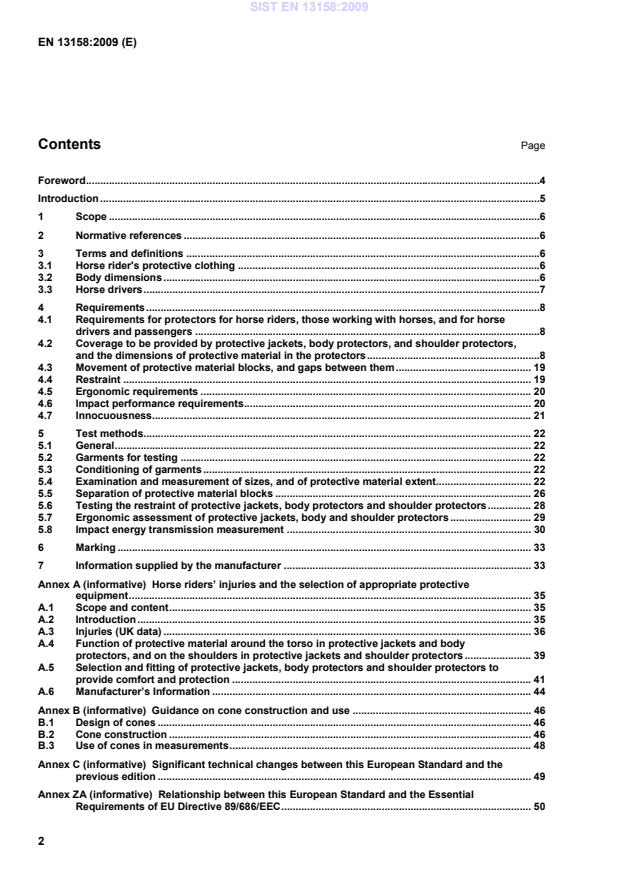
Horse riders’ injuries and the selection of appropriate protective equipment . 35 A.1 Scope and content . 35 A.2 Introduction . 35 A.3 Injuries (UK data) . 36 A.4 Function of protective material around the torso in protective jackets and body protectors, and on the shoulders in protective jackets and shoulder protectors . 39 A.5 Selection and fitting of protective jackets, body protectors and shoulder protectors to provide comfort and protection . 41 A.6 Manufacturer’s Information . 44 Annex B (informative)
Guidance on cone construction and use . 46 B.1 Design of cones . 46 B.2 Cone construction . 46 B.3 Use of cones in measurements . 48 Annex C (informative)
Significant technical changes between this European Standard and the previous edition . 49 Annex ZA (informative)
Relationship between this European Standard and the Essential Requirements of EU Directive 89/686/EEC . 50 SIST EN 13158:2009
Tables Table 1 — Requirements for dimensions of protective material in protective jackets and body protectors . 12 Table 2 — Maximum distance that 50 % thickness material shall extend from the top of the shoulder line . 14 Table 3 — Impact energy for testing to performance levels 1, 2 and 3 . 21 Table A.1 — Injuries to 1 000 hospitalised patients . 37 Table A.2 — Injury distribution comparing jockeys and lads . 39 Table A.3 — Maximum coverage . 42 Table A.4 — Size ranges . 44 Table B.1 — Base, middle and upper cone board dimensions. 47 Table ZA — Correspondence between this
European
Standard and Directive 89/686/EEC . 50
Key 1 front view 2 back view 3 the seventh cervical vertebra 4 level of the top of the iliac crests l1 minimum length of protective material below the ribcage (25 mm for a protector for a user with an over-the-shoulder length of 1 000 mm) l2 maximum distance between the lower edge of protective material and the iliac crest at the side of the body (30 mm for a protector for a user with an over-the-shoulder length of 1 000 mm) l3 minimum length of protective material below the level of the iliac crests at the points the lines E and EI (see 4.2.3) intercept the bottom edge of the protective material (50 mm for a protector for a user with an over-the-shoulder length of 1 000 mm) Figure 1 — Coverage to be provided by a horse rider's body protector 4.2.2.2 Protectors for horse drivers and passengers When correctly worn, a protective jacket, or a body protector for horse drivers and passengers shall cover the following area of the body. The numerical dimensions are for a user with an over-the-shoulder length of 1 000 mm and shall be scaled pro rata for users with different over-the-shoulder lengths. a) The whole circumference of the torso. SIST EN 13158:2009
NOTE 1 The positions for measurement of the control dimensions A, B and C stated by the manufacturer and used in sizing the protective clothing. a) Body dimensions
NOTE 2 The positions for measuring the dimensions of protective material in body protectors and the torso regions of protective jackets. AI , BI and L are measured on the inside of the protective clothing. D to K, M and N are measured on the outside of the protective clothing. b) Diagram of the protective material in a protective jacket or body protector Figure 2 — Body dimensions and dimensions of protective material in the torso region of protective jackets and body protectors SIST EN 13158:2009
Table 1 — Requirements for dimensions of protective material in protective jackets and body protectors Dimension Control dimension Requirement, as a percentage of the control dimension Protectors for horse riders and those working with horses Protectors for horse drivers and passengers AImax Amax > 103 > 103 AImin Amin < 107 < 107 BImax Bmax > 102 > 102 BImin Bmin < 110 < 110 D Cmax > 43 > 43 E Cmax > 57 > 48 F Cmax > 52 > 43 G Cmax > 15 > 15 H Cmax > 28 > 28 I Amax > 27 > 27 J Amax > 20 > 20 K Amax > 20 No requirement L Amax < 74 < 74 M Cmax 50 No requirement N Amax > 4 > 4 Key to the dimensions Amax is the chest girth or bust girth given by the manufacturer for the largest user. Amin is the chest girth or bust girth given by the manufacturer for the smallest user. Bmax is the waist girth given by the manufacturer for the largest user. Bmin is the waist girth given by the manufacturer for the smallest user. Cmax is the over-the-shoulder length given by the manufacturer for the largest user. Cmin is the over-the-shoulder length given by the manufacturer for the smallest user. AImax is the maximum internal girth of the garment below the armholes. AImin is the minimum internal girth of the garment below the armholes. BImax is the maximum internal girth of the garment at the lower edge of the protective
material. BImin is the minimum internal girth of the garment at the lower edge of the protective
material. D and DI are vertical lines on the chest separated by a distance of 25 % of A. E and EI are vertical lines on the back separated by a distance of 25 % of A. F is the centre back length. G is the height of the side below the armhole. SIST EN 13158:2009
the armhole opening. J is the width across the chest between the armholes measured at a level half-way down
the armhole opening. K is the width of the back at a distance equal to 50 % of dimension C max from the neck
inlet. L is the circumference of the armhole. M is the distance below the centre of the back of the neck of the garment at which dimension K is measured. (M = 0,5 Cmax). N is the smallest width of the shoulder strap.
4.2.4 Exceptions to the requirements in 4.2.3 The exceptions listed in (a) to (e) below are permitted. Examination and measurement of the exceptions shall be carried out according to 5.4. The areas and dimensions relate to a protective jacket or body protector to fit a person with a chest girth of 1 000 mm. Except where stated, the areas and dimensions shall be graded pro rata with the size of the protector:
1) linear dimension on a protector = length stated below × actual largest user’s chest girth in mm/1 000; 2) area on a protector = area stated below × (actual largest user’s chest girth in mm)2/1 000 000. Protective material is permitted to be reduced to 50 % of its normal thickness in specified areas providing all layers are the same material. If the layers are of unequal thickness and the "50 % thickness“ area is thinner than 45 % of the total, or the layers are of different construction or are of different composition, it shall be shown by impact testing that the "50 % thickness“ construction meets the impact requirements when two layers (100 % thickness) are tested together. a) Protective material over the top of the shoulder may be reduced to 50 % of its normal thickness in two areas on each shoulder permitting adjustment of the shoulder by overlapping 50 % thickness areas by varying amounts. The maximum length of each area along the waist to waist over-the-shoulder dimension line shall not exceed 35 mm at maximum opening and 50 % thickness material shall not be present more than the distance specified in Table 2 from the shoulder top line when measured as described in 5.4.1.2. At maximum opening of adjusters there shall be at least 25 mm of overlapping 50 % thickness protective material in the centre of the adjuster in all sizes of protector (not scaled). This is illustrated in Figure 3. SIST EN 13158:2009
Table 2 — Maximum distance that 50 % thickness material shall extend from the top of the shoulder line Range of sizes of user the protector is stated to fit Chest girth mm Maximum distance that 50 % thickness material shall extend from the top of the shoulder line mm < 500 50 500 to 550 51 551 to 600 52 601 to 650 53 651 to 700 54 701 to 750 55 751 to 800 56 801 to 850 57 851 to 900 58 901 to 950 59 951 to 1 000 60 1 001 to 1 050 61 1 051 to 1 100 62 1 101 to 1 150 63 1 151 to 1 200 64 > 1 200 65
Key 1 midline of the shoulder; the line marking the top of the shoulder on the protective jacket or body protector is on this line 2 coloured warning marker 3 shoulder 4 front of shoulder 5 back of shoulder L1 is the maximum distance 50 % thickness material shall extend from the top of the shoulder (60 mm on a protector intended to fit users with a maximum chest girth of 1 000 mm) L2 is the maximum length of 50 % thickness material that shall be present on the front and back of the shoulder (35 mm on a protector intended to fit users with a maximum chest girth of 1 000 mm) L3 > 25 mm on all sizes of protectors Figure 3 — Diagram of the adjuster at the shoulder on a protective jacket or body protector showing the maximum allowance of 50 % thickness material permitted in 4.2.4 a). b) If the garment does not have side adjustment as described in (c) below protective material below each arm hole may be reduced to 50 % of its normal thickness in an area not exceeding 2 500 mm2. c) Protective material may be reduced to 50 % of its normal thickness in areas at the side of the body, to permit adjustment of the girth of the garment provided that when the adjustment is set at its widest position, the total width of the area of 50 % thickness of protective material on the right side and the left side of the garment together does not exceed 200 mm (typically distributed in four areas approximately 50 mm wide on a protector with a maximum chest girth of 1 000 mm). At maximum opening of adjusters, there shall be at least 25 mm of overlapping 50 % thickness protective material in the centre of the adjuster in all sizes of protector. d) Protective material may be absent from torso areas of a protective jacket or body protector, that are overlaid by shoulder protectors provided that when an appropriate subject wears the jacket, or the body protector and shoulder protectors, no gaps in protection open up between the shoulder and body protectors SIST EN 13158:2009
Key 1 front or back 2 neck 3 arm Figure 4 — Shape of the template for examining the extent of protective material in shoulder protectors SIST EN 13158:2009
Figure 5 — Shoulder protector 4.2.6 Adaptability and adjustability Protective jackets and body protectors for horse riders and those who work with horses, and for horse drivers and passengers, shall have a construction that permits adjustment of the fit around the torso. For protectors that are made for a range of users the range of adjustment or adaptation shall be not less than 5 % of dimension A; the chest girth of the largest user that the garment is designed and marked to fit (see 4.2.2) or 80 % of the difference between the chest girths of the largest and smallest users that the garment is designed and marked to fit, if this value is greater. For protectors that are made-to-measure for a particular user the range of adjustment or adaptation shall be not less than 5 % of the chest girth, dimension A (see 4.2.3). Testing shall be done according to 5.4.1.4 and 5.4.1.5. Protective jackets and body protectors shall have protective material meeting the impact performance requirements of 4.6 in the areas defined by the linear dimensions in 4.2.3, at all settings of all adjusters and closures present. The exceptions permitted (4.2.4) shall not be exceeded at any setting of an adjuster or closure. SIST EN 13158:2009
6 a) This pictogram shall always be used 6 b) This pictogram may be used in addition NOTE 2
The pictograms to be used for sizing on garment labels and in information printed in booklets. The numbers shown are examples only. Figure 6 — Sizing pictograms 4.3 Movement of protective material blocks, and gaps between them Protective jackets, body protectors and shoulder protectors for horse riders and those who work with horses, and for horse drivers and passengers, shall be constructed throughout the protective area so that gaps between blocks of padding held in quilting or otherwise cannot be separated by 15 mm or more, when a force of 25 N is applied downwards between them as described in 5.5. 4.4 Restraint Protective jackets and body protectors for horse riders and those who work with horses, and for horse drivers and passengers, shall be provided with closures, such that the closure is not opened and no gap occurs at any point between protective material, when forces of 50 N are applied as described in 5.6 when the adjusters are maximally open. Body protectors shall be provided with restraining straps or other constructions such that the protector is not displaced by more than a distance equal to one tenth of dimension Amax as defined in 4.2.3 and scaled as in 4.2.4, when forces of 50 N are applied as described in 5.6. SIST EN 13158:2009
...