

FprEN 18280
(Main)Soil improvers and growing media - Enumeration of Escherichia coli
- Abstract
This document specifies a method for the enumeration of Escherichia coli (E. coli) in soil improvers and growing media. This document is applicable to material in solid form (including pre-shaped growing media) and liquid form.
This document is applicable to fertilizing product blends, where a blend is a mix of two or more fertilizing products belonging to the categories of fertilizers, liming material, soil improvers, growing media, inhibitors and plant biostimulants, and where soil improvers and/or growing media comprise the highest percentage in the blend by mass or volume, or in the case of liquid form by dry mass. If soil improvers and/or growing media are not the components with the highest percentage in the blend, the European Standard relevant to the component with the highest percentage in the blend applies. In case a blend is composed of fertilizing products in equal quantity, the user of the standard decides which standard to apply.
This document does not apply to strains of E. coli which do not grow at 44 °C ± 1 °C and, in particular, those that are β-D-glucuronidase-negative, such as E. coli O157, which will not be detected. Some strains of Shigella spp. and Salmonella spp. within the family Enterobacteriaceae can also show β-D-glucuronidase activity at 44 °C ± 1 °C.
NOTE 1 A soil improver or a growing medium consists of a single bulky (volume-building) component or a mix of bulky (volume-building) components (for example peat, wood fibres, coconut coir, compost, expanded perlite).
NOTE 2 This method has been validated in an interlaboratory study with specific products (peat, biowaste compost, green compost and solid digestate) that were present on the market during the study (Annex C).
- Status
- Not Published
- Publication Date
- 09-Feb-2027
- Technical Committee
- CEN/TC 223 - Soil improvers and growing media
- Drafting Committee
- CEN/TC 223/WG 5 - Microbiology
- Current Stage
- 5060 - Closure of Vote - Formal Approval
- Start Date
- 12-Nov-2026
- Due Date
- 24-Mar-2026
- Completion Date
- 24-Mar-2026

FprEN 18280 is a CEN method for enumerating Escherichia coli in soil improvers and growing media. It covers solid materials, including pre-shaped growing media, liquid materials, and certain fertilizing product blends when soil improvers and/or growing media are the main component. In practice, it is used to check hygienic requirements and to follow the sanitation of these products during manufacture.
What does FprEN 18280 specify?
FprEN 18280 specifies a colony-count method for E. coli in soil improvers and growing media. The document is organized into clauses for scope, references, terms, principle, media and reagents, equipment, sampling, sample preparation, procedure, expression of results, validation, test report and quality assurance.
| Annex | What it covers |
|---|---|
| Annex A | Flow diagram of the method |
| Annex B | Composition and preparation of culture media and reagents |
| Annex C | Performance characteristics from an interlaboratory study |
The scope also covers fertilizing product blends when soil improvers and/or growing media make up the highest proportion by mass, volume, or dry mass for liquid forms. When another fertilizing product is the main component, the standard for that component takes precedence. The method targets strains that grow at 44 °C ± 1 °C and form β-D-glucuronidase-positive colonies; strains such as E. coli O157 are not detected, and some Shigella and Salmonella strains may react similarly.
What are the key requirements of FprEN 18280?
FprEN 18280 uses a pour-plate count on tryptone-bile-X-glucuronide (TBX) agar, followed by optional confirmation. The practical focus is on representative sampling, controlled incubation, clear colony recognition, and documented reporting.
Core method
Clause 4 states that the initial suspension or suitable dilutions are plated on TBX agar, then incubated for 21 h ± 3 h at 44 °C. Typical colonies are β-D-glucuronidase-positive and are counted as E. coli; if needed, they are confirmed by a positive indole reaction.
Sampling and sample preparation
Clause 7 refers sampling to EN 12579, and Clause 8 refers test-sample preparation to prEN 13040-2. That means the laboratory method starts with a representative laboratory sample and a prepared test portion, not with field sampling.
Plating and incubation
Clause 9 requires at least two successive dilutions for enumeration, with two plates per dilution recommended, and two plates if only one dilution is used. The method also sets time limits between suspension preparation, inoculation and pouring, because delays can change the count.
Counting and confirmation
Clause 9.4 uses plates with fewer than 150 typical colonies and fewer than 300 total colonies. Clause 9.5 allows confirmation when colonies are doubtful or when results are near a limit value, and it accepts equivalent confirmation methods such as biochemical kits, serology, PCR or MALDI-TOF when they give the same result.
Reporting the result
Clause 10 expresses the result as CFU per gram or per millilitre. When confirmation is used, the count is corrected according to the confirmed proportion, and EN ISO 7218 is used for special reporting cases such as no colonies or counts above the usable range.
Quality and validation
Clauses 11 and 13 link the method to interlaboratory validation, laboratory quality control, positive and negative controls, blanks, and media performance testing. Annex C gives the performance data for the validated matrices.
What terms does FprEN 18280 define?
- Escherichia coli - bacteria that form typical blue colonies on TBX agar under the conditions of this method.
- Enumeration of Escherichia coli - determination of the number of colony-forming units of β-D-glucuronidase-positive E. coli per gram, per millilitre, or per sample device.
- CFU - colony-forming units, the counting unit used to report the result.
- TBX agar - tryptone-bile-X-glucuronide agar, the selective medium used for the main count.
- β-D-glucuronidase-positive - describes colonies that give the characteristic blue reaction used to identify presumptive E. coli.
- Indole reaction - a confirmation test that helps distinguish E. coli from indole-negative bacteria such as Salmonella and Enterobacter.
Who uses FprEN 18280?
FprEN 18280 is used by microbiology laboratories, technical control laboratories, and manufacturers of soil improvers and growing media. Quality managers and buyers use it when they need a repeatable way to check hygiene-related microbiological quality. It is also relevant for testing fertilizing product blends when the blend contains soil improvers and/or growing media as the main component.
Which standards are used with FprEN 18280?
FprEN 18280 refers to EN 12579 for sampling and prEN 13040-2 for sample preparation. It uses prEN 17732 for terminology and EN ISO 7218 for general microbiological laboratory practice and special result reporting. Annex B and Clause 13 rely on EN ISO 11133 for media preparation and performance testing. Clause 11 and Annex C also use ISO 5725-5, ISO 5725-6 and ISO 13528 for validation and statistical treatment, while the method itself is based on ISO 16649-2.
What does the FprEN 18280 document contain?
FprEN 18280 contains a step-by-step microbiological procedure, the equipment list, the counting rules, and the confirmation options. Annex B gives the media formulations and preparation details for TBX agar, MacConkey Agar No. 3, tryptone/tryptophan medium and Kovacs reagent. Annex C reports the interlaboratory study, including the matrices tested, the number of laboratories, and the repeatability and reproducibility data used to characterize method performance.
Get Certified
Connect with accredited certification bodies for this standard

Control Union Certifications
Global certification for agriculture and sustainability.

ECOCERT
Organic and sustainability certification.

FSC International
Forest Stewardship Council certification.
Sponsored listings
Frequently Asked Questions
FprEN 18280 is a draft published by the European Committee for Standardization (CEN). Its full title is "Soil improvers and growing media - Enumeration of Escherichia coli". This standard covers: This document specifies a method for the enumeration of Escherichia coli (E. coli) in soil improvers and growing media. This document is applicable to material in solid form (including pre-shaped growing media) and liquid form. This document is applicable to fertilizing product blends, where a blend is a mix of two or more fertilizing products belonging to the categories of fertilizers, liming material, soil improvers, growing media, inhibitors and plant biostimulants, and where soil improvers and/or growing media comprise the highest percentage in the blend by mass or volume, or in the case of liquid form by dry mass. If soil improvers and/or growing media are not the components with the highest percentage in the blend, the European Standard relevant to the component with the highest percentage in the blend applies. In case a blend is composed of fertilizing products in equal quantity, the user of the standard decides which standard to apply. This document does not apply to strains of E. coli which do not grow at 44 °C ± 1 °C and, in particular, those that are β-D-glucuronidase-negative, such as E. coli O157, which will not be detected. Some strains of Shigella spp. and Salmonella spp. within the family Enterobacteriaceae can also show β-D-glucuronidase activity at 44 °C ± 1 °C. NOTE 1 A soil improver or a growing medium consists of a single bulky (volume-building) component or a mix of bulky (volume-building) components (for example peat, wood fibres, coconut coir, compost, expanded perlite). NOTE 2 This method has been validated in an interlaboratory study with specific products (peat, biowaste compost, green compost and solid digestate) that were present on the market during the study (Annex C).
This document specifies a method for the enumeration of Escherichia coli (E. coli) in soil improvers and growing media. This document is applicable to material in solid form (including pre-shaped growing media) and liquid form. This document is applicable to fertilizing product blends, where a blend is a mix of two or more fertilizing products belonging to the categories of fertilizers, liming material, soil improvers, growing media, inhibitors and plant biostimulants, and where soil improvers and/or growing media comprise the highest percentage in the blend by mass or volume, or in the case of liquid form by dry mass. If soil improvers and/or growing media are not the components with the highest percentage in the blend, the European Standard relevant to the component with the highest percentage in the blend applies. In case a blend is composed of fertilizing products in equal quantity, the user of the standard decides which standard to apply. This document does not apply to strains of E. coli which do not grow at 44 °C ± 1 °C and, in particular, those that are β-D-glucuronidase-negative, such as E. coli O157, which will not be detected. Some strains of Shigella spp. and Salmonella spp. within the family Enterobacteriaceae can also show β-D-glucuronidase activity at 44 °C ± 1 °C. NOTE 1 A soil improver or a growing medium consists of a single bulky (volume-building) component or a mix of bulky (volume-building) components (for example peat, wood fibres, coconut coir, compost, expanded perlite). NOTE 2 This method has been validated in an interlaboratory study with specific products (peat, biowaste compost, green compost and solid digestate) that were present on the market during the study (Annex C).
FprEN 18280 is classified under the following ICS (International Classification for Standards) categories: 65.080 - Fertilizers. The ICS classification helps identify the subject area and facilitates finding related standards.
FprEN 18280 is associated with the following European legislation: EU Directives/Regulations: 2003/2003, 2019/1009; Standardization Mandates: M/564, M/564 Amd 1, M/564 Amd 2, M/588, M/XXX. When a standard is cited in the Official Journal of the European Union, products manufactured in conformity with it benefit from a presumption of conformity with the essential requirements of the corresponding EU directive or regulation.
FprEN 18280 is available in PDF format for immediate download after purchase. The document can be added to your cart and obtained through the secure checkout process. Digital delivery ensures instant access to the complete standard document.
Standards Content (Sample)
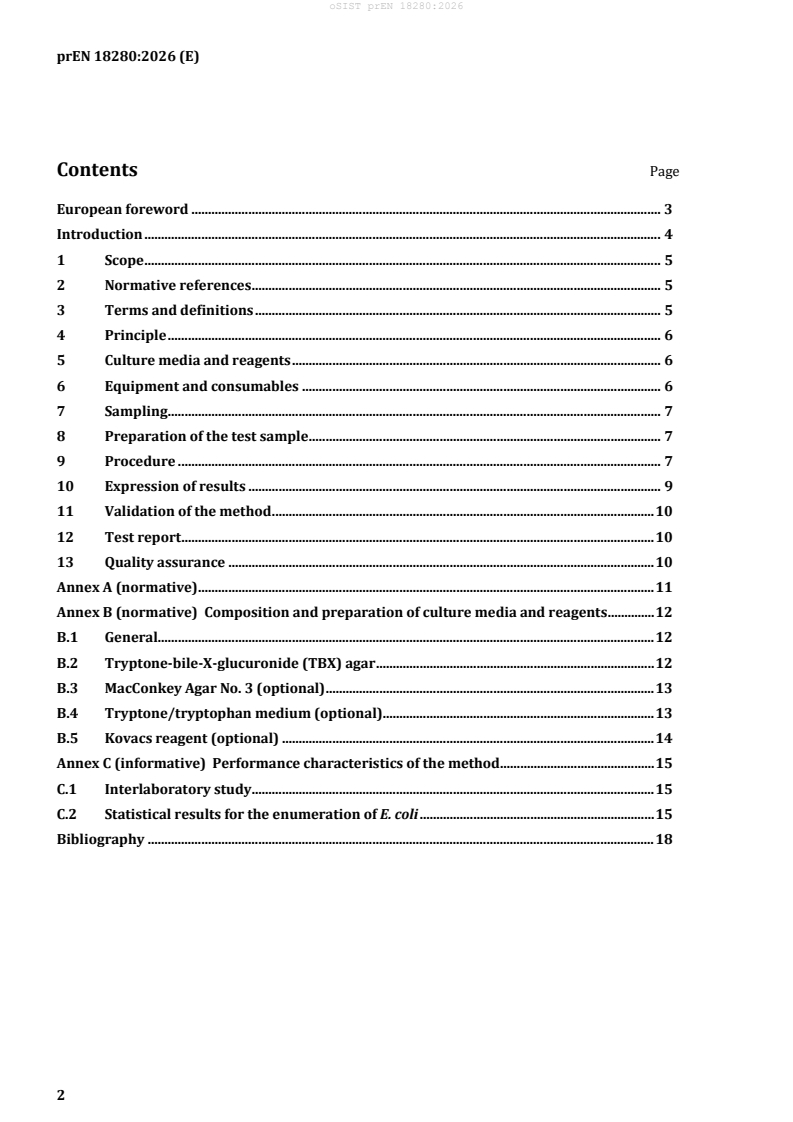
Contents
- Introduction
- 1 Scope
- 2 Normative references
- 3 Terms and definitions
- 3.1 Escherichia coli
- 3.2 enumeration of Escherichia coli
- 4 Principle
- 5 Culture media and reagents
- 6 Equipment and consumables
- 6.6 Sterile loops, of 10 μl volume (approximate diameter 3 mm) and of 1 µl volume, inoculating
- 7 Sampling
- 8 Preparation of the test sample
- 9 Procedure
- 9.1 General
- 9.2 Preparation of the initial suspension and decimal dilutions
- 9.3 Inoculation and incubation on TBX agar
- 9.4 Enumeration of colonies
- 9.5 Confirmation
- 10 Expression of results
- 11 Validation of the method
- 11.2 Performance characteristics
- 12 Test report
- 13 Quality assurance
- Annex A
- Annex B
- Annex C
- Bibliography
Introduction
This document has been developed to enumerate E. coli in soil improvers and growing media in order to be able to control certain hygienic requirements. The method described in this document is based on EN ISO 16649-2 for the enumeration of β-D-glucuronidase-positive E. coli. The species Escherichia coli is a Gram-negative bacterium of faecal origin that consists of a large number of different strains. Consequently, it can be used as an indicator of faecal contamination and as a parameter to evaluate the sanitation process during the manufacturing process of soil improvers or growing media. The presence or absence of E. coli does not reflect the presence or absence of other pathogens in the material tested.
WARNING — In order to safeguard the health of laboratory personnel, it is essential that tests for the enumeration of E. coli are only undertaken in properly equipped laboratories, under the control of a skilled microbiologist, and that great care is taken in the disposal of all incubated materials. Persons using this document should be familiar with normal laboratory practice. This document does not purport to address all of the safety aspects, if any, associated with its use. It is the responsibility of the user to establish appropriate safety and health practices.
oSIST prEN 18280:2026 prEN 18280:2026 (E)
1 Scope
This document specifies a method for the enumeration of Escherichia coli (E. coli) in soil improvers and growing media. This document is applicable to material in solid form (including pre-shaped growing media) and liquid form.
This document is applicable to fertilizing product blends, where a blend is a mix of two or more fertilizing products belonging to the categories of fertilizers, liming material, soil improvers, growing media, inhibitors and plant biostimulants, and where soil improvers and/or growing media comprise the highest percentage in the blend by mass or volume, or in the case of liquid form by dry mass. If soil improvers and/or growing media do not comprise the highest percentage in the blend, the European Standard for the highest percentage in the blend applies. In case a blend is composed of fertilising products in equal quantity, the user of the standard decides which standard to apply. NOTE 1 A soil improver or a growing medium consists of a single bulky (volume-building) component or a mix of bulky (volume-building) components (for example peat, wood fibres, coconut coir, compost, expanded perlite). Strains of E. coli which do not grow at 44 °C ± 1 °C and, in particular, those that are β-D-glucuronidasenegative, such as E. coli O157, will not be detected. Some strains of Shigella spp. and Salmonella spp. within the family Enterobacteriaceae can also show β-D-glucuronidase activity at 44 °C ± 1 °C. NOTE 2 This method has been validated in an interlaboratory study with specific products that were present on the market during the study (Annex C).
2 Normative references
The following documents are referred to in the text in such a way that some or all of their content constitutes requirements of this document. For dated references, only the edition cited applies. For undated references, the latest edition of the referenced document (including any amendments) applies. EN 12579, Soil improvers and growing media - Sampling
prEN 13040-2, Soil improvers and growing media — Sample preparation — Part 2: Sample preparation for microbiological examination
prEN 17732, Soil improvers and growing media — Terminology EN ISO 7218, Microbiology of the food chain - General requirements and guidance for microbiological examinations (ISO 7218)
3 Terms and definitions
For the purposes of this document, the terms and definitions given in prEN 17732, prEN 13040-2 and the following apply.
ISO and IEC maintain terminology databases for use in standardization at the following addresses:
- ISO Online browsing platform: available at https://www.iso.org/obp/
- IEC Electropedia: available at https://www.electropedia.org/
Under preparation. Stage at time of publication: prEN 13040-2:2025.
Under preparation. Stage at time of publication: prEN 17732:2025.
oSIST prEN 18280:2026 prEN 18280:2026 (E)
3.1 Escherichia coli
bacteria which form typical blue colonies on tryptone-bile-X-glucuronide (TBX) agar (β-D-glucuronidasepositive) at 44 °C ± 1 °C under the conditions specified in this method
3.2 enumeration of Escherichia coli
determination of the number of colony-forming units (CFU) of β-D-glucuronidase-positive Escherichia coli per gram or per millilitre of product or per sample device, when the analysis and calculation is carried out in accordance with this document
4 Principle
The initial suspension and/or aliquots of appropriate dilutions are used to inoculate the selective medium tryptone-bile-glucuronide (TBX) agar through pour plating, which is incubated for 21 h ± 3 h at 44 °C. After inoculation and incubation on TBX agar, β-D-glucuronidase-positive E. coli are enumerated and, if necessary, confirmed by a positive indole reaction.
5 Culture media and reagents
Follow current laboratory practices in accordance with standards comparable to EN ISO 7218. The composition of culture media and reagents and their preparation are specified in Annex B. For performance testing of culture media, it is advised to follow the procedures of EN ISO 11133.
6 Equipment and consumables
Disposable equipment is an acceptable alternative to reusable glassware if it has suitable specifications. The usual microbiological laboratory equipment (see ISO 7218) and, in particular, the following shall be used.
6.1 Apparatus for dry sterilization (oven) and/or wet sterilization (autoclave). 6.2 Incubator(s), capable of maintaining a temperature of 36 °C ± 2 °C, 44 °C ± 1 °C and 44°C to 47°C. 6.3 Water bath, capable of maintaining a temperature between 44 °C and 47 °C. 6.4 Cooling unit, adjustable to 5 °C ± 3 °C.
6.5 pH-meter, capable of reading to the nearest 0,1 pH unit at 20 °C to 25 °C.
6.6 Sterile loops, of 10 μl volume (approximate diameter 3 mm) and of 1 µl volume, inoculating
needles or inoculating wires.
6.7 Sterile tubes, bottles or flasks with caps, of appropriate capacity. 6.8 Sterile Petri dishes, with a diameter of approximately 90 mm or a diameter of approximately 140 mm (optional).
6.9 Graduated pipettes or automatic pipettes and sterile tips, with wide opening if necessary, of nominal capacities of 1 ml and 10 ml.
oSIST prEN 18280:2026 prEN 18280:2026 (E)
7 Sampling
Sampling is not part of the method specified in this document. Follow EN 12579 dealing with soil improvers and growing media. It is important that the laboratory receives a sample that is representative of the product under consideration. The sample should not have been damaged or changed during transport or storage.
8 Preparation of the test sample
Prepare the test sample from the laboratory sample in accordance with prEN 13040-2. If there is no specific International Standard available, it is recommended that the parties concerned come to an agreement on this subject.
9 Procedure
9.1 General
The procedure as given in Annex A shall be followed.
The time elapsing between the start of the preparation of the initial suspension and the moment when the plates are inoculated shall not exceed 45 min.
To check sterility, a control pour plate shall be prepared.
9.2 Preparation of the initial suspension and decimal dilutions
Preparation of the initial suspension and further decimal dilutions shall be performed according to
prEN 13040-2 .
Aliquots of the initial suspension should only be used for cultivation if no toxic or inhibiting substances are expected in the sample. For blended products with high amounts of minerals, it is recommended to −2 use aliquots from the first dilution (10 ) and higher. Liquid materials may be used undiluted if they do not contain any toxic or inhibiting substances.
9.3 Inoculation and incubation on TBX agar
For enumeration, one plate per dilution shall be used with at least two successive dilutions. To improve the reliability of the results, two plates per dilution are recommended. If only one dilution is used, then two plates of this dilution shall be used to improve reliability of the results.
For laboratories that do not operate under quality assurance principles, two plates per dilution shall be used to improve reliability of the results.
Using a sterile pipette or a micropipette (6.9), 1 ml of the test sample (if liquid) or 1 ml of the appropriate dilution shall be transferred to a sterile Petri dish (6.8).
...