


EN 1342:2012
(Main)Setts of natural stone for external paving - Requirements and test methods
Setts of natural stone for external paving - Requirements and test methods
This European Standard specifies the performance requirements and the corresponding test methods for all natural stone setts used for external paving and road finishes.
External paving use includes all pavements typical of road works, such as pedestrian and trafficked areas, outdoor squares and similar to be used in an outdoor condition that are subject to the weathering agents, such as temperature changes, rain, ice, wind, etc.
This European Standard provides also for the evaluation of conformity and for marking of the natural stone setts.
This European Standard also covers characteristics that are of importance to the trade.
Pflastersteine aus Naturstein für Außenbereiche - Anforderungen und Prüfverfahren
Diese Europäische Norm legt die Leistungsanforderungen an und entsprechenden Prüfverfahren für alle
Pflastersteine aus Naturstein für Außenbereiche und Straßenoberflächen fest.
Die Verwendung in Außenbereichen umfasst alle für den Straßenbau typischen Straßenbeläge, beispielsweise
Fußgängerbereiche und Verkehrsflächen, Außenflächen und ähnliche Bereiche, die unter Außenbedingungen
verwendet werden und Verwitterungsfaktoren, wie z. B. Temperaturänderungen, Regen, Eis,
Wind usw. unterliegen.
Diese Europäische Norm ermöglicht außerdem die Konformitätsbewertung und die Kennzeichnung von
Pflastersteinen aus Naturstein.
Diese Europäische Norm behandelt außerdem charakteristische Merkmale, die für den Handel von
Bedeutung sind.
Pavés de pierre naturelle pour le pavage extérieur - Exigences et méthodes d'essai
La présente Norme européenne spécifie les exigences de performances et les méthodes d'essai correspondantes, relatives à tous les pavés de pierre naturelle utilisées en revêtement de sol extérieur et de route.
L'utilisation en extérieur du pavage comprend tous les types de revêtement utilisés pour les travaux routiers, tels que les zones de circulation des piétons et des véhicules, les espaces extérieurs et assimilés devant être utilisés dans les conditions extérieures, qui sont exposés aux facteurs climatiques tels que les variations de température, la pluie, la glace, le vent, etc.
Elle spécifie le marquage et l'évaluation de conformité du produit à la présente Norme européenne.
La présente Norme européenne précise également des caractéristiques importantes sur le plan commercial.
Tlakovci iz naravnega kamna za zunanje tlakovanje - Zahteve in preskusne metode
Ta evropski standard določa zahteve glede zmogljivosti in pripadajoče preskusne metode za vse tlakovce iz naravnega kamna, ki se uporabljajo za zunanje tlakovanje in zaključno tlakovanje cest. Zunanje tlakovanje vključuje vse voziščne konstrukcije, ki so značilne za zunanje tlakovanje območij, kot so območja za pešce in promet, zunanji trgi in podobna območja, in so izpostavljene vremenskim vplivom, kot so spremembe temperature, dež, led, veter idr. Ta evropski standard podaja tudi oceno skladnosti in označevanje tlakovcev iz naravnega kamna. Ta evropski standard pokriva tudi značilnosti, ki so pomembne v panogi.
General Information
- Status
- Published
- Publication Date
- 27-Nov-2012
- Withdrawal Date
- 30-Aug-2014
- Technical Committee
- CEN/TC 178 - Paving units and kerbs
- Drafting Committee
- CEN/TC 178 - Paving units and kerbs
- Current Stage
- 9093 - Decision to confirm - Review Enquiry
- Start Date
- 11-Jun-2024
- Completion Date
- 11-Feb-2026
- Directive
- 89/106/EEC - Construction products
Relations
- Effective Date
- 05-Dec-2012
- Effective Date
- 28-Jan-2026
Overview
EN 1342:2012 - Setts of natural stone for external paving: requirements and test methods is a European Standard published by CEN that defines performance requirements, test methods and conformity assessment for natural stone setts used in external paving and road finishes. It covers setts for pedestrian and trafficked areas, outdoor squares and similar outdoor conditions exposed to weathering agents (temperature changes, rain, ice, wind). The standard also addresses trade-related characteristics, marking and labelling and supports CE marking under the EU Construction Products Directive (see informative Annex ZA).
Key Topics
- Scope and definitions: precise definitions for “sett”, work dimensions, upper/bed/side faces, textured/hewn finishes and minimum working thickness (40 mm).
- Dimensions and tolerances: declaration of work dimensions, measurement procedures and tolerances for plan dimensions, thickness and side undercut to ensure uniform laying and patterning.
- Durability tests: freeze/thaw resistance (including de-icing salts), water absorption, apparent density and open porosity - to assess resistance to weathering and frost.
- Mechanical performance: breaking strength / uniaxial compressive strength and abrasion resistance to confirm load-bearing capacity and surface wear.
- Safety performance: slip and skid resistance (pendulum tester) and durability of slip/skid properties.
- Appearance and trade characteristics: reference sample, visual inspection and acceptance criteria, petrographic description and denomination per EN 12440.
- Conformity & quality control: initial type testing (ITT), factory production control (FPC), evaluation of conformity, CE marking and labelling requirements; includes statistical concepts such as Lower Expected Value (EL) and Higher Expected Value (EH).
- Supporting guidance: Annex A on sampling methods and Annex B with calculation examples.
Applications
EN 1342:2012 is used to specify, test and certify natural stone setts for:
- Urban paving (squares, promenades, pedestrian zones)
- Vehicular pavements and road finishes in historic or high-value paved areas
- Hard landscaping and public realm projects requiring durable, non-slip stone surfacing
Who uses it:
- Quarry operators and stone manufacturers (product specification, production control)
- Testing laboratories and product certifiers (type testing, conformity assessment)
- Architects, civil engineers and landscape designers (material selection and procurement)
- Contractors and public works authorities (acceptance criteria and on-site inspection)
Related Standards
Key referenced standards for test methods and denomination include:
- EN 1926, EN 1936, EN 12371, EN 12407, EN 12440, EN 13373, EN 13755, EN 14157, EN 14231
EN 1342:2012 integrates these methods into a practical framework to ensure natural stone setts meet performance, durability and safety expectations for external paving applications.



Get Certified
Connect with accredited certification bodies for this standard

Zavod za gradbeništvo Slovenije (ZAG) - Inšpekcija
ZAG inspection body for construction products, structures, and materials.
Sponsored listings
Frequently Asked Questions
EN 1342:2012 is a standard published by the European Committee for Standardization (CEN). Its full title is "Setts of natural stone for external paving - Requirements and test methods". This standard covers: This European Standard specifies the performance requirements and the corresponding test methods for all natural stone setts used for external paving and road finishes. External paving use includes all pavements typical of road works, such as pedestrian and trafficked areas, outdoor squares and similar to be used in an outdoor condition that are subject to the weathering agents, such as temperature changes, rain, ice, wind, etc. This European Standard provides also for the evaluation of conformity and for marking of the natural stone setts. This European Standard also covers characteristics that are of importance to the trade.
This European Standard specifies the performance requirements and the corresponding test methods for all natural stone setts used for external paving and road finishes. External paving use includes all pavements typical of road works, such as pedestrian and trafficked areas, outdoor squares and similar to be used in an outdoor condition that are subject to the weathering agents, such as temperature changes, rain, ice, wind, etc. This European Standard provides also for the evaluation of conformity and for marking of the natural stone setts. This European Standard also covers characteristics that are of importance to the trade.
EN 1342:2012 is classified under the following ICS (International Classification for Standards) categories: 93.080.20 - Road construction materials. The ICS classification helps identify the subject area and facilitates finding related standards.
EN 1342:2012 has the following relationships with other standards: It is inter standard links to EN 1342:2001, CEN/TR 17024:2017. Understanding these relationships helps ensure you are using the most current and applicable version of the standard.
EN 1342:2012 is associated with the following European legislation: EU Directives/Regulations: 305/2011, 89/106/EEC; Standardization Mandates: M/119, M/122. When a standard is cited in the Official Journal of the European Union, products manufactured in conformity with it benefit from a presumption of conformity with the essential requirements of the corresponding EU directive or regulation.
EN 1342:2012 is available in PDF format for immediate download after purchase. The document can be added to your cart and obtained through the secure checkout process. Digital delivery ensures instant access to the complete standard document.
Standards Content (Sample)
2003-01.Slovenski inštitut za standardizacijo. Razmnoževanje celote ali delov tega standarda ni dovoljeno.Tlakovci iz naravnega kamna za zunanje tlakovanje - Zahteve in preskusne metodePflastersteine aus Naturstein für Außenbereiche - Anforderungen und PrüfverfahrenPavés de pierre naturelle pour le pavage extérieur - Exigences et méthodes d'essaiSetts of natural stone for external paving - Requirements and test methods93.080.20Materiali za gradnjo cestRoad construction materials91.100.15Mineralni materiali in izdelkiMineral materials and productsICS:Ta slovenski standard je istoveten z:EN 1342:2012SIST EN 1342:2013en,fr,de01-marec-2013SIST EN 1342:2013SLOVENSKI
STANDARDSIST EN 1342:20021DGRPHãþD
EUROPEAN STANDARD NORME EUROPÉENNE EUROPÄISCHE NORM
EN 1342
November 2012 ICS 93.080.20 Supersedes EN 1342:2001English Version
Setts of natural stone for external paving - Requirements and test methods
Pavés de pierre naturelle pour le pavage extérieur - Exigences et méthodes d'essai
Pflastersteine aus Naturstein für Außenbereiche - Anforderungen und Prüfverfahren This European Standard was approved by CEN on 6 October 2012.
CEN members are bound to comply with the CEN/CENELEC Internal Regulations which stipulate the conditions for giving this European Standard the status of a national standard without any alteration. Up-to-date lists and bibliographical references concerning such national standards may be obtained on application to the CEN-CENELEC Management Centre or to any CEN member.
This European Standard exists in three official versions (English, French, German). A version in any other language made by translation under the responsibility of a CEN member into its own language and notified to the CEN-CENELEC Management Centre has the same status as the official versions.
CEN members are the national standards bodies of Austria, Belgium, Bulgaria, Croatia, Cyprus, Czech Republic, Denmark, Estonia, Finland, Former Yugoslav Republic of Macedonia, France, Germany, Greece, Hungary, Iceland, Ireland, Italy, Latvia, Lithuania, Luxembourg, Malta, Netherlands, Norway, Poland, Portugal, Romania, Slovakia, Slovenia, Spain, Sweden, Switzerland, Turkey and United Kingdom.
EUROPEAN COMMITTEE FOR STANDARDIZATION
COMITÉ EUROPÉEN DE NORMALISATION EUROPÄISCHES KOMITEE FÜR NORMUNG
Management Centre:
Avenue Marnix 17,
B-1000 Brussels © 2012 CEN All rights of exploitation in any form and by any means reserved worldwide for CEN national Members. Ref. No. EN 1342:2012: ESIST EN 1342:2013
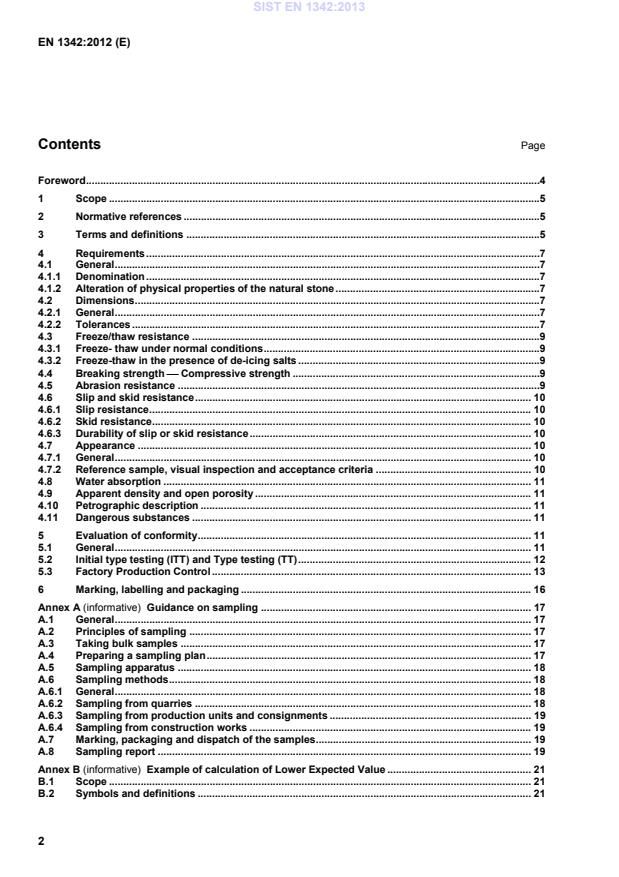
Guidance on sampling . 17A.1 General . 17A.2 Principles of sampling . 17A.3 Taking bulk samples . 17A.4 Preparing a sampling plan . 17A.5 Sampling apparatus . 18A.6 Sampling methods . 18A.6.1 General . 18A.6.2 Sampling from quarries . 18A.6.3 Sampling from production units and consignments . 19A.6.4 Sampling from construction works . 19A.7 Marking, packaging and dispatch of the samples . 19A.8 Sampling report . 19Annex B (informative)
Example of calculation of Lower Expected Value . 21B.1 Scope . 21B.2 Symbols and definitions . 21SIST EN 1342:2013
Clauses of this European Standard addressing the provisions of the EU Construction Products Directive . 24ZA.1 Scope and relevant characteristics . 24ZA.2 Procedure for the attestation of conformity of setts of natural stone . 25ZA.2.1 System of attestation of conformity . 25ZA.2.2 EC Declaration of conformity . 26ZA.3 CE marking and labelling . 27Bibliography . 30 SIST EN 1342:2013
b) The values to be declared have been clarified and where applicable the declared values are now ‘lower expected values’. According to the CEN/CENELEC Internal Regulations, the national standards organisations of the following countries are bound to implement this European Standard: Austria, Belgium, Bulgaria, Croatia, Cyprus, Czech Republic, Denmark, Estonia, Finland, Former Yugoslav Republic of Macedonia, France, Germany, Greece, Hungary, Iceland, Ireland, Italy, Latvia, Lithuania, Luxembourg, Malta, Netherlands, Norway, Poland, Portugal, Romania, Slovakia, Slovenia, Spain, Sweden, Switzerland, Turkey and the United Kingdom.
EN 14157, Natural stone test methods — Determination of the abrasion resistance
EN 14231, Natural stone test methods — Determination of the slip resistance by means of the pendulum tester 3 Terms and definitions For the purposes of this document, the following terms and definitions apply. 3.1 sett unit of natural stone obtained by cutting or splitting used as a paving material, in which the working width does not exceed two times the thickness, and the length does not exceed two times the width Note 1 to entry: The minimum working thickness is 40 mm. SIST EN 1342:2013
3.10 textured sett with a surface finish produced by secondary processing, from a saw or hewn surface 3.11 fine textured
surface finish with a maximum difference of 1,0 mm between peaks and depressions (for example polished, honed or sawn with a diamond disc or blade) 3.12 coarse textured
surface finish with more than 1,0 mm difference between peaks and depressions (for example dolly pointed, shot blasted or flame textured) 3.13 hewn sett with a rough surface finish, for example a riven or split face 3.14 lower expected value
EL value which corresponds to the 5 %-quantile of a logarithmic normal distribution for a confidence level of 75 % SIST EN 1342:2013
EH value which corresponds to the 95 %-quantile of a logarithmic normal distribution for a confidence level of 75 % 4 Requirements 4.1 General 4.1.1 Denomination The denomination shall always be declared in accordance with EN 12440 (meaning traditional name, petrological family, typical colour and place of origin as precisely as possible for example geo coordinates). 4.1.2 Alteration of physical properties of the natural stone If during production the natural stone setts have been subjected to a treatment process that physically alters the properties of the stone (for example chemical treatment, patching, or filling or other similar products for natural holes, faults or cracks) then the use of such a treatment shall be stated. In addition, specimens for testing shall be representative of the product and any processes that the stone is subjected to. 4.2 Dimensions 4.2.1 General The work dimensions of the setts shall be declared. Dimensions between faces shall be stated as a unitary nominal dimension or as a range of nominal minimum-maximum dimensions, e.g. (100 - 200) mm.
Dimensions of each shall be measured in accordance with EN 13373. 4.2.2 Tolerances 4.2.2.1 Plan dimensions and thickness Plan dimensions and thickness of a sett shall be measured in accordance with EN 13373:2003, 5.2 and 5.3 and the deviations from the declared plan dimensions and thickness shall conform to tolerances given in Table 1. Different deviations may be declared for plan dimensions and thickness. Unless stated otherwise, a consignment of setts shall be intended to be laid in rectilinear patterns and all setts within a consignment, when measured in accordance with EN 13373:2003, 5.4, shall conform with the tolerances from the plan and thickness dimensions described in Table 1.
Class 0Class 1Class 2≤ 60 mm Textured No requirements
± 7 mm ± 5 mm
Hewn ± 10 mm ± 7 mm > 60 mm ≤ 120 mm Textured ± 10 mm ± 5 mm
Hewn ± 15 mm ± 10 mm > 120 mm Textured ± 10 mm ± 7 mm
Hewn
± 15 mm ± 12 mm
Where a consignment of setts is specifically designated for being laid in radial or arch patterns then it may include a proportion of the total agreed by the specifier, that are bigger, smaller and trapezoidal setts not varying from the dimensions allowed by the stated tolerance by more than 10 %. When dimensions between faces are declared as a range of nominal minimum – maximum thickness, the deviation shall be declared on the limits of the range. This is particularly applicable to hewn setts. In all cases the thickness of the setts shall be observed.
4.2.2.2 Undercut of sides
When measured in accordance with EN 13373:2003, 5.5, deviations of the undercut of a side shall not exceed the tolerances given in Table 2 with respect to the perpendicularity of the upper face (see Figure 1).
Key 1 = upper face 2 = side face 3 = bed face u = undercut of side face o = overcut of side face T = thickness W = overall width Figure 1 Tolerances on under and overcut faces
No requirement Maximum one side
Maximum sum Maximum one side
Maximum sum ≤60 mm 10 mm 20 mm 5 mm 10 mm >60 mm ≤ 120 mm 15 mm 25 mm 10 mm 15 mm >120 mm 25 mm 30 mm 15 mm 20 mm
4.2.2.3 Hewn and coarse textured face irregularities When measured in accordance with EN 13373:2003, 5.3, deviations of upper and side face cavity and protrusions shall not exceed the tolerances given in Table 3. Table 3 Tolerances on hewn and coarse textured face irregularities
Class 0Class 1Class 2Hewn No Requirements ± 10 mm ± 5 mm Coarse Textured ± 5 mm ± 3 mm
4.3 Freeze/thaw resistance 4.3.1 Freeze- thaw under normal conditions
When the setts are intended to be used in areas subjected to freeze and thaw freeze-thaw requirements, the freeze/thaw resistance shall be determined using the test method in EN 12371. The results shall be expressed and declared as the mean compressive strength before and after 56 cycles of freeze/thaw (technological test). The frost damage, which a natural stone may suffer when installed, depends on the climatic conditions of the place of use, the relative position in the works (which determines the degree of saturation) and the predicted service life of the works. This number of cycles is appropriate to a specific project and may help to provide guidance for the interpretation of the test results. The selection of the stones is subjected to climatic zones and/or to codes of practice. For some specific uses, for example in locations that are subject to temperatures below - 12 °C, it may be appropriate to use different test cycles, e.g. freezing in water, freezing to a lower temperature, or testing specimens embedded in non-porous siliceous granules or a different number of cycles, e.g. the identification test as defined in EN 12371. 4.3.2 Freeze-thaw in the presence of de-icing salts
Where required, freeze-thaw resistance with the effect of de-icing salts shall be determined and declared. In the absence of a European test method, freeze-thaw resistance with the effect of de-icing salts shall be determined and declared according to national provisions valid in the place of use of the product. 4.4 Breaking strength Compressive strength The compressive strength shall be determined using the test method in EN 1926 and the lower expected value (EL) shall be declared. 4.5 Abrasion resistance The abrasion resistance shall be determined using the test method in EN 14157 and the higher expected value (EH) shall be declared. SIST EN 1342:2013
In the absence of a European test method, skid resistance may be determined and declared according to national provisions valid en the place of use of the product. 4.6.3 Durability of slip or skid resistance When required, durability of slip and skid resistance shall be declared.
In the absence of European test methods, durability of slip and skid resistance shall be determined and declared according to national provisions valid in the place of use of the product. 4.7 Appearance
4.7.1 General The colour, veining, texture, etc. of the stone shall be identified visually, typically by a reference sample of the same stone suitable for providing a general description of visual appearance.
A reference sample shall be provided by the supplier in accordance with 4.7.2. 4.7.2 Reference sample, visual inspection and acceptance criteria A reference sample shall be an adequate number of setts of natural stone of sufficient size to indicate the general appearance of the finished work. They shall indicate the range of appearance regarding the colouring, the vein pattern, the physical structure and the surface finish. In particular the reference sample shall show specific characteristics of the stone, such as specific holes, glass seams, spots, crystalline veins and rusty spots. The reference samples does not imply strict uniformity between the sample itself and the actual supply; natural variations may always occur. SIST EN 1342:2013
b) factory production control by the manufacturer, including product assessment. SIST EN 1342:2013
Reference to the test method standards should be made to allow the selection of a suitable representative sample. All essential characteristics, given in bold in Table 4, for which the manufacturer declares performances, are subject to Initial Type Testing.
In addition, the need to perform Type Tests applies to all other characteristics included in Table 4, when the man
...
Questions, Comments and Discussion
Ask us and Technical Secretary will try to provide an answer. You can facilitate discussion about the standard in here.
Loading comments...