

EN 13863-2:2003
(Main)Concrete pavements - Part 2: Test method for the determination of the bond between two layers
- Abstract
This European Standard specifies a method for the determination of the tensile bond strength between two concrete layers. This method is carried out on cores cut from hardened concrete.
- Status
- Published
- Publication Date
- 14-Oct-2003
- Withdrawal Date
- 30-Mar-2005
- Technical Committee
- CEN/TC 227 - Road materials
- Current Stage
- 9093 - Decision to confirm - Review Enquiry
- Start Date
- 03-Jun-2026
- Completion Date
- 14-Oct-2026

Overview
EN 13863-2:2003 - Concrete pavements - Part 2: Test method for the determination of the bond between two layers (CEN) specifies a laboratory procedure to measure the tensile bond strength between two hardened concrete layers. The method is carried out on cores taken from in‑situ pavements or laboratory specimens and determines whether layers will act compositely or are susceptible to delamination. Test specimens shall have a maturity equivalent to at least 28 days at testing.
Key topics and technical requirements
- Purpose: Determine ultimate tensile bond strength (N/mm²) by pulling bonded cores in a tensile testing machine until failure.
- Specimen sampling and geometry
- Core diameter > 4 × maximum aggregate size.
- Length/diameter ratio ≥ 2.
- Apparatus
- Tensile testing machine conforming to EN ISO 7500-1 (loading rate 0.03–0.07 N/mm²/s, accuracy ±3%).
- Core drilling equipment per EN 12504-1, saw/grinder and bonded steel platens.
- Specimen preparation
- Both ends sawn and ground; perpendicularity and surface tolerances per EN 12390-1 (surface tolerance ±0.05 mm).
- Protect surfaces from drying during preparation (e.g., wet towels).
- Dry core until concrete light in colour before bonding platens; after bonding, store under water until testing.
- Bonding adhesives used per manufacturer instructions; discard results if failure occurs at glued joint.
- Test procedure
- Center specimen in testing machine (concentric within ±1 mm).
- Apply tensile load at constant rate (0.03–0.07 N/mm²/s) until failure; record ultimate load.
- Calculate tensile bond strength = load at failure / cross-sectional area.
- Identify break location (top layer, bottom layer, or interface).
- Report strength to two decimal places (last digit rounded to 0 or 5).
- Test report must include
- Reference to EN 13863-2:2003, specimen identification/composition/age, tensile bond results and break location, and any deviations.
Applications and users
This test method is practical for:
- Pavement engineers and designers assessing overlay or layer bonding performance.
- Quality control and acceptance testing for new concrete overlays and joint repairs.
- Road authorities and contractors verifying composite action and preventing delamination.
- Materials laboratories and forensic investigators evaluating cause of pavement failures.
Keywords: EN 13863-2:2003, concrete pavements, bond between layers, tensile bond strength, core testing, CEN, road construction materials.
Related standards
- EN 12390-1 - Testing hardened concrete: specimen shape, dimensions and tolerances.
- EN 12504-1 - Testing concrete in structures: cored specimens.
- EN ISO 7500-1 - Verification of static uniaxial testing machines.
- Related parts in the same series: EN 13863-1, prEN 13863-3, prEN 13863-4.
Relations
- Effective Date
- 28-Jan-2026
- Effective Date
- 28-Jan-2026
- Effective Date
- 28-Jan-2026
- Effective Date
- 28-Jan-2026
- Referred By
EN 13877-2:2023 - Concrete pavements - Part 2: Functional requirements for concrete pavements - Effective Date
- 28-Jan-2026
- Referred By
EN 13877-2:2013 - Concrete pavements - Part 2: Functional requirements for concrete pavements - Effective Date
- 28-Jan-2026
- Referred By
EN 13877-2:2004 - Concrete pavements - Part 2: Functional requirements for concrete pavements - Effective Date
- 28-Jan-2026
Get Certified
Connect with accredited certification bodies for this standard

Zavod za gradbeništvo Slovenije (ZAG) - Inšpekcija
ZAG inspection body for construction products, structures, and materials.
Sponsored listings
Frequently Asked Questions
EN 13863-2:2003 is a standard published by the European Committee for Standardization (CEN). Its full title is "Concrete pavements - Part 2: Test method for the determination of the bond between two layers". This standard covers: This European Standard specifies a method for the determination of the tensile bond strength between two concrete layers. This method is carried out on cores cut from hardened concrete.
This European Standard specifies a method for the determination of the tensile bond strength between two concrete layers. This method is carried out on cores cut from hardened concrete.
EN 13863-2:2003 is classified under the following ICS (International Classification for Standards) categories: 93.080.20 - Road construction materials. The ICS classification helps identify the subject area and facilitates finding related standards.
EN 13863-2:2003 has the following relationships with other standards: It is inter standard links to EN 12504-1:2019, EN ISO 7500-1:2018, EN 12390-1:2021, EN ISO 19019:2005, EN 13877-2:2023, EN 13877-2:2013, EN 13877-2:2004. Understanding these relationships helps ensure you are using the most current and applicable version of the standard.
EN 13863-2:2003 is associated with the following European legislation: EU Directives/Regulations: 305/2011, 89/106/EEC. When a standard is cited in the Official Journal of the European Union, products manufactured in conformity with it benefit from a presumption of conformity with the essential requirements of the corresponding EU directive or regulation.
EN 13863-2:2003 is available in PDF format for immediate download after purchase. The document can be added to your cart and obtained through the secure checkout process. Digital delivery ensures instant access to the complete standard document.
Standards Content (Sample)
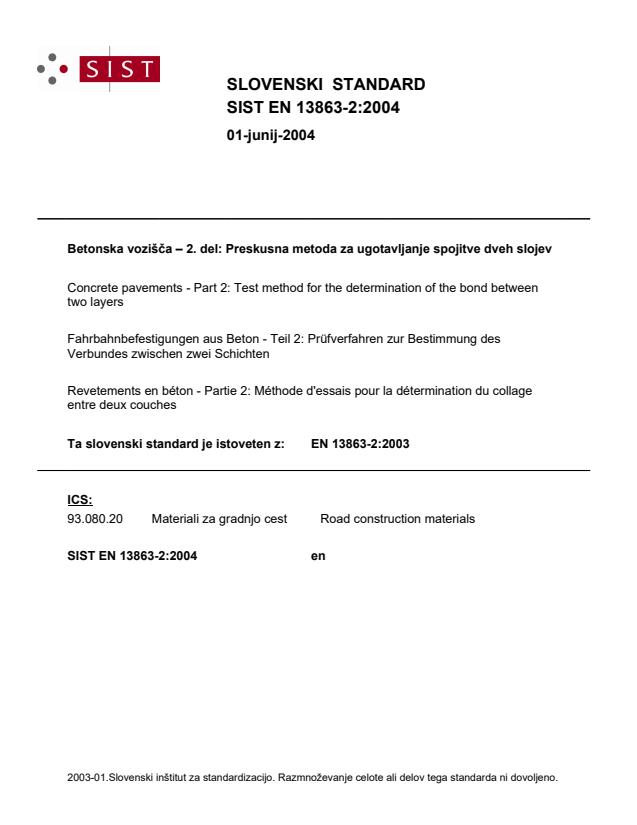
2003-01.Slovenski inštitut za standardizacijo. Razmnoževanje celote ali delov tega standarda ni dovoljeno.Fahrbahnbefestigungen aus Beton - Teil 2: Prüfverfahren zur Bestimmung des Verbundes zwischen zwei SchichtenRevetements en béton - Partie 2: Méthode d'essais pour la détermination du collage entre deux couchesConcrete pavements - Part 2: Test method for the determination of the bond between two layers93.080.20Materiali za gradnjo cestRoad construction materialsICS:Ta slovenski standard je istoveten z:EN 13863-2:2003SIST EN 13863-2:2004en01-junij-2004SIST EN 13863-2:2004SLOVENSKI
STANDARD
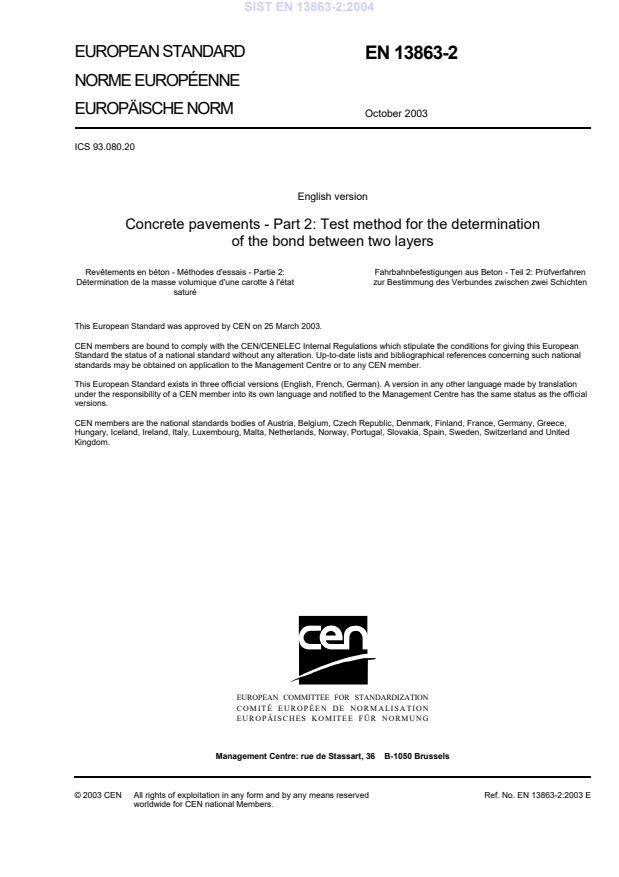
EUROPEAN STANDARDNORME EUROPÉENNEEUROPÄISCHE NORMEN 13863-2October 2003ICS 93.080.20English versionConcrete pavements - Part 2: Test method for the determinationof the bond between two layersRevêtements en béton - Méthodes d'essais - Partie 2:Détermination de la masse volumique d'une carotte à l'étatsaturéFahrbahnbefestigungen aus Beton - Teil 2: Prüfverfahrenzur Bestimmung des Verbundes zwischen zwei SchichtenThis European Standard was approved by CEN on 25 March 2003.CEN members are bound to comply with the CEN/CENELEC Internal Regulations which stipulate the conditions for giving this EuropeanStandard the status of a national standard without any alteration. Up-to-date lists and bibliographical references concerning such nationalstandards may be obtained on application to the Management Centre or to any CEN member.This European Standard exists in three official versions (English, French, German). A version in any other language made by translationunder the responsibility of a CEN member into its own language and notified to the Management Centre has the same status as the officialversions.CEN members are the national standards bodies of Austria, Belgium, Czech Republic, Denmark, Finland, France, Germany, Greece,Hungary, Iceland, Ireland, Italy, Luxembourg, Malta, Netherlands, Norway, Portugal, Slovakia, Spain, Sweden, Switzerland and UnitedKingdom.EUROPEAN COMMITTEE FOR STANDARDIZATIONCOMITÉ EUROPÉEN DE NORMALISATIONEUROPÄISCHES KOMITEE FÜR NORMUNGManagement Centre: rue de Stassart, 36
B-1050 Brussels© 2003 CENAll rights of exploitation in any form and by any means reservedworldwide for CEN national Members.Ref. No. EN 13863-2:2003 ESIST EN 13863-2:2004
Test methods for functional requirements - Part 3: Determination of thethickness of a concrete slab.prEN 13863-4, Concrete pavements —
Test methods - Part 4: Determination of wear resistance to studded tyres.According to the CE
...