

EN 3635:2014
(Main)Aerospace series - Weld lip - Geometrical configuration
- Abstract
The purpose of this European Standard is to specify the dimensions and tolerances for orbital-welding fittings, intended for stainless steel fluid pipes to EN 3717.
- Status
- Published
- Publication Date
- 30-Sep-2014
- Withdrawal Date
- 29-Apr-2015
- Technical Committee
- ASD-STAN - Aerospace
- Drafting Committee
- ASD-STAN/D 3 - Mechanical
- Current Stage
- 9093 - Decision to confirm - Review Enquiry
- Start Date
- 21-Jan-2025
- Completion Date
- 07-Oct-2026

Overview
EN 3635:2014 - Aerospace series - Weld lip - Geometrical configuration is a CEN European Standard that specifies the geometrical dimensions and tolerances for orbital‑welding fittings (weld lips) used with stainless steel fluid pipes to EN 3717. Approved in 2014 and superseding EN 3635:2008, this standard defines the form, key dimensions, tolerances and drawing designation rules required for consistent manufacture, assembly and inspection of aerospace welded tube fittings.
Key topics and requirements
- Scope: Specifies dimensions and tolerances for orbital‑welding fittings intended for stainless steel aerospace fluid pipes (EN 3717).
- Fitting dimensions: Detailed sizes are given by diameter code and thickness code with tabulated values for features such as A, B, D, S, T, W and the tube outside diameter. Nominal wall thickness is identified in a table footnote.
- Tolerance system: Includes tolerance class (h12) and specific plus/minus tolerances for critical diameters to ensure interchangeability and correct weld preparation.
- Tube end geometry: Defines the required tube end shape and permissible edge break (e.g., break edges maximum values) to ensure correct fit-up for orbital welding.
- Designation and drawing practice: Prescribes an example designation format (for example, EN3635-060-080) and shows how fittings should be identified on engineering drawings.
- Normative reference: EN 3717 (Aerospace series - Tubes - Selection for engines fluid systems) is normatively referenced and essential for application.
Applications and users
Who uses EN 3635:2014 and why:
- Aerospace component manufacturers - to produce consistent orbital‑welding fittings (weld lips) that mate correctly with EN 3717 tubes.
- Design and stress engineers - to select and specify correct fitting geometry and tolerances on assembly drawings.
- Quality, inspection and procurement teams - to verify dimensional conformity, tolerance class and correct part identification.
- Welding shops and fabricators - to prepare tube ends and set up orbital welding processes that rely on standardised geometry for reliable joints.
- Certification and regulatory bodies - to confirm compliance with aerospace fluid system standards.
Practical benefits include improved interchangeability, predictable weld fit‑up, reduced rework, and clearer procurement/specification language for aerospace fluid systems.
Related standards
- EN 3717 - Aerospace series - Tubes - Selection for engines fluid systems (normative reference).
- EN 3635:2014 supersedes EN 3635:2008 (see foreword for evolution notes).
Keywords: EN 3635:2014, aerospace series, weld lip, geometrical configuration, orbital‑welding fittings, stainless steel fluid pipes, EN 3717, dimensions and tolerances, tube end geometry, diameter code, designation.
Relations
- Effective Date
- 08-Jun-2022
- Effective Date
- 28-Jan-2026
- Effective Date
- 28-Jan-2026
- Effective Date
- 28-Jan-2026
- Effective Date
- 28-Jan-2026
- Effective Date
- 28-Jan-2026
Get Certified
Connect with accredited certification bodies for this standard

BUREAU VERITAS Certification Germany
Bureau Veritas certification in Germany.

Element Materials Technology
Materials testing and product certification.

AQMS Ltd.
AQMS provides ISO certification to SMEs across the UK.
Sponsored listings
Frequently Asked Questions
EN 3635:2014 is a standard published by the European Committee for Standardization (CEN). Its full title is "Aerospace series - Weld lip - Geometrical configuration". This standard covers: The purpose of this European Standard is to specify the dimensions and tolerances for orbital-welding fittings, intended for stainless steel fluid pipes to EN 3717.
The purpose of this European Standard is to specify the dimensions and tolerances for orbital-welding fittings, intended for stainless steel fluid pipes to EN 3717.
EN 3635:2014 is classified under the following ICS (International Classification for Standards) categories: 49.080 - Aerospace fluid systems and components. The ICS classification helps identify the subject area and facilitates finding related standards.
EN 3635:2014 has the following relationships with other standards: It is inter standard links to EN 3635:2008, EN 3717:2008, EN 3630:2008, EN ISO 21090:2011, EN 3631:2008, EN 3631:2014. Understanding these relationships helps ensure you are using the most current and applicable version of the standard.
EN 3635:2014 is available in PDF format for immediate download after purchase. The document can be added to your cart and obtained through the secure checkout process. Digital delivery ensures instant access to the complete standard document.
Standards Content (Sample)
2003-01.Slovenski inštitut za standardizacijo. Razmnoževanje celote ali delov tega standarda ni dovoljeno.þUWLuft- und Raumfahrt - Rohranschlussende geschweißt - MasseSérie aérospatiale - Embout à souder - Configuration géométriqueAerospace series - Weld lip - Geometrical configuration49.080Aerospace fluid systems and componentsICS:Ta slovenski standard je istoveten z:EN 3635:2014SIST EN 3635:2015en,fr,de01-januar-2015SIST EN 3635:2015SLOVENSKI
STANDARDSIST EN 3635:20081DGRPHãþD
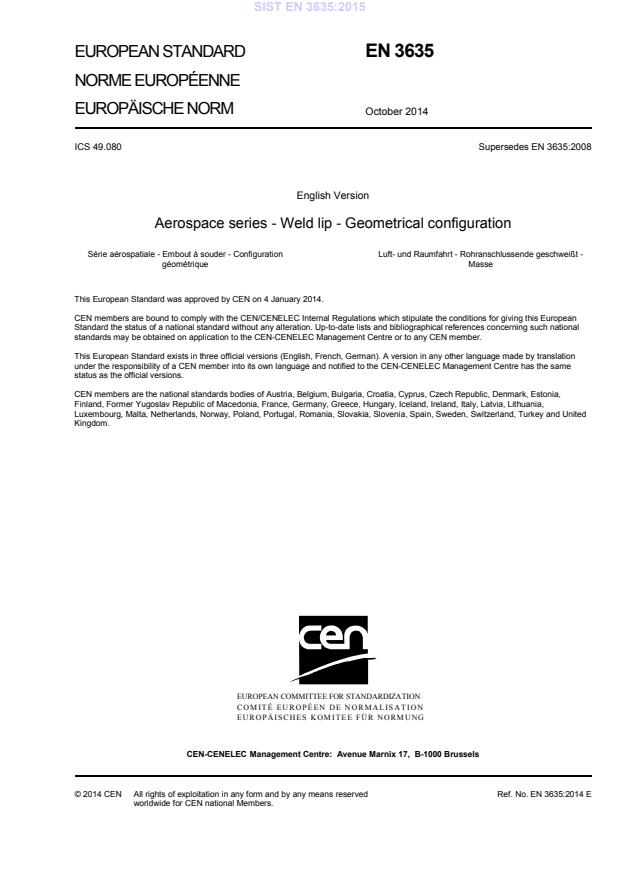
EUROPEAN STANDARD NORME EUROPÉENNE EUROPÄISCHE NORM
EN 3635
October 2014 ICS 49.080 Supersedes EN 3635:2008English Version
Aerospace series - Weld lip - Geometrical configuration
Série aérospatiale - Embout à souder - Configuration géométrique
Luft- und Raumfahrt - Rohranschlussende geschweißt - Masse This European Standard was approved by CEN on 4 January 2014.
CEN members are bound to comply with the CEN/CENELEC Internal Regulations which stipulate the conditions for giving this European Standard the status of a national standard without any alteration. Up-to-date lists and bibliographical references concerning such national standards may be obtained on application to the CEN-CENELEC Management Centre or to any CEN member.
This European Standard exists in three official versions (English, French, German). A version in any other language made by translation under the responsibility of a CEN member into its own language and notified to the CEN-CENELEC Management Centre has the same status as the official versions.
CEN members are the national standards bodies of Austria, Belgium, Bulgaria, Croatia, Cyprus, Czech Republic, Denmark, Estonia, Finland, Former Yugoslav Republic of Macedonia, France, Germany, Greece, Hungary, Iceland, Ireland, Italy, Latvia, Lithuania, Luxembourg, Malta, Netherlands, Norway, Poland, Portugal, Romania, Slovakia, Slovenia, Spain, Sweden, Switzerland, Turkey and United Kingdom.
EUROPEAN COMMITTEE FOR STANDARDIZATION
COMITÉ EUROPÉEN DE NORMALISATION EUROPÄISCHES KOMITEE FÜR NORMUNG
CEN-CENELEC Management Centre:
Avenue Marnix 17,
B-1000 Brussels © 2014 CEN All rights of exploitation in any form and by any means reserved worldwide for CEN national Members. Ref. No. EN 3635:2014 ESIST EN 3635:2015
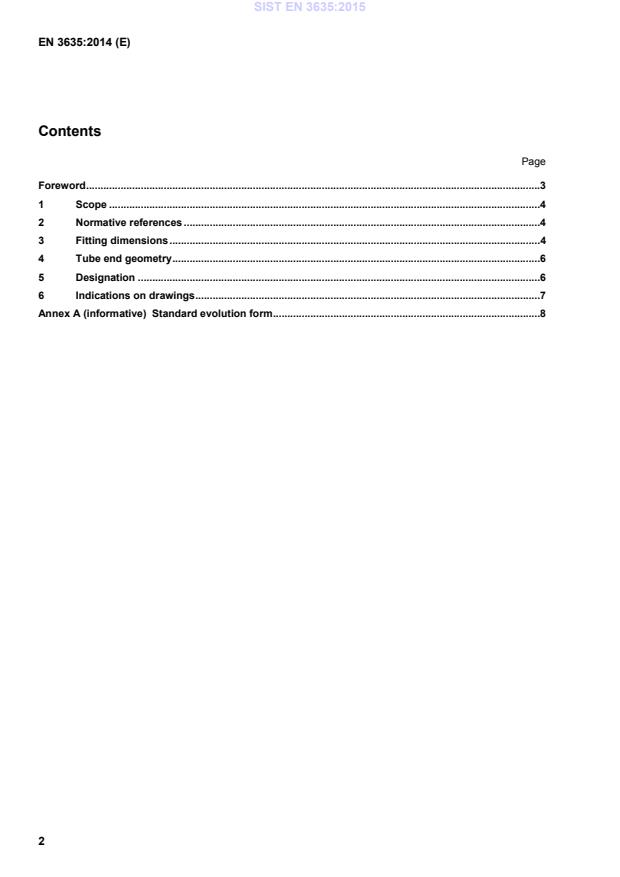
Page Foreword .3 1 Scope .4 2 Normative references .4 3 Fitting dimensions .4 4 Tube end geometry .6 5 Designation .6 6 Indications on drawings .7 Annex A (informative)
Standard evolution form .8
...