

EN 14389-2:2004
(Main)Road traffic noise reducing devices - Procedures for assessing long term performance - Part 2: Non-acoustical characteristics
- Abstract
This document specifies assumed working life requirements and is also intended to assist suppliers in its prediction.
It is to be used only for devices manufactured from materials covered by documents which allow prediction of working life (see Annex B). Materials excepted are those which do not affect the non acoustic performance of the device required by EN 1794 parts 1 and 2.
Standards of construction and any material tests conducted should provide evidence of resistance to specified conditions selected from the following:
I. Chemical Agents Location
dependent
II. De-icing salt Location/climate
Dependent
III. Dirty water/dust Location/
Climate
dependent
IV. Dew Climate
dependent
V. Freeze/thaw Climate
dependent
VI. Cold Climate
dependent
VII. Heat Climate
dependent
VIII. UV Radiation Climate
dependent
IX. Traffic Vibration Location
dependent
X. Biological Process Climate
dependent
XI. Ozone Location
dependent
XII. Water Climate
dependent
XIII. Water spray Location
Wet/dry dependent
dependent
IV. Dew Climate
dependent
V. Freeze/thaw Climate
dependent
VI. Cold Climate
dependent
VII. Heat Climate
dependent
VIII. UV Radiation Climate
dependent
IX. Traffic Vibration Location
dependent
X. Biological Process Climate
dependent
XI. Ozone Location
dependent
XII. Water Climate
dependent
XIII. Water spray Location
Wet/dry dependent
- Status
- Withdrawn
- Publication Date
- 24-Aug-2004
- Withdrawal Date
- 06-Oct-2026
- Technical Committee
- CEN/TC 226 - Road equipment
- Drafting Committee
- CEN/TC 226/WG 6 - Noise reducing devices
- Current Stage
- 9960 - Withdrawal effective - Withdrawal
- Start Date
- 06-May-2015
- Completion Date
- 07-Oct-2026

Relations
- Effective Date
- 12-Dec-2012
- Effective Date
- 09-Feb-2026
- Effective Date
- 28-Jan-2026
- Effective Date
- 28-Jan-2026
- Effective Date
- 28-Jan-2026
- Effective Date
- 28-Jan-2026
- Effective Date
- 22-Dec-2008
Get Certified
Connect with accredited certification bodies for this standard

Zavod za gradbeništvo Slovenije (ZAG) - Inšpekcija
ZAG inspection body for construction products, structures, and materials.
Sponsored listings
Frequently Asked Questions
EN 14389-2:2004 is a standard published by the European Committee for Standardization (CEN). Its full title is "Road traffic noise reducing devices - Procedures for assessing long term performance - Part 2: Non-acoustical characteristics". This standard covers: This document specifies assumed working life requirements and is also intended to assist suppliers in its prediction. It is to be used only for devices manufactured from materials covered by documents which allow prediction of working life (see Annex B). Materials excepted are those which do not affect the non acoustic performance of the device required by EN 1794 parts 1 and 2. Standards of construction and any material tests conducted should provide evidence of resistance to specified conditions selected from the following: I. Chemical Agents Location dependent II. De-icing salt Location/climate Dependent III. Dirty water/dust Location/ Climate dependent IV. Dew Climate dependent V. Freeze/thaw Climate dependent VI. Cold Climate dependent VII. Heat Climate dependent VIII. UV Radiation Climate dependent IX. Traffic Vibration Location dependent X. Biological Process Climate dependent XI. Ozone Location dependent XII. Water Climate dependent XIII. Water spray Location Wet/dry dependent dependent IV. Dew Climate dependent V. Freeze/thaw Climate dependent VI. Cold Climate dependent VII. Heat Climate dependent VIII. UV Radiation Climate dependent IX. Traffic Vibration Location dependent X. Biological Process Climate dependent XI. Ozone Location dependent XII. Water Climate dependent XIII. Water spray Location Wet/dry dependent
This document specifies assumed working life requirements and is also intended to assist suppliers in its prediction. It is to be used only for devices manufactured from materials covered by documents which allow prediction of working life (see Annex B). Materials excepted are those which do not affect the non acoustic performance of the device required by EN 1794 parts 1 and 2. Standards of construction and any material tests conducted should provide evidence of resistance to specified conditions selected from the following: I. Chemical Agents Location dependent II. De-icing salt Location/climate Dependent III. Dirty water/dust Location/ Climate dependent IV. Dew Climate dependent V. Freeze/thaw Climate dependent VI. Cold Climate dependent VII. Heat Climate dependent VIII. UV Radiation Climate dependent IX. Traffic Vibration Location dependent X. Biological Process Climate dependent XI. Ozone Location dependent XII. Water Climate dependent XIII. Water spray Location Wet/dry dependent dependent IV. Dew Climate dependent V. Freeze/thaw Climate dependent VI. Cold Climate dependent VII. Heat Climate dependent VIII. UV Radiation Climate dependent IX. Traffic Vibration Location dependent X. Biological Process Climate dependent XI. Ozone Location dependent XII. Water Climate dependent XIII. Water spray Location Wet/dry dependent
EN 14389-2:2004 is classified under the following ICS (International Classification for Standards) categories: 93.080.30 - Road equipment and installations. The ICS classification helps identify the subject area and facilitates finding related standards.
EN 14389-2:2004 has the following relationships with other standards: It is inter standard links to EN 14389-2:2015, EN IEC 60721-3-4:2019, EN 1794-1:2024, EN 1794-2:2024, EN 1794-1:2018, EN 14388:2005; is excused to EN 14389-1:2007. Understanding these relationships helps ensure you are using the most current and applicable version of the standard.
EN 14389-2:2004 is associated with the following European legislation: EU Directives/Regulations: 305/2011, 89/106/EEC. When a standard is cited in the Official Journal of the European Union, products manufactured in conformity with it benefit from a presumption of conformity with the essential requirements of the corresponding EU directive or regulation.
EN 14389-2:2004 is available in PDF format for immediate download after purchase. The document can be added to your cart and obtained through the secure checkout process. Digital delivery ensures instant access to the complete standard document.
Standards Content (Sample)
2003-01.Slovenski inštitut za standardizacijo. Razmnoževanje celote ali delov tega standarda ni dovoljeno.Lärmschutzeinrichtungen an Straßen - Verfahren zur Bewertung der Langzeitwirksamkeit - Teil 2: Nichtakustische EigenschaftenDispositifs de réduction du bruit du trafic routier - Méthodes d'évaluation des performances a long terme - Partie 2 : Caractéristiques non acoustiquesRoad traffic noise reducing devices - Procedures for assessing long term performance - Part 2: Non-acoustical characteristics93.080.30Cestna oprema in pomožne napraveRoad equipment and installations17.140.30Emisija hrupa transportnih sredstevNoise emitted by means of transportICS:Ta slovenski standard je istoveten z:EN 14389-2:2004SIST EN 14389-2:2005en01-januar-2005SIST EN 14389-2:2005SLOVENSKI
STANDARD
EUROPEAN STANDARDNORME EUROPÉENNEEUROPÄISCHE NORMEN 14389-2August 2004ICS 93.080.30English versionRoad traffic noise reducing devices - Procedures for assessinglong term performance - Part 2: Non-acoustical characteristicsDispositifs de réduction du bruit du trafic routier - Méthodesd'évaluation des performances à long terme - Partie 2 :Caractéristiques non acoustiquesLärmschutzeinrichtungen an Straßen - Verfahren zurBewertung der Langzeitwirksamkeit - Teil 2:Nichtakustische EigenschaftenThis European Standard was approved by CEN on 24 June 2004.CEN members are bound to comply with the CEN/CENELEC Internal Regulations which stipulate the conditions for giving this EuropeanStandard the status of a national standard without any alteration. Up-to-date lists and bibliographical references concerning such nationalstandards may be obtained on application to the Central Secretariat or to any CEN member.This European Standard exists in three official versions (English, French, German). A version in any other language made by translationunder the responsibility of a CEN member into its own language and notified to the Central Secretariat has the same status as the officialversions.CEN members are the national standards bodies of Austria, Belgium, Cyprus, Czech Republic, Denmark, Estonia, Finland, France,Germany, Greece, Hungary, Iceland, Ireland, Italy, Latvia, Lithuania, Luxembourg, Malta, Netherlands, Norway, Poland, Portugal, Slovakia,Slovenia, Spain, Sweden, Switzerland and United Kingdom.EUROPEAN COMMITTEE FOR STANDARDIZATIONCOMITÉ EUROPÉEN DE NORMALISATIONEUROPÄISCHES KOMITEE FÜR NORMUNGManagement Centre: rue de Stassart, 36
B-1050 Brussels© 2004 CENAll rights of exploitation in any form and by any means reservedworldwide for CEN national Members.Ref. No. EN 14389-2:2004: ESIST EN 14389-2:2005
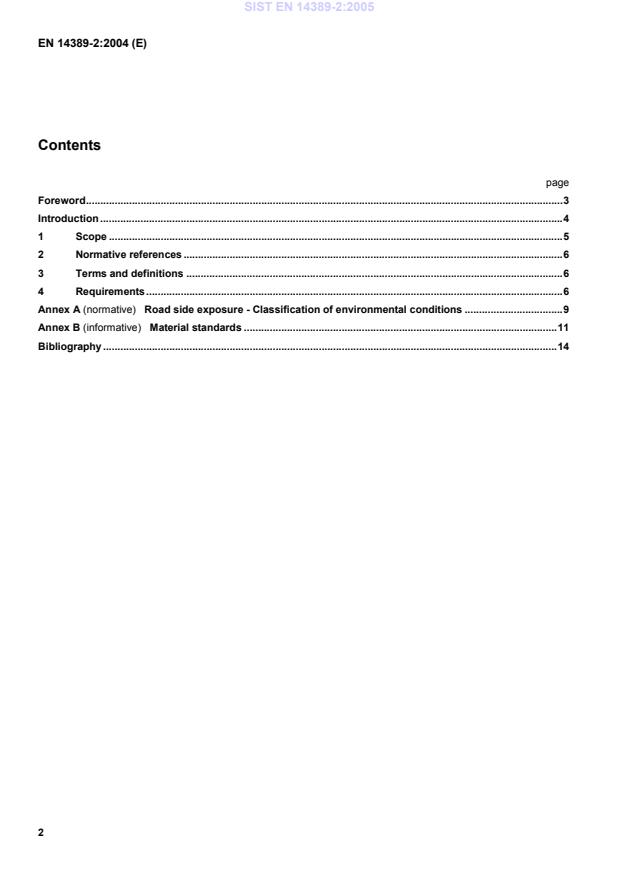
Road side exposure - Classification of environmental conditions.9 Annex B (informative)
Material standards.11 Bibliography.14
dependent II. De-icing salt Location/climate
Dependent III. Dirty water/dust Location/
Climate
dependent IV. Dew Climate
dependent V. Freeze/thaw Climate
dependent VI. Cold Climate
dependent VII. Heat Climate
dependent VIII. UV Radiation Climate
dependent IX. Traffic Vibration Location
dependent X. Biological Process Climate
dependent XI. Ozone Location
dependent XII. Water Climate
dependent XIII. Water spray Location
Wet/dry dependent SIST EN 14389-2:2005
structural elements elements whose primary function is to support or hold in place acoustic elements 3.2
acoustic elements elements whose primary function is to provide the acoustic performance of the device 3.3
working life period of time during which the performance of the device will be maintained which enables it to fulfil the performance characteristics as identified in EN 1794 parts 1 and 2 3.4
roadside exposure use of the product as a noise reducing device installed alongside a road 4 Requirements 4.1 General The structural design shall comply with the requirements of the appropriate European code. When assessed against the environmental conditions listed in Annex A of this document, the product shall satisfy the normative parts of road traffic noise reducing devices - non acoustic performance EN 1794 parts 1 and 2. 4.2 Structural elements All structural elements shall normally be designed to give a working life of 30 years under specific conditions, however, a longer or shorter life may be specified. SIST EN 14389-2:2005
...