


EN 368:1992
(Main)Protective clothing - Protection against liquid chemicals - Test method: Resistance of materials to penetration by liquids
Protective clothing - Protection against liquid chemicals - Test method: Resistance of materials to penetration by liquids
This European Standard is concerned with the application of the described method of test, usually with chemicals of low volatility. Clothing made of these materials is not for use as the sole means of protection where resistance to permeation by chemicals at the molecular level (see EN 369) is essential and where a complete barrier to liquid (or gaseous chemicals) is required (e.g. risk of exposure to massive and forceful discharges of concentrated liquid chemicals). Clothing which has been developed from materials selected by this method of test should be used therefore only in well-defined circumstances when an evaluation of the finished item has indicated an acceptable level of performance (e.g. in laboratory and field testing of a garment, consideration of exposure levels to specified chemicals etc.). Two levels of the potential performance of materials are assessed by the method of test to meet with possible requirements for protection against: a) deposition on the surface of a material, at minimal pressure, of spray droplets up to coalescence or occasional small drips; b) contamination by a single copious splash or low pressure jet, allowing sufficient time to divest the clothing or take other action as necessary to eliminate any hazard to the wearer from chemical retained by the protective garment, or, in circumstances where pressure is applied to liquid contaminants on the surface of the clothing material as a result of natural movements of the wearer (flexing of contaminated areas of clothing at arms, knees, shoulders) and contact with contaminated surfaces (e.g. walking through sprayed foliage).
Schutzkleidung - Schutz gegen flüssige Chemikalien - Prüfverfahren: Widerstand von Materialien gegen die Durchdringung von Flüssigkeiten
Diese europäische Norm betrifft die Anwendung des beschriebenen Prüfverfahrens unter Verwendung von Chemikalien mit meist niedriger Flüchtigkeit. Die aus den geprüften Materialien hergestellte Schutzkleidung ist nicht als alleiniges Schutzmittel anzuwenden, wenn die Festigkeit gegen Permeation von chemischen Stoffen auf molekularer Ebene (siehe prEN 369) von wesentlicher Bedeutung ist und wenn eine vollständige Barriere gegen flüssige (oder gasförmige chemische Stoffe) gefordert wird (z.B. Expositionsgefahr bei starker und kräftiger Freisetzung von konz. flüss. Chem.
Vêtements de protection - Protection contre les produits chimiques liquides - Méthode d'essai: Résistance des matériaux à la pénétration des liquides
Cette norme concerne l'application de la méthode d'essai décrite mettant généralement en jeu des produits chimiques de faible volatilité. Des vêtements réalisés avec de tels matériaux ne constituent pas le seul moyen de protection lorsque la résistance à la perméation par des produits chimiques à l'échelle moléculaire (voir EN 369) est essentielle et lorsqu'une barrière complète au liquide (ou aux produits chimiques gazeux) est nécessaire (par exemple risque d'exposition à des émissions massives et puissantes de produits chimiques liquides concentrés.
Zaščitna obleka - Zaščita pred učinki tekočih kemikalij - Preskusna metoda: Odpornost materialov na penetracijo tekočin
General Information
- Status
- Withdrawn
- Publication Date
- 29-Nov-1992
- Withdrawal Date
- 31-Jan-2005
- Current Stage
- 9960 - Withdrawal effective - Withdrawal
- Start Date
- 01-Feb-2005
- Completion Date
- 01-Feb-2005
- Directive
- 96/98/EC - Marine equipment
Relations
- Effective Date
- 22-Dec-2008



Get Certified
Connect with accredited certification bodies for this standard

NSF International
Global independent organization facilitating standards development and certification.

CIS Institut d.o.o.
Personal Protective Equipment (PPE) certification body. Notified Body NB-2890 for EU Regulation 2016/425 PPE.

Kiwa BDA Testing
Building and construction product certification.
Sponsored listings
Frequently Asked Questions
EN 368:1992 is a standard published by the European Committee for Standardization (CEN). Its full title is "Protective clothing - Protection against liquid chemicals - Test method: Resistance of materials to penetration by liquids". This standard covers: This European Standard is concerned with the application of the described method of test, usually with chemicals of low volatility. Clothing made of these materials is not for use as the sole means of protection where resistance to permeation by chemicals at the molecular level (see EN 369) is essential and where a complete barrier to liquid (or gaseous chemicals) is required (e.g. risk of exposure to massive and forceful discharges of concentrated liquid chemicals). Clothing which has been developed from materials selected by this method of test should be used therefore only in well-defined circumstances when an evaluation of the finished item has indicated an acceptable level of performance (e.g. in laboratory and field testing of a garment, consideration of exposure levels to specified chemicals etc.). Two levels of the potential performance of materials are assessed by the method of test to meet with possible requirements for protection against: a) deposition on the surface of a material, at minimal pressure, of spray droplets up to coalescence or occasional small drips; b) contamination by a single copious splash or low pressure jet, allowing sufficient time to divest the clothing or take other action as necessary to eliminate any hazard to the wearer from chemical retained by the protective garment, or, in circumstances where pressure is applied to liquid contaminants on the surface of the clothing material as a result of natural movements of the wearer (flexing of contaminated areas of clothing at arms, knees, shoulders) and contact with contaminated surfaces (e.g. walking through sprayed foliage).
This European Standard is concerned with the application of the described method of test, usually with chemicals of low volatility. Clothing made of these materials is not for use as the sole means of protection where resistance to permeation by chemicals at the molecular level (see EN 369) is essential and where a complete barrier to liquid (or gaseous chemicals) is required (e.g. risk of exposure to massive and forceful discharges of concentrated liquid chemicals). Clothing which has been developed from materials selected by this method of test should be used therefore only in well-defined circumstances when an evaluation of the finished item has indicated an acceptable level of performance (e.g. in laboratory and field testing of a garment, consideration of exposure levels to specified chemicals etc.). Two levels of the potential performance of materials are assessed by the method of test to meet with possible requirements for protection against: a) deposition on the surface of a material, at minimal pressure, of spray droplets up to coalescence or occasional small drips; b) contamination by a single copious splash or low pressure jet, allowing sufficient time to divest the clothing or take other action as necessary to eliminate any hazard to the wearer from chemical retained by the protective garment, or, in circumstances where pressure is applied to liquid contaminants on the surface of the clothing material as a result of natural movements of the wearer (flexing of contaminated areas of clothing at arms, knees, shoulders) and contact with contaminated surfaces (e.g. walking through sprayed foliage).
EN 368:1992 is classified under the following ICS (International Classification for Standards) categories: 13.340.10 - Protective clothing. The ICS classification helps identify the subject area and facilitates finding related standards.
EN 368:1992 has the following relationships with other standards: It is inter standard links to EN ISO 6530:2005. Understanding these relationships helps ensure you are using the most current and applicable version of the standard.
EN 368:1992 is associated with the following European legislation: EU Directives/Regulations: 2014/90/EU, 89/686/EEC, 96/98/EC; Standardization Mandates: M/BC/CEN/88/10. When a standard is cited in the Official Journal of the European Union, products manufactured in conformity with it benefit from a presumption of conformity with the essential requirements of the corresponding EU directive or regulation.
EN 368:1992 is available in PDF format for immediate download after purchase. The document can be added to your cart and obtained through the secure checkout process. Digital delivery ensures instant access to the complete standard document.
Standards Content (Sample)
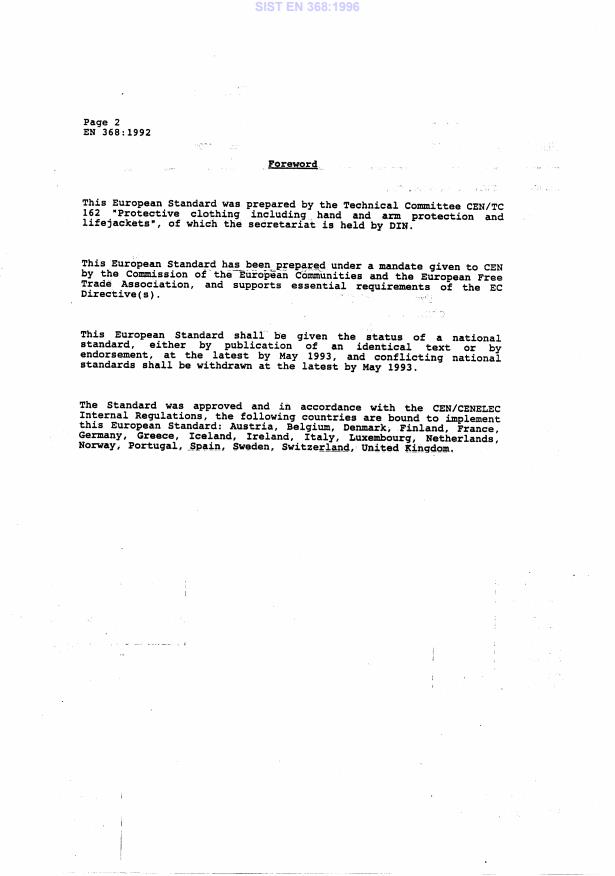
2003-01.Slovenski inštitut za standardizacijo. Razmnoževanje celote ali delov tega standarda ni dovoljeno.Schutzkleidung - Schutz gegen flüssige Chemikalien - Prüfverfahren: Widerstand von Materialien gegen die Durchdringung von FlüssigkeitenVetements de protection - Protection contre les produits chimiques liquides - Méthode d'essai: Résistance des matériaux a la pénétration des liquidesProtective clothing - Protection aga
...
Questions, Comments and Discussion
Ask us and Technical Secretary will try to provide an answer. You can facilitate discussion about the standard in here.
Loading comments...