

FprEN 18255
(Main)Soil improvers and growing media - Determination of organic nitrogen
- Abstract
This document specifies a method for the determination of the organic nitrogen content in soil improvers and growing media.
NOTE This method has been validated in an interlaboratory study with specific products that were present on the market during the study (as included in Annex A, being composted bark (20 mm to 40 mm), biowaste compost (Rottegrad 3), green compost (Rottegrad 5,0 mm to 15 mm), solid digestate and growing media blend 1: white peat, green compost, wood fibre, lime, inorganic fertilizer (NPK + micro elements))).
- Status
- Not Published
- Publication Date
- 09-Feb-2027
- Technical Committee
- CEN/TC 223 - Soil improvers and growing media
- Drafting Committee
- CEN/TC 223/WG 4 - Analytical methods
- Current Stage
- 5060 - Closure of Vote - Formal Approval
- Start Date
- 19-Nov-2026
- Due Date
- 15-Feb-2025
- Completion Date
- 15-Feb-2025

FprEN 18255 is a CEN draft European Standard for determining organic nitrogen in soil improvers and growing media. It specifies a calculation based on total nitrogen, CAT-extractable nitrogen and urea nitrogen, with urea measured by a spectrophotometric method after extraction. Laboratories, manufacturers and quality teams use it when they need a common test method for these materials.
What does FprEN 18255 specify?
FprEN 18255 specifies a method for determining the organic nitrogen content in soil improvers and growing media. Sampling is handled by EN 12579, and sample preparation and dry-matter correction are taken from prEN 13040-1.
The document is organized into scope, normative references, terms and definitions, principle, a detailed urea-nitrogen procedure, calculation and expression of results, test report requirements, and validation of the method. A scope note says the method was validated on market products including composted bark, biowaste compost, green compost, solid digestate, and a growing media blend with white peat, green compost, wood fibre, lime and inorganic fertilizer.
| Annex | What it covers |
|---|---|
| Annex A (informative) | Performance characteristics of the method from an interlaboratory study. |
What are the key requirements of FprEN 18255?
FprEN 18255 builds organic nitrogen from separate nitrogen measurements. In practice, users need total nitrogen, CAT-extractable nitrogen and urea nitrogen before they can calculate the final result.
Measuring urea nitrogen
- Clause 5 extracts the sample with water and a clarifying agent, filters the suspension, and reacts dissolved urea with 4-(dimethylamino)benzaldehyde (4-DMAB).
- The coloured product is measured at 435 nm, so a spectrophotometer is required.
- Clause 5.2 and 5.3 list the main reagents and equipment, including Carrez solutions, activated carbon, a horizontal shaker and a balance accurate to 0.001 g.
- Clause 5.4 says sampling is outside the method and refers users to EN 12579; the sample must be representative and unchanged by transport or storage.
- Clause 5.5 requires dried samples prepared according to prEN 13040-1 and gives the test-portion approach for unknown or highly staining samples.
- The urea result is corrected with dry matter data, so the laboratory needs the dry matter content of the 70 °C dried sample from prEN 13040-1.
Converting results to organic nitrogen
- Clause 4 states that organic nitrogen is calculated as total nitrogen minus CAT-extractable nitrogen.
- CAT-extractable nitrogen is the sum of ammonium nitrogen, nitrate nitrogen and urea nitrogen.
- Clause 6 combines total nitrogen from prEN 13654-1 or prEN 13654-2, CAT extraction from prEN 13651, and dry matter and laboratory bulk density from prEN 13040-1.
- Results below the limit of quantification are set to zero for the calculation, and individual results below the LOQ are not used.
- Clause 7 requires the report to identify the sample, give the result in g/kg sample as whole numbers, and record sampling information and any unusual operating details.
- Clause 8 and Annex A provide the validation basis, so users can see the method’s repeatability and reproducibility from interlaboratory testing.
What terms does FprEN 18255 define?
FprEN 18255 applies the terms and definitions of CEN/TS 17732:2022. The document also uses these key terms and abbreviations in the method and calculation.
- CAT - calcium chloride/DTPA extractable nutrients and elements, used for the extractable nitrogen part of the calculation.
- LOQ - limit of quantification; values below it are not carried into the calculation in the same way as measurable results.
- DM - dry matter content of the original sample, used to report results on a dry basis.
- 4-DMAB - 4-(dimethylamino)benzaldehyde, the reagent that forms the measured urea derivative.
- Urea nitrogen - the urea fraction determined in Clause 5 and included in the CAT-extractable nitrogen sum.
- Repeatability - closeness of results under the same conditions, used in Annex A to describe method precision.
- Reproducibility - closeness of results between laboratories, also reported in Annex A.
Who uses FprEN 18255?
FprEN 18255 is used by laboratories that test soil improvers and growing media for product control, incoming inspection or specification checks. It is also relevant to manufacturers, buyers and quality managers who need comparable nitrogen results across lots, suppliers or test reports.
The method is especially useful for organizations handling composted materials, digestates and blended growing media, because Annex A validates the method on five such materials. Certification and regulatory teams can also use it when they need a documented procedure and a defined reporting format.
Which standards are used with FprEN 18255?
| Standard | What it contributes |
|---|---|
| CEN/TS 17732:2022 | Terms and definitions for soil improvers and growing media. |
| EN 12579:2024 | Sampling of soil improvers and growing media. |
| prEN 13040-1:2025 | Sample preparation, dry matter content, moisture content and laboratory bulk density. |
| prEN 13651:2025 | CAT extraction for soluble nutrients and elements used in the calculation. |
| prEN 13654-1:2025 | Total nitrogen by the modified Kjeldahl method. |
| prEN 13654-2:2025 | Total nitrogen by the Dumas method. |
| ISO 5725-2 | Accuracy, repeatability and reproducibility framework used for validation. |
| EN 15604 and CEN/TS 17771 | Other nitrogen-determination methods mentioned as alternatives for urea or nitrogen analysis. |
What does the FprEN 18255 document contain?
FprEN 18255 contains a wet-chemical spectrophotometric procedure for urea nitrogen, including extraction, clarification, filtration, calibration and measurement at 435 nm. It also contains the calculation formulas that turn the measured urea value, total nitrogen and CAT-extractable nitrogen into organic nitrogen on a dry-matter basis.
Clause 7 gives the test report items, so laboratories know what to record and report. Clause 8 and Annex A summarize the validation work, including the interlaboratory study and the precision data in Tables A.1 and A.2.
Get Certified
Connect with accredited certification bodies for this standard

Control Union Certifications
Global certification for agriculture and sustainability.

ECOCERT
Organic and sustainability certification.

FSC International
Forest Stewardship Council certification.
Sponsored listings
Frequently Asked Questions
FprEN 18255 is a draft published by the European Committee for Standardization (CEN). Its full title is "Soil improvers and growing media - Determination of organic nitrogen". This standard covers: This document specifies a method for the determination of the organic nitrogen content in soil improvers and growing media. NOTE This method has been validated in an interlaboratory study with specific products that were present on the market during the study (as included in Annex A, being composted bark (20 mm to 40 mm), biowaste compost (Rottegrad 3), green compost (Rottegrad 5,0 mm to 15 mm), solid digestate and growing media blend 1: white peat, green compost, wood fibre, lime, inorganic fertilizer (NPK + micro elements))).
This document specifies a method for the determination of the organic nitrogen content in soil improvers and growing media. NOTE This method has been validated in an interlaboratory study with specific products that were present on the market during the study (as included in Annex A, being composted bark (20 mm to 40 mm), biowaste compost (Rottegrad 3), green compost (Rottegrad 5,0 mm to 15 mm), solid digestate and growing media blend 1: white peat, green compost, wood fibre, lime, inorganic fertilizer (NPK + micro elements))).
FprEN 18255 is classified under the following ICS (International Classification for Standards) categories: 65.080 - Fertilizers. The ICS classification helps identify the subject area and facilitates finding related standards.
FprEN 18255 is associated with the following European legislation: EU Directives/Regulations: 2003/2003, 2019/1009; Standardization Mandates: M/564, M/564 Amd 1, M/564 Amd 2, M/588, M/XXX. When a standard is cited in the Official Journal of the European Union, products manufactured in conformity with it benefit from a presumption of conformity with the essential requirements of the corresponding EU directive or regulation.
FprEN 18255 is available in PDF format for immediate download after purchase. The document can be added to your cart and obtained through the secure checkout process. Digital delivery ensures instant access to the complete standard document.
Standards Content (Sample)
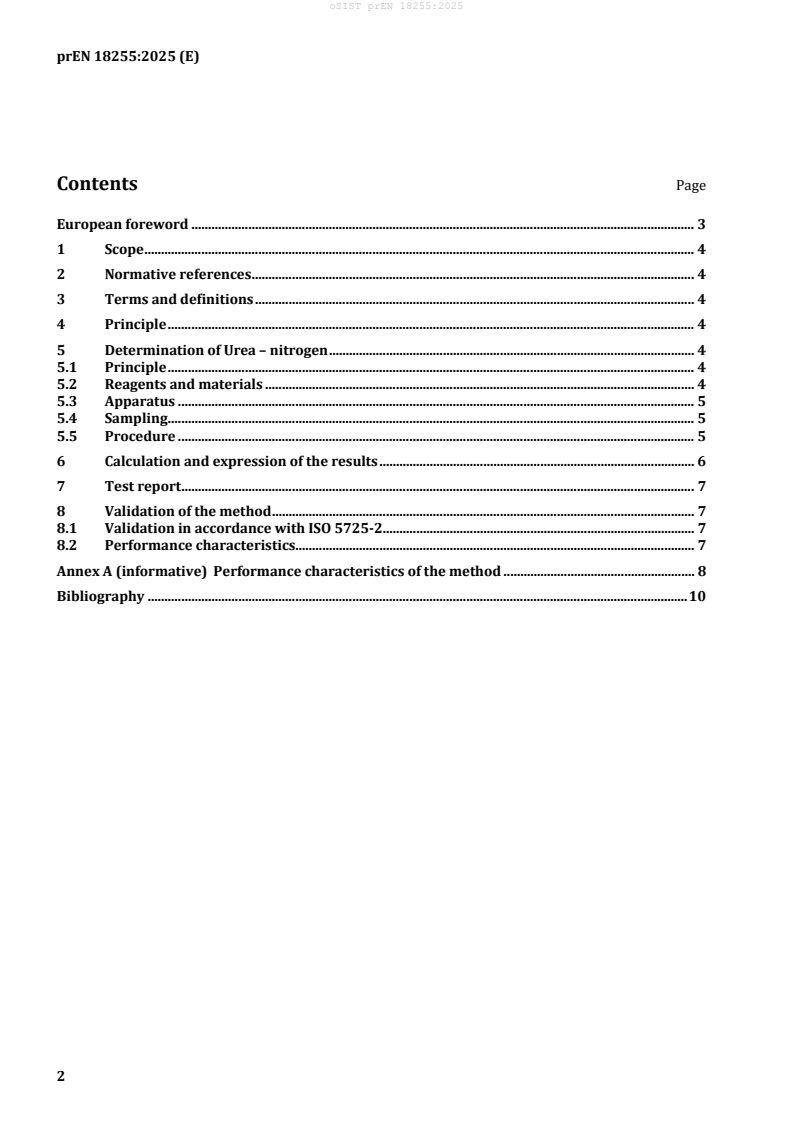
Contents
- 1 Scope
- 2 Normative references
- 3 Terms and definitions
- 4 Principle
- 5 Determination of Urea – nitrogen
- 5.1 Principle
- 5.2 Reagents and materials
- 5.3 Apparatus
- 5.4 Sampling
- 5.5 Procedure
- 6 Calculation and expression of the results
- 7 Test report
- 8 Validation of the method
- 8.2 Performance characteristics
- Annex A
- Bibliography
1 Scope
This document specifies a method for the determination of the organic nitrogen content in organic soil improvers.
2 Normative references
The following documents are referred to in the text in such a way that some or all of their content constitutes requirements of this document. For dated references, only the edition cited applies. For undated references, the latest edition of the referenced document (including any amendments) applies. CEN/TS 17732:2022, Soil improvers and growing media - Terminology EN 12579:2024, Soil improvers and growing media - Sampling prEN 13040-1:2025, Soil improvers and growing media — Sample preparation — Part 1: Sample preparation for chemical and physical tests, determination of dry matter content, moisture content and laboratory bulk density prEN 13651:2025, Soil improvers and growing media — Extraction of calcium chloride/DTPA (CAT) soluble nutrients and elements prEN 13654-1:2025, Soil improvers and growing media — Determination of nitrogen — Part 1: Modified Kjeldahl method prEN 13654-2:2025, Soil improvers and growing media — Determination of nitrogen — Part 2: Dumas method
3 Terms and definitions
For the purposes of this document, the terms and definitions given in CEN/TS 17732:2022 apply.
4 Principle
The content of organic nitrogen is calculated as the difference of the total nitrogen content and the content of CAT extractable nitrogen calculated as the sum of ammonium nitrogen, nitrate nitrogen and the urea nitrogen determined as described in this document.
5 Determination of Urea – nitrogen
5.1 Principle
The sample is extracted with water with the addition of a clarifying agent. The suspension is filtered. The urea that has gone into solution is converted in the filtrate by the addition of 4- dimethylaminobenzaldehyde (4-DMAB) into a urea-aldehyde condensation compound, the absorbance of which is measured at 435 nm.
NOTE Additionally to the method described, other methods for the determination of urea nitrogen are possible, e.g. CEN/TS 17771 or EN 15604.
5.2 Reagents and materials
5.2.1 Ethanol (C H OH), 96 %.
2 5 5.2.2 Hydrochloric acid (HCl) = 37 %; (HCl) = 1,19 g/ml.
oSIST prEN 18255:2025 prEN 18255:2025 (E) 5.2.3 4-(Dimethylamino)benzaldehyde (C H NO) (DMBA).
9 11 5.2.4 4-Dimethylaminobenzaldehyde solution: dissolve 1,6 g DMAB (5.2.3) in 100 ml ethanol (5.2.1) and add 10 ml hydrochloric acid (5.2.2). The solution is stable for 2 weeks. 5.2.5 Zinc acetate dihydrate [Zn(CH COO) × 2 H O].
3 2 2 5.2.6 Acetic acid (CH COOH = 100 %).
5.2.7 Carrez solution I: dissolve 240 g zinc acetate dihydrate (5.2.5) and 30 g acetic acid (5.2.6) in water and make up to 1000 ml with water. The solution shall be kept tightly closed and can be stored indefinitely.
5.2.8 Potassium ferrocyanide(II) [K4[Fe(CN)6] x 3 H2O].
5.2.9 Carrez solution II: dissolve 106 g potassium ferrocyanide(II) (5.2.8) in water and make up to 1000 ml with water. The solution shall be kept tightly closed and has an unlimited shelf life. 5.2.10 Activated carbon (shall not adsorb urea).
5.2.11 Urea [(NH ) CO].
2 2
5.2.12 Urea stock solution, [(NH ) CO] = 1 mg/ml: dissolve 500 mg urea (5.2.11) in water and make
2 2 up to 500 ml. The solution is stable for 6 months.
5.2.13 Calibration solutions: in a series of six 100 ml volumetric flasks add aliquots of 0 ml, 1 ml (1 mg), 2 ml (2 mg), 4 ml (4 mg), 5 ml (5 mg) and 10 ml (10 mg) of the urea stock solution (5.2.12). Then fill the volumetric flask with water and homogenize the solution thoroughly. 5.2.14 Filter (pleated), mean pore diameter 2,4 µm.
5.3 Apparatus
5.3.1 Spectrophotometer.
5.3.2 Balance, with a required accuracy of 0,001 g.
5.3.3 Horizontal shaker.
...