


EN ISO 4865-1:2023
(Main)Dentistry - General requirements of hand instruments - Part 1: Non-hinged hand instruments (ISO 4865-1:2023)
Dentistry - General requirements of hand instruments - Part 1: Non-hinged hand instruments (ISO 4865-1:2023)
This document specifies requirements and test methods common to all non-hinged hand instruments used in dentistry, including materials, hardness, surface finish, resistance to reprocessing and information for marking, although some can have additional specific requirements and test methods.
This document does not specify terms and definitions or classification of specific types of hand instruments.
This document excludes powered instruments. The classification and the shape of working ends of non-hinged hand instruments are excluded from this document.
Zahnheilkunde - Allgemeine Anforderungen an Handinstrumente - Teil 1: Gelenklose Handinstrumente (ISO 4865-1:2023)
Dieses Dokument legt Anforderungen und Prüfverfahren für alle in der Zahnheilkunde verwendeten gelenklosen Handinstrumente fest, einschließlich Werkstoff, Härte, Oberflächenbeschaffenheit, Beständigkeit gegen Wiederaufbereitung und Informationen zur Kennzeichnung. Für einige Instrumente können jedoch zusätzliche spezifische Anforderungen und Prüfverfahren gelten.
Dieses Dokument legt keine Begriffe fest oder klassifiziert bestimmte Arten von Handinstrumenten.
Dieses Dokument gilt nicht für elektrisch betriebene Instrumente. Die Klassifizierung und die Form der Arbeitsenden der gelenklosen Handinstrumente sind nicht Gegenstand dieses Dokuments.
Médecine bucco-dentaire - Exigences générales relatives aux instruments à main - Partie 1: Instruments à main non articulés (ISO 4865-1:2023)
Le présent document spécifie des exigences et méthodes d’essai communes à tous les instruments à main non articulés utilisés en médecine bucco-dentaire, y compris les matériaux, la dureté, le fini de surface, la résistance au retraitement, ainsi que des informations relatives au marquage. Néanmoins il se peut que certains instruments présentent des exigences et méthodes d’essai additionnelles spécifiques.
Le présent document ne spécifie pas de termes et définitions ni de classification des types spécifiques d’instruments à main.
Il ne traite pas des instruments électriques. La classification et la forme des extrémités utiles des instruments à main non articulés ne sont pas abordées dans le présent document.
Zobozdravstvo - Splošne zahteve za ročne instrumente - 1. del: Ročni instrumenti brez tečajev (ISO 4865-1:2023)
Ta dokument določa zahteve in preskusne metode za vse zobozdravstvene ročne instrumente brez tečajev, vključno z materiali, trdoto, površinsko obdelavo, odpornostjo proti ponovni obdelavi in informacijami za označevanje. Ne določa izrazov in definicij oziroma klasifikacije posebnih vrst ročnih instrumentov. Ta dokument izključuje električne instrumente.
General Information
Overview - EN ISO 4865-1:2023 (Non-hinged hand instruments)
EN ISO 4865-1:2023 (adopted by CEN) defines general requirements and test methods common to all non-hinged hand instruments used in dentistry. The standard covers material selection, surface finish, hardness, resistance to reprocessing, dimensional checks, mechanical tests and information for marking, labelling and packaging. It applies to rigid manual dental devices (examples: explorers, scalers, curettes, spoons, spatulas, mirrors) and intentionally excludes powered instruments, classification or the specific shape of working ends, and detailed terminology (see ISO 1942).
Key topics and technical requirements
- Materials: Manufacturer’s choice provided performance criteria are met; stainless steel examples referenced via ISO 21850-1.
- Handle and design: Shape of handles is at manufacturer discretion but must comply with performance and reprocessing requirements.
- Surface finish: Requirements for surface condition to ensure safety, cleanability and durability.
- Resistance to reprocessing: Tests and acceptance criteria for repeated cleaning, disinfection and sterilization.
- Hardness testing: Vickers and Rockwell hardness methods specified (see ISO 6507-1 and ISO 6508-1).
- Mechanical tests: Tensile strength and torque strength test methods and reporting requirements.
- Measurements and inspection: Visual inspection, dimensional verification and defined test procedures.
- Marking, labelling and packaging: Mandatory marking and labelling information, traceability and packaging to support sterile processing and clinical use.
- Instructions for use: Manufacturer information required for safe processing and handling (linked to ISO 17664-1/2 and ISO 20417).
Practical applications - who uses this standard
- Manufacturers and product designers of dental hand instruments - to design, test and document compliance for product launches.
- Quality assurance and regulatory teams - to implement harmonized test methods and demonstrate conformity with EU/national rules.
- Test laboratories and certification bodies - to perform specified hardness, tensile and torque tests and reprocessing assessments.
- Dental clinics and procurement - to specify instruments that meet harmonized requirements for durability, reprocessing and labelling.
- R&D and materials engineers - to select appropriate steels and surface treatments that meet performance criteria.
Related standards
- ISO 1942 (vocabulary), ISO 6507-1 (Vickers), ISO 6508-1 (Rockwell), ISO 15223-1 (symbols), ISO 17664-1/2 (processing information), ISO 20417 (manufacturer information), ISO 21850-1 (stainless steel examples).
EN ISO 4865-1:2023 promotes harmonization of dental instrument requirements, improving patient safety, reprocessing reliability and regulatory clarity for non-hinged dental hand instruments.
Frequently Asked Questions
EN ISO 4865-1:2023 is a standard published by the European Committee for Standardization (CEN). Its full title is "Dentistry - General requirements of hand instruments - Part 1: Non-hinged hand instruments (ISO 4865-1:2023)". This standard covers: This document specifies requirements and test methods common to all non-hinged hand instruments used in dentistry, including materials, hardness, surface finish, resistance to reprocessing and information for marking, although some can have additional specific requirements and test methods. This document does not specify terms and definitions or classification of specific types of hand instruments. This document excludes powered instruments. The classification and the shape of working ends of non-hinged hand instruments are excluded from this document.
This document specifies requirements and test methods common to all non-hinged hand instruments used in dentistry, including materials, hardness, surface finish, resistance to reprocessing and information for marking, although some can have additional specific requirements and test methods. This document does not specify terms and definitions or classification of specific types of hand instruments. This document excludes powered instruments. The classification and the shape of working ends of non-hinged hand instruments are excluded from this document.
EN ISO 4865-1:2023 is classified under the following ICS (International Classification for Standards) categories: 11.060.20 - Dental equipment. The ICS classification helps identify the subject area and facilitates finding related standards.
You can purchase EN ISO 4865-1:2023 directly from iTeh Standards. The document is available in PDF format and is delivered instantly after payment. Add the standard to your cart and complete the secure checkout process. iTeh Standards is an authorized distributor of CEN standards.
Standards Content (Sample)
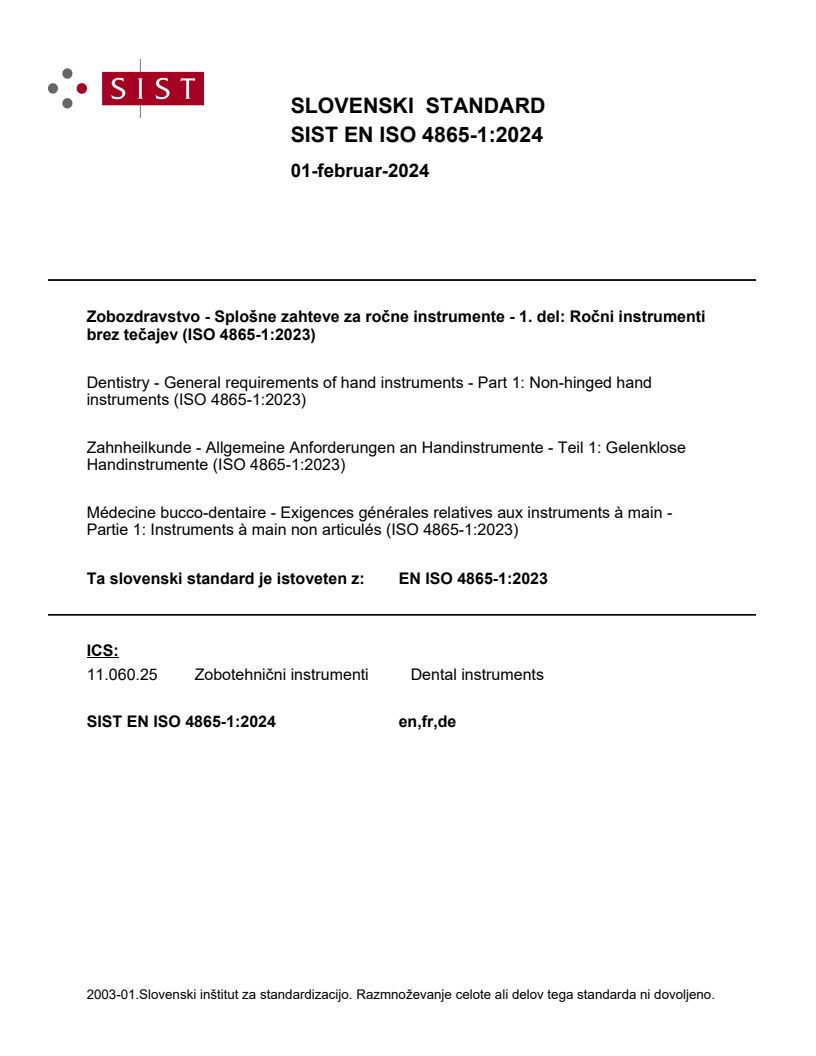
SLOVENSKI STANDARD
01-februar-2024
Zobozdravstvo - Splošne zahteve za ročne instrumente - 1. del: Ročni instrumenti
brez tečajev (ISO 4865-1:2023)
Dentistry - General requirements of hand instruments - Part 1: Non-hinged hand
instruments (ISO 4865-1:2023)
Zahnheilkunde - Allgemeine Anforderungen an Handinstrumente - Teil 1: Gelenklose
Handinstrumente (ISO 4865-1:2023)
Médecine bucco-dentaire - Exigences générales relatives aux instruments à main -
Partie 1: Instruments à main non articulés (ISO 4865-1:2023)
Ta slovenski standard je istoveten z: EN ISO 4865-1:2023
ICS:
11.060.25 Zobotehnični instrumenti Dental instruments
2003-01.Slovenski inštitut za standardizacijo. Razmnoževanje celote ali delov tega standarda ni dovoljeno.
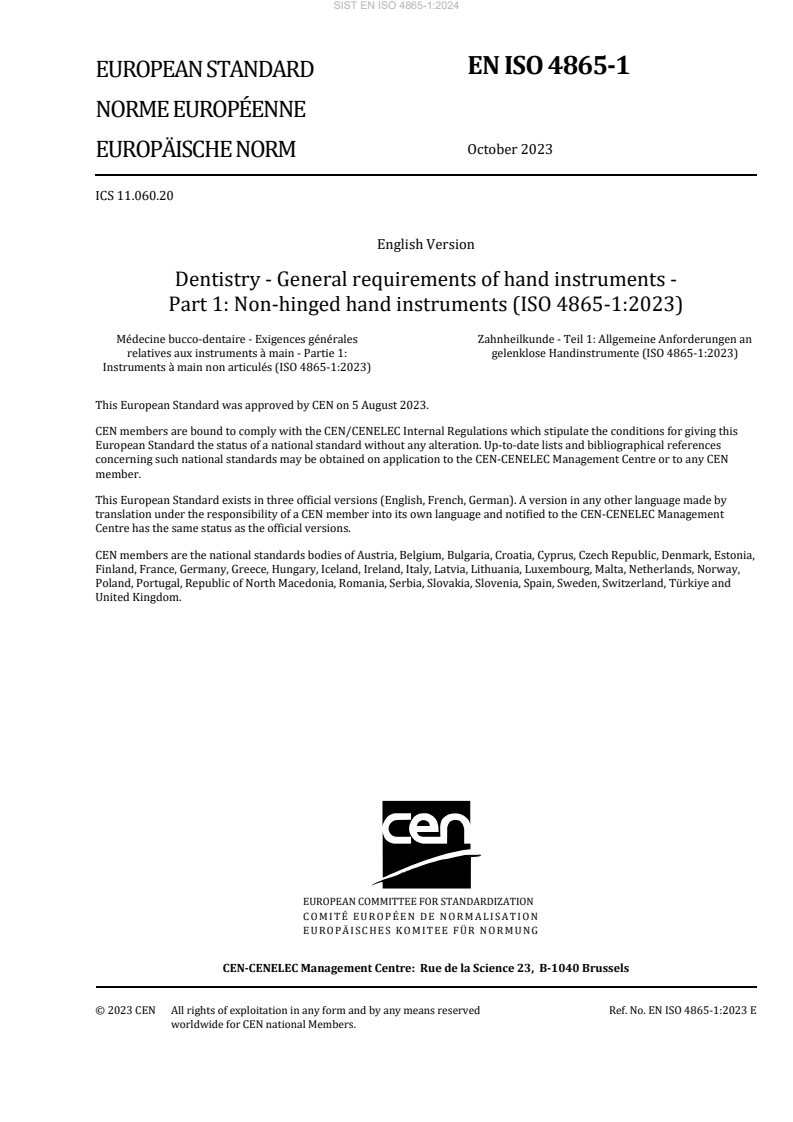
EN ISO 4865-1
EUROPEAN STANDARD
NORME EUROPÉENNE
October 2023
EUROPÄISCHE NORM
ICS 11.060.20
English Version
Dentistry - General requirements of hand instruments -
Part 1: Non-hinged hand instruments (ISO 4865-1:2023)
Médecine bucco-dentaire - Exigences générales Zahnheilkunde - Teil 1: Allgemeine Anforderungen an
relatives aux instruments à main - Partie 1: gelenklose Handinstrumente (ISO 4865-1:2023)
Instruments à main non articulés (ISO 4865-1:2023)
This European Standard was approved by CEN on 5 August 2023.
CEN members are bound to comply with the CEN/CENELEC Internal Regulations which stipulate the conditions for giving this
European Standard the status of a national standard without any alteration. Up-to-date lists and bibliographical references
concerning such national standards may be obtained on application to the CEN-CENELEC Management Centre or to any CEN
member.
This European Standard exists in three official versions (English, French, German). A version in any other language made by
translation under the responsibility of a CEN member into its own language and notified to the CEN-CENELEC Management
Centre has the same status as the official versions.
CEN members are the national standards bodies of Austria, Belgium, Bulgaria, Croatia, Cyprus, Czech Republic, Denmark, Estonia,
Finland, France, Germany, Greece, Hungary, Iceland, Ireland, Italy, Latvia, Lithuania, Luxembourg, Malta, Netherlands, Norway,
Poland, Portugal, Republic of North Macedonia, Romania, Serbia, Slovakia, Slovenia, Spain, Sweden, Switzerland, Türkiye and
United Kingdom.
EUROPEAN COMMITTEE FOR STANDARDIZATION
COMITÉ EUROPÉEN DE NORMALISATION
EUROPÄISCHES KOMITEE FÜR NORMUNG
CEN-CENELEC Management Centre: Rue de la Science 23, B-1040 Brussels
© 2023 CEN All rights of exploitation in any form and by any means reserved Ref. No. EN ISO 4865-1:2023 E
worldwide for CEN national Members.
Contents Page
European foreword . 3
European foreword
This document (EN ISO 4865-1:2023) has been prepared by Technical Committee ISO/TC 106
"Dentistry" in collaboration with Technical Committee CEN/TC 55 “Dentistry” the secretariat of which
is held by DIN.
This European Standard shall be given the status of a national standard, either by publication of an
identical text or by endorsement, at the latest by April 2024, and conflicting national standards shall be
withdrawn at the latest by April 2024.
Attention is drawn to the possibility that some of the elements of this document may be the subject of
patent rights. CEN shall not be held responsible for identifying any or all such patent rights.
Any feedback and questions on this document should be directed to the users’ national standards
body/national committee. A complete listing of these bodies can be found on the CEN website.
According to the CEN-CENELEC Internal Regulations, the national standards organizations of the
following countries are bound to implement this European Standard: Austria, Belgium, Bulgaria,
Croatia, Cyprus, Czech Republic, Denmark, Estonia, Finland, France, Germany, Greece, Hungary, Iceland,
Ireland, Italy, Latvia, Lithuania, Luxembourg, Malta, Netherlands, Norway, Poland, Portugal, Republic of
North Macedonia, Romania, Serbia, Slovakia, Slovenia, Spain, Sweden, Switzerland, Türkiye and the
United Kingdom.
Endorsement notice
The text of ISO 4865-1:2023 has been approved by CEN as EN ISO 4865-1:2023 without any
modification.
INTERNATIONAL ISO
STANDARD 4865-1
First edition
2023-10
Dentistry — General requirements of
hand instruments —
Part 1:
Non-hinged hand instruments
Médecine bucco-dentaire — Exigences générales relatives aux
instruments à main —
Partie 1: Instruments à main non articulés
Reference number
ISO 4865-1:2023(E)
ISO 4865-1:2023(E)
© ISO 2023
All rights reserved. Unless otherwise specified, or required in the context of its implementation, no part of this publication may
be reproduced or utilized otherwise in any form or by any means, electronic or mechanical, including photocopying, or posting on
the internet or an intranet, without prior written permission. Permission can be requested from either ISO at the address below
or ISO’s member body in the country of the requester.
ISO copyright office
CP 401 • Ch. de Blandonnet 8
CH-1214 Vernier, Geneva
Phone: +41 22 749 01 11
Email: copyright@iso.org
Website: www.iso.org
Published in Switzerland
ii
ISO 4865-1:2023(E)
Contents Page
Foreword .iv
Introduction .v
1 Scope . 1
2 Normative references . 1
3 Terms and definitions . 1
4 Requirements . 2
4.1 Materials . 2
4.2 Handle . 2
4.3 Surface finish . 2
4.4 Dimensions . 2
4.5 Resistance against reprocessing . 2
4.6 Vickers and Rockwell hardness . 2
4.7 Tensile strength . 2
4.8 Torque strength . 3
5 Measurements and test method .3
5.1 Visual inspection . 3
5.2 Dimensions . 3
5.3 Resistance against reprocessing . 3
5.4 Vickers and Rockwell hardness . 3
5.5 Tensile test . 4
5.5.1 Principle . 4
5.5.2 Apparatus . 4
5.5.3 Procedure . 4
5.5.4 Expression of results . 4
5.6 Torque test. 4
5.6.1 Principle . 4
5.6.2 Apparatus . 4
5.6.3 Procedure . 4
5.6.4 Expression of results . 4
6 Marking, labelling and packaging .4
6.1 General . 4
6.2 Marking . 4
6.3 Labelling . 5
7 Instructions for use . .5
Bibliography . 6
iii
ISO 4865-1:2023(E)
Foreword
ISO (the International Organization for Standardization) is a worldwide federation of national standards
bodies (ISO member bodies). The work of preparing International Standards is normally carried out
through ISO technical committees. Each member body interested in a subject for which a technical
committee has been established has the right to be represented on that committee. International
organizations, governmental and non-governmental, in liaison with ISO, also take part in the work.
ISO collaborates closely with the International Electrotechnical Commission (IEC) on all matters of
electrotechnical standardization.
The procedures used to develop this document and those intended for its further maintenance are
described in the ISO/IEC Directives, Part 1. In particular, the different approval criteria needed for the
different types of ISO document should be noted. This document was drafted in accordance with the
editorial rules of the ISO/I
...
EN ISO 4865-1:2023は、歯科用の非ヒンジ式手用器具に関する標準化文書であり、この分野における手用器具の一般的な要件を明確に規定しています。この標準の範囲は、材料、硬度、表面仕上げ、再加工への耐性、マーキングに関する情報を含む、すべての非ヒンジ式手用器具に共通する要件と試験方法に及びます。 この標準の強みは、幅広い適用性を持つ一般的な要件を提供している点です。例えば、歯科治療における器具の安全性や効率を確保するために求められる材料や表面の質などが明記されており、これにより製造業者は必要な基準を遵守しやすくなります。また、再加工への耐性に関する要求は、持続可能な歯科医療の実現に貢献しています。 さらに、EN ISO 4865-1:2023は、手用器具の設計や形状、特定の器具タイプの分類には言及しておらず、これにより標準自体の焦点は非常に明瞭です。これは、製品開発や品質管理のプロセスにおいて重要な柔軟性をもたらす一方で、非ヒンジ式手用器具の適切な評価や標準化に向けた一貫性を促進します。 仕上げに関する具体的要件や試験方法が必要な場合は、別途特定の標準を参照する必要がありますが、EN ISO 4865-1:2023は、基礎となる大枠を提供する重要な文書であり、歯科技術者や製造業者にとって価値あるガイドラインとなっています。この標準の適用により、患者に提供される歯科サービスの質が向上することが期待されます。
The EN ISO 4865-1:2023 standard establishes a comprehensive framework for evaluating and ensuring the quality of non-hinged hand instruments utilized within the field of dentistry. Its scope effectively encompasses all essential requirements and standardized test methods applicable to these instruments, thereby promoting reliable and safe dental practices. One of the major strengths of this standard lies in its detailed specification of material requirements, hardness, and surface finish, which are critical to the performance and longevity of dental instruments. By addressing these elements, the standard ensures that practitioners can rely on the instruments for effective treatment without compromising on safety or efficacy. Furthermore, the EN ISO 4865-1:2023 standard emphasizes the importance of resistance to reprocessing, which is vital for maintaining the hygienic integrity of non-hinged hand instruments after they have been used. This focus on reprocessing aligns with contemporary best practices within the dental industry, highlighting the standard’s relevance in an era where infection control and instrument usability are paramount. While the document does not delve into terms and definitions or classification specifics of hand instruments, its clear delineation of general requirements allows manufacturers and professionals to easily adhere to best practices. Additionally, by excluding powered instruments, the standard maintains a focused approach that enhances clarity for users of non-hinged tools in dental settings. In summary, the EN ISO 4865-1:2023 standard stands out for its comprehensive treatment of non-hinged hand instruments in dentistry, offering robust guidelines that bolster quality, safety, and effectiveness. Its relevance in reinforcing procedural standards cannot be overstated, as it plays a crucial role in the ongoing advancement of dental instrument reliability.
La norme ***EN ISO 4865-1:2023***, intitulée "Dentisterie - Exigences générales des instruments à main - Partie 1 : Instruments à main non articulés", établit des exigences et des méthodes d'essai qui sont essentielles pour garantir la qualité et la sécurité des instruments dentaires non articulés. Le champ d'application de cette norme est particulièrement pertinent car il couvre tous les instruments manuels non articulés utilisés en dentisterie, abordant des critères essentiels tels que les matériaux, la dureté, la finition de surface, ainsi que la résistance au retraitement. Ces exigences garantissent non seulement la durabilité des instruments mais aussi leur efficacité lors des traitements dentaires. Par ailleurs, la norme précise les informations de marquage nécessaires, ce qui est crucial pour la traçabilité et la conformité des produits sur le marché. Parmi les points forts de cette norme, on peut souligner qu'elle ne se limite pas aux exigences générales mais inclut également des méthodes d'essai qui permettent de vérifier la conformité des instruments. Cela contribue à un haut niveau de confiance pour les praticiens dentaires qui utilisent ces outils, sachant qu’ils répondent aux critères de qualité établis. Cependant, il est important de noter que cette norme exclut les instruments motorisés et ne définit pas les termes ou la classification de types spécifiques d'instruments à main. Cela permet de maintenir une concentration sur les instruments non articulés tout en laissant la porte ouverte à d'autres normes ou documents qui pourraient aborder ces aspects de manière complémentaire. En résumé, la norme ***EN ISO 4865-1:2023*** est un document fondamental pour l'industrie dentaire, établissant des exigences claires pour les instruments à main non articulés, ce qui renforce leur sécurité, leur efficacité et leur conformité aux standards élevés de qualité requis dans les pratiques dentaires.
EN ISO 4865-1:2023 표준은 치의학의 비히든 핸드 기구에 대한 일반 요구 사항을 규정하고 있습니다. 이 문서는 치과에서 사용되는 모든 비히든 핸드 기구에 공통적으로 적용되는 요구 사항과 시험 방법을 명확히 하고 있으며, 여기에는 재료, 경도, 표면 마감, 재처리에 대한 저항성 및 표기 정보를 포함합니다. 이러한 범위는 비히든 핸드 기구의 안전성과 효율성을 보장하기 위한 기본 토대를 제공합니다. 이 표준의 강점 중 하나는 다양한 종류의 비히든 핸드 기구가 다양한 환경에서 효과적으로 사용될 수 있도록 설계된 요구 사항을 포함하고 있다는 점입니다. 이를 통해 치과 의사와 환자 모두의 안전을 확보하는 동시에, 다양한 기구의 신뢰성을 높이는 데 기여하고 있습니다. 또한, 검증된 시험 방법을 제공함으로써 장비 제조업체들이 일관된 품질을 유지할 수 있도록 지원합니다. 이 문서는 특정 핸드 기구의 용어 및 정의나 분류를 명시하지 않으며, 전동 기구를 제외하는 점도 중요한 사항입니다. 이는 비히든 핸드 기구와 그 사용에 특화된 기준을 세우는 데 도움을 주며, 특정 기구 형태나 용도에 대한 혼란을 줄이는 데 기여합니다. 표준의 명확한 구조는 제조업체와 사용자 간의 이해를 증진시키며, 치과 기구의 품질을 높이는 데 필요한 필수 기준을 제공합니다. EN ISO 4865-1:2023 표준은 치과 분야에서 비히든 핸드 기구의 품질과 안전성을 확보하기 위한 필수 문서로, 치과 기기 개발 및 품질 관리에 있어 매우 중요한 역할을 할 것입니다. 이러한 표준의 유효함과 관련성은 치의학의 발전에 기여하며, 더 나은 환자 치료 결과를 도출하는 데 도움을 줄 것입니다.
Das Dokument SIST EN ISO 4865-1:2024 legt die allgemeinen Anforderungen an nicht-gegliederte Handinstrumente in der Zahnheilkunde fest. Die Norm bietet einen umfassenden Rahmen für die Qualitätssicherung und -kontrolle dieser Instrumente und ist von erheblicher Bedeutung für die zahnmedizinische Praxis. Ein wesentlicher Aspekt der Norm ist die Festlegung von Anforderungen und Testmethoden für alle nicht-gegliederte Handinstrumente, einschließlich Materialien, Härte, Oberflächenfinish und Widerstandsfähigkeit gegenüber der Aufbereitung. Diese Anforderungen sind entscheidend, um sicherzustellen, dass die verwendeten Instrumente sowohl langlebig als auch sicher für die Patienten sind. Die Norm dokumentiert eine klare Richtung für die Hersteller, die sicherstellen möchten, dass ihre Produkte den festgelegten Standards entsprechen. Die Stärken der EN ISO 4865-1:2023 liegen nicht nur in der genauen Spezifizierung der Anforderungen, sondern auch in der Berücksichtigung wichtiger Faktoren wie der Kennzeichnung von Instrumenten. Diese Informationen sind für die Rückverfolgbarkeit und die Gewährleistung der Sicherheit von entscheidender Bedeutung. Die Norm fördert auch die Standardisierung innerhalb der Branche, was zur Vereinheitlichung in der zahnmedizinischen Praxis beiträgt. Es ist ebenso bemerkenswert, dass die Norm nicht-gegliederte Handinstrumente definiert, ohne spezifische Begriffe oder Klassifikationen einzubringen. Dies ermöglicht eine breitere Anwendbarkeit und Flexibilität, da Hersteller unterschiedliche Instrumententypen unter denselben Rahmenbedingungen entwickeln können. Auch wenn elektrische Instrumente von dieser Norm ausgeschlossen sind, bleibt der Fokus auf der Qualität und den Sicherheitsaspekten für nicht-gegliederte Handinstrumente klar und präzise. Insgesamt ist die EN ISO 4865-1:2023 ein entscheidendes Dokument für die zahnmedizinische Industrie, das die Anforderungen an nicht-gegliederte Handinstrumente regelt. Ihre umfassenden Richtlinien und Prüfstandards tragen nicht nur zur Sicherheit der Patienten bei, sondern fördern auch beständige Qualität und Innovation in der Entwicklung von zahnärztlichen Instrumenten.
Questions, Comments and Discussion
Ask us and Technical Secretary will try to provide an answer. You can facilitate discussion about the standard in here.
Loading comments...