


EN 12730:2015
(Main)Flexible sheets for waterproofing - Bitumen, plastic and rubber sheets for roof waterproofing - Determination of resistance to static loading
Flexible sheets for waterproofing - Bitumen, plastic and rubber sheets for roof waterproofing - Determination of resistance to static loading
This European Standard specifies a test for puncture by static loading for roofing membranes. Mechanical stress on membranes varies from static long-term loads to dynamic short-term loads. This method represents the static category of load where the stress is applied over a period of time.
This European Standard may also be applied for waterproofing.
Abdichtungsbahnen - Bitumen-, Kunststoff- und Elastomerbahnen für Dachabdichtungen - Bestimmung des Widerstandes gegen statische Belastung
Diese Europäische Norm legt ein Prüfverfahren zur Bestimmung der Perforation bei statischer Belastung von Dachabdichtungsbahnen fest. Die mechanische Belastung auf Bahnen variiert von statischen Langzeitbelastungen bis zu dynamischen Kurzzeitbelastungen. Dieser Versuch repräsentiert die statische Belastung, bei der eine Perforation durch ruhende Lasten verursacht wird.
Diese Europäische Norm kann auch für andere Abdichtungen angewendet werden.
Feuilles souples d'étanchéité - Feuilles d'étanchéité de toitures bitumineuses, plastiques et élastomères - Détermination de la résistance au poinçonnement statique
Cette norme européenne définit un essai de détermination de la résistance au poinçonnement statique des feuilles d'étanchéité de toitures. La gamme des contraintes mécaniques exercées sur les feuilles s'étend du chargement statique à long terme au chargement dynamique à court terme. Cet essai représente le cas d'une charge statique produisant une contrainte mécanique étalée dans le temps.
Cette norme peut également être utilisée dans d'autres domaines de l'étanchéité.
Hidroizolacijski trakovi - Bitumenski, polimerni in elastomerni trakovi za tesnjenje streh - Ugotavljanje odpornosti proti statičnim obremenitvam
General Information
- Status
- Published
- Publication Date
- 31-Mar-2015
- Technical Committee
- CEN/TC 254 - Flexible sheets for water proofing
- Drafting Committee
- CEN/TC 254/WG 12 - Static loading
- Current Stage
- 9093 - Decision to confirm - Review Enquiry
- Start Date
- 15-Sep-2021
- Completion Date
- 14-Apr-2025
Relations
- Effective Date
- 08-Apr-2015
Overview
EN 12730:2015 defines a standardized laboratory test for the resistance to static loading (puncture by static loading) of flexible sheets for roof waterproofing - including bitumen, plastic and rubber sheets. Developed by CEN, the method characterises how membranes behave under concentrated, long‑term mechanical stress (static loads applied over time). The standard applies to factory-produced sheets (pre‑installation) and can also be used for waterproofing products beyond roofing.
Key topics and technical requirements
- Test principle: a 10 mm diameter steel ball puncturing tool applies a concentrated load through a loading rod and discs onto a membrane laid on either a soft or hard support.
- Test methods:
- Method A (soft support) - represents unprotected sheets; downward movement limited to 40 mm.
- Method B (hard support) - loose-laid on concrete paving slab to simulate rigid substrate.
- Method C (soft support, protection layer) - for sheets that require protective layers; downward movement limited to 10 mm.
- Apparatus details: calibrated loading rod (2 kg mass), loading discs (3 kg and 5 kg), ball puncturing tool hardened to ~50 HRC, guide rail, clamp/frame and supports.
- Supports: soft support is EPS (CS(10)150) sized 300×300×50 mm (see EN 13163); hard support is concrete slab 300×300×40 mm.
- Specimens & conditioning: three specimens per loading stage; specimen sizes 550×550 mm (Methods A/C) and 300×300 mm (Method B); conditioned at (23 ± 2) °C for ≥24 h.
- Loading procedure: loads applied in 5 kg steps starting at 5 kg up to 20 kg; each loading interval held for 24 h.
- Leak detection: vacuum/pressure device (≥20 mm inner diameter) and 15 kPa pressure difference; no visible bubbles within 60 s = not punctured.
- Result expression: the maximum load not causing leakage in 3/3 specimens for the chosen method.
Practical applications and users
- Manufacturers use EN 12730:2015 for product development, quality control and compliance claims on static puncture resistance.
- Third‑party test laboratories perform certified testing for CE marking and technical data sheets.
- Specifiers, architects and roofing contractors reference results when selecting membranes for roofs subject to static loads (e.g., foot traffic, mounted equipment, temporary scaffolding).
- Procurement and certification bodies use the standard to verify product suitability in tendering and compliance processes.
Related standards
- EN 13163 - EPS specification (soft support material)
- EN 13416 - Sampling rules for flexible sheets
- Relevant product standards for bitumen, plastic and rubber roofing sheets (for full performance context)
EN 12730:2015 provides a clear, reproducible method to assess static puncture resistance, enabling consistent product classification and informed decisions in roofing and waterproofing specifications.



Frequently Asked Questions
EN 12730:2015 is a standard published by the European Committee for Standardization (CEN). Its full title is "Flexible sheets for waterproofing - Bitumen, plastic and rubber sheets for roof waterproofing - Determination of resistance to static loading". This standard covers: This European Standard specifies a test for puncture by static loading for roofing membranes. Mechanical stress on membranes varies from static long-term loads to dynamic short-term loads. This method represents the static category of load where the stress is applied over a period of time. This European Standard may also be applied for waterproofing.
This European Standard specifies a test for puncture by static loading for roofing membranes. Mechanical stress on membranes varies from static long-term loads to dynamic short-term loads. This method represents the static category of load where the stress is applied over a period of time. This European Standard may also be applied for waterproofing.
EN 12730:2015 is classified under the following ICS (International Classification for Standards) categories: 91.100.50 - Binders. Sealing materials. The ICS classification helps identify the subject area and facilitates finding related standards.
EN 12730:2015 has the following relationships with other standards: It is inter standard links to EN 12730:2001. Understanding these relationships helps ensure you are using the most current and applicable version of the standard.
You can purchase EN 12730:2015 directly from iTeh Standards. The document is available in PDF format and is delivered instantly after payment. Add the standard to your cart and complete the secure checkout process. iTeh Standards is an authorized distributor of CEN standards.
Standards Content (Sample)
2003-01.Slovenski inštitut za standardizacijo. Razmnoževanje celote ali delov tega standarda ni dovoljeno.Abdichtungsbahnen - Bitumen-, Kunststoff- und Elastomerbahnen für Dachabdichtungen - Bestimmung des Widerstandes gegen statische BelastungFeuilles souples d'étanchéité - Feuilles d'étanchéité de toitures bitumineuses, plastiques et élastomères - Détermination de la résistance au poinçonnement statiqueFlexible sheets for waterproofing - Bitumen, plastic and rubber sheets for roof waterproofing - Determination of resistance to static loading91.100.50Veziva. Tesnilni materialiBinders. Sealing materials91.060.20StreheRoofsICS:Ta slovenski standard je istoveten z:EN 12730:2015SIST EN 12730:2015en,fr,de01-junij-2015SIST EN 12730:2015SLOVENSKI
STANDARDSIST EN 12730:20011DGRPHãþD
EUROPEAN STANDARD NORME EUROPÉENNE EUROPÄISCHE NORM
EN 12730
April 2015 ICS 91.100.50 Supersedes EN 12730:2001English Version
Flexible sheets for waterproofing - Bitumen, plastic and rubber sheets for roof waterproofing - Determination of resistance to static loading
Feuilles souples d'étanchéité - Feuilles d'étanchéité de toitures bitumineuses, plastiques et élastomères - Détermination de la résistance au poinçonnement statique Abdichtungsbahnen - Bitumen-, Kunststoff- und Elastomerbahnen für Dachabdichtungen - Bestimmung des Widerstandes gegen statische Belastung This European Standard was approved by CEN on 1 February 2015.
CEN members are bound to comply with the CEN/CENELEC Internal Regulations which stipulate the conditions for giving this European Standard the status of a national standard without any alteration. Up-to-date lists and bibliographical references concerning such national standards may be obtained on application to the CEN-CENELEC Management Centre or to any CEN member.
This European Standard exists in three official versions (English, French, German). A version in any other language made by translation under the responsibility of a CEN member into its own language and notified to the CEN-CENELEC Management Centre has the same status as the official versions.
CEN members are the national standards bodies of Austria, Belgium, Bulgaria, Croatia, Cyprus, Czech Republic, Denmark, Estonia, Finland, Former Yugoslav Republic of Macedonia, France, Germany, Greece, Hungary, Iceland, Ireland, Italy, Latvia, Lithuania, Luxembourg, Malta, Netherlands, Norway, Poland, Portugal, Romania, Slovakia, Slovenia, Spain, Sweden, Switzerland, Turkey and United Kingdom.
EUROPEAN COMMITTEE FOR STANDARDIZATION
COMITÉ EUROPÉEN DE NORMALISATION EUROPÄISCHES KOMITEE FÜR NORMUNG
CEN-CENELEC Management Centre:
Avenue Marnix 17,
B-1000 Brussels © 2015 CEN All rights of exploitation in any form and by any means reserved worldwide for CEN national Members. Ref. No. EN 12730:2015 ESIST EN 12730:2015
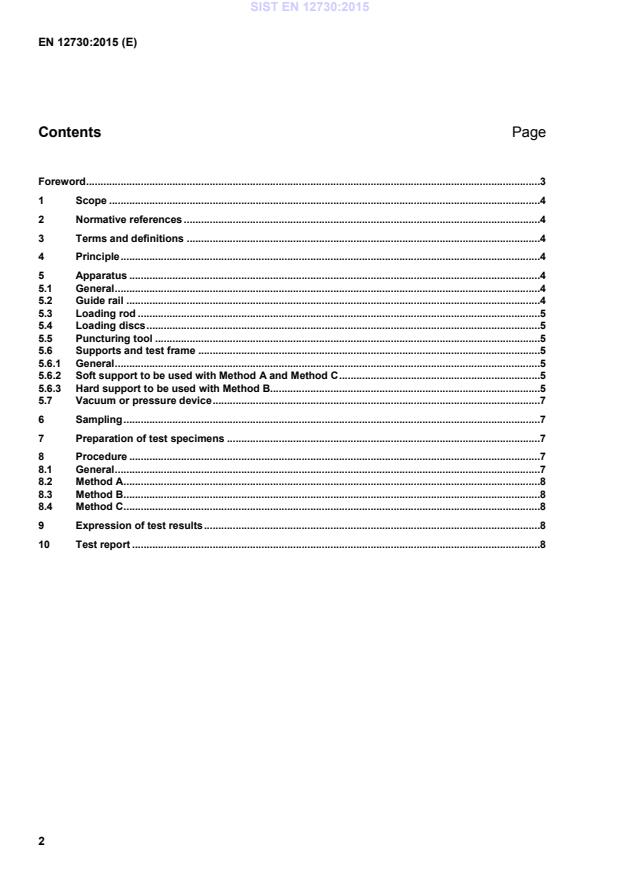
Foreword .3 1 Scope .4 2 Normative references .4 3 Terms and definitions .4 4 Principle .4 5 Apparatus .4 5.1 General .4 5.2 Guide rail .4 5.3 Loading rod .5 5.4 Loading discs .5 5.5 Puncturing tool .5 5.6 Supports and test frame .5 5.6.1 General .5 5.6.2 Soft support to be used with Method A and Method C .5 5.6.3 Hard support to be used with Method B.5 5.7 Vacuum or pressure device .7 6 Sampling .7 7 Preparation of test specimens .7 8 Procedure .7 8.1 General .7 8.2 Method A .8 8.3 Method B .8 8.4 Method C .8 9 Expression of test results .8 10 Test report .8
...
Questions, Comments and Discussion
Ask us and Technical Secretary will try to provide an answer. You can facilitate discussion about the standard in here.
Loading comments...