


EN 15559:2009
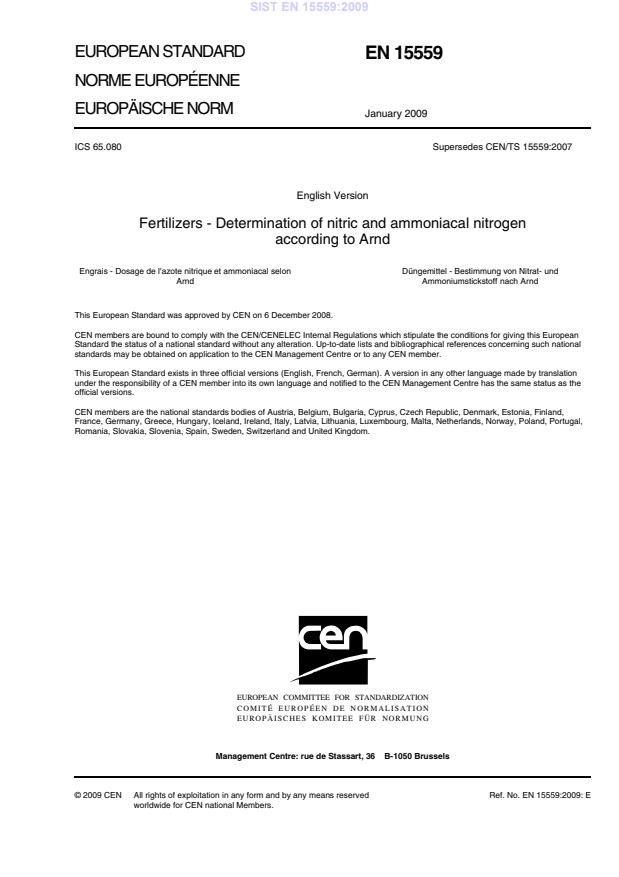
(Main)Fertilizers - Determination of nitric and ammoniacal nitrogen according to Arnd
Fertilizers - Determination of nitric and ammoniacal nitrogen according to Arnd
This European Standard specifies a method for the determination of nitric and ammoniacal nitrogen with reduction according to Arnd (modified for each of the variants a, b and c).
The method is applicable to all nitrogenous fertilizers, including compound fertilizers, in which nitrogen is found exclusively in nitrate form, or in ammoniacal and nitrate form.
Düngemittel - Bestimmung von Nitrat- und Ammoniumstickstoff nach Arnd
Diese Europäische Norm legt ein Verfahren zur Bestimmung von Nitrat- und Ammoniumstickstoff mittels Reduktion nach Arnd fest (modifiziert für jede der Varianten a, b und c).
Das Verfahren ist auf alle stickstoffhaltigen Düngemittel anwendbar, einschließlich Mehrnährstoffdünger, in denen Stickstoff ausschließlich als Nitrat oder als Nitrat- und Ammoniumstickstoff vorliegt.
Engrais - Dosage de l'azote nitrique et ammoniacal selon Arnd
La présente Norme européenne décrit une méthode de dosage de l’azote nitrique et ammoniacal, avec
réduction, selon Arnd (modifiée pour chacune des variantes a, b et c).
La présente méthode est applicable à tous les engrais azotés, y compris les engrais composés où l’azote se
trouve exclusivement sous forme nitrique ou sous forme ammoniacale et nitrique.
2
Gnojila - Določevanje nitratnega in amonijevega dušika po Arndu
General Information
- Status
- Published
- Publication Date
- 20-Jan-2009
- Technical Committee
- CEN/TC 260 - Fertilizers and liming materials
- Drafting Committee
- CEN/TC 260/WG 7 - Chemical analysis
- Current Stage
- 9093 - Decision to confirm - Review Enquiry
- Start Date
- 05-Feb-2025
- Completion Date
- 21-Jan-2026
Relations
- Replaces
CEN/TS 15559:2007 - Fertilizers - Determination of nitric and ammoniacal nitrogen according to Arnd - Effective Date
- 08-Jun-2022
- Effective Date
- 28-Jan-2026
- Effective Date
- 28-Jan-2026
Overview
EN 15559:2009 (CEN) specifies a laboratory method for the determination of nitric (nitrate) and ammoniacal (ammonium) nitrogen in nitrogenous fertilizers using the Arnd reduction technique. The standard covers three modified variants (a, b and c) to suit different expected nitrogen concentrations and is applicable to fertilizers in which nitrogen occurs as nitrate only, or as a mixture of nitrate and ammoniacal nitrogen.
Keywords: EN 15559, fertilizer standard, Arnd method, nitric nitrogen determination, ammoniacal nitrogen, nitrogenous fertilizers analysis.
Key topics and technical requirements
- Principle: Reduction of nitrates/nitrites to ammonia using Arnd’s alloy (60% Cu / 40% Mg) in presence of magnesium chloride; distillation of released ammonia into a known volume of standard sulfuric acid; back-titration of excess acid with standardized NaOH or KOH.
- Variants: Three analysis variants (a, b, c) are provided with different sample weights, dilution volumes, acid normalities and titrant strengths to handle approximate maximum nitrogen distilled of 50 mg, 100 mg and 200 mg respectively.
- Reagents: Analytical-grade chemicals only. Key reagents include Arnd’s alloy (powdered, <1 mm), magnesium chloride solution, different concentrations of sulfuric acid and carbonate-free NaOH/KOH as specified for each variant, mixed indicator solutions (methyl red/methylene blue, etc.), and anti-bump granules.
- Apparatus: Borosilicate glass distillation assemblies (several recommended configurations), pipettes, 500 ml graduated flasks, rotary shaker (35–40 rpm) and standard volumetric equipment.
- Sampling & sample prep: Sampling is outside the method; sample preparation should follow EN 1482-2. Solubility tests at 2% w/v determine whether acid extraction is required prior to analysis.
- Calculations & reporting: Results expressed as percentage nitrogen using back-titration volumes (A) and variant-specific factors (F). The standard specifies blank controls and test-report requirements.
Applications and users
This standard is intended for:
- Fertilizer manufacturers performing routine quality control and product certification.
- Independent testing laboratories and accreditation bodies analyzing nitrogen content of fertilizers.
- Regulatory agencies verifying compliance with national/EU fertilizer composition requirements.
- Agronomy and research labs needing reliable quantification of nitrate and ammonium nitrogen in compound and straight fertilizers.
Practical benefits: accurate separation of nitrate and ammoniacal nitrogen fractions, adaptable sensitivity through variants, and a standardized procedure suitable for inter-laboratory comparability.
Related standards
- EN 1482-2 - Sampling and sample preparation for fertilizers
- EN 12944-1 and EN 12944-2 - Fertilizers vocabulary (terms and definitions)
- EN ISO 3696 - Water for analytical laboratory use
For laboratories implementing fertilizer nitrogen analysis, EN 15559:2009 provides a proven, CEN‑approved Arnd-based procedure to ensure consistent and traceable nitric and ammoniacal nitrogen determinations.

Get Certified
Connect with accredited certification bodies for this standard

Rainforest Alliance
International non-profit sustainability certification organization.

SCS Global Services
Global leader in environmental and sustainability certification.

DNV Business Assurance China
Accredited by CNAS for wind turbine and component certification.
Sponsored listings
Frequently Asked Questions
EN 15559:2009 is a standard published by the European Committee for Standardization (CEN). Its full title is "Fertilizers - Determination of nitric and ammoniacal nitrogen according to Arnd". This standard covers: This European Standard specifies a method for the determination of nitric and ammoniacal nitrogen with reduction according to Arnd (modified for each of the variants a, b and c). The method is applicable to all nitrogenous fertilizers, including compound fertilizers, in which nitrogen is found exclusively in nitrate form, or in ammoniacal and nitrate form.
This European Standard specifies a method for the determination of nitric and ammoniacal nitrogen with reduction according to Arnd (modified for each of the variants a, b and c). The method is applicable to all nitrogenous fertilizers, including compound fertilizers, in which nitrogen is found exclusively in nitrate form, or in ammoniacal and nitrate form.
EN 15559:2009 is classified under the following ICS (International Classification for Standards) categories: 65.080 - Fertilizers. The ICS classification helps identify the subject area and facilitates finding related standards.
EN 15559:2009 has the following relationships with other standards: It is inter standard links to CEN/TS 15559:2007, EN ISO 3696:1995, EN 1482-2:2024. Understanding these relationships helps ensure you are using the most current and applicable version of the standard.
EN 15559:2009 is associated with the following European legislation: Standardization Mandates: M/335. When a standard is cited in the Official Journal of the European Union, products manufactured in conformity with it benefit from a presumption of conformity with the essential requirements of the corresponding EU directive or regulation.
EN 15559:2009 is available in PDF format for immediate download after purchase. The document can be added to your cart and obtained through the secure checkout process. Digital delivery ensures instant access to the complete standard document.
Standards Content (Sample)
2003-01.Slovenski inštitut za standardizacijo. Razmnoževanje celote ali delov tega standarda ni dovoljeno.Düngemittel - Bestimmung von Nitrat- und Ammoniumstickstoff nach ArndEngrais - Dosage de l'azote nitrique et ammoniacal selon ArndFertilizers - Determination of nitric and ammoniacal nitrogen according to Arnd65.080GnojilaFertilizersICS:Ta slovenski standard je istoveten z:EN 15559:2009SIST EN 15559:2009en,fr,de01-junij-2009SIST EN 15559:2009SLOVENSKI
STANDARDSIST-TS CEN/TS 15559:20081DGRPHãþD
EUROPEAN STANDARDNORME EUROPÉENNEEUROPÄISCHE NORMEN 15559January 2009ICS 65.080Supersedes CEN/TS 15559:2007
English VersionFertilizers - Determination of nitric and ammoniacal nitrogenaccording to ArndEngrais - Dosage de l'azote nitrique et ammoniacal selonArndDüngemittel - Bestimmung von Nitrat- undAmmoniumstickstoff nach ArndThis European Standard was approved by CEN on 6 December 2008.CEN members are bound to comply with the CEN/CENELEC Internal Regulations which stipulate the conditions for giving this EuropeanStandard the status of a national standard without any alteration. Up-to-date lists and bibliographical references concerning such nationalstandards may be obtained on application to the CEN Management Centre or to any CEN member.This European Standard exists in three official versions (English, French, German). A version in any other language made by translationunder the responsibility of a CEN member into its own language and notified to the CEN Management Centre has the same status as theofficial versions.CEN members are the national standards bodies of Austria, Belgium, Bulgaria, Cyprus, Czech Republic, Denmark, Estonia, Finland,France, Germany, Greece, Hungary, Iceland, Ireland, Italy, Latvia, Lithuania, Luxembourg, Malta, Netherlands, Norway, Poland, Portugal,Romania, Slovakia, Slovenia, Spain, Sweden, Switzerland and United Kingdom.EUROPEAN COMMITTEE FOR STANDARDIZATIONCOMITÉ EUROPÉEN DE NORMALISATIONEUROPÄISCHES KOMITEE FÜR NORMUNGManagement Centre: rue de Stassart, 36
B-1050 Brussels© 2009 CENAll rights of exploitation in any form and by any means reservedworldwide for CEN national Members.Ref. No. EN 15559:2009: ESIST EN 15559:2009
= 20 %. Dissolve 200 g of magnesium chloride (MgCl2.6H2O) in approximately 600 ml to 700 ml of water in a 1 l flat-bottomed flask. To prevent frothing, add 15 g of magnesium sulfate (MgSO4.7H2O). After dissolution add 2 g of magnesium oxide and a few anti-bump granules of pumice stone and concentrate the suspension to 200 ml by boiling, thus expelling any trace of ammonia from the reagents. Cool, make up the volume to 1 l and filter. 5.12 Indicator solutions 5.12.1 Mixed indicator Solution A: Dissolve 1 g of methyl red in 37 ml of sodium hydroxide solution c = 0,1 mol/l and make up to 1 l with water. Solution B: Dissolve 1 g of methylene blue in water and make up to 1 l. Mix one volume of solution A with two volumes of solution B. This indicator is violet in acid solution, grey in neutral solution and green in alkaline solution. Use 0,5 ml (10 drops) of this indicator solution. 5.12.2 Methyl red indicator solution Dissolve 0,1 g of methyl red in 50 ml of 95 % ethanol. Make up to 100 ml with water and filter if necessary. This indicator may be used (4 to 5 drops) instead of that specified in 5.12.1. 5.12.3 Congo red indicator solution Dissolve 3 g of Congo red in 1 l of warm water and filter if necessary after cooling. This indicator may be used, instead of that specified in 5.12.1.or 5.12.2, in the neutralization of acid extracts before distillation, using 0,5 ml per 100 ml of liquid to be neutralized. 5.13 Anti-bump granules, for example pumice stone, washed in hydrochloric acid and reclaimed. SIST EN 15559:2009
5.14 Sodium nitrate, p.a. 6 Apparatus 6.1 Distillation apparatus Consisting of a round-bottomed flask of suitable capacity connected to a condenser by means of a splash head. The equipment is made of borosilicate glass. NOTE The different types of equipment recommended for this determination are reproduced, showing all the features of construction, in Figures 1, 2, 3 and 4. An automatic distillation apparatus may also be used, provided that the results are statistically equivalent. SIST EN 15559:2009
Key 1 round-bottomed, long-necked flask of 1 000 ml capacity 2 distillation tube with a splash head, connected to the condenser by means of a spherical joint (No 18) (the spherical joint for the connection to the condenser may be replaced by an appropriate rubber connection) 3 funnel with a polytetrafluoroethylene (PTFE) tap (6) for the addition of sodium hydroxide (the tap may likewise be replaced by a rubber connection with a clip) 4 six-bulb condenser with spherical joint (No 18) at the entrance, and joined at the issue to a glass extension tube by means of a small rubbe
...
Questions, Comments and Discussion
Ask us and Technical Secretary will try to provide an answer. You can facilitate discussion about the standard in here.
Loading comments...