

CEN/TR 15522-2:2006
(Main)Oil spill identification - Waterborne petroleum and petroleum products - Part 2: Analytical methodology and interpretation of results
General Information
- Abstract
This Technical Report (TR) describes a methodology to identify waterborne oils spilled in marine, estuarine and aquatic environments by comparing samples from spills with those of suspected sources . It provides detailed analytical and processing specifications for identifying waterborne oil spills and their correlation to suspected sources. When suspected sources are not available, the methodology may be used to characterise the spill as far as possible with respect to the oil type.
This methodology is restricted to petroleum and petroleum products containing a significant proportion of
HC-components with a boiling point above 200 °C. Examples are: Crude oils, condensates, light fuel oils, diesel oils, residual bunker oils, lubricants, and mixtures of bilge and sludge samples. Still, the general concepts described in this methodology have a limited applicability for some kerosenes and some condensates, but may not be applicable for gasoline
NOTE This method is not intended for oil spills to groundwater and soil. The chromatograms of oil extracted from soil and found in ground water may contain reduced and/or additional peaks compared to the source sample. Including such samples in this method makes it necessary to add extraction methods and to describe which compounds are possibly reduced and/or which additional peaks can be expected to change the final conclusion from a probable match into a match. This is beyond the scope of this guideline, however, when case samples completely match according to this method, the method is valid for those samples.
- Status
- Withdrawn
- Publication Date
- 31-Oct-2006
- Withdrawal Date
- 02-Oct-2012
- Technical Committee
- CEN/SS S27 - Waste - Characterization, treatment and streams
- Drafting Committee
- CEN/SS S27 - Waste - Characterization, treatment and streams
- Current Stage
- 9960 - Withdrawal effective - Withdrawal
- Start Date
- 03-Oct-2012
- Completion Date
- 03-Oct-2012


Relations
- Effective Date
- 08-Oct-2012
Get Certified
Connect with accredited certification bodies for this standard

Element Materials Technology
Materials testing and product certification.

ABS Group Brazil
ABS Group certification services in Brazil.

ABS Quality Evaluations Inc.
American Bureau of Shipping quality certification.
Sponsored listings
Frequently Asked Questions
CEN/TR 15522-2:2006 is a technical report published by the European Committee for Standardization (CEN). Its full title is "Oil spill identification - Waterborne petroleum and petroleum products - Part 2: Analytical methodology and interpretation of results". This standard covers: This Technical Report (TR) describes a methodology to identify waterborne oils spilled in marine, estuarine and aquatic environments by comparing samples from spills with those of suspected sources . It provides detailed analytical and processing specifications for identifying waterborne oil spills and their correlation to suspected sources. When suspected sources are not available, the methodology may be used to characterise the spill as far as possible with respect to the oil type. This methodology is restricted to petroleum and petroleum products containing a significant proportion of HC-components with a boiling point above 200 °C. Examples are: Crude oils, condensates, light fuel oils, diesel oils, residual bunker oils, lubricants, and mixtures of bilge and sludge samples. Still, the general concepts described in this methodology have a limited applicability for some kerosenes and some condensates, but may not be applicable for gasoline NOTE This method is not intended for oil spills to groundwater and soil. The chromatograms of oil extracted from soil and found in ground water may contain reduced and/or additional peaks compared to the source sample. Including such samples in this method makes it necessary to add extraction methods and to describe which compounds are possibly reduced and/or which additional peaks can be expected to change the final conclusion from a probable match into a match. This is beyond the scope of this guideline, however, when case samples completely match according to this method, the method is valid for those samples.
This Technical Report (TR) describes a methodology to identify waterborne oils spilled in marine, estuarine and aquatic environments by comparing samples from spills with those of suspected sources . It provides detailed analytical and processing specifications for identifying waterborne oil spills and their correlation to suspected sources. When suspected sources are not available, the methodology may be used to characterise the spill as far as possible with respect to the oil type. This methodology is restricted to petroleum and petroleum products containing a significant proportion of HC-components with a boiling point above 200 °C. Examples are: Crude oils, condensates, light fuel oils, diesel oils, residual bunker oils, lubricants, and mixtures of bilge and sludge samples. Still, the general concepts described in this methodology have a limited applicability for some kerosenes and some condensates, but may not be applicable for gasoline NOTE This method is not intended for oil spills to groundwater and soil. The chromatograms of oil extracted from soil and found in ground water may contain reduced and/or additional peaks compared to the source sample. Including such samples in this method makes it necessary to add extraction methods and to describe which compounds are possibly reduced and/or which additional peaks can be expected to change the final conclusion from a probable match into a match. This is beyond the scope of this guideline, however, when case samples completely match according to this method, the method is valid for those samples.
CEN/TR 15522-2:2006 is classified under the following ICS (International Classification for Standards) categories: 75.080 - Petroleum products in general. The ICS classification helps identify the subject area and facilitates finding related standards.
CEN/TR 15522-2:2006 has the following relationships with other standards: It is inter standard links to CEN/TR 15522-2:2012. Understanding these relationships helps ensure you are using the most current and applicable version of the standard.
CEN/TR 15522-2:2006 is available in PDF format for immediate download after purchase. The document can be added to your cart and obtained through the secure checkout process. Digital delivery ensures instant access to the complete standard document.
Standards Content (Sample)
SLOVENSKI STANDARD
01-julij-2008
Prepoznavanje razlitij olj - Nafta in naftni proizvodi v vodi - 2. del: Analitske
metode in podajanje rezultatov
Oil spill identification - Waterborne petroleum and petroleum products - Part 2: Analytical
methodology and interpretation of results
Identifizierung von Ölverschmutzungen - Rohöl und Mineralölerzeugnisse aus dem
Wasser - Teil 2: Analytische Methodik und Interpretation der Ergebnisse
Identification des pollutions pétrolieres - Pétrole et produits pétroliers dans l'eau - Partie
2 : Méthodologie analytique et interprétation des résultats
Ta slovenski standard je istoveten z: CEN/TR 15522-2:2006
ICS:
13.020.40 Onesnaževanje, nadzor nad Pollution, pollution control
onesnaževanjem in and conservation
ohranjanje
13.060.99 Drugi standardi v zvezi s Other standards related to
kakovostjo vode water quality
2003-01.Slovenski inštitut za standardizacijo. Razmnoževanje celote ali delov tega standarda ni dovoljeno.
TECHNICAL REPORT
CEN/TR 15522-2
RAPPORT TECHNIQUE
TECHNISCHER BERICHT
November 2006
ICS 75.080
English Version
Oil spill identification - Waterborne petroleum and petroleum
products - Part 2: Analytical methodology and interpretation of
results
Identification des pollutions pétrolières - Pétrole et produits Identifizierung von Ölverschmutzungen - Rohöl und
pétroliers dans l'eau - Partie 2 : Méthodologie analytique et Mineralölerzeugnisse aus dem Wasser - Teil 2: Analytische
interprétation des résultats Methodik und Interpretation der Ergebnisse
This Technical Report was approved by CEN on 25 September 2006. It has been drawn up by the Technical Committee CEN/BT/TF 120.
CEN members are the national standards bodies of Austria, Belgium, Cyprus, Czech Republic, Denmark, Estonia, Finland, France,
Germany, Greece, Hungary, Iceland, Ireland, Italy, Latvia, Lithuania, Luxembourg, Malta, Netherlands, Norway, Poland, Portugal, Romania,
Slovakia, Slovenia, Spain, Sweden, Switzerland and United Kingdom.
EUROPEAN COMMITTEE FOR STANDARDIZATION
COMITÉ EUROPÉEN DE NORMALISATION
EUROPÄISCHES KOMITEE FÜR NORMUNG
Management Centre: rue de Stassart, 36 B-1050 Brussels
© 2006 CEN All rights of exploitation in any form and by any means reserved Ref. No. CEN/TR 15522-2:2006: E
worldwide for CEN national Members.
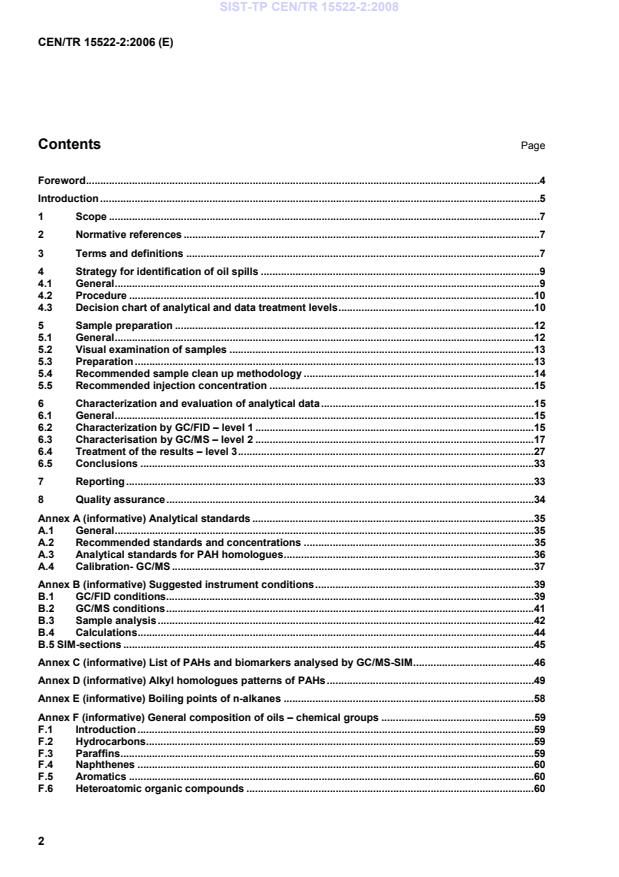
Contents Page
Foreword.4
Introduction .5
1 Scope .7
2 Normative references .7
3 Terms and definitions .7
4 Strategy for identification of oil spills .9
4.1 General.9
4.2 Procedure .10
4.3 Decision chart of analytical and data treatment levels.10
5 Sample preparation .12
5.1 General.12
5.2 Visual examination of samples .13
5.3 Preparation .13
5.4 Recommended sample clean up methodology .14
5.5 Recommended injection concentration .15
6 Characterization and evaluation of analytical data.15
6.1 General.15
6.2 Characterization by GC/FID – level 1 .15
6.3 Characterisation by GC/MS – level 2 .17
6.4 Treatment of the results – level 3.27
6.5 Conclusions .33
7 Reporting .33
8 Quality assurance.34
Annex A (informative) Analytical standards .35
A.1 General.35
A.2 Recommended standards and concentrations .35
A.3 Analytical standards for PAH homologues.36
A.4 Calibration- GC/MS .37
Annex B (informative) Suggested instrument conditions.39
B.1 GC/FID conditions.39
B.2 GC/MS conditions.41
B.3 Sample analysis.42
B.4 Calculations.44
B.5 SIM-sections .45
Annex C (informative) List of PAHs and biomarkers analysed by GC/MS-SIM.46
Annex D (informative) Alkyl homologues patterns of PAHs.49
Annex E (informative) Boiling points of n-alkanes .58
Annex F (informative) General composition of oils – chemical groups .59
F.1 Introduction.59
F.2 Hydrocarbons.59
F.3 Paraffins.59
F.4 Naphthenes .60
F.5 Aromatics .60
F.6 Heteroatomic organic compounds .60
F.7 Resins.60
F.8 Asphaltenes .60
Annex G (informative) Weathering of oils spilled at sea.61
G.1 Introduction.61
G.2 Evaporation.62
G.3 Dissolution .64
G.4 Re-distribution of chemical composition.65
G.5 Biodegradation .66
G.6 Contamination / in-homogeneity .67
G.7 Evaluation of weathering.67
G.8 Optional - Semi-quantitative distribution of PAH homologues - weathering check.69
Annex H (informative) Characteristic Features of Different Oil Types in Oil Spill Identification .70
H.1 Introduction.70
H.2 Light fuel oil (gas oil, diesel, fuel No 2).70
H.3 Lubricating oil.75
H.4 Heavy fuel oil (HFO, Bunker C, Fuel No 6).79
H.5 Waste oil (bilge oil, sludge, slops).87
H.6 Crude oil .93
H.7 Conclusion .98
Annex I (informative) Example of the evaluation of an oil case .100
I.1 Introduction.100
I.2 GC/FID results.100
I.3 GC/MS results .102
I.4 Conclusion .106
Bibliography.107
Foreword
This document (CEN/TR 15522-2:2006) has been prepared by CEN/BT/TF 120 “Oil spill identification”, the
secretariat of which is held by SN.
Introduction
This Technical Report gives a recommendation on a forensic methodology for identifying waterborne oils. The
methodology may be a support to the legal process as evidence for prosecuting offenders ("potential
responsible party" – PRP). This methodology is a technical revision of the Nordtest Method NT CHEM 001
(1991) "Oil spill identification".
This methodology is described by the following CEN documents:
Part 1 – Sampling: describes sampling techniques and the handling of oil samples prior to their arrival at the
forensic laboratory;
Part 2 – Methodology: covers the general concepts and laboratory procedures of oil spill identification
methodology, analytical techniques, data processing, data treatment, and interpretation/evaluation of results.
Oil spill identification and oil comparison is a complex methodology due to the large variation in samples and
oil spill situations, which can be encountered. Part 1 is a compilation of instructions and experiences from
experts all over the world and will guide the user in sampling, storing and delivering oil samples. Part 2 will
guide the reader through the process by dividing the methodology into 3 tiered levels. It prescribes how to
prepare and analyse oil samples with GC/FID and, if necessary, with GC-low-resolution mass spectrometry.
Differences found between samples are only relevant if a difference is larger than the analytical variance of
the method. Therefore good analytical performance and strict quality assurance are essential. In the annexes
of part 2, relevant information concerning different types of oil and oil comparison is presented.
The main purpose of the methodology described in this Technical Report (TR) is to identify oil spills in marine,
estuarine and other aquatic environments by comparing samples from spills with those of suspected sources.
In oil spill identification cases, both the oil spill and also suspected source(s) may not necessarily be
homogeneous in nature e.g. due to the changing/variable nature of oil in the bilge tanks or e.g. mixing of oil
spills from several sources in a case of a larger incident. The risk therefore exists that the chemical
composition of the reference samples may not be related to that of the spill. In such cases oil spill
fingerprinting methodologies in general will have its limitations and may not necessarily lead to firm
conclusions. To minimise the danger for “false negative” matches, good sampling practice, and particularly the
need to obtain appropriate reference/suspect source samples, is therefore crucial (as described in Part 1
Sampling).
When suspected sources are not available, this methodology may be used to characterise the spill as far as
possible with respect to oil type. The identification of the type of oil in a sample can be essential for several
reasons:
if the origin of an oil pollution event is unknown, the investigating authorities must be advised on where to
find a possible source. In case of a “mystery” spill, the mere differentiation between pure, unused
products or crude oil and waste oil (bilge residues, sludge, slops) is valuable information. Oils must be
identified rapidly in such cases because the chances of identifying sources generally decrease with time;
meaning of analytical results, i.e. their contribution to the overall evidence in criminal proceedings,
depends very much on the types of oil that are involved in oil spills. Depending on these types, the search
can be more or less focused on a few possible sources, or even a single one;
in court trials, the differentiation between pure products and waste oil may be highly important because it
allows conclusions to be drawn regarding the cause of an oil discharge, e.g. technical failure,
inadvertence, intention;
conclusions obtained from the defensible identification of spilled oil and their correlation to suspected
sources will not, however, on their own identify the "potential responsible party" (PRP), but is often a
critical part of, and a support to, the legal process.
In these guidelines, some activities are marked as “Optional”. These are suggestions to supplementary
diagnostic documentations, e.g. in cases where there may still be uncertainty in drawing conclusions based on
the “standard” recommended methodology.
The first draft of the methodology was evaluated through a Round Robin study organised by the CEN/BT/TF
120 Oil Spill Identification. This test was limited to crude oils and heavy fuel oils. Two more recent Round
Robin tests organised by RIZA in the Netherlands, where fifteen laboratories participated, covered cases with
light fuel oil distillates (diesel oils,) and bilge water samples (a mixture of gas oils and lube oil). Findings from
these RR-tests have been taken into account for refining the suggested methodology.
1 Scope
This Technical Report (TR) describes a methodology to identify waterborne oils spilled in marine, estuarine
and aquatic environments by comparing samples from spills with those of suspected sources . It provides
detailed analytical and processing specifications for identifying waterborne oil spills and their correlation to
suspected sources. When suspected sources are not available, the methodology may be used to characterise
the spill as far as possible with respect to the oil type.
This methodology is restricted to petroleum and petroleum products containing a significant proportion of
HC-components with a boiling point above 200 °C. Examples are: Crude oils, condensates, light fuel oils,
diesel oils, residual bunker oils, lubricants, and mixtures of bilge and sludge samples. Still, the general
concepts described in this methodology have a limited applicability for some kerosenes and some
condensates, but may not be applicable for gasoline
NOTE This method is not intended for oil spills to groundwater and soil. The chromatograms of oil extracted from soil
and found in ground water may contain reduced and/or additional peaks compared to the source sample. Including such
samples in this method makes it necessary to add extraction methods and to describe which compounds are possibly
reduced and/or which additional peaks can be expected to change the final conclusion from a probable match into a match.
This is beyond the scope of this guideline, however, when case samples completely match according to this method, the
method is valid for those samples.
2 Normative references
The following referenced documents are indispensable for the application of this European Standard. For
dated references, only the edition cited applies. For undated references, the latest edition of the referenced
document (including any amendments) applies.
CEN/TR 15522-1, Oil spill identification – Waterborne petroleum and petroleum products – Part 1: Sampling
3 Terms and definitions
For the purposes of this document, the following terms and definitions apply.
3.1
chain of custody
line of actions taken for samples from spill and suspected sources at court for safe surveillance and storing; to
ensure that the samples have not been tampered with or altered accidentally
3.2
contamination
all changes in oil composition which take place during/after the spillage, by mixing with additional compounds,
including natural products
3.3
critical difference (CD)
value less than or equal to which the absolute difference between two test results obtained under repeatability
conditions may be expected to be with a probability of 0,95; the critical difference is defined as CD= ((mean x
r )/(100)
95%
3.4
diagnostic ratios
ratios between the peak height or peak area of single compounds or compound groups selected by their
diversity in chemical composition in petroleum and petroleum products and on their known behaviour in
weathering processes
3.5
identity
no differences observed in the chromatographic patterns of GC/FID and GC/MS apart from those changes
introduced after the spill (weathering, degradation etc.)
3.6
inconclusive
when differences in chromatographic patterns and diagnostic ratios of the samples submitted for comparison
are larger than the analytical variance of the method and may only, to some extent, be explained by external
factors like weathering, contamination, heterogeneity of the samples or too low an amount of sample material
NOTE Differences may be due to e.g. heterogeneities of the oil either within the spill or within the suspected source
(e.g. within the ship tank), that is not reflected in the available samples analysed, or differences are present because the
samples do not originate from the same source.
3.7
non-match
when differences in chromatographic patterns and diagnostic ratios of the samples submitted for comparison
are distinct and larger than the analytical variance of the method and they cannot be explained by external
factors like weathering, contamination and heterogeneity. The samples are distinctly different
3.8
positive match
when differences in chromatographic patterns and diagnostic ratios of the samples submitted for comparison
are lower than the analytical variance of the method or can clearly be explained by weathering. The samples
are identical beyond reasonable doubt
3.9
probable match
when differences in chromatographic patterns and diagnostic ratios of the samples submitted for comparison
are larger than the analytical variances of the method, but can be explained by external factors like
contamination or heterogeneity of the samples
EXAMPLE Comparing lubricating oil with the lubricating oil part of a bilge sample may lead to a probable match.
3.10
repeatability (r)
precision under repeatability conditions
[ISO 5725-2]
3.11
repeatability conditions
conditions where independent test results are obtained by the same method on identical test material in the
same laboratory by the same operator (panel leader) using the same equipment within short intervals of time
[ISO 5725-2]
3.12
repeatability limit (r95%)
value less than or equal to the difference between two test results obtained under repeatability conditions
which may be expected to be within a probability of 0,95
[ISO 5725-2]
3.13
waterborne oil
petroleum and petroleum products borne by water or available in the water column from marine, estuarial and
aquatic environments (includes lakes and rivers but excludes groundwater)
3.14
weathering
all changes in oil composition which take place after the spillage, including evaporation, dissolution,
emulsification, oxidation and biological decomposition. See also Annex G
4 Strategy for identification of oil spills
4.1 General
Identification of spilled oils in the context of this CEN Technical Report implies the comparison of the total
chemical composition of the spilled oil with that of candidate source samples.
NOTE Identity, per se requires all measurable data to be the same. This definition is practically and technically
impossible to fulfill and instead, the definition of identity is rephrased in operational terms: two samples are identical if no
differences in the analysed GC/FID and GC/MS data are present that cannot be explained by weathering. The task of
looking for differences in chemical composition instead of proving similarity is conceptually more logical and easier to
comply with. According to this, only distinct differences between samples can be proved, whereas identity per se cannot.
Therefore, only when no differences between samples are observed should identity be concluded as being beyond
reasonable doubt.
Identity should be tested by analyzing and comparing the detailed chemical composition of the selected
samples by chemical fingerprinting of a suite of generic and diagnostic petroleum compounds. If no or only
insignificant differences (i.e. differences being smaller than the analytical variance) are observed, identity
should be concluded as being beyond reasonable doubt. On the other hand, if true differences (i.e differences
not related to changes in the chemical composition introduced after the spill, e.g. from weathering etc.), that
are larger than the variance of the analysis are observed within these diagnostic compounds, it should be
concluded that the samples are different.
In the European community oil comparison is performed by laboratories, which analyse oil samples daily, but
also by laboratories, which only compare samples a few times a year. Common practice has traditionally been
to analyse samples qualitatively and then compare the chromatograms and ion chromatograms visually. The
outcome of such comparisons depends on the experience of the analyst. Laboratories, which rarely analyse
oil samples, may experience difficulties in reaching the right conclusions, therefore, this guideline introduces
the use of diagnostic ratios. The selection of the ratios is based on the known weathering behavior of
compounds and the diversity in chemical composition of oils from different wells and oil types [14]. To reduce
the variance, ratios are generated by using the area or peak height of compounds, which are recorded by the
same m/z value and that are within the same reasonable retention time range. The resulting ratios are
compared using the repeatability limit (3.12) as a test method. For those laboratories who work daily on a
“quantitative analytical” level, and that have good laboratory routines for doing “exact” quantification of the
recommended diagnostic peaks, the ratios recommended in these guidelines may be established based on
exact quantitative analysis.
For the comparison of the diagnostic ratios from the GC/MS data, 29 diagnostic ratios, generated from
diagnostic PAH compounds and biomarkers, that are robust against weathering have been selected to cope
with the differences in oil samples and oil types. Whereas most of the ratios may be used when crude oil,
bunker oil and bilge samples are involved, only a limited number may be useful for lighter fuel oils (e.g.
kerosene, parafin, diesel, gas oil) because some of the high boiling biomarkers may not be present in such
light refined products. In identification cases where the oil spill has been exposed to a low degree of
weathering, 3 ratios of acyclic isoprenoids (the n-C17 /pristane, n-C18 /phytane and pristane/phytane ratios)
from the GC/FID analyses and 4 suggested ratios of the sesquiterpanes (in the C13 to C16 area) may also
be included for comparison of diagnostic ratios if a weathering check shows that these compounds have not
been exposed to weathering.
Before integrating the compounds applied for calculating the diagnostic ratios, a visual inspection of the
diagnostic ion chromatograms (see 6.3.5.2 – 6.3.5.4) should be carried out to eliminate some of the
recommended diagnostic peaks that may not be present in sufficient concentrations, used to establish robust
diagnostic ratios. Also, a visual comparison of the ion chromatograms is advised to enable exclusion of
obviously different samples. After the comparison study of diagnostic ratios(see 6.4), a visual, one by one
comparison of the printed ion chromatograms of the relevant samples should also be carried out to verify
(ground-truth) the conclusion.
4.2 Procedure
When an oil spill has been discovered, samples should be taken from the current spill and from any potential
responsible parties such as suspected ships or other sources. All samples should be sent either via an
authorised “Sampling Co-ordinator” or directly to a forensic laboratory for oil spill identification.
The oil spill identification methodology is comprised of:
sampling from the spill and from the suspected sources. When suspected sources are not available,
methodology may be used to characterise the spill as far as possible with respect to the oil type. The
sampling shall be carried out in accordance with CEN/TR 15522-1;
visual description of samples, see 5.2;
preparation of samples, see 5.3;
gas chromatography combined with flame ionization detection (GC/FID) screening of all involved samples.
Evaluation of the chromatograms and calculation of diagnostic ratios, see 4.3.2 and 6.2;
gas chromatography combined with mass spectrometry (GC/MS) fingerprinting of samples. Evaluation of
the chromatograms and calculation of diagnostic ratios, see 4.3.3 and 6.3;
comparison of diagnostic ratios, see 6.4;
conclusions and reporting see clause 7.
4.3 Decision chart of analytical and data treatment levels
4.3.1 General
The identification system for oil spills is divided into three levels of decisions, see Figure 1.
4.3.2 GC/FID screening (level 1)
After sample preparation (see 5.3), the chemical fingerprinting analysis in the laboratory starts with the
GC/FID screening analysis of all samples, i.e. both samples of spilled oils and suspected sources. The data
from this screening should be used for:
characterising the oil sample(s) by obtaining the overall boiling (carbon) range of the oils, i.e. the total
distribution of hydrocarbons including n-alkanes from C to C if present, see 6.2.1. For an overview of
10 40
boiling points of n-alkanes, see Annex E;
visual inspections of the chromatograms for possible characteristic features and a tentative classification
to a type of the spilled oil if possible, see Annex H;
establishing selected acyclic isoprenoid ratios readily determined using GC/FID, see 6.2.2.1.
If the chromatograms are different and those differences are possibly caused by weathering a “weathering
check”, either by a chromatographic overlay manipulation or by normalising the distribution of n-alkanes to
non-weathered compounds is recommended, see 6.2.2.2 and Annex G.
If the GC chromatograms from the spill samples compared to the suspected sources show differences in the
hydrocarbon distribution, the unresolved complex mixture distribution and/or the acyclic isoprenoid ratios (see
criteria in 6.2.2.1.) that obviously are not caused by weathering (non-matched samples), should be ruled out
and eliminated from additional levels of analysis (see Figure 1). If there are any doubts, the samples should
be analysed in accordance with level 2.
See also Annex H, on the evaluation of the GC-screening results (comparison of unresolved envelopes).
4.3.3 GC/MS fingerprinting (level 2)
At this level, analysis of spill and candidate source samples using gas chromatography combined with mass
spectrometry that generally operates in the selected ion monitoring mode (GC/MS-SIM) should be performed.
This analysis is useful for determining the content and distributions of a suite of diagnostic petroleum
biomarkers and PAH target analytes. Data from this analysis should be used for:
visual inspection of the ion profiles in the chromatograms for possible characteristic features, and an oil
type classification of the spilled oil, see Annex H;
generating a suite of diagnostic ratios based on an evaluation of the presence and “robustness” of the
diagnostic PAHs and biomarkers described in 6.3.5.
To give additional diagnostic information, a semi-quantitative histogram established from a suite of selected
PAH homologues may be used as a supplementary diagnostic fingerprint and as a check on the weathering of
the PAH homologues (optional), see Annex G, Clause 8.
4.3.4 Evaluation of data (level 3)
At level 3, the results obtained from level 1 and 2 should be used for:
assessing the impact of weathering based on a weathering check of n-alkane data from level 1 and the
semi-quantitative distribution of the PAH groups from level 2. The weathering checks are performed
optionally;
deciding which diagnostic ratio can be used for comparison based on oil type and analytical variance, and
which samples should be reanalysed because of heterogeneity, see 6.4.2;
comparison of diagnostic ratios data using repeatability limit, see 6.4.3;
visual comparison of generated ion chromatograms to check the results of the ratio comparison (ground-
truth all data).
The results from all analytical levels should be assessed and the conclusions should be reported for the
combined results of the test methodology used, see clause 6.5. Results should be specified either as a
Positive Match, Probable Match, Inconclusive or Non-Match.
Note These categories represent four operational and technical defensible conclusion terms (3.6-3.9) to identify or
differentiate between oils from a spill and any available candidate sources.
Figure 1 — Protocol/decision chart for oil spill identification
5 Sample preparation
5.1 General
The same sample preparation procedure should be followed for both GC/FID and GC/MS analysis, i.e. the
same extracts should be analysed for both analyses. The sample preparation does not generally require
asphaltene removal or separation of e.g. aliphatic from aromatic i.e., analysis of a ‘whole oil’ aliquot is
recommended.
The present methodology is based on semi-quantitative analysis (i.e. no internal standards are added), for
establishing diagnostic ratios.
5.2 Visual examination of samples
Colour, odour, viscosity and content of any free water and debris should be visually noted and reported. It is
also recommended that each sample is photographed in order to document its "as-received" condition. Any
pieces of wood, fabric, feathers or other debris should be removed from the sample with a pair of tweezers
and noted in the report.
5.3 Preparation
5.3.1 General
If a sample contains a significant amount of oil/emulsion, and an aliquot on the sample cannot be immediately
o
prepared after arriving at the laboratory, the sample bottle should be stored in a refrigerator at (5 ± 2) C.
Sample preparation should be carried out as soon as possible, preferably within a week, particularly in cases
concerning emulsions.
If a sample contains primarily water and it cannot be immediately extracted, dichloromethane (DCM) should
be immediately added after arrival, (e.g. 10 ml to a 1 l water sample). After shaking, the sample should be
o
stored in a refrigerator at (5 ± 2) C. Further sample preparation should be carried out as soon as possible,
preferably within a week.
5.3.2 Water samples
If samples consist primarily of water (no visual oil on the surface), the oily water is transferred to a separating
funnel. Use dichloromethane (DCM) .Depending on the amount of oil, the sample should be extracted one by
one or serially (e.g. 60 ml, 30 ml and 30 ml of solvent if the sample volume is 1 l, less volume if the water
sample is smaller). The sample bottle is rinsed inside with DCM before pouring it into the water sample for
extraction. The extract is dried with sodium sulphate and diluted or concentrated to a suitable injection
concentration. If a concentration step is needed use a gentle evaporation technique (e.g. Kudena Danish,
Turbo Vap, N-Evap).
5.3.3 Oil samples from polytetrafluoroethylene (PFTE) net
PFTE net is recommended for sampling thin oil films [39]. The oil should be thoroughly rinsed off the PFTE
1 1
net using DCM or the PFTE net can be extracted in DCM . After drying with sodium sulphate, the extract
should be diluted or concentrated to a suitable injection concentration.
5.3.4 Thick oil and emulsified oil samples
Samples consisting primarily of water or emulsified oil should be allowed to equilibrate at room temperature.
Any free water should be decanted into a separating funnel. The oil/emulsion fraction is gently homogenised
before an aliquot, 20 mg to 50 mg, is weighed in a tarred volumetric flask (5 ml) and diluted with DCM to the
final volume. The extract should be dried with sodium sulphate. Samples consisting of solid oil, e.g. high
elastic/viscous HFO, should be adjusted to room temperature. When homogeneity is questionable, take two
aliquots, 20 mg to 50 mg, at different spots and treat the aliquots as different samples.
5.3.5 Tar balls and emulsified lumps
Oils weathered for a long time at sea and/or on shore may form very viscous oil lumps (“tar balls”) often
centimetres in diameter. Their exposure to weathering may not be homogenous thus in such cases, it is
If DCM is not allowed, use another appropriate solvent e.g. hexane.
Teflon is example of a suitable commercially available product. This information is given for the convenience of users
of this CEN Technical Report and does not constitute an endorsement by CEN of this product. An example is Teflon net
manufactured by SEFAR – Internet: www.sefar.com (Sefar Fluortex Product ref.09-150/36).
recommended to split the lump and obtain two aliquot samples of oil (20 mg to 50 mg each), one from the
middle (inside) of the lump and one from the more exposed surface of the lump. Samples should be diluted in
DCM as described in 5.3.4 before analysis by GC/FID and eventually GC/MS in order to obtain information
about the variability in component composition within the sample.
5.3.6 Samples from oiled birds, fish and other animals
Samples from oiled birds, fish and other animals should be handled with the necessary care and precaution
(e.g. to prevent carryover of contageous diseases). Visible oil on birds or sea animals should be wiped off
using a piece of PFTE net. The PFTE net should be rinsed with DCM and the extract should be filtrated
through a glass fibre filter to take away feathers and other particles. A clean up should be performed as
described below to remove lipids and other polar substances before analysis by GC/FID and eventually
GC/MS. If the oil cannot be wiped off, the feathers may be rinsed with hexane and followed by an extract
clean up procedure as described in 5.4.2. When homogeneity is questionable, take aliquots from different
areas and treat the aliquots as different samples.
5.4 Recommended sample clean up methodology
5.4.1 General
Matrix interferences may be caused by contaminants that are co-extracted from the sample. Since biogenic
materials and other naturally occurring materials may cause interferences, alumina and/or silica clean up is
recommended for petroleum analyses to eliminate matrix interference prior to GC/MS and GC/FID analysis.
If the purpose of the clean up is to remove polar compounds from the extract, it is recommended to use a pre-
packed silica column (see 5.4.3, [16]). If, e.g. heavy bunker oil is involved, silica clean-up may also be used to
remove the high amount of asphalthenes in order not to deteriorate the instrumental conditions (injector,
column and detector).
5.4.2 Biogenic materials
If the contamination of e.g. lipids or fatty acids is very high, it may be necessary to clean the extracts using an
alumina column before the silica column.
The alumina column should be prepared just prior to use: Pack the tip of a 19 mm ID column with a small
piece of glass wool. Add ca 25 ml DCM to the column. Weigh 20,0 g of alumina into the beaker and add 30 ml
of DCM . Swirl to remove any bubbles. Slowly pour the alumina into the column while rinsing the beaker with
DCM . Allow to settle. Add approximately 2 g of sodium sulphate. Drain the DCM from the column until the
head of the liquid in the column is just above the sodium sulphate. Close the stopcock to stop solvent flow.
Add 50 ml of hexane and drain to the top of the packing material. Transfer the 1 ml sample extract (in DCM)
onto the column. Rinse out the extract vial with 1 ml DCM and immediately add it to the column. Allow the
sample to drain to the top of the packing material. Add 100 ml of DCM and slowly drain the column
(approximately 2 ml/min). Collect the eluate in a 250 ml EM-flask. Concentrate the extract to 1 ml and do a
solvent exchange as described below in 5.4.3. Alternative clean up procedures are described in [25].
5.4.3 Polar compounds from oil extracts
If sample clean up is necessary due to a high content of polar compounds, pre-packed Bond Elut silica
columns (500 mg of silica, e.g. Varian, Supelco or Isolute) are recommended. Displace the solvent (DCM )
with hexane by adding 1 ml of hexane and concentrate to a volume of 1 ml. This step should be repeated
three times. Rinse the vial walls frequently with hexane to ensure that all the extraction solvent is displaced.
The 1 ml sample is now ready for silica column clean up. The sample should be fractionated on the prepacked
silica columns. Three bed volumes of the hexane eluant should be used. The extract should be concentrated
to 1 ml and transferred to a GC-vial. The efficiency of the silica clean up has been tested by [16].
5.5 Recommended injection concentration
Oil samples contain a range of compounds in a range of concentrations. In an oil spill case both high and low
concentration levels of compounds (diagnostic ratios) have to be evaluated. It is recommended, for the
comparison of samples, that spill and source samples have about the same injection concentration as a large
concentration difference may influence the final comparison. Therefore, it is recommended to use a mid-level
injection concentration that should be tested during the validation of the instrument/method. The mid-level
injection concentration may be determined by analysing the calibration range of an alkane standard mixture
(see Annex A) and a crude oil (e.g. SINTEF Oil Mixture, see 6.2.2.1) to find the best peak shape for both high
and low level compounds, and a sufficient S/N ratio (see 6.4.3.1) for the low level biomarkers in one injection.
6 Characterization and evaluation of analytical data
6.1 General
When evaluating analytical data, it is important to have a good understanding of how a variety of weathering
processes such as: evaporation, dissolution, photo-chemical oxidation, microbial degradation, wax-
enrichment/-depletion, etc., may influence the analytical results, see Annex G. Within a course of hours to
days after an oil spill, evaporation may cause considerable changes in the chemical composition and physical
properties of the spilled oil, which has to be taken into account when interpreting the defensible oil spill
identification analysis [39].
Samples should be compared visually by comparison of ratios. Basically
...