

EN 13362:2018
(Main)Geosynthetic Barriers - Characteristics required for use in the construction of canals
- Abstract
This European Standard specifies the characteristics of geosynthetic barriers, including polymeric geosynthetic barriers, clay geosynthetic barriers and bituminous geosynthetic barriers, when used as fluid barriers and separation layer forwater, in the construction of canals and the appropriate test methods to determine these characteristics.
The intended use of these products is to control the leakage of the fluid through the construction.
This document is not applicable to geotextiles or geotextile-related products, as defined in EN ISO 10318 1.
This document provides for the assessment and verification of constancy of performance (AVCP) of the product to this European Standard including factory production control procedures.
This document defines characteristics to be considered with regard to the presentation of performance.
This document does not cover applications where the geosynthetic barrier is to be in contact with water that has been treated for human consumption.
NOTE Where potable water is or can be in direct contact with the product, other relevant standards, requirements and/or regulations can be considered for the design.
- Status
- Published
- Publication Date
- 13-Mar-2018
- Withdrawal Date
- 30-Dec-2019
- Technical Committee
- CEN/TC 189 - Geotextiles and geotextile-related products
- Current Stage
- 9093 - Decision to confirm - Review Enquiry
- Start Date
- 06-Oct-2023
- Completion Date
- 07-Oct-2026

Overview
EN 13362:2018 is the European Standard that specifies the required characteristics of geosynthetic barriers used as fluid barriers and separation layers in the construction of canals. It covers polymeric geosynthetic barriers, geosynthetic clay barriers (GCB/GCL) and bituminous geosynthetic barriers, and the appropriate test methods to verify those characteristics. The primary purpose is to control leakage through canal structures. This standard also sets out procedures for Assessment and Verification of Constancy of Performance (AVCP) and factory production control (FPC).
Note: EN 13362:2018 does not apply to geotextiles (see EN ISO 10318-1) and does not cover applications where the barrier is in contact with potable (treated) water.
Key Topics
- Scope and product types: polymeric, clay-based and bituminous geosynthetic barriers for canals.
- Performance characteristics: permeability/water flux, tensile strength, puncture/burst resistance, thickness and mass per unit area, elongation, and release of dangerous substances.
- Durability: requirements and test considerations for weathering, ageing, wetting–drying and freeze–thaw cycles (detailed in Annex A).
- Test methods: references to standardized tests for permeability (e.g., EN 14150), burst strength (EN 14151), water flux index (EN 16416 for clay barriers), tensile tests (EN ISO 10319 / EN ISO 527 series), and other laboratory screening methods for chemical, root and oxidation resistance.
- Conformity & quality control: AVCP procedures, factory production control and presentation of declared performance values.
- Limitations: excludes geotextiles and potable water contact; designers should consider other regulations where potable water contact is possible.
Applications
EN 13362:2018 is used to specify and verify geosynthetic barriers in:
- Canal liners and embankment separation layers to minimize leakage and control seepage.
- Water conveyance and irrigation infrastructure where long-term containment performance is required (excluding direct contact with potable water unless further standards are applied).
- Design, procurement and quality assurance documentation for civil engineering and hydraulic projects.
Who should use this standard
- Design engineers and geotechnical consultants specifying canal lining systems.
- Manufacturers of polymeric, clay and bituminous geosynthetic barriers (for product declarations and FPC).
- Contractors and installers for compliance checks and on-site acceptance.
- Regulators and clients assessing conformity to European performance requirements.
Related Standards
EN 13362 cross-references many normative standards for test methods and terminology, including (but not limited to): EN 14150, EN 14151, EN 14414/14415, EN 16416, EN ISO 10318-1, EN ISO 10319 and EN ISO 527 series. See Annex ZA for the relationship with Regulation (EU) No 305/2011 (CPR).
Keywords: EN 13362:2018, geosynthetic barriers, canal liners, geosynthetic clay barriers, polymeric geomembrane, bituminous barriers, permeability, AVCP, factory production control, durability, test methods.
Relations
- Effective Date
- 21-Mar-2018
- Effective Date
- 25-Aug-2026
- Effective Date
- 25-Aug-2026
- Effective Date
- 28-Jan-2026
- Effective Date
- 28-Jan-2026
- Effective Date
- 28-Jan-2026
- Refers
CEN/TS 14416:2014 - Geosynthetic barriers - Test method for determining the resistance to roots - Effective Date
- 28-Jan-2026
- Effective Date
- 28-Jan-2026
- Effective Date
- 28-Jan-2026
- Effective Date
- 28-Jan-2026
- Refers
EN 14415:2004 - Geosynthetic barriers - Test method for determining the resistance to leaching - Effective Date
- 28-Jan-2026
- Effective Date
- 28-Jan-2026
- Effective Date
- 28-Jan-2026
- Effective Date
- 28-Jan-2026
- Effective Date
- 28-Jan-2026
Get Certified
Connect with accredited certification bodies for this standard

Control Union Certifications
Global certification for agriculture and sustainability.

DIBt (Deutsches Institut für Bautechnik)
German Institute for Building Technology.
DIN CERTCO
DIN Group product certification.
Sponsored listings
Frequently Asked Questions
EN 13362:2018 is a standard published by the European Committee for Standardization (CEN). Its full title is "Geosynthetic Barriers - Characteristics required for use in the construction of canals". This standard covers: This European Standard specifies the characteristics of geosynthetic barriers, including polymeric geosynthetic barriers, clay geosynthetic barriers and bituminous geosynthetic barriers, when used as fluid barriers and separation layer forwater, in the construction of canals and the appropriate test methods to determine these characteristics. The intended use of these products is to control the leakage of the fluid through the construction. This document is not applicable to geotextiles or geotextile-related products, as defined in EN ISO 10318 1. This document provides for the assessment and verification of constancy of performance (AVCP) of the product to this European Standard including factory production control procedures. This document defines characteristics to be considered with regard to the presentation of performance. This document does not cover applications where the geosynthetic barrier is to be in contact with water that has been treated for human consumption. NOTE Where potable water is or can be in direct contact with the product, other relevant standards, requirements and/or regulations can be considered for the design.
This European Standard specifies the characteristics of geosynthetic barriers, including polymeric geosynthetic barriers, clay geosynthetic barriers and bituminous geosynthetic barriers, when used as fluid barriers and separation layer forwater, in the construction of canals and the appropriate test methods to determine these characteristics. The intended use of these products is to control the leakage of the fluid through the construction. This document is not applicable to geotextiles or geotextile-related products, as defined in EN ISO 10318 1. This document provides for the assessment and verification of constancy of performance (AVCP) of the product to this European Standard including factory production control procedures. This document defines characteristics to be considered with regard to the presentation of performance. This document does not cover applications where the geosynthetic barrier is to be in contact with water that has been treated for human consumption. NOTE Where potable water is or can be in direct contact with the product, other relevant standards, requirements and/or regulations can be considered for the design.
EN 13362:2018 is classified under the following ICS (International Classification for Standards) categories: 59.080.70 - Geotextiles; 91.100.50 - Binders. Sealing materials. The ICS classification helps identify the subject area and facilitates finding related standards.
EN 13362:2018 has the following relationships with other standards: It is inter standard links to EN 13362:2013, ISO 34-1:2015, ISO 11465:1993, EN ISO 11357-6:2013, EN ISO 9864:2005, EN 13249:2016, CEN/TS 14416:2014, EN 14150:2006, EN 13252:2016, EN ISO 12957-1:2005, EN 14415:2004, EN 1849-2:2009, EN 13254:2016, EN 13255:2016, EN ISO 1183-2:2004. Understanding these relationships helps ensure you are using the most current and applicable version of the standard.
EN 13362:2018 is associated with the following European legislation: EU Directives/Regulations: 305/2011, 89/106/EEC; Standardization Mandates: M/107. When a standard is cited in the Official Journal of the European Union, products manufactured in conformity with it benefit from a presumption of conformity with the essential requirements of the corresponding EU directive or regulation.
EN 13362:2018 is available in PDF format for immediate download after purchase. The document can be added to your cart and obtained through the secure checkout process. Digital delivery ensures instant access to the complete standard document.
Standards Content (Sample)
2003-01.Slovenski inštitut za standardizacijo. Razmnoževanje celote ali delov tega standarda ni dovoljeno.Geosynthetische Dichtungsbahnen - Eigenschaften, die für die Anwendung beim Bau von Kanälen erforderlich sindBarrières géosynthétiques - Caractéristiques requises pour l'utilisation dans la construction des canauxGeosynthetic Barriers - Characteristics required for use in the construction of canals93.140Construction of waterways, ports and dykes59.080.70GeotekstilijeGeotextilesICS:Ta slovenski standard je istoveten z:EN 13362:2018SIST EN 13362:2018en,fr,de01-maj-2018SIST EN 13362:2018SLOVENSKI
STANDARDSIST EN 13362:20131DGRPHãþD
EUROPEAN STANDARD NORME EUROPÉENNE EUROPÄISCHE NORM
EN 13362
March
t r s z ICS
w {ä r z rä y râ
{ sä s r rä w r Supersedes EN
s u u x tã t r s uEnglish Version
Geosynthetic Barriers æ Characteristics required for use in the construction of canals Géomembranes et géosynthétiques bentonitiques æ Caractéristiques requises pour l 5utilisation dans la construction des canaux
Geosynthetische Dichtungsbahnen æ Eigenschaftená die für die Anwendung beim Bau von Kanälen erforderlich sind This European Standard was approved by CEN on
t u October
t r s yä
egulations which stipulate the conditions for giving this European Standard the status of a national standard without any alterationä Upætoædate lists and bibliographical references concerning such national standards may be obtained on application to the CENæCENELEC Management Centre or to any CEN memberä
translation under the responsibility of a CEN member into its own language and notified to the CENæCENELEC Management Centre has the same status as the official versionsä
CEN members are the national standards bodies of Austriaá Belgiumá Bulgariaá Croatiaá Cyprusá Czech Republicá Denmarká Estoniaá Finlandá Former Yugoslav Republic of Macedoniaá Franceá Germanyá Greeceá Hungaryá Icelandá Irelandá Italyá Latviaá Lithuaniaá Luxembourgá Maltaá Netherlandsá Norwayá Polandá Portugalá Romaniaá Serbiaá Slovakiaá Sloveniaá Spainá Swedená Switzerlandá Turkey and United Kingdomä
EUROPEAN COMMITTEE FOR STANDARDIZATION COMITÉ EUROPÉEN DE NORMALISATION EUROPÄISCHES KOMITEE FÜR NORMUNG
CEN-CENELEC Management Centre:
Rue de la Science 23,
B-1040 Brussels
t r s z CEN All rights of exploitation in any form and by any means reserved worldwide for CEN national Membersä Refä Noä EN
s u u x tã t r s z ESIST EN 13362:2018
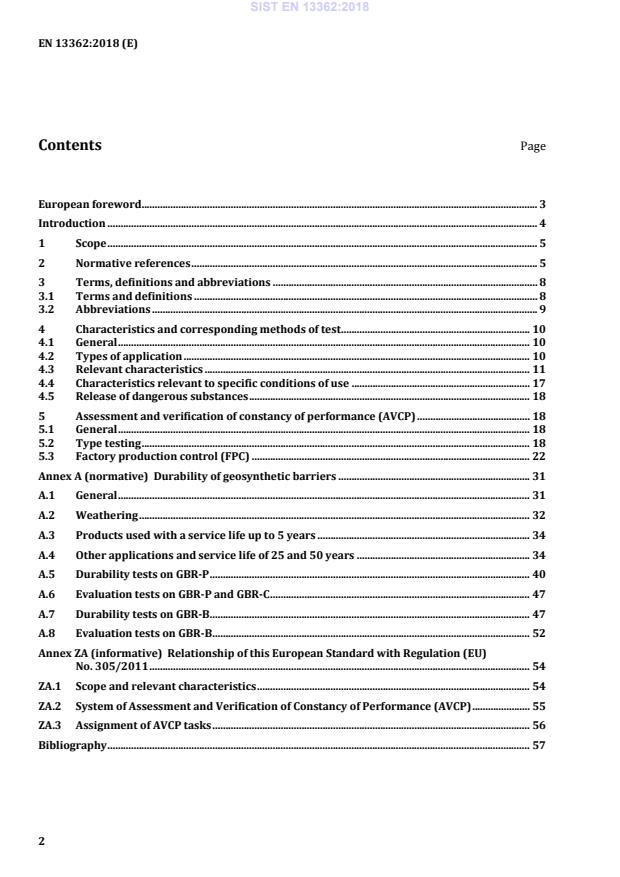
European foreword . 3 Introduction . 4 1 Scope . 5 2 Normative references . 5 3 Terms, definitions and abbreviations . 8 3.1 Terms and definitions . 8 3.2 Abbreviations . 9 4 Characteristics and corresponding methods of test . 10 4.1 General . 10 4.2 Types of application . 10 4.3 Relevant characteristics . 11 4.4 Characteristics relevant to specific conditions of use . 17 4.5 Release of dangerous substances . 18 5 Assessment and verification of constancy of performance (AVCP) . 18 5.1 General . 18 5.2 Type testing . 18 5.3 Factory production control (FPC) . 22 Annex A (normative)
Durability of geosynthetic barriers . 31 A.1 General . 31 A.2 Weathering . 32 A.3 Products used with a service life up to 5 years . 34 A.4 Other applications and service life of 25 and 50 years . 34 A.5 Durability tests on GBR-P . 40 A.6 Evaluation tests on GBR-P and GBR-C . 47 A.7 Durability tests on GBR-B . 47 A.8 Evaluation tests on GBR-B . 52 Annex ZA (informative)
Relationship of this European Standard with Regulation (EU) No. 305/2011 . 54 ZA.1 Scope and relevant characteristics . 54 ZA.2 System of Assessment and Verification of Constancy of Performance (AVCP) . 55 ZA.3 Assignment of AVCP tasks . 56 Bibliography . 57
the list of normative references has been updated;
in 3.1 three terms have been added;
in 3.2 list of abbreviations has been updated;
in 4.3, Table 1, has been modified to comply with the modified mandate M/386 (inclusion of elongation in separation and filtration functions) and has been technically revised, all H-coded characteristics have been replaced by “A”,
figures and keys have been revised;
Clause 5 “Evaluation of conformity” has been superseded by new Clause 5 “Assessment and verification of constancy of performance (AVCP)”
Annex A “Factory production control – Factory production control scheme” has been deleted;
former Annex B “Durability” becomes Annex A, which has been totally revised;
Annex ZA has been updated according to new template to fulfil requirements of CPR, also examples for CE-marking have been deleted. According to the CEN-CENELEC Internal Regulations, the national standards organisations of the following countries are bound to implement this European Standard: Austria, Belgium, Bulgaria, Croatia, Cyprus, Czech Republic, Denmark, Estonia, Finland, Former Yugoslav Republic of Macedonia, France, Germany, Greece, Hungary, Iceland, Ireland, Italy, Latvia, Lithuania, Luxembourg, Malta, Netherlands, Norway, Poland, Portugal, Romania, Serbia, Slovakia, Slovenia, Spain, Sweden, Switzerland, Turkey and the United Kingdom.
¯ y v °C and 30 °C SIST EN 13362:2018
ASTM D5890, Standard test method for swell index of clay mineral component of geosynthetic clay liners ASTM D6141, Standard guide for screening clay portion of geosynthetic clay liner (GCL) for chemical compatibility to liquids1 ASTM D7409, Standard Test Method for Carboxyl End Group Content of Polyethylene Terephthalate (PET) Yarns 3 Terms, definitions and abbreviations 3.1 Terms and definitions For the purposes of this document, the terms and definitions given in EN ISO 10318-1 and the following apply. 3.1.1 product geosynthetic barrier, including polymeric, bituminous and clay barriers 3.1.2 geosynthetic barrier barrier with at least one of whose components is made from a synthetic or natural polymer, in the form of a sheet, a strip or a three dimensional structure, used in contact with soil and/or other materials in geotechnical and civil engineering applications 3.1.3 project specification document in which the works, functions, specific conditions and required material property values of the geosynthetic barrier are described 3.1.4 canal waterway which is intended to convey water from source to user or to be used by boats, ships or barges for commercial or pleasure purposes Note 1 to entry: The waterway may be an entirely engineered feature or it may be a natural river which has been engineered to improve its capacity as a waterway. 3.1.5 revetment construction that comprises one or more layers of material to provide protection against erosion 3.1.6 top water level normal highest water level in the canal 3.1.7 fluid gas, liquid and vapour in its pure phase as well as mixtures there of
1 http://www.astm.org/Standards/D6141.htm SIST EN 13362:2018
Key 1 top water level 2 protection geosynthetic (optional) 3 subgrade 4 geosynthetic barrier 5 revetment Figure 1 — Geosynthetic barrier laid in a canal on either fill or cut natural soils and covered with a revetment 4.2.3 Application 2: “not covered in service” As in application 1, but with the GBR not covered in service with a revetment or other protective layers. Figure 2 shows a typical installation. SIST EN 13362:2018
Key 1 top water level 2 fill embankment 3 geosynthetic barrier 4 protection geosynthetic (optional) Figure 2 — Geosynthetic barrier laid in a canal on either fill or cut natural soils and exposed without any revetment or protection 4.3 Relevant characteristics The characteristics, their relevance to the conditions of use, and the test methods to be used, are specified in Table 1. The list of characteristics in Table 1 includes those relevant to all conditions of use (A) (essential characteristics are listed in Table ZA.1), and those relevant to specific conditions of use (S). The indication “–” means that the characteristic is not relevant for that function. Where, for the same property, data for more than one function shall be provided, the following ranking order shall be observed: A overrules S, and S overrules “–”. The functions and conditions of use, corresponding with the S-coded characteristics in Table 1, are specified in 4.4. The performances of the characteristics shall be given on basis of the results of tests specified in this document and, where relevant, in accordance with 5.1. Information on how functioning joints can be made should be provided. Where products are jointed in the factory the liquid tightness and if relevant the strength of the joints shall be tested and data presented. SIST EN 13362:2018
Covered in service Not covered in service Test methods Remarks No Property to be tested a GBR-P GBR-B GBR-C GBR-P GBR-B GBR-P GBR-B GBR-C
Physical properties
1 Thickness A A A A A EN ISO 9863-1 EN 1849–1 EN ISO 9863-1 For products which cannot be tested according to EN ISO 9863-1, such as geotextile backed GBR-P, EN 1849–2 is applicable. 2 Mass per unit area A A A A A EN 1849–2 EN 1849–1 EN 14196
Hydraulic properties
3 Liquid tightness A A A A A EN 14150 EN 14150 EN 16416 Test liquid is water. Report value index flux for GBR-C and permeability for GBR-P and GBR-B. 4 Swell index — — A — — — — ASTM D5890
Mechanical properties
5 Tensile strength A A A A A PE-HD and PE-LLD EN ISO 527-3, specimen type 5 FPO, PVC-P homogenous EN ISO 527-3, specimen type 5 (reference test method) equivalent to EN 12311–2, method B FPO, PVC-P EN 12311–1 EN ISO 10319 PE-HD and PE-LLD v = 100 mm/min Tensile stress at break in N/mm2 to be reported FPO, PVC-P homogenous v = 100 mm/min if elongation at break is > 400 % the test speed is 500 mm/min maximum tensile strength in N/mm2 to be reported FPO, PVC-P multicomponent v = 100 mm/min maximum tensile force in N/50 mm to be reported EPDM homogenous v = 100 mm/min SIST EN 13362:2018
EN 13362:2017 (E) 13
Covered in service Not covered in service Test methods Remarks No Property to be tested a GBR-P GBR-B GBR-C GBR-P GBR-B GBR-P GBR-B GBR-C
multicompo-nent EN 12311–2 method A (reference test method) equivalent to EN ISO 527-4; specimen type
2; width: 50 mm,
EPDM homogenous EN 12311–2, method B EPDM multicompo-nent EN 12311–2, method A
if elongation at break is > 400 % the test speed is 500 mm/min maximum tensile strength in N/mm2 to be reported EPDM multicomponent v = 100 mm/min max tensile force in N/50 mm to be reported
6 Elongation A A A A A PE-HD and PE-LLD EN ISO 527-3, specimen type 5 FPO, PVC-P homogenous EN ISO 527-3, specimen type 5 (reference test method) EN 12311–1 EN ISO 10319 PE-HD and PE-LLD with reference length
(l0)50 mm,
v = 100 mm/min Elongation at break to be reported FPO, PVC-P homogenous v = 100 mm/min if elongation at break is > 400 % the test speed is 500 mm/min – Elongation at break to be reported FPO, PVC-P multicomponent v = 100 mm/min SIST EN 13362:2018
Covered in service Not covered in service Test methods Remarks No Property to be tested a GBR-P GBR-B GBR-C GBR-P GBR-B GBR-P GBR-B GBR-C
equivalent to EN 12311–2, method B FPO, PVC-P multicompo-nent EN 12311–2 method A (reference test method) equivalent to EN ISO 527-4; specimen type 2; width: 50 mm EPDM homogenous EN 12311–2, method B EPDM multicompo-nent EN 12311–2, method A
Elongation at maximum tensile force
in % to be reported EPDM homogenous v = 100 mm/min if elongation at break is > 400 % the test speed is 500 mm/min Elongation at break to be reported PDM multicomponent v = 100 mm/min Elongation at maximumtensile force
in % to be reported
7 Static puncture A A A A A EN ISO 12236 EN ISO 12236 EN ISO 12236
8 Burst strength and elongation S S S S S EN 14151 EN 14151 EN 14151 This test applies to GBR-C only if they contain a polymeric or bituminous barrier element. 9 Tear strength S S — S S ISO 34-1 EN 12310–1 — For GBR-P use ISO 34-1 method B, angle specimen (Figure 2) without nick at a speed of 50 mm/min. 10 Friction direct S S S — — EN ISO 12957-EN ISO 12957-1 EN ISO 12957-For determining the bonding strength of GBR-C, an SIST EN 13362:2018
EN 13362:2017 (E) 15
Covered in service Not covered in service Test methods Remarks No Property to be tested a GBR-P GBR-B GBR-C GBR-P GBR-B GBR-P GBR-B GBR-C
shear 1 1 internal shear or peel bond test may be applicable. 11 Friction inclined plane S S S — — EN ISO 12957-2 EN ISO 12957-2 EN ISO 12957-2
Thermal properties
12 Low temp behaviour (flexure) S S — S S EN 495–5 EN 1109 —
13 Thermal expansion A — — A — ASTM D696 — —
Durability
14 Weathering A A S A A EN 12224 EN 12224 EN 12224 In accordance with Annex A. 15 Microorganisms A A A A A EN 12225 EN 12225 EN 12225 In accordance with Annex A. 16 Oxidation A A A A A EN 14575 EN 14575 EN ISO 13438 In accordance with Annex A. EN ISO 13438 is applicable for the geotextile elements and reinforcement yarns of GBR-C barriers. 17 Environmental stress cracking A — A A — EN 14576
EN 14576 In accordance with Annex A. EN 14576 is applicable to GBR-P with a semi-crystalline structure. If GPR-P is between 0,5 mm and 1,0 mm the test EN 14576 shall be performed with the same composition at a thickness greater than 1,0 mm. 18 Chemical resistance S S S — — EN 14414 EN 14414 ASTM D6141 In accordance with Annex A. Chemical resistance testing should be conducted in line with site specific circumstances. This should be restricted to a consideration of the substrate onto which the material is laid and/or chemicals contained. SIST EN 13362:2018
Covered in service Not covered in service Test methods Remarks No Property to be tested a GBR-P GBR-B GBR-C GBR-P GBR-B GBR-P GBR-B GBR-C
19 Leaching (water soluble) A A A A A EN 14415 EN 14415 EN 14415 In accordance with Annex A. 20 Wetting/drying — — — — — — — CEN/TS 14417 In accordance with Annex A. 21 Freezing/thawing — — S — — — — CEN/TS 14418 In accordance with Annex A. 22 Root penetration S S S S S CEN/TS 14416 CEN/TS 14416 CEN/TS 14416 In accordance with Annex A. a NOTE The 95 % confidence level corresponds to the mean value minus (and/or plus) a tolerance value (see Annex ZA, Table ZA.1 column Notes). Both the mean value and the tolerance value are defined by the manufacturer to be representative of the performance of the product for the corresponding characteristic (these two values are not necessarily based on a statistical calculation). Relevance of codes: A: relevant to all conditions of use S: relevant to specific conditions of use “—”: indicates that the characteristic is not relevant for that product. Particular site-specific application cases may contain requirements for additional properties and - preferably standardized - test methods, if they are technically relevant and not conflicting with European Standards. The design life of the product should be determined, since its function may be temporary, as construction expediency, or permanent, for the lifetime of the structure. SIST EN 13362:2018
(CBR test) 4.3, Table1 According to 4.3, Table 1 5 Not defined Liquid tightness (Water permeability respective water flux index) 4.3, Table 1 According to 4.3, Table 1 1 Not defined Elongation 4.3, Table 1 According to 4.3, Table 1 5 MD/5 CMD Not defined Durability 4.3, Table 1 and Annex A According to 4.3, Table 1 and Annex A See Annex A See Annex A 5.2.3 Test reports The results of the determination of the product type shall be documented in test reports. All test reports shall be retained by the manufacturer for at least 10 years after the last date of production of the geosynthetic barriers, for use in the construction of canals to which they relate. 5.2.4 Shared other party results A manufacturer may use the results of the product type determination (in consistency with this standard) obtained by someone else (e.g. by another manufacturer, as a common service to manufacturers, or by a product developer), to justify his own declaration of performance regarding a product that is manufactured according to the same design (e.g. dimensions) and with raw materials, constituents and manufacturing methods of the same kind, provided that: — the results are known to be valid for products with the same essential characteristics relevant for the product performance; — in addition to any information essential for confirming that the product has such same performances related to specific essential characteristics, the other party who has carried out the determination of the product type concerned or has had it carried out, has expressly accepted 2) to transmit to the manufacturer the results and the test report to be used for the latter’s product type determination, as well as information regarding production facilities and the production control process that can be taken into account for FPC; — the manufacturer using other party results accepts to remain responsible for the product having the declared performances and he also: a) ensures that the product has the same characteristics relevant for performance as the one that has been subjected to the determination of the product type, and that there are no significant
2) The formulation of such an agreement can be done by license, contract, or any other type of written consent. SIST EN 13362:2018
...