


prEN 18250
(Main)Soil improvers and growing media - Plugs - Determination of the dimensions, volume and bulk density
Soil improvers and growing media - Plugs - Determination of the dimensions, volume and bulk density
This document specifies a method for the determination of the dimensions, volume and the bulk density of pre-shaped and non pre-shaped plugs.
Bodenverbesserungsmittel und Kultursubstrate - Plugs - Bestimmung der gemessenen Abmessungen und der Schüttdichte
Dieses Dokument legt ein Verfahren für die Bestimmung der Abmessungen, des Volumens und der Schüttdichte von vorgeformten und nicht vorgeformten Plugs fest.
Amendements du sol et supports de culture - Plugs - Détermination des dimensions, du volume et de la masse volumique apparente
Le présent document spécifie une méthode pour la détermination des dimensions, du volume et de la masse volumique apparente des plugs préformés et non préformés.
Izboljševalci tal in rastni substrati - Substrati (plugs) - Določanje mer, prostornine in prostorninske gostote
General Information
- Status
- Not Published
- Publication Date
- 11-Dec-2024
- Technical Committee
- CEN/TC 223 - Soil improvers and growing media
- Drafting Committee
- CEN/TC 223/WG 3 - Sampling
- Current Stage
- 4060 - Closure of enquiry - Enquiry
- Start Date
- 08-Jan-2026
- Due Date
- 19-Oct-2023
- Completion Date
- 08-Jan-2026
Overview
prEN 18250 (CEN draft 2025) defines a standardized laboratory method to determine the dimensions, volume and bulk density of pre-shaped and non pre-shaped plugs used in soil improvers and growing media. Developed by CEN/TC 223, this method supports consistent product description, quality control and reporting-critical when plugs are marketed, specified for propagation trays or used as the basis for chemical analyses reported per unit volume.
Key topics and technical requirements
- Scope: Applies to small self-contained units of growing medium (plugs), typically 1–100 ml, both pre-shaped and non pre-shaped.
- Dimensions measured:
- Rectangular plugs: length (l), width (w), height (h)
- Cylindrical/conical plugs: height (h) and diameter (D)
- Volume determination: Uses a pycnometer-style method with glass beads (particle size 0.4–0.8 mm) and a calibrated measuring cylinder; the plug’s volume is derived from displacement of beads.
- Bulk density: Calculated as the ratio of plug mass to measured volume; units expressed in g/l or kg/m³.
- Apparatus and metrology:
- Measuring cylinder (~3× estimated plug volume) calibrated at controlled temperature (10–29 °C)
- Balances (0.001 g and 0.1 g readability)
- Metal rule, height gauge, dimensional instrument (0.5 mm resolution)
- Fall controller (supported screen or flow unit) to standardize bead fill
- Optional bead cleaning (drying oven, muffle furnace or chemical treatment) for bead reuse
- Procedure notes:
- Sampling aligned with EN 12579
- Calibration and calculation steps defined (including correction factors for water density and temperature)
- Method validation referenced to ISO 5725‑2 and performance characteristics provided in an informative annex
Applications and users
- Who uses it: manufacturers of plugs and blocks, growing media laboratories, QA/QC technicians, seedling tray designers, traders, certification bodies and regulatory authorities across horticulture and horticultural substrate supply chains.
- Practical uses:
- Verifying plug size compatibility with propagation trays and rooting units
- Converting analytical results to a mass-per-volume basis for nutrient and contaminant reporting
- Product labelling and conformity testing for market transactions
- Internal quality control and batch consistency checks
Related standards
- CEN/TS 17732:2022 - Terminology for soil improvers and growing media
- EN 12579:2024 - Sampling of soil improvers and growing media
- ISO 5725‑2 - Method validation (reproducibility & repeatability)
- References cited for apparatus/metrology: OIML R35‑1:2007, OIML R76‑1:2006, EN 933‑6 (flow unit concepts)
Keywords: soil improvers, growing media, plugs, bulk density determination, volume measurement, dimensions measurement, pycnometer method, CEN prEN 18250.

Get Certified
Connect with accredited certification bodies for this standard

Control Union Certifications
Global certification for agriculture and sustainability.

ECOCERT
Organic and sustainability certification.

Rainforest Alliance Certification
Sustainable agriculture and forestry certification.
Sponsored listings
Frequently Asked Questions
prEN 18250 is a draft published by the European Committee for Standardization (CEN). Its full title is "Soil improvers and growing media - Plugs - Determination of the dimensions, volume and bulk density". This standard covers: This document specifies a method for the determination of the dimensions, volume and the bulk density of pre-shaped and non pre-shaped plugs.
This document specifies a method for the determination of the dimensions, volume and the bulk density of pre-shaped and non pre-shaped plugs.
prEN 18250 is classified under the following ICS (International Classification for Standards) categories: 65.080 - Fertilizers. The ICS classification helps identify the subject area and facilitates finding related standards.
prEN 18250 is associated with the following European legislation: EU Directives/Regulations: 2019/1009; Standardization Mandates: M/564, M/564 AMD 1, M/564 AMD 2. When a standard is cited in the Official Journal of the European Union, products manufactured in conformity with it benefit from a presumption of conformity with the essential requirements of the corresponding EU directive or regulation.
prEN 18250 is available in PDF format for immediate download after purchase. The document can be added to your cart and obtained through the secure checkout process. Digital delivery ensures instant access to the complete standard document.
Standards Content (Sample)
SLOVENSKI STANDARD
01-december-2025
Izboljševalci tal in rastni substrati - Substrati (plugs) - Določanje mer, prostornine
in prostorninske gostote
Soil improvers and growing media - Plugs - Determination of the dimensions, volume
and bulk density
Bodenverbesserungsmittel und Kultursubstrate - Plugs - Bestimmung der gemessenen
Abmessungen und der Schüttdichte
Amendements du sol et supports de culture - Plugs - Détermination des dimensions, du
volume et de la masse volumique apparente
Ta slovenski standard je istoveten z: prEN 18250
ICS:
65.080 Gnojila Fertilizers
2003-01.Slovenski inštitut za standardizacijo. Razmnoževanje celote ali delov tega standarda ni dovoljeno.
DRAFT
EUROPEAN STANDARD
NORME EUROPÉENNE
EUROPÄISCHE NORM
October 2025
ICS 65.080
English Version
Soil improvers and growing media - Plugs - Determination
of the dimensions, volume and bulk density
Amendements du sol et supports de culture - Plugs - Bodenverbesserungsmittel und Kultursubstrate - Plugs
Détermination des dimensions, du volume et de la - Bestimmung der gemessenen Abmessungen und der
masse volumique apparente Schüttdichte
This draft European Standard is submitted to CEN members for enquiry. It has been drawn up by the Technical Committee
CEN/TC 223.
If this draft becomes a European Standard, CEN members are bound to comply with the CEN/CENELEC Internal Regulations
which stipulate the conditions for giving this European Standard the status of a national standard without any alteration.
This draft European Standard was established by CEN in three official versions (English, French, German). A version in any other
language made by translation under the responsibility of a CEN member into its own language and notified to the CEN-CENELEC
Management Centre has the same status as the official versions.
CEN members are the national standards bodies of Austria, Belgium, Bulgaria, Croatia, Cyprus, Czech Republic, Denmark, Estonia,
Finland, France, Germany, Greece, Hungary, Iceland, Ireland, Italy, Latvia, Lithuania, Luxembourg, Malta, Netherlands, Norway,
Poland, Portugal, Republic of North Macedonia, Romania, Serbia, Slovakia, Slovenia, Spain, Sweden, Switzerland, Türkiye and
United Kingdom.
Recipients of this draft are invited to submit, with their comments, notification of any relevant patent rights of which they are
aware and to provide supporting documentation.
Warning : This document is not a European Standard. It is distributed for review and comments. It is subject to change without
notice and shall not be referred to as a European Standard.
EUROPEAN COMMITTEE FOR STANDARDIZATION
COMITÉ EUROPÉEN DE NORMALISATION
EUROPÄISCHES KOMITEE FÜR NORMUNG
CEN-CENELEC Management Centre: Rue de la Science 23, B-1040 Brussels
© 2025 CEN All rights of exploitation in any form and by any means reserved Ref. No. prEN 18250:2025 E
worldwide for CEN national Members.
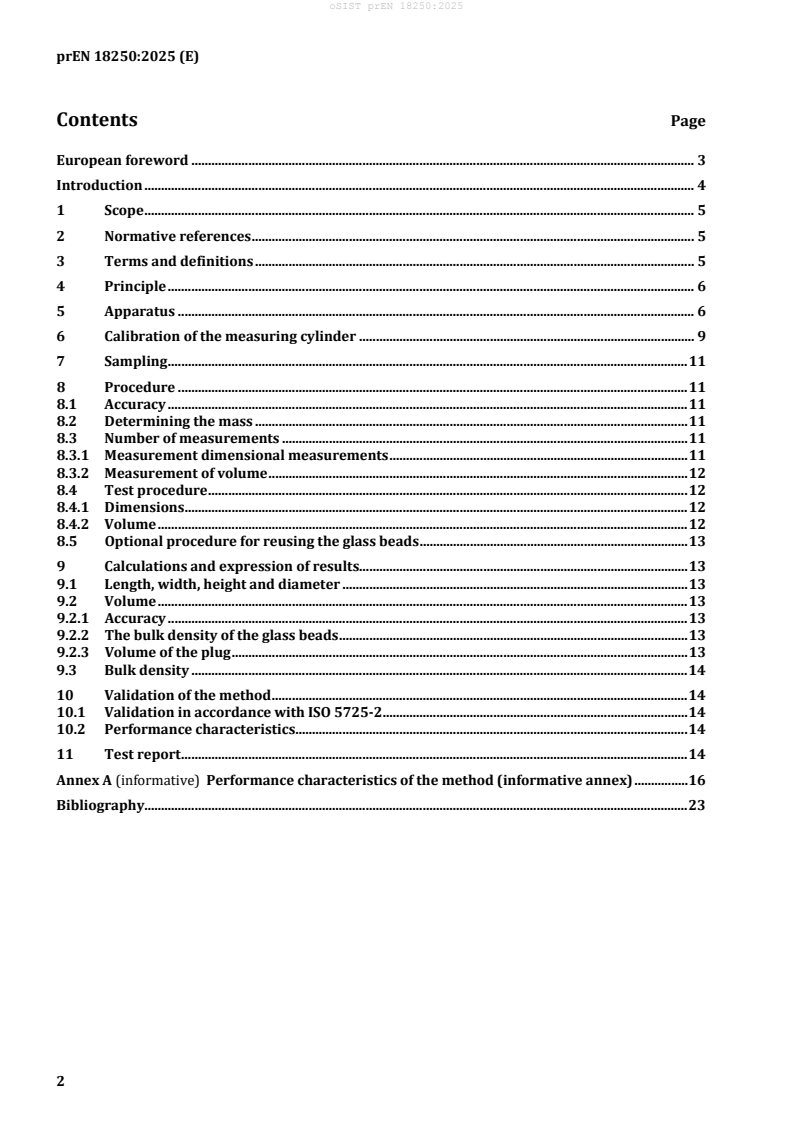
Contents Page
European foreword . 3
Introduction . 4
1 Scope . 5
2 Normative references . 5
3 Terms and definitions . 5
4 Principle . 6
5 Apparatus . 6
6 Calibration of the measuring cylinder . 9
7 Sampling . 11
8 Procedure . 11
8.1 Accuracy . 11
8.2 Determining the mass . 11
8.3 Number of measurements . 11
8.3.1 Measurement dimensional measurements . 11
8.3.2 Measurement of volume . 12
8.4 Test procedure . 12
8.4.1 Dimensions . 12
8.4.2 Volume . 12
8.5 Optional procedure for reusing the glass beads . 13
9 Calculations and expression of results. 13
9.1 Length, width, height and diameter . 13
9.2 Volume . 13
9.2.1 Accuracy . 13
9.2.2 The bulk density of the glass beads . 13
9.2.3 Volume of the plug . 13
9.3 Bulk density . 14
10 Validation of the method . 14
10.1 Validation in accordance with ISO 5725-2 . 14
10.2 Performance characteristics . 14
11 Test report . 14
Annex A (informative) Performance characteristics of the method (informative annex) . 16
Bibliography. 23
European foreword
This document (prEN 18250:2025) has been prepared by Technical Committee CEN/TC 223 “Soil
improvers and growing media”, the secretariat of which is held by NEN.
This document is currently submitted for CEN Enquiry.
This document has been prepared under a standardization request given to CEN by the European
Commission. The Standing Committee of the EFTA States subsequently approves these requests for its
Member States.
Introduction
This document has been developed to provide a standardized method to measure and weigh plugs and
to calculate their volume and bulk density.
It is important for consumers, manufacturers, and traders to know the volume of a plug product when
placed on the market. For the cultivation of plants, it is critical that the volume of the plug corresponds to
the chosen cultivation technique, e.g. when propagating seedlings in trays having specific-sized rooting
units.
The bulk density is crucial as the reporting of all chemical analytical results is expressed in units of mass
per volume, and the volume is determined from the mass of the sample used for the chemical analyses.
Pre-shaped growing media can be made from mineral wool, synthetic materials and others from
stabilized organic materials. Plugs can be pre-shaped and non-preshaped.
1 Scope
This document specifies a method for the determination of the dimensions, volume and the bulk density
of pre-shaped and non pre-shaped plugs.
2 Normative references
The following documents are referred to in the text in such a way that some or all of their content
constitutes requirements of this document. For dated references, only the edition cited applies. For
undated references, the latest edition of the referenced document (including any amendments) applies.
CEN/TS 17732:2022, Soil improvers and growing media — Terminology
EN 12579:2024, Soil improvers and growing media — Sampling
3 Terms and definitions
For the purposes of this document, the terms and definitions given in CEN/TS 17732:2022 and the
following apply.
3.1
length
l
longest linear dimension of the major surface of the regular rectangular plug, expressed in millimetres
(mm)
3.2
width
w
shortest linear dimension of the major surface of the regular rectangular plug measured at right angles
to the length, expressed in millimetres (mm)
3.3
height
h
linear dimension measured from top to bottom of the plug, expressed in millimetres (mm)
3.4
diameter
D
average distance between two points taken transversally of the conical or cylindrical plug at its widest
and thinnest part of the truncated conical form, expressed in millimetres (mm)
3.5
bulk density
p
b
ratio of the plug’s mass to its total volume
Note 1 to entry: The bulk density is expressed in grams per litre (g/l) or in kilograms per cubic metre (kg/m ).
3.6
plug
small, self-contained unit of growing medium, used for plant propagation
Note 1 to entry: Typically, plugs have a size from 1 ml up to 100 ml.
3.7
pre-shaped plug
small, solid, uniform shaped, stable growing medium, which does not require reconstitution by wetting
(other than blocks) and is ready to use for propagation, including rooting of seedlings or plant material
Note 1 to entry: The bulk density is expressed in grams per litre (g/l) or in kilograms per cubic metre (kg/m ).
3.8
non pre-shaped plug
small unit of growing medium, other than pre-shaped plugs, used for propagation, including rooting of
seedlings or plant material
Note 1 to entry: Non pre-shaped plugs can require reconstitution.
3.9
block
pre-shaped growing medium, possibly containing holes to take plugs
Note 1 to entry: Blocks are generally used for propagation purposes.
Note 2 to entry: Blocks can vary in size.
3.10
pressed tablet
compressed non pre-shaped plug, composed of organic components (such as peat, coir or wood fibre)
and which requires reconstitution with water
3.11
plug holder
small container of the size of a plug, with openings for roots
4 Principle
The plug is placed on a flat surface.
For regular rectangular material, measurements of the dimensions length, width and height are taken.
For (truncated) conical plugs and cylindrical plugs, measurements of the dimensions height and diameter
are taken.
NOTE These measurements are made to determine the dimensions, but are not to be used for the volume
calculation.
The volume is determined using the pycnometer’s method (see 8.3.2) [1].
The bulk density is calculated based on the weight and volume of the plug.
5 Apparatus
The following laboratory apparatus shall be used.
5.1 Flat surface, horizontal, flat stable surface, e.g. table top, which is large enough for the plug and the
measuring devices.
5.2 Metal rule or metal tape, graduated in millimetres and permitting reading to 0,5 mm or less.
NOTE Measures conforming to the requirements of OIML R35-1:2007, Material measures of length for general
use. Part 1: Metrological and technical requirements [2], Class II are appropriate. This can be obtained from
https://www.oiml.org/publications/.
5.3 (Height) gauge, having a maximum scale interval of 0,5 mm.
5.4 Measuring cylinder, the measuring cylinder shall be rigid, transparent, regularly cylindrical and
with a volume of approximately three times the estimated volume of the plug.
NOTE A logic range for measuring cylinder sizes is 10, 25, 50, 100 and 250 ml.
5.5 Balance, having a maximum scale interval of 0,001 g.
NOTE Any balance conforming to the requirements of OIML R76-1:2006, Non-automatic weighing instruments.
Part 1: Metrological and technical requirements – Tests [3], Class II is appropriate. This can be obtained from
https://www.oiml.org/publications/.
5.6 Balance, having a maximum scale interval of 0,1 g.
NOTE Any balance conforming to the requirements of OIML R76-1:2006, Non-automatic weighing instruments.
Part 1: Metrological and technical requirements – Tests [3], Class II is appropriate. This can be obtained from
https://www.oiml.org/publications/.
5.7 Dimensional measuring instrument, with a maximum scale of 0,5 mm.
NOTE Any instrument conforming the requirements of Directive 2014/32/EU [4] is appropriate.
5.8 Glass beads, solid, dry with a particle size within 0,4 – 0,8 mm tolerance for particles < 0,4 mm
(max. 1 %).
5.9 Straight-edge, rigid, of rectangular cross section, of thickness not exceeding 3 mm, preferably with
a sharp edge, and at least 200 mm long.
5.10 Strike, transparent sheet of flat material, normally glass, which is large enough to cover the top of
the measuring cylinder.
5.11 Fall controller, to standardize the falling speed of the glass beads. There are two options:
1. A supported fall controller, composed of a sieve with a perforated plate or woven wire screen with
1 mm square mesh apertures and a diameter equal to the diameter of the measuring cylinder
(200 mm). The fall controller shall be independently supported 25 mm ± 3 mm above the rim of the
measuring cylinder and not connected to it, avoiding jogging or vibrating (Figure 1).
2. A flow unit for fine aggregates as used in EN 933-6 [5] with an adapted lower hole diameter of
6 mm ± 0,5 mm, held 25 mm ± 3 mm above the rim of the measuring cylinder (Figure 2).
If following the procedure in 8.5 for reusing the glass beads, the following apparatus shall be used.
5.12 Water with a specific conductivity not higher than 0,2 mS/m at 25 °C
5.13 Drying oven, capable of maintaining a temperature of 105 °C ± 2 °C. The drying oven is to be used
if glass beads are to be reused.
5.14 Sieves, respective with 1 mm and 0,25 mm mesh size.
5.15 Electric muffle furnace, capable of maintaining a temperature of 450 °C ± 25 °C. The furnace may
be used to remove remaining organic matter from the glass beads if glass beads are to be reused.
Alternatively, a hydrogen peroxide solution may be used to remove remaining organic matter from the
glass beads.
Key
1 glass beads in a scoop or cup
2 supported fall controller with screen
3 plug
4 measuring cylinder
5 bottom filled with glass beads
Figure 1 — Schematic arrangement of the equipment for measuring the volume of a plug
Key
1 glass beads in a cylindrical body connected to funnel (2), internal diameter 90 mm ± 0,1 mm,
internal height 125 mm ± 2 mm
2 funnel section, upper cone diameter, 90 mm, cone angle 60°, lower hole diameter 6 mm ± 0,5 mm
3 plug
4 measuring cylinder
5 bottom filled with glass beads
Figure 2 — Schematic arrangement of the equipment for measuring the volume of a plug,
alternative
6 Calibration of the measuring cylinder
To calibrate the measuring cylinder (5.4), place the measuring cylinder and sufficient distilled water
together in a room so that the temperature of both stabilizes. Determine the temperature, T. The
temperature should be in between 10 and 29 °C. Weigh the empty measuring cylinder (5.4) with the
strike (5.10), using the balance (5.6). This is mass m .
e
Fill to the brim with water using the strike. When the water level is near the top of the measuring cylinder,
start to slide the strike onto the rim of the measuring cylinder and pick up the meniscus of the water on
its underside. Filling continues gradually, continuing to slide the strike over the surface of the measuring
cylinder so that no air bubbles are trapped under it. The measuring cylinder is completely filled when the
strike covers the top of the measuring cylinder without any air being trapped under it. Weigh the filled
measuring cylinder and strike in 0,1 g, mass, m using the balance (5.6). Calculate the mass of water using
f
Formula (1):
m mm − (1)
w f e
where
m is the mass of the water;
w
m is the mass of the filled measuring cylinder;
f
m is the mass of the empty measuring cylinder with the strike.
e
Calculate the volume of water by multiplying by the factor given in Table 1. This gives the volume of the
measuring cylinder, V in cubic centimetres, at the temperature, T, at which it has been calibrated.
T
Table 1 — Multiplication factor at various temperatures for the calculation of the volume of the
measuring cylinder
Temperature Factor
(°C)
10 1,001 35
11 1,001 45
12 1,001 55
13 1,001 67
14 1,001 81
15 1,001 96
16 1,002 11
17 1,002 29
18 1,002 47
19 1,002 66
20 1,002 86
21 1,003 07
22 1,003 29
23 1,003 52
24 1,003 76
25 1,004 02
26 1,004 29
27 1,004 56
=
Temperature Factor
(°C)
28 1,004 84
29 1,005 14
Calculate the volume of the measuring cylinder (V ) in cubic centimetres at 20 °C using Formula (2):
Vc= V×+1 E 20− T (2)
( )
( )
T
where
E is the coefficient of cubical expansion for the material from which the
measuring cylinder is made. For steel this is 0,000 033/°C, for glass
0,000 0255/°C and for polyethylene it is 0,000 200/°C;
V is the volume of the measuring cylinder, in cm ;
c
V is the volume of the measuring cylinder at temperature T, in cm ;
T
T is the temperature at which the measuring cylinder has been calibrated.
The volume shall be rounded to the nearest 0,1 cm .
NOTE 1 In some countries there is a legal requirements to have the measuring cylinder calibrated by an
accredited calibration laboratory.
NOTE 2 To check if the calibration has been performed correctly, an additional check can be performed by using
a reference material with a known volume (e.g. an aluminium cylinder) and following the procedure in 8.4.2.
Perform this calibration in duplicate and calculate the average v
...
Questions, Comments and Discussion
Ask us and Technical Secretary will try to provide an answer. You can facilitate discussion about the standard in here.
Loading comments...