

EN 14154-1:2005
(Main)Water meters - Part 1: General requirements
- Abstract
This document applies to water meters intended for residential, commercial, light industrial and industrial use, and specifies the requirements and certification procedures for water meters, irrespective of the design technologies used to meter the actual volume of clean cold potable water or heated water, flowing through a fully charged, closed conduit. These water meters shall incorporate devices, which indicate the integrated volume.
This document also applies to water meters based on electrical or electronic principles, and to water meters based on mechanical principles incorporating electronic devices, used to meter the actual volume flow of cold potable water or heated water. It provides metrological requirements for electronic ancillary devices when they are subject to metrological control. As a rule the ancillary devices are optional. However national or international regulations make some ancillary devices mandatory in relation to the utilisation of the water meter.
- Status
- Withdrawn
- Publication Date
- 22-Feb-2005
- Withdrawal Date
- 10-Apr-2007
- Technical Committee
- CEN/TC 92 - Test methods and equipment for cold water meters
- Drafting Committee
- CEN/TC 92 - Test methods and equipment for cold water meters
- Current Stage
- 9960 - Withdrawal effective - Withdrawal
- Start Date
- 11-Apr-2007
- Completion Date
- 11-Apr-2007

Relations
- Effective Date
- 22-Dec-2008
Get Certified
Connect with accredited certification bodies for this standard

DIBt (Deutsches Institut für Bautechnik)
German Institute for Building Technology.
DIN CERTCO
DIN Group product certification.

Aboma Certification B.V.
Specialized in construction, metal, and transport sectors.
Sponsored listings
Frequently Asked Questions
EN 14154-1:2005 is a standard published by the European Committee for Standardization (CEN). Its full title is "Water meters - Part 1: General requirements". This standard covers: This document applies to water meters intended for residential, commercial, light industrial and industrial use, and specifies the requirements and certification procedures for water meters, irrespective of the design technologies used to meter the actual volume of clean cold potable water or heated water, flowing through a fully charged, closed conduit. These water meters shall incorporate devices, which indicate the integrated volume. This document also applies to water meters based on electrical or electronic principles, and to water meters based on mechanical principles incorporating electronic devices, used to meter the actual volume flow of cold potable water or heated water. It provides metrological requirements for electronic ancillary devices when they are subject to metrological control. As a rule the ancillary devices are optional. However national or international regulations make some ancillary devices mandatory in relation to the utilisation of the water meter.
This document applies to water meters intended for residential, commercial, light industrial and industrial use, and specifies the requirements and certification procedures for water meters, irrespective of the design technologies used to meter the actual volume of clean cold potable water or heated water, flowing through a fully charged, closed conduit. These water meters shall incorporate devices, which indicate the integrated volume. This document also applies to water meters based on electrical or electronic principles, and to water meters based on mechanical principles incorporating electronic devices, used to meter the actual volume flow of cold potable water or heated water. It provides metrological requirements for electronic ancillary devices when they are subject to metrological control. As a rule the ancillary devices are optional. However national or international regulations make some ancillary devices mandatory in relation to the utilisation of the water meter.
EN 14154-1:2005 is classified under the following ICS (International Classification for Standards) categories: 91.140.60 - Water supply systems. The ICS classification helps identify the subject area and facilitates finding related standards.
EN 14154-1:2005 has the following relationships with other standards: It is inter standard links to EN 14154-1:2005+A1:2007. Understanding these relationships helps ensure you are using the most current and applicable version of the standard.
EN 14154-1:2005 is available in PDF format for immediate download after purchase. The document can be added to your cart and obtained through the secure checkout process. Digital delivery ensures instant access to the complete standard document.
Standards Content (Sample)
2003-01.Slovenski inštitut za standardizacijo. Razmnoževanje celote ali delov tega standarda ni dovoljeno.Water meters - Part 1: General requirementsVodomeri – 1. del: Splošne zahteveCompteurs d'eau - Partie 1: Exigences généralesWasserzähler - Teil 1: Allgemeine AnforderungenTa slovenski standard je istoveten z:EN 14154-1:2005SIST EN 14154-1:2005en91.140.60Sistemi za oskrbo z vodoWater supply systemsICS:SLOVENSKI
STANDARDSIST EN 14154-1:200501-maj-2005
EUROPEAN STANDARDNORME EUROPÉENNEEUROPÄISCHE NORMEN 14154-1February 2005ICS 91.140.60English versionWater meters - Part 1: General requirementsCompteurs d'eau - Partie 1: Exigences généralesWasserzähler - Teil 1: Allgemeine AnforderungenThis European Standard was approved by CEN on 26 August 2004.CEN members are bound to comply with the CEN/CENELEC Internal Regulations which stipulate the conditions for giving this EuropeanStandard the status of a national standard without any alteration. Up-to-date lists and bibliographical references concerning such nationalstandards may be obtained on application to the Central Secretariat or to any CEN member.This European Standard exists in three official versions (English, French, German). A version in any other language made by translationunder the responsibility of a CEN member into its own language and notified to the Central Secretariat has the same status as the officialversions.CEN members are the national standards bodies of Austria, Belgium, Cyprus, Czech Republic, Denmark, Estonia, Finland, France,Germany, Greece, Hungary, Iceland, Ireland, Italy, Latvia, Lithuania, Luxembourg, Malta, Netherlands, Norway, Poland, Portugal, Slovakia,Slovenia, Spain, Sweden, Switzerland and United Kingdom.EUROPEAN COMMITTEE FOR STANDARDIZATIONCOMITÉ EUROPÉEN DE NORMALISATIONEUROPÄISCHES KOMITEE FÜR NORMUNGManagement Centre: rue de Stassart, 36
B-1050 Brussels© 2005 CENAll rights of exploitation in any form and by any means reservedworldwide for CEN national Members.Ref. No. EN 14154-1:2005: E
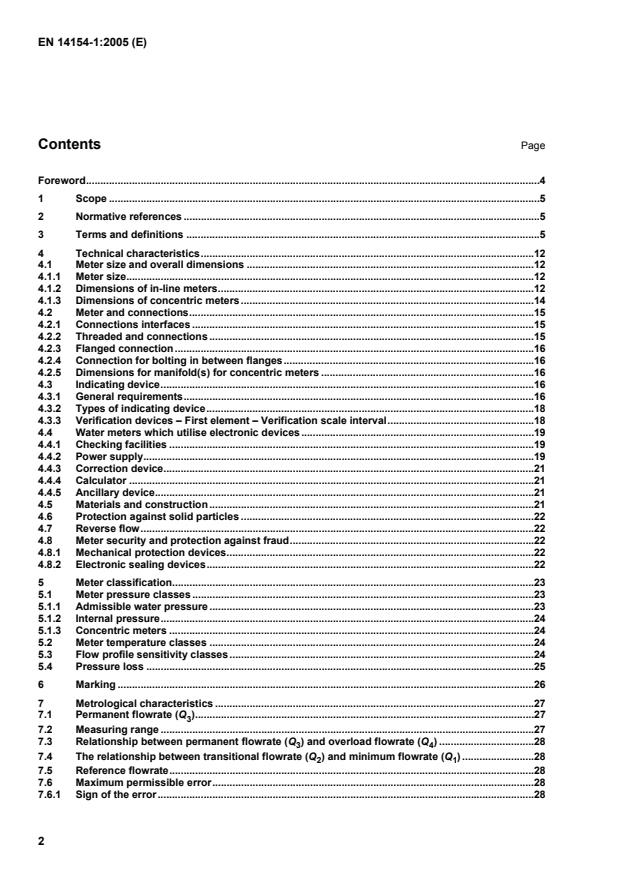
Checking facilities.35 A.1 Action of checking facilities.35 A.2 Checking facilities for the measurement transducer.35 A.2.1 Pulse input solutions.35 A.2.2 Other technologies.36 A.3 Checking facilities for the calculator.36 A.3.1 Checking of correct functioning.36 A.3.2 Checking of the validity of calculations.37 A.4 Checking facility for the indicating device.37 A.4.1 First possibility.37 A.4.2 Second possibility.38 A.5 Checking facilities for ancillary devices.38 A.6 Checking facilities for the associated measuring instruments.38 Annex B (normative)
In-line meter dimensions (including alternative lengths).39 Annex C (informative)
Table of rated operating, limiting and references conditions.42 Annex D (informative)
Test program.44 Bibliography.45
H1, H2, L, W1 and W2 define the height, length and width respectively of a cuboid within which the water meter can be contained (the cover being at right angles to its closed position). H1, H2, W1 and W2 are maximum dimensions. L is a fixed value with specified tolerances. NOTE 1 Where there is a separate indicating device or calculator, the overall size specified in Figure 1 applies only to the housing of the measurement transducer (flow sensor). NOTE 2 Flange diameter sizes of in-line meters with flanges may lay outside the W and/or H sizes of the cuboid. Key 1 Pipe axis Figure 1 — In-line meter dimensions
Dimensions in mm DN L (preferred) W1, W2 H1 H2 15 165 65 60 220 20 190 65 60 240 25 260 85 65 260 32 260 85 70 280 40 300 105 75 300 50 200 65 200 80 200 100 250 125 250 150 300 200 350 250 450 300 500 400 600 500 600 600 800 ≥ 800 1,25 × DN Table 2 — Combination meter dimensions
Dimensions in mm DN L (preferred) W1, W2 50 300 220 65 300 240 80 350 260 100 350 350 125 350 350 150 500 400 200 500 400
NOTE Where there is a separate indicating device or calculator, the overall size specified in Figure 2 applies only to the housing of the measurement transducer. Figure 2 — Concentric meter dimensions
L J φφφφ K Type 1 (G 1½ B) a 220 110 Type 2 (G 2 B) a 220 135 Type 3 (M62 × 2) a 220 135 a Metric or Whitworth threading at the choice of the manufacturer. The relative annex in EN 14154-2 gives a set of figures, which is one of many solutions at the choice of the manufacturer. J and K define respectively the height and diameter of a cylinder enclosing the meter. 4.2 Meter and connections 4.2.1 Connections interfaces Four meter to conduit connection interfaces are standardised: connection of meters to conduit with male threads; connection of meters to conduit with flanges; connection of meters to a concentric manifold; connection of meters by means of bolting between two (conduit) flanges. 4.2.2 Threaded and connections The thread shall comply with EN ISO 228-1:2000, Class B. Acceptable minimum thread dimensions are indicated in Table 4. Figure 3 defines dimensions a and b. Table 4 — Threaded and connections dimensions Minimum dimensions in mm Thread a b G 3/4 B 10 12 G 1 B 12 14 G 1 1/4 B 12 16 G 1 1/2 B 13 18 G 2 B 13 20 G 21/2 B 14 22
Figure 3 — Threaded end connections 4.2.3 Flanged connection Flanged end connections shall comply with ISO 7005-2 and ISO 7005-3 for a nominal pressure corresponding to that of the water meter. NOTE The manufacturer shall provide a reasonable clearance behind the rear face of the flange to allow access for installation and removal. 4.2.4 Connection for bolting in between flanges Meters suitable for bolting between two (conduit) flanges shall be suitable to fit in between two flanges. 4.2.5 Dimensions for manifold(s) for concentric meters Examples of manifolds for concentric meters are shown in an Annex A of EN 14154-2:2004. 4.3 Indicating device 4.3.1 General requirements 4.3.1.1 Function The indicating device of the water meter shall provide an easily read, reliable and unambiguous visual indication of the indicated volume. The indicating device may include elements for testing and calibration by other methods, e.g. for automatic testing and calibration. 4.3.1.2 Unit of measurement, symbol and its placement The volume of water shall be indicated in cubic metres. The symbol m3 shall appear on the dial or immediately adjacent to the numbered display. 4.3.1.3 Indicating range The indicating range shall fulfil provisions formulated in Table 5:
6,3 < Q3 ≤ 63 99 999 63 < Q3 ≤ 630 999 999 630 < Q3 ≤ 6 300 9 999 999 4.3.1.4 Colour coding for indicating devices The colour black should be used to indicate the cubic metre and its multiples. The colour red should be used to indicate sub-multiples of a cubic metre. These colours shall be applied to either the pointers, indexes, numbers, wheels, discs, dials or aperture frames. Other means of indicating the cubic metre, its multiples and its sub-multiples may be used, provided there is no ambiguity in distinguishing between the integer part and the decimal part of the volume. 4.3.1.5 Electronic indicating device The totalizing device shall provide a reliable, clear and unambiguous reading of the volume of water measured. A non-permanent display is permitted, even during measuring, however it shall be possible to display the volume upon request at any time. If the display is non-permanent, the volume indication time shall be at least ten seconds. When the totalizing device is capable of displaying additional information, this information shall be displayed without ambiguity. NOTE This condition could be satisfied if, for example, an extra indication indicates the exact nature of the further information currently displayed, or if each display is controlled by a separate button. A feature shall be included which enables the correct operation of the display to be checked, for example, by successive display of the various characters. Each step of the sequence shall last at least one second. The decimal part of the reading expressed in cubic metres need not necessarily be displayed on the same displaying device as the whole unit part. In such a case, the reading shall be clear and without ambiguity (an extra indication of flow shall be displayed on the indicator). The value may be read, for example: using two separate displaying devices on the totalizing device; in two successive steps on the same displaying device; using a removable indicating device enabling the decimal part display to be read. In such a case a permanent device shall show that the meter is counting with a suitable resolution. The manufacturer shall provide information on the meter about the approximate resolution of this permanent indicating device.
...