


EN 12588:2006
(Main)Lead and lead alloys - Rolled lead sheet for building purposes
Lead and lead alloys - Rolled lead sheet for building purposes
This European Standard specifies the designation, the requirements for chemical composition, surface condition and dimensional tolerances for rolled lead sheet. Lead sheet covered by this European standard is made by the roll deformation process and is intended for roofs, flashings, weatherings, claddings, pre-formed panels, damp-proof courses and similar building work.
No requirements for supporting construction, design of roof or cladding systems and methods of joining are included.
Blei und Bleilegierungen - Gewalzte Bleche aus Blei für das Bauwesen
Diese Europäische Norm legt die Bezeichnung sowie Anforderungen an die chemische Zusammensetzung, Oberflächenbeschaffenheit und Maßtoleranzen für gewalzte Bleche aus Blei fest. Bleche aus Blei nach dieser Europäischen Norm werden im Formwalzverfahren hergestellt und sind für Dächer, Verwahrungen, Ab¬deckungen, Fassadenbekleidungen, vorgefertigte Fassadenelemente, wasserdichte Sperrschichten und ähnliche bautechnische Zwecke bestimmt.
Diese Norm enthält keine Anforderungen an Tragkonstruktionen, Dachkonstruktionen, Verkleidungsverfahren sowie Verbindungsmethoden.
Plomb et alliages de plomb - Feuilles de plomb laminé pour le bâtiment
La présente Norme européenne spécifie la désignation, les exigences en matière de composition chimique,
l'aspect de surface et les tolérances dimensionnelles des feuilles de plomb laminé. Les feuilles de plomb
traitées par la présente Norme européenne sont fabriquées par laminage et sont destinées aux toitures,
accessoires d'étanchéité et de couverture, bardages, panneaux préformés, couches isolantes et travaux de
construction similaires.
Les exigences concernant le support de la construction, la conception du toit ou des systèmes de bardage et
les méthodes de raccordement ne sont pas incluses.
Svinec in svinčeve zlitine - Valjana svinčena pločevina za gradbeništvo
General Information
- Status
- Published
- Publication Date
- 12-Dec-2006
- Withdrawal Date
- 29-Jun-2007
- Technical Committee
- CEN/TC 306 - Lead and lead alloys
- Drafting Committee
- CEN/TC 306/WG 4 - Lead sheet
- Current Stage
- 9093 - Decision to confirm - Review Enquiry
- Start Date
- 08-Dec-2021
- Completion Date
- 14-Apr-2025
Relations
- Effective Date
- 22-Dec-2008
Overview - EN 12588:2006 (Lead sheet for building purposes)
EN 12588:2006 is a CEN European Standard that defines requirements for rolled lead sheet used in building works. It covers designation, chemical composition, surface condition, dimensional tolerances and marking for lead sheet produced by roll deformation and intended for roofs, flashings, weatherings, claddings, pre‑formed panels, damp‑proof courses and similar construction uses. The standard does not cover supporting construction, joining methods or system design.
Key topics and technical requirements
- Material designation: Product designation example - “Lead sheet EN 12588 - 1,25” (denomination + standard number + nominal thickness). Material number system given in Annex A.
- Chemical composition (material PB810M):
- Copper: 0.03 – 0.06 %
- Antimony: ≤ 0.005 %
- Bismuth: ≤ 0.100 %
- Silver: ≤ 0.005 %
- Tin: ≤ 0.05 %
- Zinc: ≤ 0.001 %
- Other impurities: ≤ 0.005 %
- Lead: remainder
- Dimensions & tolerances:
- Thickness up to 6 mm; typical width 100–2 500 mm; lengths up to 12 m (coiled).
- Thickness tolerance: ±5% of nominal.
- Width tolerance: ±5 mm.
- Length tolerance: +50 / 0 mm.
- Surface condition: Sheet must be smooth and free from holes, cracks, dross inclusions and laminations.
- Test methods:
- Thickness measurement: use micrometer with flat-faced 6 mm anvils and thimble ratchet; specified measurement grid across/along the sheet.
- Chemical analysis: representative sampling; method agreed between purchaser and supplier.
- Marking & labelling: each roll/pack must show manufacturer, EN 12588 number, nominal dimensions, identification code and mass. Colour codes are used to indicate thickness (e.g., 1.25 mm - green; 2.00 mm - red; 2.50 mm - black).
- Transport, storage & handling: store under cover, ventilated, separated from ground; avoid deformation and condensation staining.
- Safety: follow supplier SDS (ISO 11014‑1). Manual lifting guidance: masses over 25 kg require two people and/or lifting aids.
Practical applications and users
- Typical uses: roofing membranes, flashings, weatherings, claddings, pre‑formed panels, damp‑proof courses.
- Primary users: lead sheet manufacturers, architects and specifiers, roofers and cladding installers, building product purchasers, compliance officers and building inspectors.
- Benefits: clear acceptance criteria for chemical purity, dimensions, surface quality and traceability - useful for procurement, quality control and on‑site installation planning.
Related standards
- Supersedes EN 12588:1999 (this edition: EN 12588:2006).
- Referenced for safety data sheets: ISO 11014‑1.
Keywords: EN 12588:2006, rolled lead sheet, lead sheet for building, rolled lead, lead roofing, flashings, dimensional tolerances, PB810M.



Frequently Asked Questions
EN 12588:2006 is a standard published by the European Committee for Standardization (CEN). Its full title is "Lead and lead alloys - Rolled lead sheet for building purposes". This standard covers: This European Standard specifies the designation, the requirements for chemical composition, surface condition and dimensional tolerances for rolled lead sheet. Lead sheet covered by this European standard is made by the roll deformation process and is intended for roofs, flashings, weatherings, claddings, pre-formed panels, damp-proof courses and similar building work. No requirements for supporting construction, design of roof or cladding systems and methods of joining are included.
This European Standard specifies the designation, the requirements for chemical composition, surface condition and dimensional tolerances for rolled lead sheet. Lead sheet covered by this European standard is made by the roll deformation process and is intended for roofs, flashings, weatherings, claddings, pre-formed panels, damp-proof courses and similar building work. No requirements for supporting construction, design of roof or cladding systems and methods of joining are included.
EN 12588:2006 is classified under the following ICS (International Classification for Standards) categories: 77.150.60 - Lead, zinc and tin products. The ICS classification helps identify the subject area and facilitates finding related standards.
EN 12588:2006 has the following relationships with other standards: It is inter standard links to EN 12588:1999. Understanding these relationships helps ensure you are using the most current and applicable version of the standard.
EN 12588:2006 is available in PDF format for immediate download after purchase. The document can be added to your cart and obtained through the secure checkout process. Digital delivery ensures instant access to the complete standard document.
Standards Content (Sample)
2003-01.Slovenski inštitut za standardizacijo. Razmnoževanje celote ali delov tega standarda ni dovoljeno.Lead and lead alloys - Rolled lead sheet for building purposesQLãWYRPlomb et alliages de plomb - Feuilles de plomb laminé pour le bâtimentBlei und Bleilegierungen - Gewalzte Bleche aus Blei für das BauwesenTa slovenski standard je istoveten z:EN 12588:2006SIST EN 12588:2007en77.150.60L]GHONLLead, zinc and tin productsICS:SIST EN 12588:20001DGRPHãþDSLOVENSKI
STANDARDSIST EN 12588:200701-februar-2007
EUROPEAN STANDARDNORME EUROPÉENNEEUROPÄISCHE NORMEN 12588December 2006ICS 77.150.60Supersedes EN 12588:1999
English VersionLead and lead alloys - Rolled lead sheet for building purposesPlomb et alliages de plomb - Feuilles de plomb laminé pourle bâtimentBlei und Bleilegierungen - Gewalzte Bleche aus Blei für dasBauwesenThis European Standard was approved by CEN on 19 November 2006.CEN members are bound to comply with the CEN/CENELEC Internal Regulations which stipulate the conditions for giving this EuropeanStandard the status of a national standard without any alteration. Up-to-date lists and bibliographical references concerning such nationalstandards may be obtained on application to the Central Secretariat or to any CEN member.This European Standard exists in three official versions (English, French, German). A version in any other language made by translationunder the responsibility of a CEN member into its own language and notified to the Central Secretariat has the same status as the officialversions.CEN members are the national standards bodies of Austria, Belgium, Cyprus, Czech Republic, Denmark, Estonia, Finland, France,Germany, Greece, Hungary, Iceland, Ireland, Italy, Latvia, Lithuania, Luxembourg, Malta, Netherlands, Norway, Poland, Portugal, Romania,Slovakia, Slovenia, Spain, Sweden, Switzerland and United Kingdom.EUROPEAN COMMITTEE FOR STANDARDIZATIONCOMITÉ EUROPÉEN DE NORMALISATIONEUROPÄISCHES KOMITEE FÜR NORMUNGManagement Centre: rue de Stassart, 36
B-1050 Brussels© 2006 CENAll rights of exploitation in any form and by any means reservedworldwide for CEN national Members.Ref. No. EN 12588:2006: E
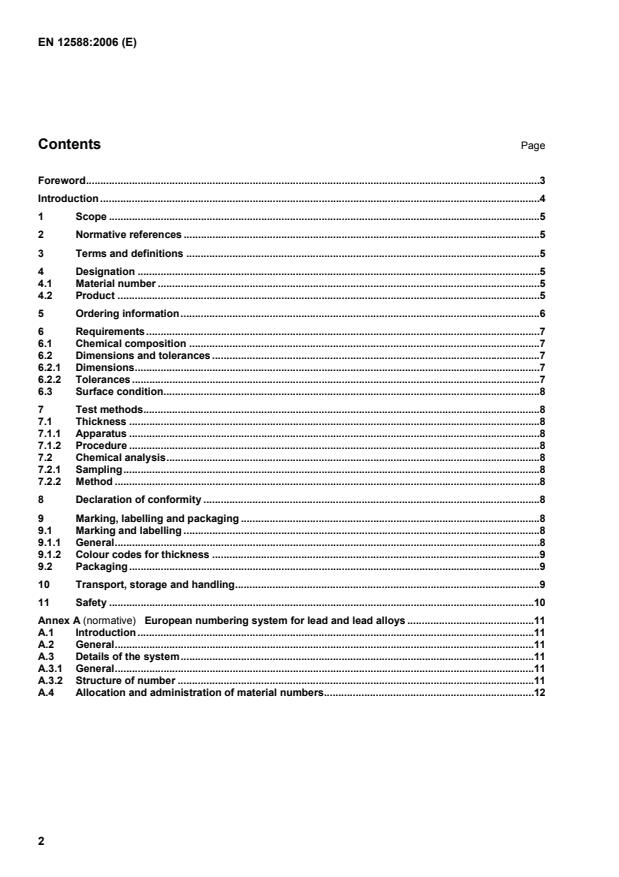
European numbering system for lead and lead alloys.11 A.1 Introduction.11 A.2 General.11 A.3 Details of the system.11 A.3.1 General.11 A.3.2 Structure of number.11 A.4 Allocation and administration of material numbers.12
Environment: Studies into construction and demolition waste carried out by Enviros Aspinall have shown that the recycling rate of the product is above 90 %. Recommendations have been included within this standard on good management of surplus material during construction. According to the CEN/CENELEC Internal Regulations, the national standards organizations of the following countries are bound to implement this European Standard: Austria, Belgium, Cyprus, Czech Republic, Denmark, Estonia, Finland, France, Germany, Greece, Hungary, Iceland, Ireland, Italy, Latvia, Lithuania, Luxembourg, Malta, Netherlands, Norway, Poland, Portugal, Romania, Slovakia, Slovenia, Spain, Sweden, Switzerland and United Kingdom.
In this European Standard, the performance of the product has been defined as far as possible in terms of a number of type tests. The performance of a building element made with these products depends not only on the properties of the product as it is required by this European standard, but also on the design and quality of the fabrication of the building element and on the design, construction and behaviour of the part of the building concerned in relation to the environment and conditions of use. The lead sheet supplied shall be specified and used according to the National Code of Practice, depending on service conditions such as exposure to direct sunlight and the area of the piece of lead to be fixed.
No requirements for supporting construction, design of roof or cladding systems and methods of joining are included. 2 Normative references The following referenced documents are indispensable for the application of this document. For dated references, only the edition cited applies. For undated references, the latest edition of the referenced document (including any amendments) applies. ISO 11014-1, Safety data sheet for chemical products – Part 1: Content and order of sections 3 Terms and definitions For the purposes of this European Standard, the following term and definition applies.
rolled
...
Questions, Comments and Discussion
Ask us and Technical Secretary will try to provide an answer. You can facilitate discussion about the standard in here.
Loading comments...