

FprEN 18251
(Main)Soil improvers and growing media - Determination of phosphonate content
- Abstract
This document specifies a method for the extraction and determination of phosphonates (P-PO3) in growing media and soil improvers using ion chromatography and conductivity detection (IC-CD).
This document is applicable to the fertilizing product blends where a blend is a mix of two or more fertilizing products belonging to the categories of fertilizers, liming material, soil improvers, growing media, inhibitors and plant biostimulants, and where soil improvers and/or growing media are the components with the highest percentage in the blend by mass or volume, or in the case of products in liquid form by dry mass. If the soil improvers and/or growing media are not the components with the highest percentage in the blend, the document relevant to the component with the highest percentage in the blend applies. In case a blend is composed of fertilizing products mixed in equal quantities, the user of the document decides which standard to apply.
NOTE 1 A soil improver consists of a single bulky (volume-building) component or a mix of bulky (volume-building) components (for example peat, wood fibres, coconut coir, compost, expanded perlite).
NOTE 2 This method has been validated in an interlaboratory study with specific products that were present on the market during the study (as included in Annex A, being biowaste compost (dry spiked), liquid digestate (spiked) and growing media blend (peat, green compost, wood fibre, liming material and inorganic fertilizer (NPK + micro elements), dry spiked).
- Status
- Not Published
- Publication Date
- 13-Jan-2027
- Technical Committee
- CEN/TC 223 - Soil improvers and growing media
- Drafting Committee
- CEN/TC 223/WG 4 - Analytical methods
- Current Stage
- 5020 - Submission to Vote - Formal Approval
- Start Date
- 24-Sep-2026
- Due Date
- 21-Dec-2024
- Completion Date
- 24-Sep-2026
- Mandate
- M/XXX - M/XXX

FprEN 18251 is a draft European Standard from CEN for soil improvers and growing media. It specifies a water extraction and ion chromatography with conductivity detection (IC-CD) method for determining phosphonate content, and it also applies to certain fertilizing product blends when soil improvers and/or growing media are the main components. It is written for laboratories and other users who need a common test method for product control and regulatory work.
What does FprEN 18251 specify?
FprEN 18251 specifies how to extract phosphonates from growing media and soil improvers, and how to measure them as phosphorus bound in free water-soluble phosphonates (P-PO3). The document also sets the conditions for applying the method to blends of fertilizing products when the relevant matrix is soil improvers and/or growing media.
In practice, the scope matters because it tells users when this method is the right one and when another product-specific standard should be used instead. If soil improvers and/or growing media are not the main components in a blend, the standard for the dominant component applies. For equal blends, the user chooses the standard.
| Annex | What it covers |
|---|---|
| Annex A | Performance characteristics of the method from the interlaboratory study |
The document is organized into scope, normative references, terms and definitions, principle, reagents, apparatus, sampling, procedure, calculation and expression of results, test report, and validation of the method.
What are the key requirements of FprEN 18251?
FprEN 18251 is built around a water extraction followed by IC-CD measurement, with external calibration for quantification. The method is designed to separate phosphonates from other ions and to report a result that can be used consistently across soil improvers and growing media.
Applicability and sample handling
FprEN 18251 applies to representative samples of soil improvers and growing media, and to certain blends where those materials are the main constituents. Sampling itself is not part of the method; EN 12579:2024 is used for that step. This matters because the laboratory result is only as reliable as the sample it receives.
Sample preparation and extraction
FprEN 18251 requires solid samples to be milled and homogenized as needed before extraction, while liquid samples are homogenized before weighing the test portion. A representative portion is extracted with water, with adjustments for highly absorbent, gel-forming, non-homogeneous, or completely soluble samples. In practice, this means the analyst must choose a preparation route that fits the material and still protects the result from bias.
Reagents, calibration, and separation
FprEN 18251 uses analytical-grade reagents, low-conductivity water, a phosphonate standard solution, and calibration solutions prepared in the working range. The chromatographic system must separate the phosphonate peak from chloride and nitrate, and the document recommends checking this separation with a dedicated solution. This is important because co-eluting anions can distort the phosphonate result.
Measurement and quality control
FprEN 18251 requires all blanks, calibration solutions, test solutions, and control samples to be measured under the same optimized conditions. The method calls for blank control, sensitivity checks during a run, internal reference samples with known phosphonate content, or spike experiments when reference materials are not available. That gives users a routine way to detect drift, contamination, and memory effects.
Calculation and reporting
FprEN 18251 calculates phosphonate content from the calibration function and then expresses the result as a mass fraction in mg/kg on a dry matter basis, with a conversion to %. The test report must identify the sample, state the method used, give the results, record sampling details if known, and note any operating details or incidents that could affect the outcome. This makes the report usable for traceability, quality control, and compliance records.
Validation
FprEN 18251 includes method validation based on an interlaboratory study and cites repeatability and reproducibility characteristics in Annex A. For users, this is the evidence base for understanding how the method performed on different matrices and what precision can be expected under collaborative-laboratory conditions.
What terms does FprEN 18251 define?
- Phosphonates - salts derived from phosphonic acid, reported in this method as P-PO3.
- IC-CD - ion chromatography with conductivity detection, the analytical technique used to separate and measure phosphonates.
- External calibration - quantification based on calibration solutions rather than on an internal standard.
- Blank solution - a solution prepared like the sample but without the analyte, used to correct background contribution.
- Dry matter content - the proportion of sample solids used to express the final result on a dry matter basis.
- Repeatability - the closeness of results obtained under the same conditions in the validation study.
- Reproducibility - the closeness of results obtained across different laboratories in the validation study.
Who uses FprEN 18251?
FprEN 18251 is used by analytical laboratories, manufacturers, and quality-control teams working with soil improvers, growing media, and qualifying fertilizing product blends. It supports routine product testing, method validation, and compliance-oriented measurements where phosphonate content must be determined in a consistent way. It is also relevant to buyers and specifiers who need a defined test method when reviewing product documentation.
Which standards are used with FprEN 18251?
- CEN/TS 17732:2022 - provides the terminology for soil improvers and growing media used with this document.
- EN 12579:2024 - covers sampling of soil improvers and growing media.
- prEN 13040-1:2025 - covers sample preparation for chemical and physical tests, including dry matter content and moisture content.
- ISO 5725-2 - provides the statistical basis used to validate repeatability and reproducibility.
What does the FprEN 18251 document contain?
FprEN 18251 contains the full analytical workflow: principle, reagents, apparatus, sampling guidance, procedure, calculation, test reporting, and validation. It includes practical details such as the extraction sequence, preparation of calibration solutions, instrument operating examples, chromatographic separation checks, and criteria for control samples. The calculation section gives the formulas needed to convert chromatographic results into phosphonate content in mg/kg and % on a dry matter basis. Annex A summarizes the interlaboratory performance data used to characterize the method.
Relations
- Effective Date
- 28-Jan-2026
Get Certified
Connect with accredited certification bodies for this standard

Control Union Certifications
Global certification for agriculture and sustainability.

ECOCERT
Organic and sustainability certification.

FSC International
Forest Stewardship Council certification.
Sponsored listings
Frequently Asked Questions
FprEN 18251 is a draft published by the European Committee for Standardization (CEN). Its full title is "Soil improvers and growing media - Determination of phosphonate content". This standard covers: This document specifies a method for the extraction and determination of phosphonates (P-PO3) in growing media and soil improvers using ion chromatography and conductivity detection (IC-CD). This document is applicable to the fertilizing product blends where a blend is a mix of two or more fertilizing products belonging to the categories of fertilizers, liming material, soil improvers, growing media, inhibitors and plant biostimulants, and where soil improvers and/or growing media are the components with the highest percentage in the blend by mass or volume, or in the case of products in liquid form by dry mass. If the soil improvers and/or growing media are not the components with the highest percentage in the blend, the document relevant to the component with the highest percentage in the blend applies. In case a blend is composed of fertilizing products mixed in equal quantities, the user of the document decides which standard to apply. NOTE 1 A soil improver consists of a single bulky (volume-building) component or a mix of bulky (volume-building) components (for example peat, wood fibres, coconut coir, compost, expanded perlite). NOTE 2 This method has been validated in an interlaboratory study with specific products that were present on the market during the study (as included in Annex A, being biowaste compost (dry spiked), liquid digestate (spiked) and growing media blend (peat, green compost, wood fibre, liming material and inorganic fertilizer (NPK + micro elements), dry spiked).
This document specifies a method for the extraction and determination of phosphonates (P-PO3) in growing media and soil improvers using ion chromatography and conductivity detection (IC-CD). This document is applicable to the fertilizing product blends where a blend is a mix of two or more fertilizing products belonging to the categories of fertilizers, liming material, soil improvers, growing media, inhibitors and plant biostimulants, and where soil improvers and/or growing media are the components with the highest percentage in the blend by mass or volume, or in the case of products in liquid form by dry mass. If the soil improvers and/or growing media are not the components with the highest percentage in the blend, the document relevant to the component with the highest percentage in the blend applies. In case a blend is composed of fertilizing products mixed in equal quantities, the user of the document decides which standard to apply. NOTE 1 A soil improver consists of a single bulky (volume-building) component or a mix of bulky (volume-building) components (for example peat, wood fibres, coconut coir, compost, expanded perlite). NOTE 2 This method has been validated in an interlaboratory study with specific products that were present on the market during the study (as included in Annex A, being biowaste compost (dry spiked), liquid digestate (spiked) and growing media blend (peat, green compost, wood fibre, liming material and inorganic fertilizer (NPK + micro elements), dry spiked).
FprEN 18251 is classified under the following ICS (International Classification for Standards) categories: 65.080 - Fertilizers. The ICS classification helps identify the subject area and facilitates finding related standards.
FprEN 18251 has the following relationships with other standards: It is inter standard links to CEN/TS 18117:2025. Understanding these relationships helps ensure you are using the most current and applicable version of the standard.
FprEN 18251 is associated with the following European legislation: EU Directives/Regulations: 2003/2003, 2019/1009; Standardization Mandates: M/564, M/564 AMD 1, M/564 AMD 2, M/XXX. When a standard is cited in the Official Journal of the European Union, products manufactured in conformity with it benefit from a presumption of conformity with the essential requirements of the corresponding EU directive or regulation.
FprEN 18251 is available in PDF format for immediate download after purchase. The document can be added to your cart and obtained through the secure checkout process. Digital delivery ensures instant access to the complete standard document.
Standards Content (Sample)
SLOVENSKI STANDARD
oSIST prEN 18251:2025
01-december-2025
Izboljševalci tal in rastni substrati - Določanje fosfonatov
Soil improvers and growing media - Determination of phosphonate content
Bodenverbesserungsmittel und Kultursubstrate - Bestimmung des Phosphonatgehalts
Amendements du sol et supports de culture - Détermination de la teneur en
phosphonates
Ta slovenski standard je istoveten z: prEN 18251
ICS:
65.080 Gnojila Fertilizers
oSIST prEN 18251:2025 en,fr,de
2003-01.Slovenski inštitut za standardizacijo. Razmnoževanje celote ali delov tega standarda ni dovoljeno.
oSIST prEN 18251:2025
oSIST prEN 18251:2025
DRAFT
EUROPEAN STANDARD
prEN 18251
NORME EUROPÉENNE
EUROPÄISCHE NORM
October 2025
ICS 65.080
English Version
Soil improvers and growing media - Determination of
phosphonate content
Amendements du sol et supports de culture - Bodenverbesserungsmittel und Kultursubstrate -
Détermination de la teneur en phosphonates Bestimmung des Phosphonatgehalts
This draft European Standard is submitted to CEN members for enquiry. It has been drawn up by the Technical Committee
CEN/TC 223.
If this draft becomes a European Standard, CEN members are bound to comply with the CEN/CENELEC Internal Regulations
which stipulate the conditions for giving this European Standard the status of a national standard without any alteration.
This draft European Standard was established by CEN in three official versions (English, French, German). A version in any other
language made by translation under the responsibility of a CEN member into its own language and notified to the CEN-CENELEC
Management Centre has the same status as the official versions.
CEN members are the national standards bodies of Austria, Belgium, Bulgaria, Croatia, Cyprus, Czech Republic, Denmark, Estonia,
Finland, France, Germany, Greece, Hungary, Iceland, Ireland, Italy, Latvia, Lithuania, Luxembourg, Malta, Netherlands, Norway,
Poland, Portugal, Republic of North Macedonia, Romania, Serbia, Slovakia, Slovenia, Spain, Sweden, Switzerland, Türkiye and
United Kingdom.
Recipients of this draft are invited to submit, with their comments, notification of any relevant patent rights of which they are
aware and to provide supporting documentation.
Warning : This document is not a European Standard. It is distributed for review and comments. It is subject to change without
notice and shall not be referred to as a European Standard.
EUROPEAN COMMITTEE FOR STANDARDIZATION
COMITÉ EUROPÉEN DE NORMALISATION
EUROPÄISCHES KOMITEE FÜR NORMUNG
CEN-CENELEC Management Centre: Rue de la Science 23, B-1040 Brussels
© 2025 CEN All rights of exploitation in any form and by any means reserved Ref. No. prEN 18251:2025 E
worldwide for CEN national Members.
oSIST prEN 18251:2025
prEN18251:2025 (E)
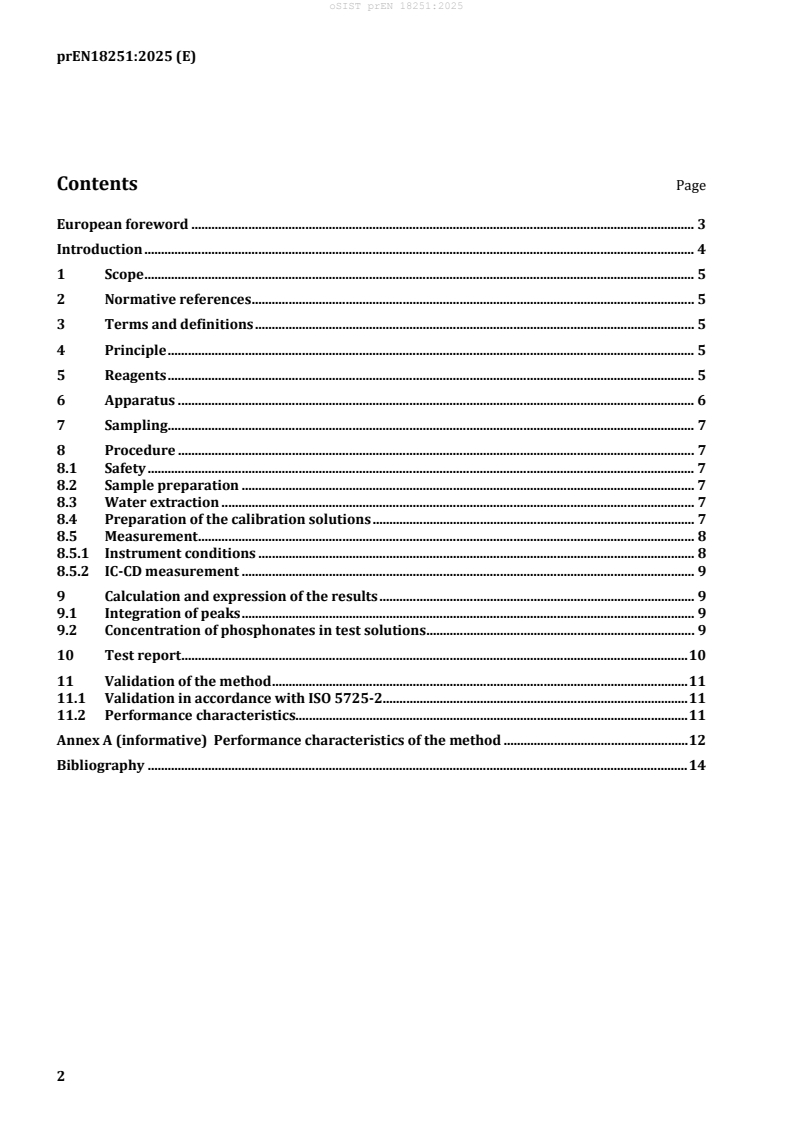
Contents Page
European foreword . 3
Introduction . 4
1 Scope . 5
2 Normative references . 5
3 Terms and definitions . 5
4 Principle . 5
5 Reagents . 5
6 Apparatus . 6
7 Sampling . 7
8 Procedure . 7
8.1 Safety . 7
8.2 Sample preparation . 7
8.3 Water extraction . 7
8.4 Preparation of the calibration solutions . 7
8.5 Measurement . 8
8.5.1 Instrument conditions . 8
8.5.2 IC-CD measurement . 9
9 Calculation and expression of the results . 9
9.1 Integration of peaks . 9
9.2 Concentration of phosphonates in test solutions . 9
10 Test report . 10
11 Validation of the method . 11
11.1 Validation in accordance with ISO 5725-2. 11
11.2 Performance characteristics. 11
Annex A (informative) Performance characteristics of the method . 12
Bibliography . 14
oSIST prEN 18251:2025
prEN18251:2025 (E)
European foreword
This document (prEN 18251:2025) has been prepared by Technical Committee CEN/TC 223 “Soil
improvers and growing media”, the secretariat of which is held by NEN, in collaboration with CEN/TC 260
“Fertilizers and liming materials” and CEN/TC 455 “Plant Biostimulants”.
This document is currently submitted to the CEN Enquiry.
This document has been prepared under a standardization request addressed to CEN by the European
Commission. The Standing Committee of the EFTA States subsequently approves these requests for its
Member States.
oSIST prEN 18251:2025
prEN18251:2025 (E)
Introduction
This document was prepared by the experts of CEN/TC 223 “Soil improvers and growing media”. The
European Committee for Standardization (CEN) was requested by the European Commission (EC) to
draft European standards or European standardization deliverables to support the implementation of
Regulation (EU) 2019/1009 of 5 June 2019 laying down rules on the making available on the market of
EU fertilizing products (“FPR” or “Fertilising Products Regulation”) [1].
This standardization request, presented as M/564, also contributes to the Communication on “Innovating
for Sustainable Growth: A Bio economy for Europe”. CEN/TC 223 “Soil improvers and growing media”
was established to carry out the work programme that will prepare a series of standards. WG 4 of
CEN/TC 223 “Analytical methods”, was requested to develop a work programme as part of this request.
The interest in soil improvers and growing media have increased significantly in Europe as a valuable
tool to use in agriculture.
This document describes an extraction and measurement for the determination of phosphonate
(phosphite) in growing media and soil improvers. The standard is based on a water extraction of the
phosphonate (phosphite) followed by ion chromatography with conductivity detection (IC-CD) [2], [3],
[4], [5], [6].
The ion chromatography with a conductivity detector (IC-CD) method can be used in well-equipped
analytical laboratories for the determination of different ions. In the field of fertilizing products, the
method is used and standardized for the determination of perchlorates in mineral fertilizers. The IC-CD
method can determine more ions simultaneously.
The legislative limit for phosphonate content is 0,5 % (mass fraction) and the method described in this
document was adapted to achieve this requirement and simultaneously to reduce interferences from
other co-extracted anions as much as possible.
The definition of phosphonates is not clearly stated in the Regulation (EU) 2019/1009 [1] and to avoid
any misunderstanding the results are expressed as a content of phosphorus (P) bound in the form of free
water-soluble phosphonates (P-PO ).
oSIST prEN 18251:2025
prEN18251:2025 (E)
1 Scope
This document specifies a method for the extraction and determination of phosphonates (P-PO ) in
growing media and soil improvers using ion chromatography and conductivity detection (IC-CD).
This document is applicable to the fertilizing product blends where a blend is a mix of two or more
fertilising products belonging to the categories of fertilizers, liming material, soil improvers, growing
media, inhibitors and plant biostimulants, and where soil improvers and/or growing media are the
components with the highest percentage in the blend by mass or volume, or in the case of products in
liquid form by dry mass. If the soil improvers and/or growing media are not the components with the
highest percentage in the blend, the document relevant to the component with the highest percentage in
the blend applies. In case a blend is composed of fertilising products mixed in equal quantities, the user
of the document decides which standard to apply.
NOTE A soil improver consists of a single bulky (volume-building) component or a mix of bulky (volume-
building) components (for example peat, wood fibres, coconut coir, compost, expanded perlite).
2 Normative references
The following documents are referred to in the text in such a way that some or all of their content
constitutes requirements of this document. For dated references, only the edition cited applies. For
undated references, the latest edition of the referenced document (including any amendments) applies.
CEN/TS 17732:2022, Soil improvers and growing media - Terminology
EN 12579:2024, Soil improvers and growing media - Sampling
prEN 13040-1:2025, Soil improvers and growing media — Sample preparation — Part 1: Sample
preparation for chemical and physical tests, determination of dry matter content, moisture content and
laboratory bulk density
3 Terms and definitions
For the purposes of this document, the following terms and definitions and the terms and definitions
given in CEN/TS 17732:2022 apply.
3.1
phosphonates
salts derived from phosphonic acid (H PO )
3 3
4 Principle
A representative test portion of the sample is extracted with water. Phosphonate in the extract is
selectively separated from other compounds using ion chromatography (IC) and determined by a
conductivity detector (CD). External calibration is used for quantification of the amount of the
phosphonate.
5 Reagents
5.1 General
All reagents shall be of recognized analytical grade. The concentration of phosphonate in the reagents
and deionized water used shall be low enough not to affect the results of the determination.
5.2 Water, with a specific conductivity not higher than 0,2 mS/m at 25 °C.
oSIST prEN 18251:2025
prEN18251:2025 (E)
5.3 Phosphonate standard stock solution, r(P-PO ) = 1 000 mg/l is prepared by dissolving
commercially available sodium phosphite dibasic pentahydrate salt (Mw = 216,04 mol/l, purity ≥ 98 %).
For preparation the phosphonate standard stock solution 0,697 ± 0,001 g is weighed, transferred to
100 ml volumetric flask, fill with deionized water (5.2) to final volume and mix thoroughly.
5.4 Phosphonate standard solution, r(P-PO ) = 100 mg/l is prepared from a standard stock solution
(5.3) by appropriate dilution with deionized water (5.2). Pipette 10 ml of stock solution (5.3) to a 100 ml
volumetric flask, fill with deionized water to final volume and mix thoroughly.
5.5 Mobile phase, KOH cartridge for ion chromatography (commercially supplied). Concentration of
the KOH mobile phase is electrolytically generated in externally supplied deionized water (5.2).
NOTE Different mobile phase can be used according to the instructions of the manufacturer of the column but
it is necessary to verify optimal separation conditions. For example, Metrosep A Supp5 (250 mm/4 mm) and a
recommended mobile phase for this column – 3,2 mM Na2CO3 + 1 mM NaHCO3 was successfully used for the
analysis.
−
5.6 Chloride standard, r(Cl ) = 1000 mg/l – commercially available.
5.7 Nitrate standard, r(NO -) = 1000 mg/l – commercially available.
−
5.8 Solution for checking chromatographic separation, r(P-PO ) = 10 mg/l, r(Cl and NO -
3 3
) = 50 mg/l is prepared by pipetting 1 ml of phosphonate standard stock solution (5.3), 5 ml of chloride
standard (5.6), 5 ml of nitrate standard (5.7) to 100 ml volumetric flask and fill to final volume with
deionized water (5.2).
6 Apparatus
6.1 Common laboratory glassware and plastic.
6.2 Laboratory grinder, capable of grinding to a particle size less than 0,5 mm.
6.3 Analytical balance, accuracy ≤ 1 mg.
6.4 Shaker, rotary or horizontal shaker. Shaking shall prevent any settling of the sample during
extraction.
6.5 Extraction vessels, capacity 200 ml to 500 ml.
−1
6.6 Centrifuge (optional), for minimum 4 000 min (approx. 2 000 g).
6.7 Single use syringe filters (0,22 µm) or vials with filters, for filtering of test solutions prior to
analysis.
6.8 Ion chromatograph, with conductivity detector (IC-CD).
For lower signal noise a supressed conductivity detector is preferred.
6.9 Chromatographic column for anion exchange, suitable for the selective se
...