


EN 13565-1:2003
(Main)Fixed firefighting systems - Foam systems - Part 1: Requirements and test methods for components
Fixed firefighting systems - Foam systems - Part 1: Requirements and test methods for components
This European Standard specifies requirements for materials, construction, and performance of components intended for use in fixed foam fire fighting systems conforming to EN 13565-2, and using foam concentrates conforming to prEN 1568. Methods of test are given in Annexes A to J. Requirements are also given for the provision of the characteristic data needed for correct application of components.NOTE 1 Unless otherwise stated pressures are gauge pressures expressed in bars.
Orstfeste Brandbekämpfungsanlagen - Schaumlöschanlagen - Teil 1: Anforderungen und Prüfverfahren für Bauteile
Diese Europäische Norm legt Anforderungen für Werkstoffe, Konstruktion und Leistungsmerkmale von Bauteilen fest, die in ortsfesten Schaumlöschanlagen in Übereinstimmung mit EN xxxx-2 bei Verwendung von Schaumkonzentraten nach prEN 1568 eingesetzt werden. Prüfverfahren werden in den Anhängen A bis J aufgeführt. Es werden auch Anforderungen für die Bereitstellung der charakteristischen Angaben beschrieben, die für die korrekte Anwendung der Bauteile erforderlich sind.
Installations fixes de lutte contre l'incendie - Systèmes à émulseurs - Partie 1: Exigences et méthodes d'essais relatives aux composants
La présente Norme européenne spécifie les exigences relatives aux matériaux, à la fabrication et aux performances des composants destinés à être utilisés dans les installations fixes à mousse de lutte contre l'incendie et employant des émulseurs conformes aux EN 1568-1 à 1568-4. Les composants concernés sont les suivants : proportionneurs, pulvérisateurs, tuyaux semi-immergés, lances à mousse, générateurs de mousse bas et moyen foisonnement, générateurs de mousse haut foisonnement, chambres à mousse, réservoirs et récipients sous pression. Les méthodes d'essai sont décrites dans les Annexes A à K.
Elle prescrit également des exigences relatives à l'indication des caractéristiques nécessaires pour une utilisation correcte des composants.
NOTE 1 Sauf indications contraires, les pressions sont des pressions relatives, exprimées en bars.
Les exigences de la présente spécification ne concernent pas, sauf si cela est précisé, l'utilisation de combinaisons de composants pour constituer tout ou partie d'une installation de lutte contre l'incendie.
NOTE 2 Il convient de ne pas considérer que les composants conformes à la présente spécification sont nécessairement compatibles entre eux.
Les exigences relatives aux pompes, moteurs et au fonctionnement des composants mécaniques (par exemple, les tourelles télécommandées) n'entrent pas dans le domaine d'application de cette norme.
Vgrajene naprave za gašenje – Gašenje s peno – 1. del: Zahteve in preskusne metode za sestavne dele
General Information
- Status
- Withdrawn
- Publication Date
- 16-Dec-2003
- Withdrawal Date
- 16-Oct-2007
- Technical Committee
- CEN/TC 191 - Fixed firefighting systems
- Drafting Committee
- CEN/TC 191/WG 2 - Foam extinguishing systems
- Current Stage
- 9960 - Withdrawal effective - Withdrawal
- Start Date
- 17-Oct-2007
- Completion Date
- 17-Oct-2007
- Directive
- 89/106/EEC - Construction products
Relations
- Effective Date
- 22-Dec-2008
- Effective Date
- 28-Jan-2026

Get Certified
Connect with accredited certification bodies for this standard

NSF International
Global independent organization facilitating standards development and certification.

CIS Institut d.o.o.
Personal Protective Equipment (PPE) certification body. Notified Body NB-2890 for EU Regulation 2016/425 PPE.

Kiwa BDA Testing
Building and construction product certification.
Sponsored listings
Frequently Asked Questions
EN 13565-1:2003 is a standard published by the European Committee for Standardization (CEN). Its full title is "Fixed firefighting systems - Foam systems - Part 1: Requirements and test methods for components". This standard covers: This European Standard specifies requirements for materials, construction, and performance of components intended for use in fixed foam fire fighting systems conforming to EN 13565-2, and using foam concentrates conforming to prEN 1568. Methods of test are given in Annexes A to J. Requirements are also given for the provision of the characteristic data needed for correct application of components.NOTE 1 Unless otherwise stated pressures are gauge pressures expressed in bars.
This European Standard specifies requirements for materials, construction, and performance of components intended for use in fixed foam fire fighting systems conforming to EN 13565-2, and using foam concentrates conforming to prEN 1568. Methods of test are given in Annexes A to J. Requirements are also given for the provision of the characteristic data needed for correct application of components.NOTE 1 Unless otherwise stated pressures are gauge pressures expressed in bars.
EN 13565-1:2003 is classified under the following ICS (International Classification for Standards) categories: 13.220.20 - Fire protection. The ICS classification helps identify the subject area and facilitates finding related standards.
EN 13565-1:2003 has the following relationships with other standards: It is inter standard links to EN 13565-1:2003+A1:2007, EN 13565-2:2009. Understanding these relationships helps ensure you are using the most current and applicable version of the standard.
EN 13565-1:2003 is associated with the following European legislation: EU Directives/Regulations: 305/2011, 89/106/EEC; Standardization Mandates: M/109. When a standard is cited in the Official Journal of the European Union, products manufactured in conformity with it benefit from a presumption of conformity with the essential requirements of the corresponding EU directive or regulation.
EN 13565-1:2003 is available in PDF format for immediate download after purchase. The document can be added to your cart and obtained through the secure checkout process. Digital delivery ensures instant access to the complete standard document.
Standards Content (Sample)
2003-01.Slovenski inštitut za standardizacijo. Razmnoževanje celote ali delov tega standarda ni dovoljeno.Vgrajene naprave za gašenje –
Gašenje s peno – 1. del: Zahteve in preskusne metode za sestavne deleOrstfeste Brandbekämpfungsanlagen - Schaumlöschanlagen - Teil 1: Anforderungen und Prüfverfahren für BauteileInstallations fixes de lutte contre l'incendie - Systemes a émulseurs - Partie 1: Exigences et méthodes d'essais relatives aux composantsFixed firefighting systems - Foam systems - Part 1: Requirements and test methods for components13.220.10Gašenje požaraFire-fightingICS:Ta slovenski standard je istoveten z:EN 13565-1:2003SIST EN 13565-1:2004en01-april-2004SIST EN 13565-1:2004SLOVENSKI
STANDARD
EUROPEAN STANDARDNORME EUROPÉENNEEUROPÄISCHE NORMEN 13565-1December 2003ICS 13.220.20English versionFixed firefighting systems - Foam systems - Part 1:Requirements and test methods for componentsInstallations fixes de lutte contre l'incendie - Systèmes àémulseurs - Partie 1: Exigences et méthodes d'essais deséléments constitutifsOrstfeste Brandbekämpfungsanlagen -Schaumlöschanlagen - Teil 1: Anforderungen undPrüfverfahren für BauteileThis European Standard was approved by CEN on 21 November 2003.CEN members are bound to comply with the CEN/CENELEC Internal Regulations which stipulate the conditions for giving this EuropeanStandard the status of a national standard without any alteration. Up-to-date lists and bibliographical references concerning such nationalstandards may be obtained on application to the Management Centre or to any CEN member.This European Standard exists in three official versions (English, French, German). A version in any other language made by translationunder the responsibility of a CEN member into its own language and notified to the Management Centre has the same status as the officialversions.CEN members are the national standards bodies of Austria, Belgium, Czech Republic, Denmark, Finland, France, Germany, Greece,Hungary, Iceland, Ireland, Italy, Luxembourg, Malta, Netherlands, Norway, Portugal, Slovakia, Spain, Sweden, Switzerland and UnitedKingdom.EUROPEAN COMMITTEE FOR STANDARDIZATIONCOMITÉ EUROPÉEN DE NORMALISATIONEUROPÄISCHES KOMITEE FÜR NORMUNGManagement Centre: rue de Stassart, 36
B-1050 Brussels© 2003 CENAll rights of exploitation in any form and by any means reservedworldwide for CEN national Members.Ref. No. EN 13565-1:2003 ESIST EN 13565-1:2004
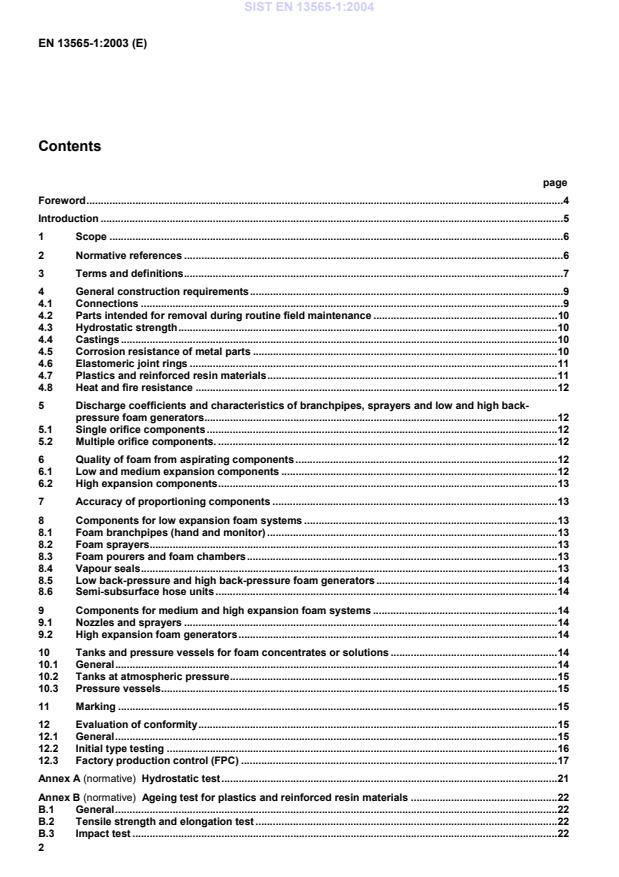
Hydrostatic test.21Annex B (normative)
Ageing test for plastics and reinforced resin materials.22B.1General.22B.2Tensile strength and elongation test.22B.3Impact test.22SIST EN 13565-1:2004
Liquid exposure test.23Annex D (normative)
Heat and fire resistance test for foam generators.24Annex E (normative)
Flow tests.25E.1General.25E.2Discharge coefficient.25E.3Discharge characteristic.25Annex F (normative)
Quality of foam from aspirating components.26F.1General.26F.2Low expansion foams.26F.3Medium expansion foams.26F.4High expansion foams.26Annex G (normative)
High expansion foam generator test.27Annex H (normative)
Range tests for branchpipes (hand and monitor).28Annex I (normative)
Area coverage test for foam sprayers and nozzles.29Annex J (normative)
Maximum flow and back pressure.30J.1General.30J.2Maximum flow.30J.3Back pressure.30Annex K (normative)
Insertion and deployment of semi-subsurface hose.31Annex ZA (informative)
Clauses of this European Standard addressing essential requirements or otherprovisions of EU Directives.32SIST EN 13565-1:2004
1: Dimensions, tolerances anddesignationISO 272, Fasteners - Hexagon products - Widths across flatsISO 885, General purpose bolts and screws - Metric series - Radii under the headISO 888, Bolts screws and studs - Nominal lengths and thread length for general purpose boltsISO 1179-1, Connections for general use and fluid power - Ports and stud ends with EN ISO 228-1 threads withelastomeric or metal-to-metal sealing - Part 1: Threaded ports (Revision of ISO 1179:1981)ISO 4633, Rubber seals - Joint rings for water supply, drainage and sewerage pipelines - Specification for materialISO 6447, Rubber seals - Joint rings used for gas supply pipes and fittings - Specification for materialISO 6448, Rubber seals - Joint rings used for petroleum product supply pipes and fittings - Specification formaterialISO 7005-1, Metallic flanges; Part 1: Steel flangesISO 7005-2, Metallic flanges; Part 2: Cast iron flangesISO 9227, Corrosion tests in artificial atmospheres; salt spray testsNordtest method NT Fire 0423 Terms and definitionsFor the purposes of this European Standard, the following terms and definitions apply.3.1aspirating componentcomponent within which air and foam solution are mixed to make foam3.2branchpipecomponent which projects foam in the form of a jet or spraySIST EN 13565-1:2004
Connections4.1.1
Permanent connections and jointsPermanent joints on components for connection to pipework or other components shall conform to ISO 7-1, ENISO 228-1, ISO 1179-1, ISO 7005-1 or ISO 7005-2. Other technical specifications valid in the place of use of thecomponent may be acceptable.4.1.2
Hose couplingsHose couplings shall conform to the requirements for delivery hose couplings and connectors as specified by thepurchaser.SIST EN 13565-1:2004
Bolting of pressure retaining partsBolts, nuts and/or studs used to fasten pressure retaining parts shall conform to ISO 272, ISO 885, EN ISO 898-1or EN ISO 4759-1.The calculated load on any bolt or stud excluding the force required to compress the gasket shall not exceed theminimum tensile strength specified in EN 20225, ISO 888 or EN ISO 898-1 when the component is pressurised tofour times the rated working pressure.The area of the application of pressure shall be calculated using the following assumptions:a) If a full-face gasket is used, the assumed area of pressure application extends out to the centre line of thebolts.b) If an 'O' ring seal or ring gasket is used, the assumed area of pressure application extends out to the centre ofthe 'O' ring or gasket.4.2
Parts intended for removal during routine field maintenance4.2.1
RemovalParts intended for removal during routine field maintenance shall be accessible, removable, and replaceablewithout damage using appropriate tools normally used by the trade, or special tools recommended by thecomponent supplier.4.2.2
Re-assemblyThe design and construction of any part intended for removal during routine field maintenance shall be such that itcannot be re-assembled so as to cause malfunction of the component, without an external visible indication.4.3
Hydrostatic strength4.3.1
Leak testThe pressure retaining parts of components (including the connection joints), except atmospheric storage tanksand pressure vessels, shall withstand for 10 min without leakage an internal hydrostatic pressure of 1,5 times theworking pressure specified by the supplier 01+ bar, when tested in accordance with annex A.4.3.2
Mechanical strengthThe component housing shall withstand a pressure of three times the design working pressure 01+ bar withoutrupture when tested in accordance with annex A.4.4
CastingsCastings shall not be plugged or filled.NOTECastings should be free from adhering sand and scale. Castings should be impregnated only if agreed between thecasting manufacturer and purchaser.4.5
Corrosion resistance of metal parts4.5.1 General corrosion resistance of metal partsAll mechanical components shall function satisfactorily (see Table 1) after being tested in accordance with ISO9227 and EN 12416-1:2001 annex I.SIST EN 13565-1:2004
Resistance to ageingAfter ageing in accordance with annex B, specimens of plastics and reinforced resin materials (other thanelastomeric joint rings covered in 4.6) used for components shall:a) have a tensile strength changed by no more than 50% of the value before exposure,b) have an elongation at break of not less than 50% of the value before exposure or;c) have an impact strength not less than 50% of the value before exposure (this method is relevant to stiffplastics i.e. flexible plastics shall be evaluated using the tensile test),d) show no signs of cracking.4.7.3
Resistance to exposure to liquidsPlastics and reinforced resin materials which come into contact with foam concentrate, foam solution or water afterexposure to the particular liquid in accordance with annex C shall have:a) a tensile strength not changed by more than 50% of the value before exposure,b) an elongation at break of not less than 50% of the value before exposure, or;c) an impact strength not changed by more than 50% of the value before exposure (this method is relevant to stiffplastics i.e. flexible plastics shall be evaluated using the tensile test),d) no signs of cracking.SIST EN 13565-1:2004
Heat and fire resistance4.8.1
Sprayers and nozzlesSprayers and nozzles shall not show significant deformation or breakage when tested in accordance with the heatresistance test in annex O of EN 12259-1: 1999.4.8.2
Foam generatorsFoam generators intended to be located entirely within the protected (fire) area (i.e. generators that draw air/smokefrom the protected area) shall meet the requirements of clauses 5 and 6 after testing in accordance with annex D.5
Discharge coefficients and characteristics of branchpipes, sprayers and low andhigh back-pressure foam generators5.1
Single orifice componentsThe discharge coefficient or pressure/flow characteristic shall be within ± 5% of the value stated by the supplierwhen measured in accordance with annex E.NOTEThis effectively requires the flow rate to be within ± 5% of that claimed by the supplier.5.2
Multiple orifice components.The discharge coefficient or pressure/flow characteristic shall be within ± 10% of the value stated by the supplierwhen measured in accordance with annex E.NOTEThis effectively requires the flow rate to be within ± 10% of that claimed by the supplier.Where such components may be used in combination with venturi type proportioning components (i.e. injectors,eductors and inductors) the discharge coefficient or characteristic tolerance shall be compatible with that of theproportioning component.6
Quality of foam from aspirating components6.1 Low and medium expansion componentsThe expansion and drainage time of foam produced by an aspirating component in conjunction with any statedassociated equipment, using a foam concentrate recommended by the supplier and conforming to EN 1568-1 toEN 1568-4 shall conform to the supplier stated values when tested in accordance with annex F.The expansion and drainage time of non-aspirated foam may be difficult to measure and therefore there are nocorresponding requirements for non-aspirating components.SIST EN 13565-1:2004
Components for low expansion foam systems8.1
Foam branchpipes (hand and monitor)The range of discharge shall be not less than the supplier’s stated values when tested in accordance with annex H.8.2
Foam sprayers8.2.1Sprayers, which will not allow a 6,0 mm sphere to pass through the waterway, shall be protected by astrainer. Where the sprayers are mounted on only corrosion resistant pipework (i.e. stainless steel and cupronickel) the strainer may be fitted at the inlet to the pipework. Where the sprayers are mounted on steel pipeworkthey shall each be fitted with a strainer.The free area of the strainer shall be not less than three times the cross-sectional area of the nozzle bore(s), theaperture size shall be no greater than 80% of the smallest orifice.8.2.2The area coverage of foam sprayers when tested in accordance with the method in annex I shall be thatarea coverage in which an average water depth is at least 5mm and with no container having less than 2,5 mm. Itshall be within + 10% of the supplier’s stated limits at the stated pressures, flows and mounting heights.8.3
Foam pourers and foam chambersThe passageway flow capacity shall be sufficient to pass foam at the maximum rate provided by the largest foammaker recommended by the supplier for use with the pourer or chamber when tested in accordance with Annex J.8.4
Vapour seals8.4.1 A vapour seal shall not rupture when a positive pressure difference of 0,1 bar0010+, is applied to theupstream face when tested in accordance with annex J.SIST EN 13565-1:2004
Low back-pressure and high back-pressure foam generatorsThese units shall generate foam within the supplier’s performance figures at their minimum claimed differentialpressure when tested in accordance with annex J.8.6
Semi-subsurface hose unitsThese units shall discharge foam within the supplier’s stated performance figures at their minimum inlet pressurewhen tested in accordance with annex J, and shall insert and deploy the hose in accordance with annex K, ready todistribute foam into a tank when tested in accordance with annex F.9
Components for medium and high expansion foam systems9.1
Nozzles and sprayersSprayers, which will not allow a 6,0 mm sphere to pass through the waterway, shall be protected by a strainer.Where the sprayers are mounted on only corrosion resistant pipework (i.e. stainless steel and cupro nickel) thestrainer may be fitted at the inlet to the pipework. Where the sprayers are mounted on steel pipework they shalleach be fitted with a strainer.The free area of the strainer shall be not less than three times the cross-sectional area of the nozzle bore(s), theaperture size shall be no greater than 80% of the smallest orifice.9.2
High expansion foam generatorsThe generator shall be of sufficient capacity to produce foam at the maximum rate specified by the supplier whentested in accordance with annex G.10
Tanks and pressure vessels for foam concentrates or solutions10.1
General10.1.1For foam concentrate storage tanks for protein based foams and/or constructed using unlined carbon steelthe outlet from the storage tank shall be raised above the base to provide an adequate sediment pocket. Thecapacities of sediment pockets shall be excluded in assessing the quantity of foam concentrate or premix in thetank. The capacity of the sediment pocket shall be adequate to contain 2% of the tank contents.This requirement does not apply to bladder tanks.SIST EN 13565-1:2004
a means of measuring the contents; andb)
outlet, filling, draining and sampling connections; andc)
means of access for inspection and cleaning of internal surfaces.10.2
Tanks at atmospheric pressureStorage tanks at atmospheric pressure shall be provided with a means of accommodating thermal expansion of thecontents.NOTEFor storage tanks at atmospheric pressure thermal expansion may be accommodated by means of a closed verticalriser/expansion dome with a pressure vacuum vent valve. Where storage tanks are vented to atmosphere, the air/liquidinterface should be of the minimum practicable area in order to minimize the possibility of internal corrosion of the tank orformation of sludge.10.3
Pressure vesselsPressure vessels for foam concentrate, foam solution or water shall conform to the requirements of EN 12542 forcarbon steel tanks. Pressure vessels for other substances that are constructed in accordance with other technicalspecifications valid in the place of use of the product are also permitted.
Vessels constructed from other suitablematerials may also be used.11 MarkingThe marking shall be non-detachable, non-flammable, permanent and legible.The components shall be marked with:a) name or trademark of the supplier; andb) model designation (type); andc) some mark(s) or code(s) (e.g. serial number or batch number), by which, or at least, the date or batch andplace of manufacture (if several places of manufacture) can be identified by the supplier; andd) working pressure(s) if relevant;e) direction of flow if relevant;f) nominal flow rate in l/min if relevant;g) percentage induction rate if relevant.Where the requirements of annex ZA.3 give the same information as above, the requirements of this clause 11 aremet.12
Evaluation of conformity12.1
GeneralThe compliance of the component with the requirements of this European Standard shall be demonstrated by:¾ initial type testing,SIST EN 13565-1:2004
Initial type testing12.2.1Initial type testing shall be performed to demonstrate conformity with this standard.All characteristics, applicable to each product, given in Clauses 4 to 10, shall be subject to this initial type testing,except as described in 12.2.3 to 12.2.5.The order of tests is given in Table 1.12.2.2In the case of modification of the component or of the method of production (where these may affect thestated properties), initial type testing shall be performed. All characteristics, applicable to each product, given inClauses 4 to 10, and which may be changed by the modification, shall be subject to this initial type testing, exceptas described in 12.2.3 to 12.2.5.12.2.3Tests previously performed in accordance with the provisions of this standard may be taken into accountproviding that they were made to the same or a more rigorous test method under the same system of attestation ofconformity on the same component or components of similar design, construction and functionality, such that theresults are applicable to the component in question.NOTESame system of attestation of conformity means testing by an independent third party under the control of a productcertification body.12.2.4Components may be grouped into families where one or more characteristics are the same for allcomponents within that family or the test results are representative of all components within that family. In this casenot all components of the family have to be tested for the purposes of the initial type testing.12.2.5This standard may by reference to special supporting standards identify characteristics of the relatedcomponents, e.g. required special characteristics of subparts of the components, for which proof delivered by themanufacturer is considered to be sufficient. If these characteristics have previously been demonstrated accordingto the requirements of the supporting standards referred to, no further evaluation of the component, in respect ofthese characteristics, is required to show conformity with this standard.12.2.6Test samples shall be representative of the normal production. If the test samples are prototypes, theyshall be representative of the intended future production and shall be selected by the manufacturer.NOTEIn the case of prototypes and third party certification, this means that it is the manufacturer not the third party who isresponsible for selecting the samples. During the initial inspection of the factory and of the factory production control (see 12.3),it is verified that the component continuously complies with the initial type testing samples.SIST EN 13565-1:2004
Factory production control (FPC)12.3.1 GeneralThe manufacturer shall establish, document and maintain an FPC system to ensure that the components placed onthe market conform with the stated performance characteristics.If the manufacturer has the component designed, manufactured, assembled, packed, processed and labelled bysubcontracting, FPC of the subcontractor may be taken into account. Where subcontracting takes place, themanufacturer shall retain the overall control of the component and ensure that he receives all the information that isnecessary to fulfil his responsibilities according to this European Standard. The manufacturer who subcontracts allof his activities may in no circumstances discharge himself of his responsibilities to a subcontractor.FPC is the permanent internal control of production exercised by the manufacturer.All the elements, requirements and provisions adopted by the manufacturer shall be documented in a systematicmanner in the form of written policies and procedures. This production control system documentation shall ensurea common understanding of conformity evaluation and enable the achievement of the required productcharacteristics and the effective operation of the production control system to be checked.Factory production control therefore brings together operational techniques and all measures allowing maintenanceand control of the conformity of the component with technical specifications. Its implementation may be achievedby controls and tests on measuring equipment, raw materials and constituents, processes, machines andmanufacturing equipment and finished products, including material properties in products, and by making use ofthe results thus obtained.SIST EN 13565-1:2004
...
Questions, Comments and Discussion
Ask us and Technical Secretary will try to provide an answer. You can facilitate discussion about the standard in here.
Loading comments...