

EN 13565-2:2009
(Main)Fixed firefighting systems - Foam systems - Part 2: Design, construction and maintenance
- Abstract
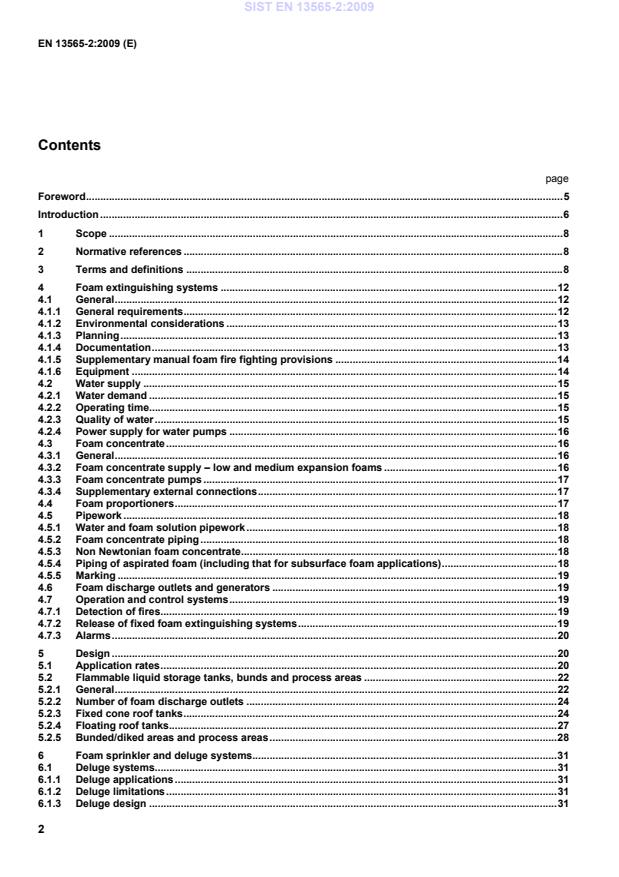
This European Standard specifies the requirements and describes the methods for design, installation, testing and maintenance of low, medium, and high expansion foam fire extinguishing systems.
This European Standard provides guidance for the design of various foam systems available to persons with knowledge and experience in determining the selection of foam fire extinguishing systems which will be effective in protecting specific hazard configurations.
This European Standard does not cover a risk analysis carried out by a competent person.
Nothing in this European Standard is intended to restrict new technologies or alternative arrangements, provided that the level of safety prescribed in this standard is not lowered, and supported by documented evidence/test reports.
- Status
- Withdrawn
- Publication Date
- 12-May-2009
- Withdrawal Date
- 06-Oct-2026
- Technical Committee
- CEN/TC 191 - Fixed firefighting systems
- Drafting Committee
- CEN/TC 191/WG 2 - Foam extinguishing systems
- Current Stage
- 9960 - Withdrawal effective - Withdrawal
- Start Date
- 31-Oct-2018
- Completion Date
- 07-Oct-2026

Relations
- Effective Date
- 07-Nov-2018
- Effective Date
- 28-Jan-2026
- Effective Date
- 28-Jan-2026
- Effective Date
- 28-Jan-2026
- Effective Date
- 28-Jan-2026
- Effective Date
- 28-Jan-2026
- Effective Date
- 28-Jan-2026
- Refers
EN 54-22:2015 - Fire detection and fire alarm systems - Part 22: Resettable line-type heat detectors - Effective Date
- 28-Jan-2026
- Effective Date
- 28-Jan-2026
- Effective Date
- 28-Jan-2026
- Effective Date
- 28-Jan-2026
- Effective Date
- 28-Jan-2026
- Effective Date
- 28-Jan-2026
- Effective Date
- 28-Jan-2026
- Effective Date
- 28-Jan-2026
Get Certified
Connect with accredited certification bodies for this standard

CIS Institut d.o.o.
Personal Protective Equipment (PPE) certification body. Notified Body NB-2890 for EU Regulation 2016/425 PPE.

Kiwa BDA Testing
Building and construction product certification.
Kmetijski inštitut Slovenije
Agricultural Institute of Slovenia. Soil testing, plant health, agricultural product analysis.
Sponsored listings
Frequently Asked Questions
EN 13565-2:2009 is a standard published by the European Committee for Standardization (CEN). Its full title is "Fixed firefighting systems - Foam systems - Part 2: Design, construction and maintenance". This standard covers: This European Standard specifies the requirements and describes the methods for design, installation, testing and maintenance of low, medium, and high expansion foam fire extinguishing systems. This European Standard provides guidance for the design of various foam systems available to persons with knowledge and experience in determining the selection of foam fire extinguishing systems which will be effective in protecting specific hazard configurations. This European Standard does not cover a risk analysis carried out by a competent person. Nothing in this European Standard is intended to restrict new technologies or alternative arrangements, provided that the level of safety prescribed in this standard is not lowered, and supported by documented evidence/test reports.
This European Standard specifies the requirements and describes the methods for design, installation, testing and maintenance of low, medium, and high expansion foam fire extinguishing systems. This European Standard provides guidance for the design of various foam systems available to persons with knowledge and experience in determining the selection of foam fire extinguishing systems which will be effective in protecting specific hazard configurations. This European Standard does not cover a risk analysis carried out by a competent person. Nothing in this European Standard is intended to restrict new technologies or alternative arrangements, provided that the level of safety prescribed in this standard is not lowered, and supported by documented evidence/test reports.
EN 13565-2:2009 is classified under the following ICS (International Classification for Standards) categories: 13.220.20 - Fire protection. The ICS classification helps identify the subject area and facilitates finding related standards.
EN 13565-2:2009 has the following relationships with other standards: It is inter standard links to EN 13565-2:2018, EN 1568-1:2018, EN 12094-1:2003, EN 54-16:2008, EN 54-1:2021, EN 54-30:2015, EN 1568-4:2018, EN 54-22:2015, EN 54-5:2017+A1:2018, EN 54-4:1997, EN 54-4:1997/A1:2002, EN 54-12:2015, EN 54-31:2014, EN 54-28:2016, EN 54-24:2008. Understanding these relationships helps ensure you are using the most current and applicable version of the standard.
EN 13565-2:2009 is associated with the following European legislation: EU Directives/Regulations: 305/2011, 89/106/EEC. When a standard is cited in the Official Journal of the European Union, products manufactured in conformity with it benefit from a presumption of conformity with the essential requirements of the corresponding EU directive or regulation.
EN 13565-2:2009 is available in PDF format for immediate download after purchase. The document can be added to your cart and obtained through the secure checkout process. Digital delivery ensures instant access to the complete standard document.
Standards Content (Sample)
2003-01.Slovenski inštitut za standardizacijo. Razmnoževanje celote ali delov tega standarda ni dovoljeno.Y]GUåHYDQMHOrtsfeste Brandbekämpfungsanlagen - Schaumlöschanlagen - Teil 2: Planung, Einbau und WartungInstallations fixes de lutte contre l'incendie - Systèmes à émulseurs - Partie 2: Calcul, installation et maintenanceFixed firefighting systems - Foam systems - Part 2: Design, construction and maintenance13.220.10Gašenje požaraFire-fightingICS:Ta slovenski standard je istoveten z:EN 13565-2:2009SIST EN 13565-2:2009en01-julij-2009SIST EN 13565-2:2009SLOVENSKI
STANDARD
EUROPEAN STANDARDNORME EUROPÉENNEEUROPÄISCHE NORMEN 13565-2May 2009ICS 13.220.20 English VersionFixed firefighting systems - Foam systems - Part 2: Design,construction and maintenanceInstallations fixes de lutte contre l'incendie - Systèmes àémulseurs - Partie 2: Calcul, installation et maintenanceOrtsfeste Brandbekämpfungsanlagen -Schaumlöschanlagen - Teil 2: Planung, Einbau undWartungThis European Standard was approved by CEN on 24 May 2007.CEN members are bound to comply with the CEN/CENELEC Internal Regulations which stipulate the conditions for giving this EuropeanStandard the status of a national standard without any alteration. Up-to-date lists and bibliographical references concerning such nationalstandards may be obtained on application to the CEN Management Centre or to any CEN member.This European Standard exists in three official versions (English, French, German). A version in any other language made by translationunder the responsibility of a CEN member into its own language and notified to the CEN Management Centre has the same status as theofficial versions.CEN members are the national standards bodies of Austria, Belgium, Bulgaria, Cyprus, Czech Republic, Denmark, Estonia, Finland,France, Germany, Greece, Hungary, Iceland, Ireland, Italy, Latvia, Lithuania, Luxembourg, Malta, Netherlands, Norway, Poland, Portugal,Romania, Slovakia, Slovenia, Spain, Sweden, Switzerland and United Kingdom.EUROPEAN COMMITTEE FOR STANDARDIZATIONCOMITÉ EUROPÉEN DE NORMALISATIONEUROPÄISCHES KOMITEE FÜR NORMUNGManagement Centre:
Avenue Marnix 17,
B-1000 Brussels© 2009 CENAll rights of exploitation in any form and by any means reservedworldwide for CEN national Members.Ref. No. EN 13565-2:2009: ESIST EN 13565-2:2009
+
LNG/LPG Process areas Yes Yes Yes
Aircraft hangers Yes < 1 400 m2 only Yes Fuel transfer areas Yes Yes Yes
Plastic packaging and storage Yes No Yes Plastic recycling Yes No No Refuse handling and storage Yes No No Liquefied Natural Gas No No Yes (and outdoors) Tyre storage Yes No Yes Rolled paper No No Yes Marine jetties Yes Yes No Oil filled transformers and switchgear Yes No Yes
Cable tunnels No No Yes LPG (Liquefied Petroleum Gas) No Yes Yes (and outdoors) Warehouses – Class A and B fuels Yes No Yes
area of operation minimum area for the design of the water and foam concentrate supplies 3.11 operation time minimum time for the supply of the extinguishing system with water 3.12 fire-fighting foam complex medium of air filled bubbles formed from a foam solution 3.13 aspirating component component within which air and foam solution are mixed to make foam 3.14 branchpipe component which projects foam in the form of a jet or spray 3.15 component item or piece of equipment conforming to EN 13565-1 and intended for use in a fixed foam fire extinguishing system 3.16 high back pressure foam generator component which introduces air into the foam solution stream for delivery against a high back pressure, for example, as is found in tank sub-surface mode 3.17 high expansion foam foam which has an expansion ratio greater than 200:1 SIST EN 13565-2:2009
Some pourers are designed to discharge the foam tangentially in order to create a circular motion, and thus promote foam distribution. 3.25 proportioning component component which controls the mixing of foam concentrate into a water flow, at a predetermined ratio, to produce a foam solution NOTE Proportioning components are variously described as inline, bypass and round the pump inductors, injectors, eductors, proportioners, venturis, constant and variable flow valves, orifice plates, water powered foam pumps and displacement proportioners. 3.26 semi-subsurface hose unit component which delivers foam below the surface of a flammable liquid so that it rises to the liquid surface within a flexible hose and spreads over the liquid surface 3.27 sprayer open sprinkler, sprayer, or nozzle without integral air aspiration 3.28 sprinkler/sealed sprayer nozzle with a thermally sensitive sealing device which opens to discharge foam solution or water for fire fighting. (see EN 12259-1) SIST EN 13565-2:2009
The pump-set(s) should comply with prEN 12259-12. 4.2.2 Operating time The water supply shall be designed for an operating time of at least equal to the minimum operating time, for the highest water demand (quantity of water), as laid down in Clauses 5 to 10. The maximum flow demand shall be determined by hydraulic calculation to determine the maximum theoretical flow and pressure in the system with a specific configuration of piping and discharge devices supplied by the water distribution system (Qmax). For foam enhanced sprinkler and spray systems the water supplies shall comply with the operating time requirements as laid down in the associated sprinkler or water spray design code. For fuel in depth hazards (fuel depth > 25 mm) the foam system(s) shall be capable of operating for the duration specified in this European Standard. For spill fire hazards (fuel depth < 25mm) the operating time may be reduced if the application rate is higher than the specified minimum, but in no case shall this be less than 70 % of the minimum operating time specified in this European Standard. 4.2.3 Quality of water Consideration shall be given to the quality of the water used. Salt water or hard water, and/or corrosion inhibitors, antifreeze agents, marine growths, oil or other contaminants could result in a reduction in foam expansion or stability. Not all foams are suitable for use with sea water and the performance classification for specific foam may differ due to the water quality. Water quality is particularly important when using high and medium expansion foam generators as water contaminants and minerals can reduce foam expansion and stability. The supplier of the foam concentrate should be consulted. The water quality may influence the efficiency and function of the foam extinguishing system, therefore a foam concentrate should be selected which is compatible with the available water. WARNING — Foam quality may be adversely affected by increased amounts of sediments and other pollutants. Reduced foam production or decreased free cross sections may result due to formation of deposits in the components NOTE Performance classification of foams according to EN 1568 is made at an air temperature between 10 °C and 20 °C and a water temperature of 15 °C to 20 °C. Using the foam at elevated air and water temperatures (> 35 °C) may reduce the fire fighting performance and require higher application rates - consult the foam concentrate manufacturer. SIST EN 13565-2:2009
Mobile pumping units may also be considered. 4.3 Foam concentrate 4.3.1 General Foam concentrates shall be tested and verified to be in accordance with EN 1568. Specific requirements are also given for low-expansion foams suitable for water-miscible fuels. NOTE 1 Foams tested as low expansion foams according to EN 1568 Parts 3 and 4 will achieve a performance classification based on its extinguishing and burnback properties. For a low expansion foam for water-immiscible fuels (EN 1568-3), there are three extinguishing classes (I, II, III) and four burnback levels (A, B, C, D), performance classification IA being the highest classification. For a low expansion foam for water-miscible fuels (EN 1568-4), there are two extinguishing classes (I, II) and three burnback levels (A, B, C). It is important to notice that not all foams are suitable for use with sea water and that the performance classification might be different when using fresh water or sea water. In a foam extinguishing system the foam proportioner and foam concentrate shall be compatible in accordance with EN 13565-1. The viscosity properties of the foam concentrate determined according to EN 1568 shall therefore be within the approved viscosity range for the proportioner acco
...