

EN 12873-2:2005
(Main)Influence of materials on water intended for human consumption - Influence due to migration - Part 2: Test method for non-metallic and non-cementitious site-applied materials
- Abstract
This European Standard specifies a procedure to determine the migration of substances from non-metallic and non-cementitious site-applied materials for use in contact with water intended for human consumption.
It is applicable to site-applied materials intended to be used under various conditions for the transport and storage of water intended for human consumption, including raw water used for the production of water intended for human consumption. It covers the extraction by water of constituents from these materials after their application on site.
The standard is applicable to materials whose physical or chemical properties alter during or after on-site application, such as coatings, paints, and adhesives. In addition, some site-applied materials that do not change in such a manner, e.g. greases or lubricants, are also included.
- Status
- Withdrawn
- Publication Date
- 08-Feb-2005
- Withdrawal Date
- 06-Oct-2026
- Technical Committee
- CEN/TC 164 - Water supply
- Drafting Committee
- CEN/TC 164/WG 3 - Effects of materials in contact with drinking water
- Current Stage
- 9960 - Withdrawal effective - Withdrawal
- Start Date
- 15-Dec-2021
- Completion Date
- 07-Oct-2026



Relations
- Effective Date
- 08-Jun-2022
- Effective Date
- 28-Jan-2026
Get Certified
Connect with accredited certification bodies for this standard

BSI Group
BSI (British Standards Institution) is the business standards company that helps organizations make excellence a habit.

Bureau Veritas
Bureau Veritas is a world leader in laboratory testing, inspection and certification services.

DNV
DNV is an independent assurance and risk management provider.
Sponsored listings
Frequently Asked Questions
EN 12873-2:2005 is a standard published by the European Committee for Standardization (CEN). Its full title is "Influence of materials on water intended for human consumption - Influence due to migration - Part 2: Test method for non-metallic and non-cementitious site-applied materials". This standard covers: This European Standard specifies a procedure to determine the migration of substances from non-metallic and non-cementitious site-applied materials for use in contact with water intended for human consumption. It is applicable to site-applied materials intended to be used under various conditions for the transport and storage of water intended for human consumption, including raw water used for the production of water intended for human consumption. It covers the extraction by water of constituents from these materials after their application on site. The standard is applicable to materials whose physical or chemical properties alter during or after on-site application, such as coatings, paints, and adhesives. In addition, some site-applied materials that do not change in such a manner, e.g. greases or lubricants, are also included.
This European Standard specifies a procedure to determine the migration of substances from non-metallic and non-cementitious site-applied materials for use in contact with water intended for human consumption. It is applicable to site-applied materials intended to be used under various conditions for the transport and storage of water intended for human consumption, including raw water used for the production of water intended for human consumption. It covers the extraction by water of constituents from these materials after their application on site. The standard is applicable to materials whose physical or chemical properties alter during or after on-site application, such as coatings, paints, and adhesives. In addition, some site-applied materials that do not change in such a manner, e.g. greases or lubricants, are also included.
EN 12873-2:2005 is classified under the following ICS (International Classification for Standards) categories: 13.060.20 - Drinking water; 67.250 - Materials and articles in contact with foodstuffs. The ICS classification helps identify the subject area and facilitates finding related standards.
EN 12873-2:2005 has the following relationships with other standards: It is inter standard links to EN 12873-2:2021, EN ISO 7393-2:2018. Understanding these relationships helps ensure you are using the most current and applicable version of the standard.
EN 12873-2:2005 is associated with the following European legislation: EU Directives/Regulations: 305/2011, 89/106/EEC; Standardization Mandates: M/136. When a standard is cited in the Official Journal of the European Union, products manufactured in conformity with it benefit from a presumption of conformity with the essential requirements of the corresponding EU directive or regulation.
EN 12873-2:2005 is available in PDF format for immediate download after purchase. The document can be added to your cart and obtained through the secure checkout process. Digital delivery ensures instant access to the complete standard document.
Standards Content (Sample)
SLOVENSKI STANDARD
01-maj-2005
Vpliv materiala na pitno vodo - Vpliv migracije – 2. del: Metoda preskušanja
nekovinskih in necementnih materialov
Influence of materials on water intended for human consumption - Influence due to
migration - Part 2: Test method for non-metallic and non-cementitious site-applied
materials
Einfluss von Materialien auf Trinkwasser - Einfluss infolge der Migration - Teil 2:
Prüfverfahren für vor Ort aufgebrachte nicht metallische und nicht zementgebundene
Materialien
Influence sur l'eau des matériaux destinés a entrer en contact avec l'eau destinée a la
consommation humaine - Influence de la migration - Partie 2 : Méthode d'essai des
matériaux appliqués sur site excepté les matériaux métalliques et ceux a base de ciment
Ta slovenski standard je istoveten z: EN 12873-2:2005
ICS:
13.060.20 Pitna voda Drinking water
67.250 Materiali in predmeti v stiku z Materials and articles in
živili contact with foodstuffs
2003-01.Slovenski inštitut za standardizacijo. Razmnoževanje celote ali delov tega standarda ni dovoljeno.
EUROPEAN STANDARD
EN 12873-2
NORME EUROPÉENNE
EUROPÄISCHE NORM
February 2005
ICS 13.060.20; 67.250
English version
Influence of materials on water intended for human consumption
- Influence due to migration - Part 2: Test method for non-
metallic and non-cementitious site-applied materials
Influence sur l'eau des matériaux destinés à entrer en Einfluss von Materialien auf Trinkwasser - Einfluss infolge
contact avec l'eau destinée à la consommation humaine - der Migration - Teil 2: Prüfverfahren für vor Ort
Influence de la migration - Partie 2 : Méthode d'essai des aufgebrachte nicht metallische und nicht zementgebundene
matériaux appliqués sur site excepté les matériaux Materialien
métalliques et ceux à base de ciment
This European Standard was approved by CEN on 3 January 2005.
CEN members are bound to comply with the CEN/CENELEC Internal Regulations which stipulate the conditions for giving this European
Standard the status of a national standard without any alteration. Up-to-date lists and bibliographical references concerning such national
standards may be obtained on application to the Central Secretariat or to any CEN member.
This European Standard exists in three official versions (English, French, German). A version in any other language made by translation
under the responsibility of a CEN member into its own language and notified to the Central Secretariat has the same status as the official
versions.
CEN members are the national standards bodies of Austria, Belgium, Cyprus, Czech Republic, Denmark, Estonia, Finland, France,
Germany, Greece, Hungary, Iceland, Ireland, Italy, Latvia, Lithuania, Luxembourg, Malta, Netherlands, Norway, Poland, Portugal, Slovakia,
Slovenia, Spain, Sweden, Switzerland and United Kingdom.
EUROPEAN COMMITTEE FOR STANDARDIZATION
COMITÉ EUROPÉEN DE NORMALISATION
EUROPÄISCHES KOMITEE FÜR NORMUNG
Management Centre: rue de Stassart, 36 B-1050 Brussels
© 2005 CEN All rights of exploitation in any form and by any means reserved Ref. No. EN 12873-2:2005: E
worldwide for CEN national Members.
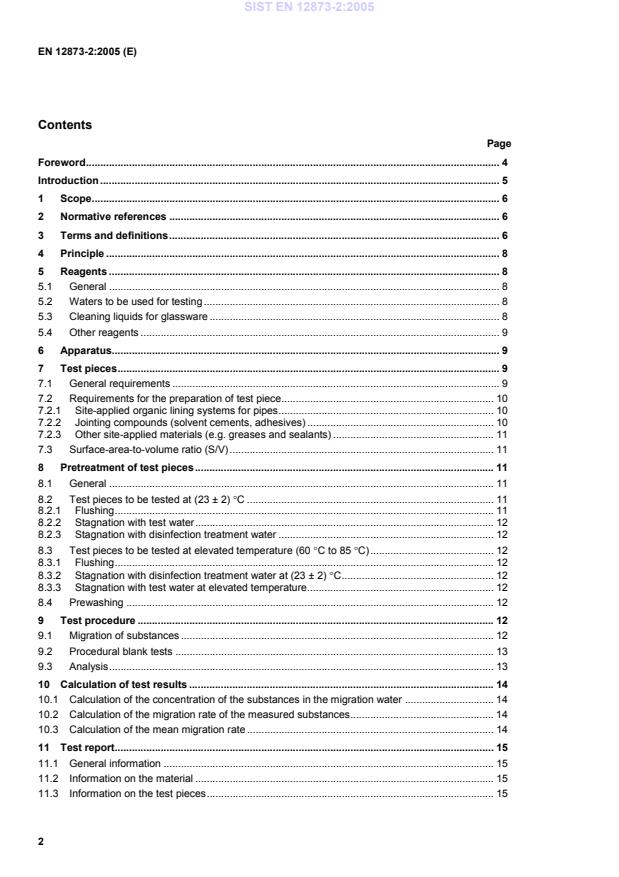
Contents
Page
Foreword. 4
Introduction . 5
1 Scope. 6
2 Normative references . 6
3 Terms and definitions. 6
4 Principle . 8
5 Reagents . 8
5.1 General . 8
5.2 Waters to be used for testing. 8
5.3 Cleaning liquids for glassware . 8
5.4 Other reagents . 9
6 Apparatus. 9
7 Test pieces. 9
7.1 General requirements . 9
7.2 Requirements for the preparation of test piece. 10
7.2.1 Site-applied organic lining systems for pipes. 10
7.2.2 Jointing compounds (solvent cements, adhesives) . 10
7.2.3 Other site-applied materials (e.g. greases and sealants) . 11
7.3 Surface-area-to-volume ratio (S/V). 11
8 Pretreatment of test pieces. 11
8.1 General . 11
8.2 Test pieces to be tested at (23 ± 2) °C . 11
8.2.1 Flushing. 11
8.2.2 Stagnation with test water. 12
8.2.3 Stagnation with disinfection treatment water . 12
8.3 Test pieces to be tested at elevated temperature (60 °C to 85 °C). 12
8.3.1 Flushing. 12
8.3.2 Stagnation with disinfection treatment water at (23 ± 2) °C. 12
8.3.3 Stagnation with test water at elevated temperature. 12
8.4 Prewashing . 12
9 Test procedure . 12
9.1 Migration of substances . 12
9.2 Procedural blank tests . 13
9.3 Analysis. 13
10 Calculation of test results . 14
10.1 Calculation of the concentration of the substances in the migration water . 14
10.2 Calculation of the migration rate of the measured substances. 14
10.3 Calculation of the mean migration rate . 14
11 Test report. 15
11.1 General information . 15
11.2 Information on the material . 15
11.3 Information on the test pieces. 15
11.4 Information on the test procedure.16
11.5 Test results .16
Annex A (informative) Arrangement for flushing pipes with nominal size greater than DN 80 .18
Annex B (normative) Additional procedure for testing non-homogeneous products and pipes with
nominal size greater than DN 80.20
B.1 Arrangement for testing .20
B.2 Flushing of the test piece.20
B.3 Blank test .20
Annex C (informative) Sequence of additional migration periods in the migration test .22
C.1 Introduction .22
C.2 Migration tests .22
Annex D (informative) Procedural tests using standard additions (positive controls) .24
Annex E (informative) Flow diagrams for migration test procedure for cold water temperature and
elevated temperature .25
Foreword
This document (EN 12873-2:2005) has been prepared by Technical Committee CEN/TC 164 “Water supply”,
the secretariat of which is held by AFNOR.
This European Standard shall be given the status of a national standard, either by publication of an identical
text or by endorsement, at the latest by August 2005, and conflicting national standards shall be withdrawn at
the latest by August 2005.
It has been drawn up with the objective to describe a test method to determine the migration of substances
from non-metallic and non-cementitious materials for use in contact with water intended for human
consumption.
This document will result in one of a series of standards on test methods which support the appropriate
standards.
This document, part 2, is the second in a series of standards for dealing with the influence of migration from
materials on water intended for human consumption, including:
― Part 1: Test method for non-metallic and non-cementitious factory made products;
― Part 2: Test method for non-metallic and non-cementitious site-applied materials;
― Part 3: Test method for ion exchange and absorbent resins;
― Part 4: Test method for water treatment membranes.
This document includes a Bibliography.
According to the CEN/CENELEC Internal Regulations, the national standards organizations of the following
countries are bound to implement this European Standard: Austria, Belgium, Cyprus, Czech Republic,
Denmark, Estonia, Finland, France, Germany, Greece, Hungary, Iceland, Ireland, Italy, Latvia, Lithuania,
Luxembourg, Malta, Netherlands, Norway, Poland, Portugal, Slovakia, Slovenia, Spain, Sweden, Switzerland
and United Kingdom.
Introduction
In respect of potential adverse effects on the quality of water intended for human consumption caused by the
materials, it is called to mind that, while awaiting the adoption of verifiable European acceptance criteria, the
relevant national regulations remain in force.
1 Scope
This document specifies a procedure to determine the migration of substances from non-metallic and non-
cementitious site-applied materials for use in contact with water intended for human consumption.
It is applicable to site-applied materials intended to be used under various conditions for the transport and
storage of water intended for human consumption, including raw water used for the production of water
intended for human consumption. It covers the extraction by water of substances from these materials after
their application on site.
The document is applicable to materials whose physical or chemical properties alter during or after on-site
application, such as coatings, paints, and adhesives. In addition, some site-applied materials that do not
change in such a manner, e.g. greases or lubricants, are also included.
2 Normative references
The following referenced documents are indispensable for the application of this document. For dated
references, only the edition cited applies. For undated references, the latest edition of the referenced
document (including any amendments) applies.
EN ISO 7393-2, Water quality — Determination of free chlorine and total chlorine — Part 2: Colorimetric
method using N, N-diethyl-1,4-phenylenediamine, for routine control purposes. (ISO 7393-2:1985)
3 Terms and definitions
For the purposes of this document, the following terms and definitions apply.
3.1
test
technical operation that consists of the determination of one or more characteristics of a given product
3.2
test procedure
specified technical method for performing a test
3.3
test report
document that presents test results and other information relevant to a test
3.4
testing laboratory
laboratory that performs tests
3.5
material
manufactured items(s) for application on-site and subsequent contact with water intended for human
consumption
3.6
product
material, in its finished form after application on site, that comes into contact with water intended for human
consumption
3.7
test piece
product to be tested for suitability for use in contact with water intended for human consumption
3.8
tap water
water intended for human consumption (5.2.1)
3.9
test water
water used for migration testing (5.2.2 and 5.2.3)
3.10
disinfection treatment water
water used for preliminary chlorination (5.2.4)
3.11
prewashing water
water used for prewashing (5.2.5)
3.12
blank water
test water, (5.2.2 and 5.2.3) which has been kept at the same specified conditions as migration water (3.15)
but without contact with test pieces
3.13
migration
movement of a substance or substances from test pieces into test water
3.14
migration period
period of time in which the migration is carried out under specified conditions
3.15
migration water
test water after exposure to a test piece under specified conditions
3.16
migration rate
mass of a measured substance or substances (in mg) migrating from one square decimetre of a test piece
into the test water in one day at a specified temperature (°C)
3.17
fitting, ancillary
complete functional unit made up of one or more components or materials, parts of which are in contact with
water intended for human consumption, e.g. taps, valves, water meters, water filters, pipe connectors and
flexible hose assemblies
3.18
lining
layer of material applied on site and intended, as a finished product, to come into contact with drinking water,
e.g. the inside surfaces of pipes, fittings or storage vessels
3.19
cure
conversion of a material into its final form; for example by chemical reaction or drying
4 Principle
Test pieces are taken on site or prepared under specific conditions that are intended to simulate site-
application taking into account the manufacturer's written instructions.
Each test piece is subjected to a specified pretreatment procedure of stagnation and prewashing. The surface
of the test piece, that is exposed in practice to water intended for human consumption, is brought into contact
with test water during at least three sequential migration periods. A migration period is either;
― 72 h at 23 °C for products intended to come into contact with cold water.
― 24 h at a specified temperature in the range 60 °C to 85 °C for products intended to come into contact
with warm or hot water.
Migration rates for the first three migration periods are determined by analysis of the required substances in
the corresponding migration waters.
NOTE 1 The test is carried out under conditions to ensure that calculation of a reliable migration rate is facilitated.
These conditions are not meant to simulate any service condition. Relating the results obtained from this document to the
service condition is carried out using a conversion procedure. This procedure will be specified in regulations.
NOTE 2 The choice of the type of test water (chlorinated and/or chlorine free), the temperature of the test water, the
number of additional migration periods and the necessity for a preliminary chlorination (see Clause 8) will be specified by
product/system standards or regulations.
5 Reagents
5.1 General
For the purpose of this document, the following reagents apply.
5.2 Waters to be used for testing
5.2.1 tap water, water intended for human consumption with a free chlorine content less than 0,2 mg/l as
Cl .
5.2.2 test water, chlorine-free water with a conductivity of < 2 mS/m and a total organic content (TOC) of
< 0,2 mg/l C, e.g. prepared by reverse osmosis, deionization or distillation, followed by activated carbon
filtration.
5.2.3 chlorinated test water, test water according to 5.2.2 having an active chlorine content of
(1 ± 0,2) mg/l as Cl2 (5.3).
5.2.4 disinfection treatment water, test water according to 5.2.2 having an active chlorine content of
(50 ± 5) mg/l as Cl2 (5.4).
5.2.5 prewashing water, tap water (5.2.1).
5.3 Cleaning liquids for glassware
5.3.1 hydrochloric acid, concentrated (30 % mass per volume) analytical reagent grade.
5.3.2 hydrochloric acid solution, prepared by slowly adding (0,5 ± 0,01) l of concentrated hydrochloric
acid (5.3.1) to (0,5 ± 0,01) l of test water (5.2.2).
NOTE Care is needed because the solution may generate heat.
5.3.3 nitric acid, concentrated (65 % mass per volume) analytical reagent grade.
5.3.4 nitric acid solution, prepared by slowly adding (0,5 ± 0,01) l of concentrated nitric acid (5.3.3) to
(0,5 ± 0,01) l of test water (5.2.2).
NOTE Care is needed because the solution may generate heat.
5.3.5 sulphuric acid, concentrated (density 1,84 g/ml) analytical reagent grade.
5.3.6 chromic acid, analytical reagent grade prepared by dissolving (50 ± 1) g of chromium (VI) oxide in
(1 ± 0,02) l of sulphuric acid (5.3.5).
NOTE Chromic acid is a storage hazard; it may burst a sealed container due to carbon dioxide release. It is a
powerful oxidant and may give potentially explosive reactions with oxidizable materials. It may ignite on contact with
acetone or alcohols. When heated to decomposition it emits acrid smoke and irritating fumes.
5.4 Other reagents
sodium hypochlorite, prepared from a technical or general purpose reagent grade of sodium hypochlorite
(NaOCl), using test water (5.2.2) and having a known concentration of about 0,1 % mass fraction of free
chlorine determined in accordance with EN ISO 7393-2.
NOTE Unless tests have proved otherwise the sodium hypochlorite solution should be considered unstable and
prepared on the day of use.
6 Apparatus
6.1 Vessels, containers, stoppers and connections, consisting of a material, such as glass, PTFE or
stainless steel, which is inert under the specified test conditions (Clause 9).
NOTE The material PTFE should only be used when there is a small contact area with the test water. Thus PTFE is
unsuitable for containers
6.2 Plates, stainless steel, mild steel, (sand blasted) glass or concrete/cement mortar plates, for testing
the material. The plates must be covered completely with the test material.
6.3 Equipment, capable of maintaining the appropriate migration temperature, e.g. (23 ± 2) °C, or (60 ± 2) °C,
to (85 ± 2) °C.
6.4 Cleaning, of laboratory glassware, stainless steel plates and sand blasted glass plates shall be cleaned
by washing with a biodegradable laboratory detergent, followed by rinsing with either hydrochloric acid
solution (5.3.2) (except for stainless steel), nitric acid solution (5.3.4) or chromic acid (5.3.6) and finally by
thoroughly rinsing with test water (5.2.2). Drain the plates and dry them in a hot air cabinet.
7 Test pieces
7.1 General requirements
The manufacturer shall provide a copy of the detailed instructions for application that accompany the
materials(s).
The application instructions shall cover aspects such as:
a) surface preparation;
b) mix ratios and method of mixing;
c) method of application;
d) minimum curing temperature and time;
e) product film thickness;
f) associated materials, e.g. primers and undercoats.
The manufacturer shall provide all necessary information on material and chemical safety.
Test pieces shall be prepared on site by the manufacturer/contractor under the supervision of the test
laboratory in accordance with the manufacturer's written instructions. If no specialised equipment for
application is required then the test pieces may be prepared by the test laboratory under conditions that
simulate site application. Where it is found necessary to deviate from these instructions, this shall only be
done with the prior agreement of the test laboratory and manufacturer or contractor.
If transportation of test pieces to the test laboratory is necessary, then this period of time shall be part of the
curing conditions (e.g. time and temperature).
The test pieces shall be delivered within the curing period.
The test laboratory shall prepare a det
...