

EN ISO 9100-14:2005
(Main)Glass containers - Vacuum lug finishes - Part 14: 110 regular (ISO 9100-14:2005)
- Abstract
ISO 9100-14:2005 specifies the dimensions of a vacuum lug finish with a nominal size of 110 mm regular for wide-mouth glass containers.
- Status
- Published
- Publication Date
- 14-Jan-2005
- Technical Committee
- CEN/TC 261 - Packaging
- Drafting Committee
- CEN/TC 261/SC 5/WG 21 - Glass packaging
- Current Stage
- 9093 - Decision to confirm - Review Enquiry
- Start Date
- 23-Oct-2009
- Completion Date
- 23-Oct-2009

Overview
EN ISO 9100-14:2005 - Glass containers: Vacuum lug finishes - Part 14: 110 regular is a European adoption of ISO 9100-14:2005 published by CEN. The standard specifies the design and precise dimensions for a vacuum lug finish with a nominal size of 110 mm (regular) intended for wide‑mouth glass containers. It defines the cutter profile, thread construction, sealing area and dimensional tolerances needed to ensure consistent closure performance for vacuum‑sealed jars and wide-mouth bottles.
Key topics and requirements
- Scope and purpose: Establishes the dimensional requirements for a 110 mm vacuum lug finish so closures and containers from different suppliers are compatible.
- Dimensional drawings: Contains detailed figures for the cutter profile, thread construction and an enlarged section view showing sealing surfaces and closure position.
- Critical features:
- Cutter inclination and profile (shown in figures) for mold and tooling design.
- Thread construction and leads for lug engagement and proper sealing.
- Sealing surface requirements - it must be free of defects (checks, dips, crizzles) that could impair vacuum sealing.
- Guidance to minimize ovality; diameters E and T should be concentric where possible for reliable closure function.
- Cross‑hatched area in the drawings indicates the closure position and required clearance.
- Tolerance and selection: Unspecified details are selected according to application; for general tolerances the standard references EN 22768-1.
- Reference and origin: Based on CETIE data (GME 20‑12:1995) and prepared by CEN/TC 261 in collaboration with ISO/TC 63.
Applications
This standard is practical for professionals involved in the design, manufacture and quality assurance of wide‑mouth glass packaging where vacuum lug closures are used:
- Glass container manufacturers - specifying finish dimensions for mould design and production.
- Closure and cap makers - ensuring caps and lids mate correctly with a 110 regular vacuum lug finish.
- Tooling and mould designers - using cutter profiles and thread construction details to shape finish tooling.
- Packaging engineers and OEMs - verifying container/closure compatibility for vacuum-packed foods, preserves and other sealed products.
- Quality and inspection teams - checking sealing surfaces, concentricity and ovality to meet functional requirements.
Related standards
- EN 22768-1 (General tolerances) - referenced for linear and angular tolerances applicable where individual tolerances are not specified.
- ISO/TC 63 publications and CETIE guidance (GME 20‑12:1995) informed this document.
Keywords: EN ISO 9100-14:2005, vacuum lug finish, 110 regular, glass containers, wide-mouth, cutter profile, thread construction, sealing surface, closure compatibility.
Relations
- Effective Date
- 12-Feb-2026
- Effective Date
- 22-Dec-2008
Get Certified
Connect with accredited certification bodies for this standard

BRCGS (Brand Reputation Compliance Global Standards)
Global food safety and quality standards owner.
Sponsored listings
Frequently Asked Questions
EN ISO 9100-14:2005 is a standard published by the European Committee for Standardization (CEN). Its full title is "Glass containers - Vacuum lug finishes - Part 14: 110 regular (ISO 9100-14:2005)". This standard covers: ISO 9100-14:2005 specifies the dimensions of a vacuum lug finish with a nominal size of 110 mm regular for wide-mouth glass containers.
ISO 9100-14:2005 specifies the dimensions of a vacuum lug finish with a nominal size of 110 mm regular for wide-mouth glass containers.
EN ISO 9100-14:2005 is classified under the following ICS (International Classification for Standards) categories: 55.100 - Bottles. Pots. Jars. The ICS classification helps identify the subject area and facilitates finding related standards.
EN ISO 9100-14:2005 has the following relationships with other standards: It is inter standard links to ISO 9100-14:2005, EN ISO 9100-14:2005/AC:2009. Understanding these relationships helps ensure you are using the most current and applicable version of the standard.
EN ISO 9100-14:2005 is associated with the following European legislation: EU Directives/Regulations: 80/232/EEC, 87/356/EEC. When a standard is cited in the Official Journal of the European Union, products manufactured in conformity with it benefit from a presumption of conformity with the essential requirements of the corresponding EU directive or regulation.
EN ISO 9100-14:2005 is available in PDF format for immediate download after purchase. The document can be added to your cart and obtained through the secure checkout process. Digital delivery ensures instant access to the complete standard document.
Standards Content (Sample)
SLOVENSKI STANDARD
01-marec-2005
Steklena embalaža – Grla za vakuumsko zapiranje - 14. del: 110, standardno (ISO
9100-14:2005)
Glass containers - Vacuum lug finishes - Part 14: 110 regular (ISO 9100-14:2005)
Glasbehälter - Vakuum-Nockenverschluss-Mündungen - Teil 14: 110 regular (ISO 9100-
14:2005)
Récipients en verre - Bagues a crans pour bouchage sous vide - Partie 14: 110 regular
(ISO 9100-14:2005)
Ta slovenski standard je istoveten z: EN ISO 9100-14:2005
ICS:
55.100 Steklenice. Lonci. Kozarci Bottles. Pots. Jars
2003-01.Slovenski inštitut za standardizacijo. Razmnoževanje celote ali delov tega standarda ni dovoljeno.
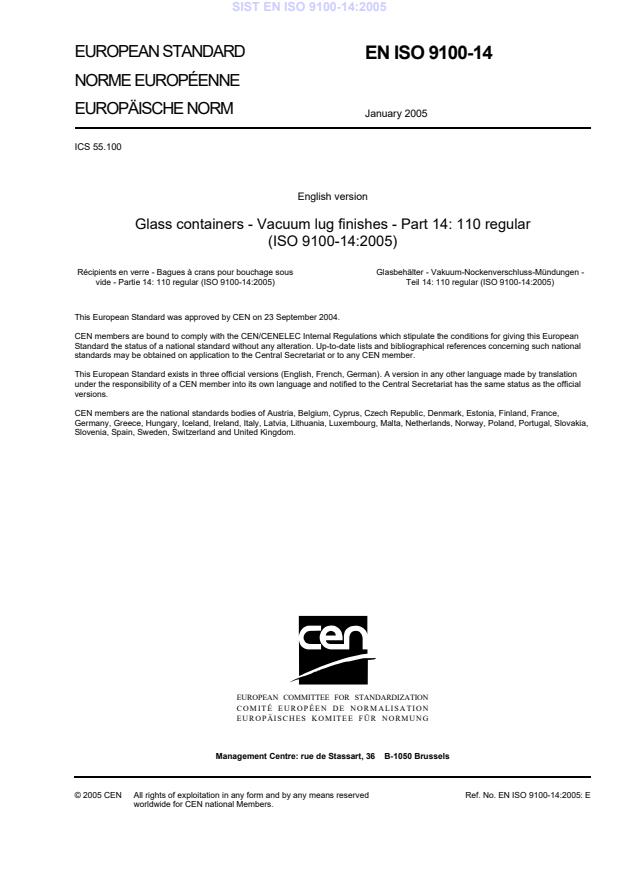
EUROPEAN STANDARD
EN ISO 9100-14
NORME EUROPÉENNE
EUROPÄISCHE NORM
January 2005
ICS 55.100
English version
Glass containers - Vacuum lug finishes - Part 14: 110 regular
(ISO 9100-14:2005)
Récipients en verre - Bagues à crans pour bouchage sous Glasbehälter - Vakuum-Nockenverschluss-Mündungen -
vide - Partie 14: 110 regular (ISO 9100-14:2005) Teil 14: 110 regular (ISO 9100-14:2005)
This European Standard was approved by CEN on 23 September 2004.
CEN members are bound to comply with the CEN/CENELEC Internal Regulations which stipulate the conditions for giving this European
Standard the status of a national standard without any alteration. Up-to-date lists and bibliographical references concerning such national
standards may be obtained on application to the Central Secretariat or to any CEN member.
This European Standard exists in three official versions (English, French, German). A version in any other language made by translation
under the responsibility of a CEN member into its own language and notified to the Central Secretariat has the same status as the official
versions.
CEN members are the national standards bodies of Austria, Belgium, Cyprus, Czech Republic, Denmark, Estonia, Finland, France,
Germany, Greece, Hungary, Iceland, Ireland, Italy, Latvia, Lithuania, Luxembourg, Malta, Netherlands, Norway, Poland, Portugal, Slovakia,
Slovenia, Spain, Sweden, Switzerland and United Kingdom.
EUROPEAN COMMITTEE FOR STANDARDIZATION
COMITÉ EUROPÉEN DE NORMALISATION
EUROPÄISCHES KOMITEE FÜR NORMUNG
Management Centre: rue de Stassart, 36 B-1050 Brussels
© 2005 CEN All rights of exploitation in any form and by any means reserved Ref. No. EN ISO 9100-14:2005: E
worldwide for CEN national Members.
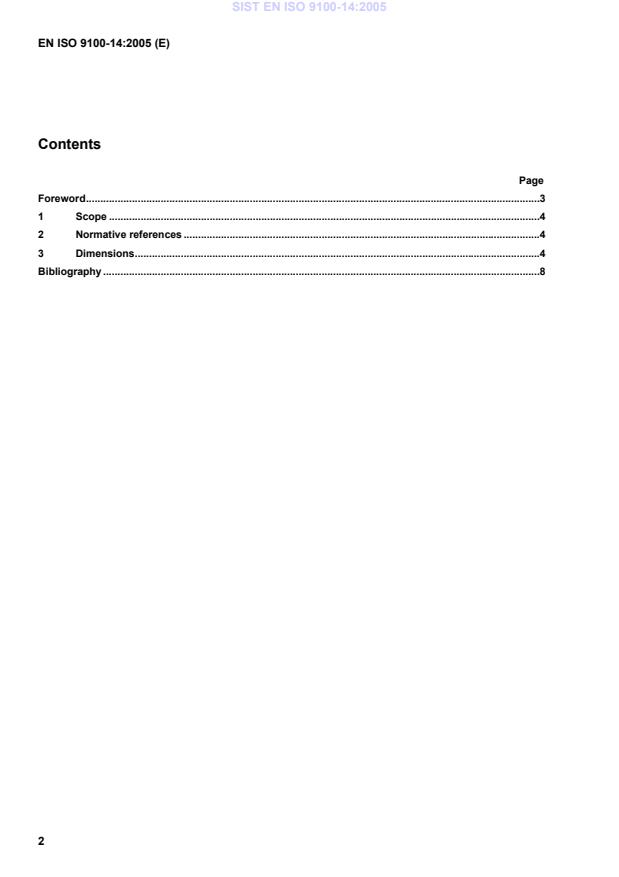
Contents
Page
Foreword.3
1 Scope .4
2 Normative references .4
3 Dimensions.4
Bibliography .8
Foreword
This document (EN ISO 9100-14:2005) has been prepared by Technical Committee CEN/TC 261 “Packaging”,
the secretariat of which is held by AFNOR,
...