


EN 13225:2013
(Main)Precast concrete products - Linear structural elements
Precast concrete products - Linear structural elements
This European Standard identifies the requirements, the basic performance criteria and evaluation of conformity for precast linear elements (such as columns, beams and frame elements) made of reinforced or prestressed normal or lightweight concrete, used for the construction of the structures of buildings and other civil engineering works, except bridges.
This document covers terminology, performance criteria, tolerances, relevant physical properties, test methods, and aspects of transport and erection.
This document does not cover load bearing capacity determined by testing.
This standard does not cover lintels with length up to 4,5 m used in masonry walls.
Betonfertigteile - Stabförmige tragende Bauteile
Diese Europäische Norm legt die Anforderungen, die grundlegenden Leistungskriterien und die Konformitäts-bewertung für stabförmige Betonfertigteile (wie z. B. Stützen, Träger und Rahmenelemente) aus bewehrtem oder vorgespanntem Normal- oder Leichtbeton fest, die im Hoch- und Tiefbau mit Ausnahme des Brückenbaus eingesetzt werden.
In diesem Dokument werden Begriffe, Leistungskriterien, Toleranzen, die maßgebenden physikalischen Eigenschaften, Prüfverfahren und Aspekte von Transport und Aufbau festgelegt.
Dieses Dokument gilt nicht für die durch die Prüfung bestimmte Tragfähigkeit.
Diese Norm gilt nicht für Stahlbetonträger mit einer Länge von bis zu 4,5 m, welche in Mauerwerkswenden verwendet werden
Produits préfabriqués en béton - Éléments de structure linéaires
La présente Norme européenne spécifie les prescriptions, les critères relatifs aux performances de base et l’évaluation de la conformité des éléments linéaires préfabriqués (tels que les poteaux, les poutres et les éléments de portiques) fabriqués en béton de granulats courants ou légers, armé ou précontraint, et utilisés pour la construction de structures de bâtiments et d’autres ouvrages de génie civil, à l’exception des ponts.
Le présent document couvre la terminologie, les critères relatifs aux performances, les tolérances, les propriétés physiques pertinentes, les méthodes d’essai et les aspects liés au transport et à la mise en œuvre.
Il ne couvre pas la capacité portante déterminée par des essais.
Il ne couvre pas les linteaux d’une longueur inférieure ou égale à 4,5 m utilisés dans les murs en maçonnerie.
Montažni betonski izdelki - Linijski konstrukcijski elementi
Ta evropski standard opredeljuje zahteve, osnovna merila učinkovitosti in vrednotenje skladnosti za montažne linijske elemente (kot so stebri, tramovi in okvirni elementi), narejene iz armiranega ali prednapetega običajnega ali lahkega betona, ki se uporabljajo za gradnjo struktur zgradb in drugih inženirskih objektov z izjemo mostov. Ta dokument zajema izrazje, merila učinkovitosti, tolerance, ustrezne fizikalne lastnosti, preskusne metode ter vidike transporta in postavitve. Ta dokument ne vključuje nosilnosti, ki se določi s preskušanjem. Ta standard ne vključuje preklad z dolžino do 4,5 m, ki se uporabljajo v zidovih.
General Information
- Status
- Published
- Publication Date
- 02-Apr-2013
- Withdrawal Date
- 30-Oct-2013
- Technical Committee
- CEN/TC 229 - Precast concrete products
- Current Stage
- 6060 - Definitive text made available (DAV) - Publishing
- Start Date
- 03-Apr-2013
- Due Date
- 17-Mar-2013
- Completion Date
- 03-Apr-2013
- Directive
- 89/106/EEC - Construction products
Relations
- Effective Date
- 10-Apr-2013
- Effective Date
- 10-Apr-2013
Overview
EN 13225:2013 - Precast concrete products: Linear structural elements is a CEN European Standard that sets requirements, basic performance criteria and conformity evaluation for precast linear elements (columns, beams and frame elements) made of reinforced or prestressed normal or lightweight concrete. The standard applies to precast elements used in building and other civil engineering structures (excluding bridges) and covers terminology, tolerances, relevant physical properties, test methods, transport and erection. It does not cover load-bearing capacity determined by testing and excludes lintels up to 4.5 m used in masonry walls.
Key topics and technical requirements
- Scope and materials
- Applicable to reinforced and prestressed normal and lightweight concrete linear elements.
- Refers to material clauses in EN 13369 and EN 206-1 for constituent materials and concrete properties.
- Geometrical tolerances and dimensions
- Defines production tolerances for linear elements (columns, beams, frame elements). Examples include bow/straightness tolerance ±L/700 and angle deviation δ = h/100 (≥ 5 mm).
- Specific tolerances for beams (skew θ, camber) and columns are given, with additional project-specific allowances possible.
- Finished product requirements
- Surface characteristics, minimum dimensions and durability provisions referenced to EN 13369.
- Mechanical resistance and serviceability follow EN 1992-1-1 (Eurocode 2) rules; verification by testing for load-bearing capacity is excluded.
- Seismic and erection considerations
- Includes seismic behaviour rules consistent with EN 1998-1 (Eurocode 8) for precast columns and conditions for framing systems.
- Annex A addresses lateral buckling risks during lifting, transport and erection.
- Conformity, marking and documentation
- Factory production control, initial type testing and CE marking procedures are described in Annex ZA, aligning with EU Construction Products Directive and Eurocodes.
- Requirements for marking and technical documentation are specified.
Practical applications
- Use for specification, manufacture and acceptance of precast columns, beams and frame elements for buildings and civil engineering works.
- Useful in project documentation for production tolerances, transport/erection planning and conformity assessment.
- Supports compatibility with structural design standards when designing precast structural members to Eurocodes.
Who should use this standard
- Precast concrete manufacturers and production managers
- Structural and civil engineers specifying precast elements
- Contractors, erectors and logistics planners
- Certification bodies, conformity assessors and regulators
Related standards
- EN 13369 - Common rules for precast concrete products
- EN 1992-1-1 (Eurocode 2) - Design of concrete structures
- EN 1992-1-2 - Fire design for concrete structures
- EN 1998-1 (Eurocode 8) - Seismic design of structures
Keywords: EN 13225:2013, precast concrete, linear structural elements, columns, beams, prestressed concrete, tolerances, test methods, CE marking, Eurocode.

Frequently Asked Questions
EN 13225:2013 is a standard published by the European Committee for Standardization (CEN). Its full title is "Precast concrete products - Linear structural elements". This standard covers: This European Standard identifies the requirements, the basic performance criteria and evaluation of conformity for precast linear elements (such as columns, beams and frame elements) made of reinforced or prestressed normal or lightweight concrete, used for the construction of the structures of buildings and other civil engineering works, except bridges. This document covers terminology, performance criteria, tolerances, relevant physical properties, test methods, and aspects of transport and erection. This document does not cover load bearing capacity determined by testing. This standard does not cover lintels with length up to 4,5 m used in masonry walls.
This European Standard identifies the requirements, the basic performance criteria and evaluation of conformity for precast linear elements (such as columns, beams and frame elements) made of reinforced or prestressed normal or lightweight concrete, used for the construction of the structures of buildings and other civil engineering works, except bridges. This document covers terminology, performance criteria, tolerances, relevant physical properties, test methods, and aspects of transport and erection. This document does not cover load bearing capacity determined by testing. This standard does not cover lintels with length up to 4,5 m used in masonry walls.
EN 13225:2013 is classified under the following ICS (International Classification for Standards) categories: 91.100.30 - Concrete and concrete products. The ICS classification helps identify the subject area and facilitates finding related standards.
EN 13225:2013 has the following relationships with other standards: It is inter standard links to EN 13225:2004, EN 13225:2004/AC:2006. Understanding these relationships helps ensure you are using the most current and applicable version of the standard.
EN 13225:2013 is associated with the following European legislation: EU Directives/Regulations: 305/2011, 89/106/EEC; Standardization Mandates: M/100. When a standard is cited in the Official Journal of the European Union, products manufactured in conformity with it benefit from a presumption of conformity with the essential requirements of the corresponding EU directive or regulation.
You can purchase EN 13225:2013 directly from iTeh Standards. The document is available in PDF format and is delivered instantly after payment. Add the standard to your cart and complete the secure checkout process. iTeh Standards is an authorized distributor of CEN standards.
Standards Content (Sample)
2003-01.Slovenski inštitut za standardizacijo. Razmnoževanje celote ali delov tega standarda ni dovoljeno.Montažni betonski izdelki - Linijski konstrukcijski elementiBetonfertigteile - Stabförmige BetonbauteileProduits préfabriqués en béton - Éléments de structure linéairesPrecast concrete products - Linear structural elements91.100.30Beton in betonski izdelkiConcrete and concrete productsICS:Ta slovenski standard je istoveten z:EN 13225:2013SIST EN 13225:2013en,fr,de01-september-2013SIST EN 13225:2013SLOVENSKI
STANDARDSIST EN 13225:2004/AC:2007SIST EN 13225:20041DGRPHãþD
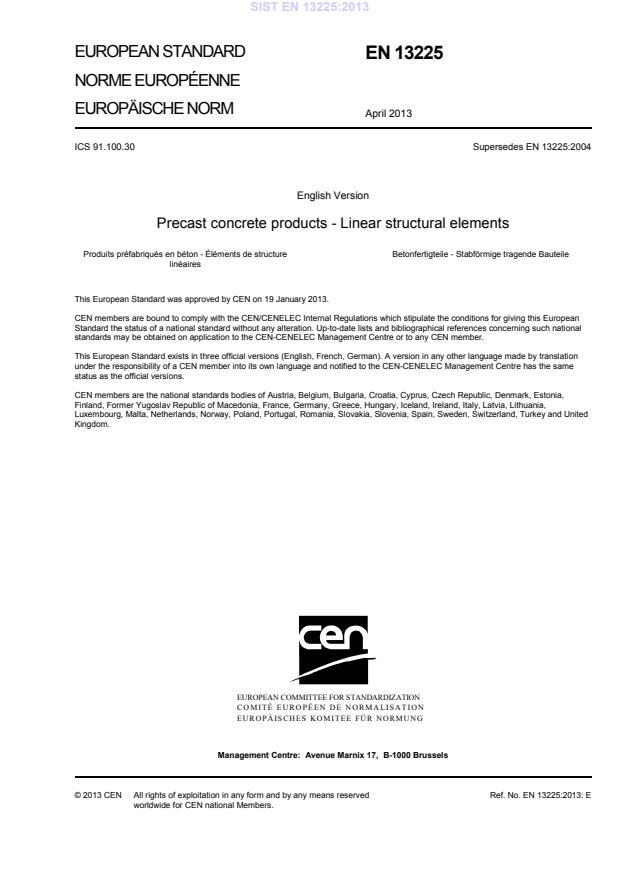
EUROPEAN STANDARD NORME EUROPÉENNE EUROPÄISCHE NORM
EN 13225
April 2013 ICS 91.100.30 Supersedes EN 13225:2004English Version
Precast concrete products - Linear structural elements
Produits préfabriqués en béton - Éléments de structure linéaires
Betonfertigteile - Stabförmige tragende Bauteile This European Standard was approved by CEN on 19 January 2013.
CEN members are bound to comply with the CEN/CENELEC Internal Regulations which stipulate the conditions for giving this European Standard the status of a national standard without any alteration. Up-to-date lists and bibliographical references concerning such national standards may be obtained on application to the CEN-CENELEC Management Centre or to any CEN member.
This European Standard exists in three official versions (English, French, German). A version in any other language made by translation under the responsibility of a CEN member into its own language and notified to the CEN-CENELEC Management Centre has the same status as the official versions.
CEN members are the national standards bodies of Austria, Belgium, Bulgaria, Croatia, Cyprus, Czech Republic, Denmark, Estonia, Finland, Former Yugoslav Republic of Macedonia, France, Germany, Greece, Hungary, Iceland, Ireland, Italy, Latvia, Lithuania, Luxembourg, Malta, Netherlands, Norway, Poland, Portugal, Romania, Slovakia, Slovenia, Spain, Sweden, Switzerland, Turkey and United Kingdom.
EUROPEAN COMMITTEE FOR STANDARDIZATION
COMITÉ EUROPÉEN DE NORMALISATION EUROPÄISCHES KOMITEE FÜR NORMUNG
Management Centre:
Avenue Marnix 17,
B-1000 Brussels © 2013 CEN All rights of exploitation in any form and by any means reserved worldwide for CEN national Members. Ref. No. EN 13225:2013: ESIST EN 13225:2013
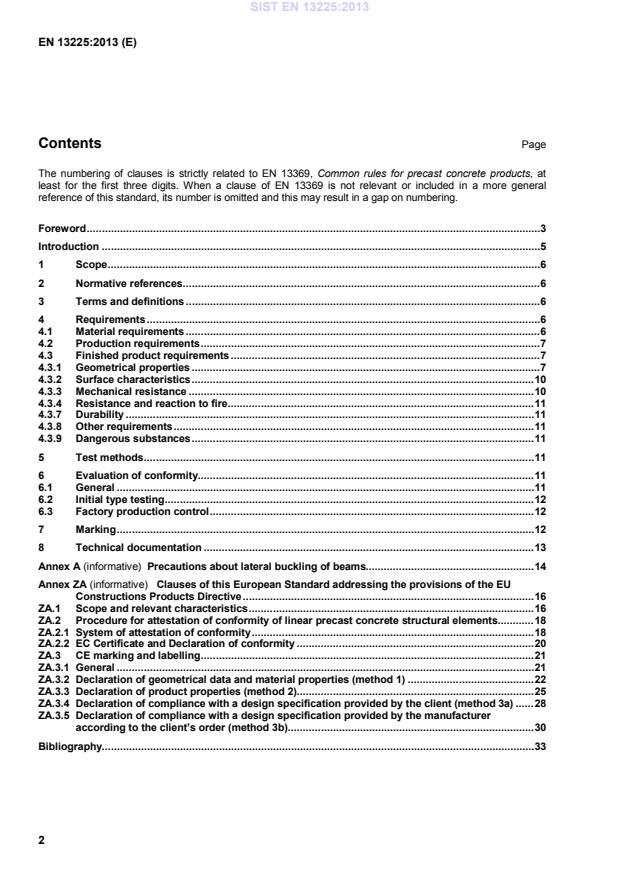
Precautions about lateral buckling of beams. 14 Annex ZA (informative)
Clauses of this European Standard addressing the provisions of the EU Constructions Products Directive . 16 ZA.1 Scope and relevant characteristics . 16 ZA.2 Procedure for attestation of conformity of linear precast concrete structural elements . 18 ZA.2.1 System of attestation of conformity . 18 ZA.2.2 EC Certificate and Declaration of conformity . 20 ZA.3 CE marking and labelling . 21 ZA.3.1 General . 21 ZA.3.2 Declaration of geometrical data and material properties (method 1) . 22 ZA.3.3 Declaration of product properties (method 2). 25 ZA.3.4 Declaration of compliance with a design specification provided by the client (method 3a) . 28 ZA.3.5 Declaration of compliance with a design specification provided by the manufacturer according to the client’s order (method 3b) . 30 Bibliography. 33
a) addition of lightweight concrete in the Scope; b) change in subclause 4.3.3.3 Seismic behaviour; c) addition of subclause 4.3.9 Dangerous substances;
d) changes referring to dangerous substances in Annex ZA. This standard is one of a series of product standards for precast concrete products. For common aspects reference is made to EN 13369 Common rules for precast products, from which also the relevant requirements of the EN 206-1 Concrete — Part 1: Specification, performances, production and conformity are taken. The references to EN 13369 by CEN/TC 229 product standards are intended to make them homogeneous and to avoid repetitions of similar requirements. This standard was examined by and agreed with a joint working group party appointed by the Liaison group CEN/TC 229 – CEN/TC 250, particularly for its compatibility with structural Eurocodes. Eurocodes are taken as a common reference for design aspects. The installation of some structural precast concrete products is dealt with by EN 13670 Execution of concrete structures.
The programme of standards for structural precast concrete products comprises the following standards, in some cases consisting of several parts: EN 1168, Precast concrete products — Hollow core slabs EN 12794, Precast concrete products — Foundation piles EN 12843, Precast concrete products — Masts and poles EN 13224, Precast concrete products — Ribbed floor elements SIST EN 13225:2013
EN 14844, Precast concrete products — Box culverts EN 14991, Precast concrete products — Foundation elements EN 14992, Precast concrete products — Wall elements EN 15037, Precast concrete products — Beam-and-block floor systems EN 15258, Precast concrete products — Retaining wall elements EN 15050, Precast concrete products — Bridge elements This standard defines in Annex ZA the application methods of CE marking to products designed using the relevant EN Eurocodes (EN 1992-1-1, EN 1992-1-2 and EN 1998-1). Where, in default of applicability conditions of EN Eurocodes to the works of destination, design provisions other than EN Eurocodes are used for mechanical strength and/or fire resistance, the conditions to affix CE marking to the product are described in ZA.3.4. According to the CEN-CENELEC Internal Regulations, the national standards organisations of the following countries are bound to implement this European Standard: Austria, Belgium, Bulgaria, Croatia, Cyprus, Czech Republic, Denmark, Estonia, Finland, Former Yugoslav Republic of Macedonia, France, Germany, Greece, Hungary, Iceland, Ireland, Italy, Latvia, Lithuania, Luxembourg, Malta, Netherlands, Norway, Poland, Portugal, Romania, Slovakia, Slovenia, Spain, Sweden, Switzerland, Turkey and the United Kingdom.
This document covers terminology, performance criteria, tolerances, relevant physical properties, test methods, and aspects of transport and erection. This document does not cover load bearing capacity determined by testing.
This standard does not cover lintels with length up to 4,5 m used in masonry walls. 2 Normative references The following documents, in whole or in part, are normatively referenced in this document and are indispensable for its application. For dated references, only the edition cited applies. For undated references, the latest edition of the referenced document (including any amendments) applies. EN 1992-1-1:2004, Eurocode 2: Design of concrete structures — Part 1-1: General rules and rules for buildings EN 1998-1:2004, Eurocode 8: Design of structures for earthquake resistance — Part 1: General rules, seismic actions and rules for buildings EN 13369:2013, Common rules for precast concrete products 3 Terms and definitions For the purposes of this document, the terms and definitions given in EN 13369:2013 and the following apply. NOTE In general, the term “product” refers to an element which is produced in large numbers. 3.1 beam element, usually horizontal, for carrying loads primarily by flexure 3.2 column vertical bearing element subject mainly to compression 3.3 frame structure composed of two or more linear elements joined together to ensure stability
4 Requirements 4.1 Material requirements For general aspects, constituent materials of concrete, reinforcing and prestressing steel, inserts and connectors, the relevant clauses of EN 13369:2013, 4.1 shall apply. In particular, the ultimate tensile and tensile yield strength of steel shall be considered. SIST EN 13225:2013
tolerances may be assumed. For the overall positioning of holes and inserts 1,5 times the values of ∆L and ∆h tolerances may be assumed. Other values may be given in project specifications. The values of the tolerances do not include the deformation effects of any applied load or of prestressing. In the verification of the measured deviations, such deformations shall be taken into account by computing their value for the test situation.
NOTE Bow misalignment corresponds to deviation from straightness. For beams in the vertical plane, it corresponds to camber. 4.3.1.1.3 Columns For columns, tolerances of 4.3.1.1.2 are described in Figure 1. SIST EN 13225:2013
Key a) lateral view: principal tolerances b) cross section (linear deviation) c) cross section (angle deviation) d) circular cross section (linear deviation) Figure 1 — Tolerances for columns SIST EN 13225:2013
v in vertical plane ± ∆v L/700 For prestressed elements 1,5 times the value of ∆v tolerance may be assumed; this includes the effects of prestressing tolerance.
Key a) lateral view: principal tolerances b) in plan view: principal tolerances
c) cross section (skew) d) cross section (angle deviation)
e) cross section (linear deviation) f) cross section (skew)
Figure 2 — Tolerances for beams SIST EN 13225:2013
Figure 3 — Examples of frame elements 4.3.1.2 Minimum dimensions 4.3.1.2 of EN 13369:2013 shall apply. 4.3.2 Surface characteristics 4.3.2 of EN 13369:2013 shall apply. 4.3.3 Mechanical resistance 4.3.3.1 General For requirements on mechanical strength, 4.3.3 of EN 13369:2013 (referring to EN 1992-1-1:2004) shall apply, except 4.3.3.4 dealing with verification by testing. 4.3.3.2 Transient situations For transient situations, 4.3.3.6 of EN 13369:2013 shall apply. In Annex A, important information is given for lateral buckling of slender beams during lifting, transportation and erection. 4.3.3.3 Seismic behaviour Within the scope of 5.2.2 of EN 1998-1:2004, precast columns of one-storey buildings with hinged top connections to the beams belong to frame systems under the following conditions: a) the columns are designed on the assumption that their tops are connected along both main directions of the building to the supported elements by structural connections as specified in 5.11.3.1(2) of
EN 1998-1:2004; b) the column normalised axial load (ratio between design axial action and corresponding design strength) does not exceed 0,3 in the seismic design situation; c) the columns are based with full degree of support in foundations designed in accordance with 5.11.2.1.2 of EN 1998-1:2004; SIST EN 13225:2013
National regulations on dangerous substances may require verification and declaration on release, and sometimes content, when construction products covered by this standard are placed on those markets. In the absence of European harmonised test methods, verification and declaration on release/content should be done taking into account national provisions valid in the place of use. NOTE An informative database covering European and national provisions on dangerous substances is available at the Construction web site on EUROPA accessed through: http://ec.europa.eu/enterprise/construction/cpd-ds/ 5 Test methods Clause 5 of EN 13369:2013 shall apply. 6 Evaluation of conformity 6.1 General 6.1 of EN 13369:2013 shall apply. SIST EN 13225:2013
notation in the record form Elements surface finish visual inspection Every element notice of imperfections Elements total length see 5.2 1 every 10 elements or 1 every casting line notation in the record form Elements vertical deflection "v" (camber)b see 5.2 1 at least every month notation in the record form Elements other geometrical tolerances see 5.2 1 at least every month for every casting line notation in the record form a Slippage (shortening of the steel versus the concrete surface) has to be limited to the values given in 4.2.3.2.4 of EN 13369:2013. b See 4.3.1.1.4 and Figure 2. The manufacturer shall keep the records of the elements produced (position number, date of casting and construction data) for the required period of archiving and make them available when required. 7 Marking Clause 7 of EN 13369:2013 shall apply. NOTE For CE marking see Annex ZA. SIST EN 13225:2013
Precautions about lateral buckling of beams Except where proper stiffening and/or bracing provisions are adopted to ensure stability during transitory stages before the completion of the structure, special verifications against lateral buckling should be performed for slender beams for which the horizontal flexural stiffness is much lower than the vertical one. This is the case of narrow sections with Iz << Iy such as the one of Figure A.1. A simplified rule to check the necessity of special verifications is given in 5.9 of EN 1992-1-1:2004.
Figure A.1 — Cross section of a deep beam The different transitory and final situations that may require special buckling verifications are listed below: lifting conditions with pendulum suspension can be very unstable because of the low degree of restraint and of possible axial compression (see Figures A.2 and A.3); storage conditions are usually less sensitive to buckling due to the higher degree of restraint, but special care is to be given to ensure the torsional effectiveness of bearings; transportation conditions of the beams can require a special design, inclusive of possible buckling effects, made case by case; transitory conditions after installation can submit the beams to overloads while lacking in the bracing effects of the surrounding elements (see Figures A.4 and A.5); final situation of the completed structure is usually stiffened by the diaphragm effect of the floor or by other special bracing systems, provided lateral supports of the beams and proper connections are applied; isolated beams in final structural conditions (e.g. for bridge crane railways) require special design calculations, inclusive of lateral and torsional effects of actions, which usually lead to non-slender proportions. SIST EN 13225:2013
Figure A.2 — Lifting condition of a beam Figure A.4 — Laying condition of a beam
Figure A.3 — Lateral buckling in lifting condition Figure A.5 — Lateral buckling in laying condition SIST EN 13225:2013
Clauses of this European Standard addressing the provisions of the EU Constructions Products Directive ZA.1 Scope and relevant characteristics This European Standard has been prepared under the mandate M/1001) "Precast Concrete Products" given to CEN by the European Commission and the European Free Trade Association. The clauses of this European Standard shown in this annex meet the requirements of the mandate given under the EU Construction Products Directive (89/106/EEC). Compliance with these clauses confers a presumption of fitness of the linear structural elements covered by this annex for the intended uses indicated herein; reference shall be made to the information accompanying the CE marking. This annex has the same scope as Clause 1 of this standard. It establishes the conditions for CE marking of linear structural elements (such as columns, beams and frame elements) made of reinforced or prestressed normal weight concrete, used for the construction of the structures of buildings and other civil engineering works, except bridges, and shows the relevant clauses applicable (see Table ZA.1).
1) As amended. SIST EN 13225:2013
Production requirements None N/mm² Ultimate tensile and tensile yield strength (of steel) All methods 4.1.3 Reinforcing steel and 4.1.4 Prestressing steel of EN13369:2013 None N/mm² Mechanical resistance
Method 1 Information listed in ZA.3.2 None Geometry and materials Method 2 4.3.3 Mechanical resistance 4.2.3.2.1 Initial tensioning stresses of EN 13369:2013 4.2.3.2.4 Slippage of tendons of EN 13369:2013 None kNm, kN, kN/m N/mm² mm
Method 3 4.3.3 Mechanical resistance
4.2.3.2.1 Initial tensioning stresses of EN 13369:2013 4.2.3.2.4 Slippage of tendons of EN 13369:
...
記事のタイトル:EN 13225:2013 - プレキャストコンクリート製品 - 線形構造要素 記事の内容:この欧州標準では、鉄筋またはプレストレスト鉄筋を使用して造られた通常または軽量コンクリートのプレキャスト線形要素(柱、梁、フレーム要素など)に関する要求事項、基本的な性能基準、適合性の評価について定めています。これらの要素は、建物やその他の土木工事の構造物の建設に使用されますが、橋は含まれません。 この規格では、用語、性能基準、許容範囲、関連する物理的特性、試験方法、運搬および施工の側面について取り扱っています。 ただし、この標準では試験によって決定される耐荷重能力を扱っていません。 また、この標準では、れんが壁に使用される長さが4.5メートル以下のリンテルについては取り扱っていません。
The article discusses the European Standard EN 13225:2013, which outlines the requirements and performance criteria for precast linear structural elements made of reinforced or prestressed concrete. These elements, such as columns, beams, and frame elements, are used in the construction of buildings and civil engineering works (excluding bridges). The standard includes guidelines on terminology, performance criteria, tolerances, physical properties, test methods, transport, and erection. However, it does not cover load-bearing capacity testing or lintels with lengths up to 4.5 meters used in masonry walls.
기사 제목: EN 13225:2013 - 목판 콘크리트 제품 - 선형 구조 요소 기사 내용: 이 유럽 표준은 보강 또는 사전응력 일반 또는 경량 콘크리트로 만들어진 선형 요소 (예: 기둥, 보, 프레임 요소)에 대한 요구 사항, 기본 성능 기준 및 준수 평가를 식별합니다. 이러한 요소들은 건물 및 다른 토목 공사의 구조물을 건설하기 위해 사용되며, 다리는 제외됩니다. 이 문서는 용어, 성능 기준, 허용 오차, 관련 물리적 특성, 시험 방법 및 운반 및 설치 측면을 다룹니다. 이 표준은 시험을 통해 결정되는 하중 지지능력을 다루지 않습니다. 이 표준은 벽돌 벽에서 사용되는 4.5m 이하 길이의 린텔을 다루지 않습니다.
Questions, Comments and Discussion
Ask us and Technical Secretary will try to provide an answer. You can facilitate discussion about the standard in here.
Loading comments...