


FprEN 16432-4
(Main)Railway applications - Ballastless track systems - Part 4: Special ballastless track systems for attenuation of vibration
Railway applications - Ballastless track systems - Part 4: Special ballastless track systems for attenuation of vibration
This part of EN 16432 series specifies how to integrate the particular aspects of ballastless track systems for attenuation of vibration into the system and subsystem design and component configuration according to EN 16432-2:2017.
The general system and subsystem design requirements are assigned from EN 16432-1:2017.
Additional noise and vibration requirements can be project specific and are not provided by this document. Acoustic requirements are considered as input for the track design from the acoustic design. The acoustic design and the track design affect each other and may require an iterative overall design process.
The range of applicability covers all kind of rail systems including Urban Rail systems.
Bahnanwendungen - Feste Fahrbahnsysteme - Teil 4: Spezielle Feste Fahrbahnsysteme zur Vibrationsdämpfung
Dieser Teil der NormenreiheEN16432 legt fest, wie die besonderen Aspekte von FF-Systemen zur Schwingungsdämpfung in den System- und Teilsystementwurf und die Komponentenkonfiguration nach EN16432-2:2017 zu integrieren sind.
Die allgemeinen Anforderungen an den Entwurf von Systemen und Teilsystemen sind in EN16432-1:2017 festgelegt.
Zusätzliche Geräusch- und Schwingungsanforderungen können projektspezifisch sein und sind in dieser Norm nicht enthalten. Akustische Anforderungen werden als Eingabe für den Fahrbahnentwurf vom Akustikentwurf berücksichtigt. Der Akustikentwurf und der Gleisentwurf beeinflussen sich gegenseitig und können einen iterativen Gesamtentwurfsprozess erfordern.
Der Anwendungsbereich umfasst alle Arten von Bahnsystemen, einschließlich städtische Bahnsysteme.
Applications ferroviaires - Systèmes de voie sans ballast - Partie 4: Système spécial de voie sans ballast pour l'atténuation des vibrations
La présente partie de la série EN 16432 spécifie comment intégrer les aspects particuliers des systèmes de voie sans ballast pour l'atténuation des vibrations dans la conception du système et du sous-système et la configuration des composants selon l’EN 16432-2:2017.
Les exigences générales de conception du système et des sous-systèmes proviennent de l’EN 16432-1:2017.
Des exigences supplémentaires relatives au bruit et aux vibrations peuvent être spécifiques au projet et ne sont pas fournies par cette norme. Les exigences acoustiques sont prises en compte comme données d’entrée pour la conception de la voie à partir de la conception acoustique. La conception acoustique et la conception de la voie s'influencent mutuellement et peuvent nécessiter un processus de conception global itératif.
La portée d'application couvre tous les types de systèmes ferroviaires, y compris les systèmes ferroviaires urbains.
Železniške naprave - Progovni sistemi z utrjenimi tirnicami - 4. del: Posebni progovni sistemi z utrjenimi tirnicami za dušenje vibracij
General Information
- Status
- Not Published
- Publication Date
- 19-May-2026
- Technical Committee
- CEN/TC 256 - Railway applications
- Drafting Committee
- CEN/TC 256/SC 1/WG 46 - Ballastless track
- Current Stage
- 5060 - Closure of Vote - Formal Approval
- Start Date
- 12-Mar-2026
- Due Date
- 30-Mar-2026
- Completion Date
- 12-Mar-2026
Overview
EN 16432-4 (prEN 16432-4) - Railway applications: Ballastless track systems - Part 4: Special ballastless track systems for attenuation of vibration (CEN draft) specifies how to integrate vibration-mitigation features into ballastless track system design. It explains the interaction between acoustic design and track design, and sets out system, subsystem and component considerations (building on EN 16432-1 and EN 16432-2). The standard applies to all types of rail systems, including Urban Rail.
Key topics and technical requirements
- Design approach:
- Integrates acoustic requirements (project-specific) as inputs to track design.
- Emphasises iterative collaboration between acoustic designers and track designers.
- Performance metrics used by the standard:
- Natural frequency of the resilient track system.
- Insertion loss (dB reduction of vibration compared with a reference track).
- Metrics for airborne noise influenced by track (e.g., track decay rate, roughness) are noted as inputs.
- System design elements:
- Classification and design of Mass Spring Systems (MSS) including length classes, joints, transitions, and lateral/longitudinal resilient elements.
- Types of resilient supports: full surface mats, strip and discrete resilient elements.
- Use of resilient rail fastening alone or as part of MSS for vibration control.
- Consideration of drainage, maintenance, durability and structural implications of added resilience.
- Acceptance and verification:
- Design, component and works acceptance stages (including pre-installation, installation of resilient elements, installed mitigation performance and operational performance).
- Need for dynamic analysis where simplified amplification factors are insufficient.
- Normative references:
- EN 16432-1 / EN 16432-2 / EN 16432-3, EN 17495 (dynamic stiffness testing), EN 17682 and relevant Eurocodes.
Applications and users
Who uses EN 16432-4:
- Acoustic consultants who define required insertion loss and natural frequency targets.
- Track and civil engineers designing ballastless track systems with vibration attenuation.
- Rail infrastructure owners, project managers and contractors (MWCC) implementing mitigation measures.
- Designers of switches & crossings where MSS solutions are applied.
Practical applications:
- Design of floating slab or resiliently supported ballastless tracks to limit ground-borne noise and vibration near sensitive receptors.
- Custom mitigation concepts for tunnels, elevated structures and urban corridors.
- Specification and acceptance of resilient components and prefabricated track elements.
Related standards
- EN 16432-1:2017 - General requirements
- EN 16432-2:2017 - System design, subsystems and components
- EN 16432-3:2021 - Acceptance
- EN 17495:2022 - Dynamic stiffness determination
- EN 17682 - Resilient elements for floating slab systems
Keywords: ballastless track systems, attenuation of vibration, EN 16432-4, mass spring system, insertion loss, natural frequency, acoustic design, resilient elements.


Get Certified
Connect with accredited certification bodies for this standard

Bureau Veritas Railway Certification
Railway and transportation certification.

Deutsch Quality Systems (India) Pvt. Ltd. (DQS India)
Subsidiary of DQS Holding GmbH, founding member of IQNet. CDSCO Notified Body.

Excellence Ireland Quality Association (EIQA)
Irish quality certification organization.
Sponsored listings
Frequently Asked Questions
FprEN 16432-4 is a draft published by the European Committee for Standardization (CEN). Its full title is "Railway applications - Ballastless track systems - Part 4: Special ballastless track systems for attenuation of vibration". This standard covers: This part of EN 16432 series specifies how to integrate the particular aspects of ballastless track systems for attenuation of vibration into the system and subsystem design and component configuration according to EN 16432-2:2017. The general system and subsystem design requirements are assigned from EN 16432-1:2017. Additional noise and vibration requirements can be project specific and are not provided by this document. Acoustic requirements are considered as input for the track design from the acoustic design. The acoustic design and the track design affect each other and may require an iterative overall design process. The range of applicability covers all kind of rail systems including Urban Rail systems.
This part of EN 16432 series specifies how to integrate the particular aspects of ballastless track systems for attenuation of vibration into the system and subsystem design and component configuration according to EN 16432-2:2017. The general system and subsystem design requirements are assigned from EN 16432-1:2017. Additional noise and vibration requirements can be project specific and are not provided by this document. Acoustic requirements are considered as input for the track design from the acoustic design. The acoustic design and the track design affect each other and may require an iterative overall design process. The range of applicability covers all kind of rail systems including Urban Rail systems.
FprEN 16432-4 is classified under the following ICS (International Classification for Standards) categories: 45.080 - Rails and railway components; 93.100 - Construction of railways. The ICS classification helps identify the subject area and facilitates finding related standards.
FprEN 16432-4 is associated with the following European legislation: Standardization Mandates: M/591. When a standard is cited in the Official Journal of the European Union, products manufactured in conformity with it benefit from a presumption of conformity with the essential requirements of the corresponding EU directive or regulation.
FprEN 16432-4 is available in PDF format for immediate download after purchase. The document can be added to your cart and obtained through the secure checkout process. Digital delivery ensures instant access to the complete standard document.
Standards Content (Sample)
SLOVENSKI STANDARD
oSIST prEN 16432-4:2025
01-marec-2025
Železniške naprave - Progovni sistemi z utrjenimi tirnicami - 4. del: Posebni
progovni sistemi z utrjenimi tirnicami za dušenje vibracij
Railway applications - Ballastless track systems - Part 4: Special ballastless track
systems for attenuation of vibration
Bahnanwendungen - Feste Fahrbahn-Systeme - Teil 4: Spezielle Feste Fahrbahn-
Systeme zur Vibrationsdämpfung
Applications ferroviaires - Systèmes de voie sans ballast - Partie 4: Système spécial de
voie sans ballast pour l'atténuation des vibrations
Ta slovenski standard je istoveten z: prEN 16432-4
ICS:
17.160 Vibracije, meritve udarcev in Vibrations, shock and
vibracij vibration measurements
45.080 Tračnice in železniški deli Rails and railway
components
93.100 Gradnja železnic Construction of railways
oSIST prEN 16432-4:2025 en,fr,de
2003-01.Slovenski inštitut za standardizacijo. Razmnoževanje celote ali delov tega standarda ni dovoljeno.
oSIST prEN 16432-4:2025
oSIST prEN 16432-4:2025
DRAFT
EUROPEAN STANDARD
prEN 16432-4
NORME EUROPÉENNE
EUROPÄISCHE NORM
December 2024
ICS 93.100
English Version
Railway applications - Ballastless track systems - Part 4:
Special ballastless track systems for attenuation of
vibration
Applications ferroviaires - Systèmes de voie sans Bahnanwendungen - Feste Fahrbahn-Systeme - Teil 4:
ballast - Partie 4 : Système spéciale de voie sans ballast Spezielle Feste Fahrbahnsysteme zur
pour l'atténuation des vibrations Schwingungsdämpfung
This draft European Standard is submitted to CEN members for enquiry. It has been drawn up by the Technical Committee
CEN/TC 256.
If this draft becomes a European Standard, CEN members are bound to comply with the CEN/CENELEC Internal Regulations
which stipulate the conditions for giving this European Standard the status of a national standard without any alteration.
This draft European Standard was established by CEN in three official versions (English, French, German). A version in any other
language made by translation under the responsibility of a CEN member into its own language and notified to the CEN-CENELEC
Management Centre has the same status as the official versions.
CEN members are the national standards bodies of Austria, Belgium, Bulgaria, Croatia, Cyprus, Czech Republic, Denmark, Estonia,
Finland, France, Germany, Greece, Hungary, Iceland, Ireland, Italy, Latvia, Lithuania, Luxembourg, Malta, Netherlands, Norway,
Poland, Portugal, Republic of North Macedonia, Romania, Serbia, Slovakia, Slovenia, Spain, Sweden, Switzerland, Türkiye and
United Kingdom.
Recipients of this draft are invited to submit, with their comments, notification of any relevant patent rights of which they are
aware and to provide supporting documentation.
Warning : This document is not a European Standard. It is distributed for review and comments. It is subject to change without
notice and shall not be referred to as a European Standard.
EUROPEAN COMMITTEE FOR STANDARDIZATION
COMITÉ EUROPÉEN DE NORMALISATION
EUROPÄISCHES KOMITEE FÜR NORMUNG
CEN-CENELEC Management Centre: Rue de la Science 23, B-1040 Brussels
© 2024 CEN All rights of exploitation in any form and by any means reserved Ref. No. prEN 16432-4:2024 E
worldwide for CEN national Members.
oSIST prEN 16432-4:2025
prEN 16432-4:2024 (E)
Contents Page
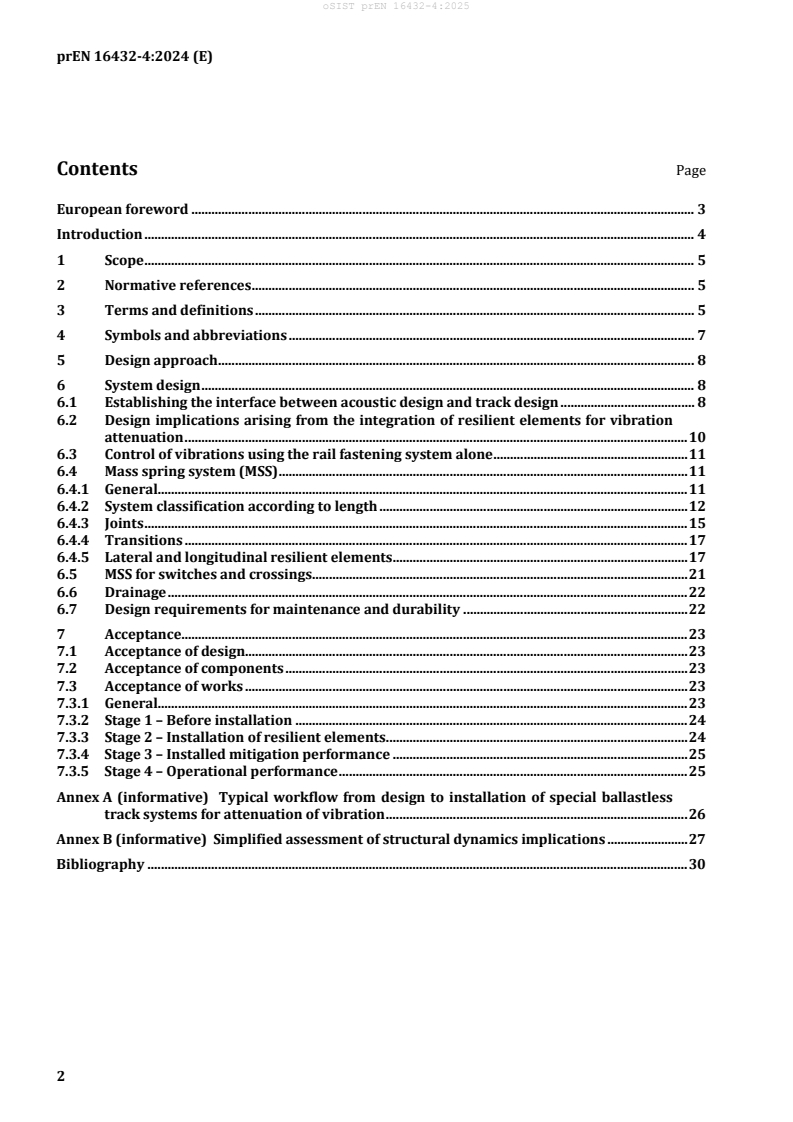
European foreword . 3
Introduction . 4
1 Scope . 5
2 Normative references . 5
3 Terms and definitions . 5
4 Symbols and abbreviations . 7
5 Design approach . 8
6 System design . 8
6.1 Establishing the interface between acoustic design and track design . 8
6.2 Design implications arising from the integration of resilient elements for vibration
attenuation . 10
6.3 Control of vibrations using the rail fastening system alone . 11
6.4 Mass spring system (MSS) . 11
6.4.1 General. 11
6.4.2 System classification according to length . 12
6.4.3 Joints . 15
6.4.4 Transitions . 17
6.4.5 Lateral and longitudinal resilient elements . 17
6.5 MSS for switches and crossings . 21
6.6 Drainage . 22
6.7 Design requirements for maintenance and durability . 22
7 Acceptance. 23
7.1 Acceptance of design. 23
7.2 Acceptance of components . 23
7.3 Acceptance of works . 23
7.3.1 General. 23
7.3.2 Stage 1 – Before installation . 24
7.3.3 Stage 2 – Installation of resilient elements . 24
7.3.4 Stage 3 – Installed mitigation performance . 25
7.3.5 Stage 4 – Operational performance . 25
Annex A (informative) Typical workflow from design to installation of special ballastless
track systems for attenuation of vibration . 26
Annex B (informative) Simplified assessment of structural dynamics implications . 27
Bibliography . 30
oSIST prEN 16432-4:2025
prEN 16432-4:2024 (E)
European foreword
This document (prEN 16432-4:2024) has been prepared by Technical Committee CEN/TC 256 “Railway
Applications”, the secretariat of which is held by DIN.
This document is currently submitted to CEN enquiry.
oSIST prEN 16432-4:2025
prEN 16432-4:2024 (E)
Introduction
Ballastless track systems may be affected by acoustic requirements for the protection of the
environment against noise and vibration.
This document covers the integration of additional acoustic requirements in the ballastless track
system design.
This part of the EN 16432 series is used in conjunction with the following parts:
— Part 1: General requirements;
— Part 2: System design, subsystems and components;
— Part 3: Acceptance.
oSIST prEN 16432-4:2025
prEN 16432-4:2024 (E)
1 Scope
This part of EN 16432 series specifies how to integrate the particular aspects of ballastless track
systems for attenuation of vibration into the system and subsystem design and component
configuration according to EN 16432-2:2017.
The general system and subsystem design requirements are assigned from EN 16432-1:2017.
Additional noise and vibration requirements can be project specific and are not provided by this
document. Acoustic requirements are considered as input for the track design from the acoustic design.
The acoustic design and the track design affect each other and may require an iterative overall design
process.
The range of applicability covers all kind of rail systems including Urban Rail systems.
2 Normative references
The following documents are referred to in the text in such a way that some or all of their content
constitutes requirements of this document. For dated references, only the edition cited applies. For
undated references, the latest edition of the referenced document (including any amendments) applies.
EN 1991 (all parts), Eurocode 1 — Actions on structures
EN 1992-1 (all parts), Eurocode 2 — Design of concrete structures — Part 1-2: Structural fire design
EN 16432-1:2017, Railway applications — Ballastless track systems — Part 1: General requirements
EN 16432-2:2017, Railway applications — Ballastless track systems — Part 2: System design, subsystems
and components
EN 16432-3:2021, Railway applications — Ballastless track systems — Part 3: Acceptance
EN 17495:2022, Railway Applications — Acoustics — Determination of the dynamic stiffness of elastic
track components related to noise and vibration: Rail pads and rail fastening assemblies
EN 17682, Railway applications — Infrastructure — Resilient element for floating slab system
3 Terms and definitions
For the purposes of this document, the following terms and definitions apply
ISO and IEC maintain terminology databases for use in standardization at the following addresses:
— ISO Online browsing platform: available at https://www.iso.org/obp/
— IEC Electropedia: available at https://www.electropedia.org/
3.1
mass spring system
ballastless track system using a designed mass in combination with its designed support stiffness
provided by resilient elements to tune it to a specific natural frequency
3.2
longitudinal resilient element
resilient element placed vertically for MSS in order to constrain the longitudinal movement of the mass
Note 1 to entry: It is installed perpendicular to the track axis.
oSIST prEN 16432-4:2025
prEN 16432-4:2024 (E)
3.3
lateral resilient element
resilient element placed vertically for MSS in order to constrain the lateral movement of the mass
Note 1 to entry: It is installed parallel to the track axis.
3.4
full surface resilient element
mat arranged between mass and its substructure to provide the required support stiffness
3.5
strip resilient element
linear support between mass and its substructure to provide the required support stiffness
3.6
discrete resilient element
point support between mass and its substructure to provide the required support stiffness
3.7
dynamic stiffness
force or stress per unit deflection measured under an uniaxial force which acts periodically at a given
frequency of (5 – 20) Hz between specific force or stress levels
Note 1 to entry: This value is determined mainly for calculation of dynamic deformation of tracks.
3.8
acoustic stiffness
dynamic stiffness of a resilient track support component that is measured under a static preload and at
small amplitudes of displacement or velocity applied in the frequency range relevant to noise or
vibration perception
3.9
insertion loss
relative reduction [dB] of vibration as a function of frequency resulting from the insertion of a
subsystem/component in the vibration transmission path
oSIST prEN 16432-4:2025
prEN 16432-4:2024 (E)
Key
X longitudinal direction
Y lateral direction
Z vertical direction
RE longitudinal resilient element
x
RE lateral resilient element
y
REz vertical resilient element
Figure 1 — Orientation of resilient elements (example: arranged as point supports)
4 Symbols and abbreviations
For the purposes of this document, the abbreviations in Table 1 apply.
Table 1 — Abbreviations
Abbreviation Abbreviated term
MSS Mass Spring System
CRCP Continuously Reinforced Concrete Pavement
MWCC Main Works Civil Contractor
GB N&V Ground Borne Noise and Vibration
S&C Switches and Crossings
FEM Finite Element Method
oSIST prEN 16432-4:2025
prEN 16432-4:2024 (E)
5 Design approach
The physical behaviour of ballastless track systems influences vibrations transmitted to the sub-
structure and noise emitted from the track. In situations where such vibrations or noise are
unacceptable due to local or regional requirements, the ballastless track system might be designed to
control vibration transmission and, therefore, incorporate elements, layers or components which in
turn might affect the structural and functional performance of the ballastless track system.
The general system and subsystem design requirements for ballastless tracks are set out in EN 16432-1.
The static and dynamic performance of the entire ballastless track system, including the interaction of
different subsystems and subsystem configurations (e.g. use of resilient fastening system or resilient
mats supporting a ballastless track), shall be considered in the design requirements.
Though the additional noise and vibration requirements are project-specific and not provided by this
document, the eventual influence of the components for vibration or noise mitigation shall be
accounted for in the design verifications (for example, they can govern the track stiffness or affect the
degree of interlayer interaction). In this regard, ballastless track systems configurations for noise and
vibration mitigation commonly consist of prefabricated elements and/or a pavement structurally
independent from the substructure, incorporating resilient elements which lead to subsystem
configurations eventually distinct from those considered in EN 16432-2:2017, 5.2. The consequence is
that design-relevant parameters (stresses, displacements, stiffness, etc.) resulting from the pavement
design approach of EN 16432-2 can be significantly affected due to the higher bending flexibility of the
system. In case that such design parameters do not fulfill the limits of EN 16432-2, a pavement-based
design might not be sufficient and structural design methods can be thus required. Furthermore,
specific dynamic analysis might be required in addition to the design methods specified in EN 16432-2
when e.g. simplified dynamic amplification factors are not sufficient.
For track systems where acoustic, noise and vibration requirements apply, the relevant criteria for
performance shall have been established. These criteria shall detail how this performance can be
demonstrated in design and following construction, for acceptance. The criteria may include one or
more of the following for ground borne noise and vibration requirements:
— the insertion loss for the track system with respect to a reference track form;
— the natural frequency of the track system;
— maximum or weighted level of accelerations at the track or at specific locations next to the track.
For airborne noise requirements influenced by the track system the criteria may include:
— track Decay Rate (see EN 15461);
— track Roughness (see EN 15610), for the relevant wavelength range.
6 System design
6.1 Establishing the interface between acoustic design and track design
Special ballastless track systems for attenuation of vibration (not noise) are custom-fitted solutions
requiring a specific design. The two decisive elements for characterizing the mitigation behaviour of the
system, are the system’s natural frequency and the insertion loss. The determination of the resilient
element depends on both the natural frequency and the insertion loss.
oSIST prEN 16432-4:2025
prEN 16432-4:2024 (E)
The design of mitigation systems includes works for the acoustic designer and the track designer, which
are usually split in between different contractors. The interface between the different designers
requires an information exchange, including detailed descriptions of the exchanged information, see
Annex A.
The natural frequency and the insertion loss are usually determined by the acoustic designer in the
ground-borne noise and vibration prediction assessment. However, both the natural frequency and the
insertion loss are often determined based on simple assessments in early project stages.
When progressing the design of the mitigation system, more detailed modelling of the mitigation
system is required, including the assessment for different loading conditions, the nonlinear behaviour
of resilient elements, and the stiffness characteristics and finally assessments of the system under
service condition.
The main aim of the acoustic designer is to provide a mitigation concept fulfilling the applicable limit
values at the sensitive receptor, including:
— determination of locations requiring resilient trackforms as a mitigation system;
— determination of the stiffness of the fastening system;
— determination of mitigation system’s natural frequency and required mass of the system;
— determination of the required insertion loss;
— preliminary schematic cross-section.
The main aim of the track designer is to provide a design of the resilient trackform able to fulfil the
required vibration mitigation behaviour including:
— achievement of the required natural frequency (of the loaded / unloaded system);
— achievement of the required insertion loss (of the loaded / unloaded system);
— fulfilling the requirements set in EN 16432-1 and EN 16432-2.
The determination and assurance of the system’s natural frequency and insertion loss is usually an
iterative process for which both the acoustic designer and the track designer are responsible. It is
therefore essential to specify the following assumptions on which the assessment has been based in the
information exchange between the acoustic and track designers:
— applied load assumptions, which may be:
o self-weight only;
o self-weight including parts of the vehicle’s load (undamped wheel-set masses of the train/s);
o entire vehicles’ axle load configuration (e.g. operating vehicle, design vehicle) and operating
conditions (e.g. speed).
— assumptions for determination of natural frequency or insertion loss, which may:
o include the vehicle’s load;
o include only parts of the vehicle’s load (e.g. undamped wheel-set mass);
o exclude the vehicle’s load (or parts of it).
oSIST prEN 16432-4:2025
prEN 16432-4:2024 (E)
— assumptions for the resilient elements, which may consider:
o static or dynamic stiffness;
o linear or nonlinear behaviour of the resilient element.
The final selection of the resilient element is usually within the responsibility of the track designer,
while the assurance of the system’s natural frequency and insertion loss are within the responsibility of
both track and acoustic designers. The track design may optimize the cross-section, select a resilient
element, and adapt masses during the concept design phase to fine-tune the resilient trackform. Any of
these modifications and adaptions to the system have an impact on the natural frequency or the
insertion loss, and therefore shall be confirmed by the acoustic designer.
6.2 Design implications arising from the integration of resilient elements for vibration
attenuation
The overall system design including the integration of resilient elements shall be in accordance with
EN 16432-2:2017, 6.1. The traffic load models required to check the structural performance may be
different from the loads required to check the acoustic functionality. In particular, the acoustic proof of
ballastless track systems incorporating resilient elements for vibration attenuation requires the
application of realistic operational loads.
In the design, special attention should be paid at the eventual change of the subsystems interaction
caused by the introduction of intermediate resilient elements: ballastless track systems designed as
monolithic multi-layered structures in terms of EN 16432-2:2017, 10.1 will behave as independent
layers after the integration of intermediate elements. In the terminology of EN 16432-2:2017, Annex B,
design Variants III may behave as Variants II, which may require a consistent adaptation of the design
analysis.
The integration of the resilient element in the system design calculation should use relevant stiffness
properties such as obtained by tests in accordance with EN 17495 and EN 17682.
The system design methods in EN 16432-2 or acoustic models needed may require input parameters
from the vibration and noise mitigation components, which can include at least:
— static vertical stiffness. The static vertical stiffness determines the vertical displacements of the
track under quasi-static loads and is a result of the contribution of the vertical stiffness of all
components and subsystems. In addition, the vertical stiffness of each component governs the
bending performance and load distribution within the ballastless track system. Therefore, the static
vertical stiffness or bedding modulus of all the components of the system shall be integrated in the
design verifications of EN 16432-2. Appropriate testing methods are necessary for each component
or sub-system (refer to particular solutions in the subclauses of this document).
— dynamic vertical stiffness. The dynamic vertical stiffness determines the vertical displacements of
the track under dynamically varying loads (e.g. train loads). It is also a result of the contribution of
the different components and subsystems of the track. The dynamic vertical stiffness or bedding
modulus of all the components shall be integrated in the design methods of EN 16432-2 when
determining the effects of train loads. Appropriate testing methods are necessary to determine the
dynamic stiffness of each component in the relevant frequency range (refer to particular solutions
in the subclauses of this document).
oSIST prEN 16432-4:2025
prEN 16432-4:2024 (E)
A track design solution to achieve the required acoustic performance (e.g. introduction of resilient
elements or definition of the required mass) usually makes use of the conceptual criterion that the
lower the natural frequency of the ballastless track system is, the better the performance of the
vibration mitigation, which implies a reduction of the system’s natural frequency. The resulting
adaptation of a reference track design not fulfilling acoustic requirements to an acoustically-acceptable
ballastless track system design can, therefore, lead to a dynamic amplification of the system’s response
at excitation frequencies around the system’s natural frequency, see Annex B. In case that specific
dynamic analysis is required for appropriate design verification, the following input parameters are to
be taken into account:
— mass (in case of discrete elements) or density (in case of distributed elements) of the system or
subsystem components;
— damping coefficients of the system or subsystem components. An alternative way to determine
experimentally the damping coefficient of resilient materials is the loss factor, which can be
measured by the energy dissipated by damping against harmonic vibrations (e.g. EN 17682,
EN 13146-9).
— operational train loads and axle configurations including running speeds.
— track Roughness (see EN 15610), for the relevant wavelength range;
— natural frequency.
Where applicable, existing subsystem or component requirements from other documents are to be
referenced.
Noise absorbers, rail dampers etc. can be handled as equipment in the ballastless track system design
(see EN 16432-2), while the acoustic design may require their full integration into the design process.
6.3 Control of vibrations using the rail fastening system alone
Vibration requirements can sometimes be met by applying rail fastening systems with a reduced
vertical stiffness. Since the rail bending stress due to vertical loading will increase as the support
stiffness is decreased, a proof of rail stresses shall be made following EN 16432-2:2017, Annex A.2, as
part of the structural track design.
The performance of rail fastening systems with respect to vibration shall be tested according to the
relevant cases of EN 17495:2022, Table 2 (“Rolling noise” and “Ground vibration/ground borne noise”).
For the calculation, estimation, or prediction of the effects on noise and vibrations, the acoustic stiffness
of the rail fastening system or the resilient pad, shall be determined in accordance with EN 17495.
Additionally, a Track Decay Rate test in accordance with EN 15461 may be required for the
consideration of airborne noise requirements.
NOTE 1 The requirements for fastening systems for ballastless track, including discrete supports and
embedded rail systems are covered by EN 13481-5.
NOTE 2 The airborne noise emissions can increase as a consequence of using a lower stiffness.
6.4 Mass spring system (MSS)
6.4.1 General
The MSS is defined by the acoustic designer in terms of mass per unit length and of the dynamic
supporting stiffness per unit length (see Annex B). The dynamic stiffness of the resilient element is
determined by EN 17682.
oSIST prEN 16432-4:2025
prEN 16432-4:2024 (E)
The mass of a MSS is provided by all the permanent weight acting on its support. It is covering all the
project specific ballastless track subsystems (see EN 16432-2:2017, Figure 1) and all the track
equipment, e.g. noise absorbers.
The project specific combination of mass and the dynamic supporting stiffness shall be selected in such
a way that the safe functionality of the track is demonstrated during the entire design life of the MSS
(see EN 16432-2).
To achieve the required mass, the density, and/or the thickness and the width of the track system can
be increased forming a pavement or structure (beam, slab) to distribute the loads (permanent and
traffic loads) via the designed support stiffness to the supporting system, e.g. tunnel.
Typically, the MSS requires more space between rail and tunnel compared to a ballastless track system
designed according to EN 16432-2. It is recommended to synchronize the tunnel design with the track
design.
The load distributing subsystem (e.g. the slab) can be designed using the pavement design approach
based on EN 16432-2. If the bending capacity of the slab based on EN 16432-2 cannot demonstrate the
required safety level, then a structural design approach based on the EN 1991 series and the EN 1992-1
series is required.
NOTE The pavement design approach is typically limited to CRCP with continuous support (see
EN 16432-2:2017, 10.2). As bending stresses obtained in the slab of MSS are typically higher than those of
conventional ballastless track systems, the concrete tensile strength might not be sufficient to resist the applied
loads. In such cases, two-layered reinforced concrete slabs alternative to CRCP with a single centred
reinforcement layer are to be designed following structural design methods.
Typically, the required additional mass designed as a load distributing structure and the ballastless
track system are forming a monolithic track system.
The track may be designed with track cant that is different to the lateral inclination of the mass
supporting resilient elements. In this case the lateral load acting on the resilient element is the
centrifugal force dependent on train speed, radius and the lateral inclination of the mass supporting
resilient elements.
6.4.2 System classification according to length
6.4.2.1 General
MSS can be classified according to the length of the load distributing subsystem as listed in Table 2.
oSIST prEN 16432-4:2025
prEN 16432-4:2024 (E)
Table 2 — General concept of mini, short and long slab
Longitudinal section Cross-section
For rail and mass supporting stiffness, see
Annex B
Demonstration of load transfer at slab joint
required.
For rail and mass supporting stiffness, see
Annex B
For rail and mass supporting stiffness. see
Annex B
6.4.2.2 Mini slab
Mini slabs are slabs supporting one rail seat per rail and distributing the load to the supporting
structure mainly by vertical displacement without significant bending of the slab.
If mini slabs are supported by discrete resilient elements the arrangement of the resilient elements
shall be done in a way that stable support of the slab (e.g. 3-point support) and identical support
stiffness to both rails is achieved.
Because of the lack of longitudinal bending stiffness provided by the mass structure, the rail bending is
typically much higher than the rail bending of a normal ballastless track system. A proof of the rail
bending moment / the rail flexural stress is required following the calculation procedure of
EN 16432-2:2017, Annex A.2. The total spring coefficient of the rail support is provided at least by the
fastening system and the support of the slab.
NOTE Rail deflection along a mini slab system is typically significantly higher compared to the rail deflection
along a normal ballastless track system.
Long slab Short slab Mini slab
oSIST prEN 16432-4:2025
prEN 16432-4:2024 (E)
A check of the geometric situation of loaded and unloaded rail at rail fracture is recommended to
evaluate the risk of derailment in the event of rail fracture.
The mass structure, the mini slab, is also not contributing to the lateral track bending stiffness. A proof
of the following criteria shall be considered:
— lateral track stiffness (see EN 16432-2);
— lateral track movement activated by all lateral forces;
— lateral elastic shear deformation of the resilient element (see EN 17682);
— risk of lateral displacements between mass, resilient element and support in case the lateral fixation
is based on friction.
Lateral resilient elements are recommended to control the lateral movement of the track along a curve
but also along straight section.
Train braking and acceleration requires proof of:
— longitudinal track movement activated by train guidance forces;
— longitudinal elastic shear deformation of the resilient element (see EN 17682);
— risk of longitudinal displacements between mass, resilient element and support in case the fixation
is based on friction.
In case a track section is receiving a combination of lateral and longitudinal forces then the resulting
shear stress τ can be calculated using:
res
2 2
ττ +τ
res lateral longitudinal
As mini slabs are more prone to excitation frequencies stemming from axle configurations and train
speeds, special attention shall be paid to avoiding resonance cases, see 7.1.
6.4.2.3 Short slab
Short slabs are slabs supporting more than one rail seat per rail and distributing the load to the
supporting structure mainly by vertical displacements. A single axle load applied to slab centre will
cause a vertical slab displacement at the joint.
With the help of modelling and simulation tools (e.g. FEM) the situation of a moving load shall be
demonstrated to identify additional vertical slab motion (typically slab rocking) and slab loading at
critical locations (typically at the joints). Loading of the rail and the fasteners next to the joints shall be
demonstrated to decide on the need for and, if required, the design of, shear connectors at the joints.
6.4.2.4 Long slab
6.4.2.4.1 General
A long slab is defined when its configuration is based on a continuous load-distributing subsystem
(slab) in which its longitudinal bending stiffness is activated upon application of vertical loads.
It distributes a single axle load applied to slab centre by longitudinal bending without any vertical
displacements observed at the slab end.
Long slabs acting as a mass can be built on site using the tunnel as a formwork and being lifted or built
using prefabricated elements connected to each other.
=
oSIST prEN 16432-4:2025
prEN 16432-4:2024 (E)
With respect to the functionality of the track, the slab bending shall be limited as well as the angle of
rotation at the joints or the end of the slab. Unless otherwise specified the limits set in
EN 16432-1:2017, 5.2.3 bridges shall be applied.
Typically, stricter limits are applied to limit the slab bending to x/L ≤ 1/2000 and the angle of rotation
at the end of the slab / at joints shall be limited to 0,3 % (1/3333).
NOTE L is the length of the slab between the “zero”-deflection points and x is the deflection in between.
Horizontal displacements of the slab under constant loading (e.g. temperature, shrinkage) and under
traffic loading shall be limited according to the performance characteristics of the resilient element.
By calculation, it shall be demonstrated that the resilient elements can handle all longitudinal and
lateral load introduced by the traffic and distributed by the track and the slab forming the mass.
The joints at the end of the slabs and intermediate joints shall be designed according to 6.4.3.
6.4.2.4.2 Long slabs cast on site
Long slab systems cast on site may be designed with a full surface resilient element, with strip resilient
elements or with discrete resilient elements supporting the slab.
In the latter case, if the tunnel floor is used to temporarily act as a formwork for the mass-slab following
requirements shall be applied:
— provisions to lift the slab (e.g. using hydraulic jacks) and to introduce the resilient elements to
support the slabs (e.g. openings) shall be integrated into the slab design. The same provisions may
be used to renew the slab support if needed;
— the openings shall avoid ingress of pollution that may block the dynamic displacement behaviour of
the slab (e.g. using covers to protect from pollution);
— to achieve a uniform loading on the support element a specified vertical level and roughness of the
supporting structure may be required.
6.4.2.4.3 Long slabs using monolithically connected precast elements
The joints between the precast elements forming the long slab are construction joints providing the
continuity of slab bending.
NOTE Joints with different functionality can be placed at the ends of the slab or elsewhere in accordance with
the system design principles.
The base for the resilient element shall be capable of compensating vertical tolerances between tunnel
and prefabricated element and to provide the final level of the track.
6.4.3 Joints
6.4.3.1 Transverse slab joints in the track
Transverse joints may be required to enable longitudinal track movements due to temperature and
concrete shrinkage effects. Without additional measures providing vertical load transfer at the joint,
higher vertical deflection could be either a structural issue for the rails as well as an issue for the
vibration mitigation effect happening when trains passing those joints. The track designer shall check
load transfer means at transverse track joints to cater for vertical and lateral force transfer.
oSIST prEN 16432-4:2025
prEN 16432-4:2024 (E)
The choice of such kind of dowels is a matter of the track design, loading assumptions and economic
options catering for dynamic and fatigue effects acting in railway tracks beside of homologation of the
product. The choice of dowels shall be made based on requirements of deflection, vibration and
durability beside of costs. Different materials are available. In addition, some shear dowels solutions
employing some rebar hooks or steel cages to improve the force-transfer and durable embedding into
the concrete slab end (see Figure 2).
The type and required number of shear dowels, if any, depends on the loads, the track design and the
choice of dowel type, if any, chosen. The designer may choose load transfer means at joints with valid
homologation for dynamic loads or shall verify the intended solution for force transfer at track joints.
The designer shall demonstrate the durability and maintenance of the longitudinal joint.
Additional provisions may be required with respect to electric interfaces (see EN 16432-1:2017, 6.9 and
EN 16432-2:2017, 6.1).
A typical dowel type is displayed in Figure 2.
Key
1 sleeve
2 steel cage
3 shear dowel
Figure 2 — Shear dowel with steel cage and sliding sleeve
Introduction of joints may be in contradiction to the requirement to provide electric continuity of the
track system.
6.4.3.2 Longitudinal joints along the tracks
The slab of the MSS shall be separated from adjacent structures (e.g. walkways, tracks) by using
longitudinal joints. Longitudinal joints shall enable an independent deflection under live loads
minimizing hindrances acting as vibration mitigation means not impairing its natural frequency
designed. Longitudinal joints in that sense can be:
— joints equipped with a separation layer (elastomer mat/resilient element, mineral fibre mat,
vertical drain mat). The acoustic designer shall check the effect on the acoustic performance of MSS
activated by the materials introduced in the joint;
— joints equipped with a joint sealant;
— just an empty space.
The designer shall demonstrate the durability and maintenance of the longitudinal joint.
oSIST prEN 16432-4:2025
prEN 16432-4:2024 (E)
6.4.4 Transitions
Transition from track forms designed as MSS with different tuning frequencies and transition to track
forms designed according to EN 16432-2 without additional vibration mitigation requirements shall
avoid abrupt stiffness changes.
The stiffness change along the track should be done gradually in defined steps to ensure that the
transition is as smooth as possible to limit additional vertical forces. Each step requires a defined
stiffness zone length.
When determining the number of stiffness zones, the following aspects should be considered in
addition to 6.8 of EN 16432-2:
— track forms designed as MSS with low natural frequency may require more gradations than track
forms with high natural frequency;
— changes of the stiffness may lead to twist, torsion, and lateral forces that shall be considered in the
slab design. Finer intervals of the stiffness change minimize these impacts but may be difficult to
implement. It can therefore be more efficient, to include additional reinforcement instead of
increasing the number of intervals.
With respect to the expected maintenance of the ballasted track, the transition from track forms
designed as MSS to ballasted track is recommended to be designed as two transitions. Following this
recommendation, the first transition should be designed from track form designed as MSS to track
forms designed according to EN 16432-2 without additional vibration mitigation requirements. The
second transition to ballasted track should be designed according to EN 16432-2:2017, 6.8.
6.4.5 Lateral and longitudinal resilient elements
6.4.5.1 General
The achievement of the vibration mitigating effect of a MSS requires mobility of the elastically
supported mass / plate / block in longitudinal and vertical direction. This requires an allowance for
displacements of the mass plate (lateral and longitudinal movements), originating from the following
load cases:
— braking and acceleration forces;
— centrifugal forces;
— nosing force;
— forces due to thermal effects, shrinking etc;
— exceptional forces, e.g. derailment.
NOTE Vertical forces are being transferred onto the supporting structure (e.g. tunnel invert) via the
horizontal resilient element of the elastically supported mass. Vertical movements are being limited by the
vertical resilient elements, horizontal movements by the horizontal resilient elements.
oSIST prEN 16432-4:2025
prEN 16432-4:2024 (E)
Lateral and longitudinal forces shall be safely dissipated, and transferred as a general requirement.
Since the lateral and longitudinal stiffness of resilient elements is usually limited, additional
connections to the MSS may be required:
— lateral forces may be transferred into the supporting structure (e.g. walkway or tunnel invert) via
additional lateral connections. Lateral connections can be vertical discrete resilient elements or
vertical full-surface mats acting as resilient elements;
— longitudinal forces may be transferred onto the supporting structure (e.g. tunnel invert) via
additional longitudinal connections. Longitudinal connections can be vertical discrete resilient
elements or full-surface elements, acting over friction.
NOTE There are existing systems without such additional connections: In this case the horizontal resilient
elements are used for the transfer of lateral and longitudinal forces onto the tunnel floor, too.
The maximum horizontal displacement of the mass-block is a function of braking / acceleration forces,
centrifugal forces at the maximum design speed or at locations with minimum radius, forces due to
temperature and thermal effects, shrinking etc. The maximum displacement of the elastically supported
mass shall not exceed the requirements specified in the project and should not exceed 5 mm for lateral
displacement.
The requirements for resilient elements are dependent on the curve radius, design speed and design of
the track supporting slab. Further requirements may be set on locations of transition areas and
switches. The required quantity of resilient elements is dependent on the length of the mitigation
system and the distance between different resilient elements. Specific considerations may apply for
sections of MSS with short lengths of systems or systems with steel spring elements.
The calculated lateral and/or longitudinal load acting on the resilient element supporting the mass shall
be used as input to determine the shear deformation of the resilient element and the resistance against
sliding (proof of friction between resilient element and tunnel surface).
Steel springs installed as vertical resilient elements also allow load transfer in the horizontal and
longitudinal directions, b
...
Questions, Comments and Discussion
Ask us and Technical Secretary will try to provide an answer. You can facilitate discussion about the standard in here.
Loading comments...