


prEN 868-8
(Main)Packaging for terminally sterilized medical devices - Part 8: Re-usable sterilization containers for steam sterilizers conforming to EN 285 - Requirements and test methods
Packaging for terminally sterilized medical devices - Part 8: Re-usable sterilization containers for steam sterilizers conforming to EN 285 - Requirements and test methods
This document specifies test methods and values for re-usable containers used as sterile barrier systems for terminally sterilized medical devices. These containers are intended to be used in large steam sterilizers as specified in EN 285.
Other than the general requirements as specified in EN ISO 11607-1 and EN ISO 11607-2, this part of EN 868 series specifies materials, test methods and values that are specific to the products covered by this document.
This document does not cover additional materials and/or accessories inside the sterile barrier system in order to ease the organization, drying or aseptic presentation (e.g. inner wrap, indicators, packing lists, mats, instrument organizer sets, tray liners or an additional envelope around the medical device).
Verpackungen für in der Endverpackung zu sterilisierende Medizinprodukte - Teil 8: Wiederverwendbare Sterilisierbehälter für Dampf-Sterilisatoren nach EN 285 - Anforderungen und Prüfverfahren
Dieses Dokument legt Prüfverfahren und Werte für wiederverwendbare Sterilisierbehälter fest, die als Sterilbarrieresysteme für in der Endverpackung sterilisierte Medizinprodukte verwendet werden. Diese Sterilisierbehälter sind für die Verwendung in großen Dampf-Sterilisatoren nach EN 285 vorgesehen.
Über die die allgemeinen Anforderungen hinaus, welche durch EN ISO 11607 1 und EN ISO 11607 2 festgelegt sind, legt dieser Teil der Normenreihe EN 868 Materialien, Prüfverfahren und Werte fest, die spezifisch für die in diesem Dokument betrachteten Produkte sind.
Dieses Dokument deckt keine zusätzlichen Materialien und/oder Zubehörteile innerhalb des Sterilbarrieresystems ab, die der Organisation, die Trocknung oder die aseptische Präsentation erleichtern (z. B. Innenverpackung, Indikatoren, Verpackungslisten, Unterlagen, Einsätze für Instrumente, Fächer oder eine zusätzliche Umhüllung für das Medizinprodukt).
Emballages des dispositifs médicaux stérilisés au stade terminal - Partie 8 : Conteneurs réutilisables de stérilisation pour stérilisateurs à la vapeur d’eau conformes à l’EN 285 - Exigences et méthodes d’essai
Le présent document spécifie des méthodes d’essai et des valeurs relatives aux conteneurs réutilisables employés comme systèmes de barrière stérile prévus pour les dispositifs médicaux stérilisés au stade terminal. Ces conteneurs sont destinés à être utilisés dans les grands stérilisateurs à la vapeur d’eau, comme spécifié dans l’EN 285.
Outre les exigences générales telles que spécifiées dans l’EN ISO 11607-1 et l’EN ISO 11607-2, la présente partie de la série EN 868 spécifie les matériaux, les méthodes d’essai et les valeurs spécifiques aux produits traités dans le présent document.
Le présent document ne couvre pas l’utilisation d’accessoires et/ou de matériaux supplémentaires à l’intérieur du système de barrière stérile de manière à faciliter le rangement, le séchage ou la présentation aseptique (par exemple, enveloppe interne, indicateurs, listes d’emballage, tapis, dispositifs de rangement des instruments, fonds de paniers ou une enveloppe supplémentaire entourant le dispositif médical).
Embalaža za končno sterilizirane medicinske pripomočke - 8. del: Ponovno uporabljivi vsebniki za parne sterilizatorje po EN 285 - Zahteve in preskusne metode
General Information
- Status
- Not Published
- Publication Date
- 21-Nov-2027
- Technical Committee
- CEN/TC 102 - Sterilizers for medical purposes
- Drafting Committee
- CEN/TC 102/WG 4 - Packaging materials
- Current Stage
- 4060 - Closure of enquiry - Enquiry
- Start Date
- 09-Apr-2026
- Due Date
- 29-Dec-2025
- Completion Date
- 09-Apr-2026
Relations
- Effective Date
- 13-Nov-2024
Overview
prEN 868-8: Packaging for Terminally Sterilized Medical Devices – Part 8: Re-usable Sterilization Containers for Steam Sterilizers Conforming to EN 285 – Requirements and Test Methods is a draft European Standard developed by CEN. It defines specific requirements, test methods, and performance criteria for reusable sterilization containers serving as sterile barrier systems in steam sterilizers, particularly those conforming to EN 285. This standard works in conjunction with the general requirements from EN ISO 11607-1 and EN ISO 11607-2.
Sterilization containers covered under prEN 868-8 are intended for repeated use in healthcare settings, ensuring the sterility maintenance of medical devices from the point of sterilization to end use. The standard intentionally excludes detailed requirements for accessories or organizational components inside the container (such as wraps, indicators, or organizing mats).
Key Topics
- Sterile Barrier System Requirements: Outlines the necessary properties for containers to maintain sterility according to internationally recognized medical device packaging standards.
- Construction and Design: Includes specifications for shape, dimensions, lids, tamper-evident closure systems, gaskets, carrying aids, and stacking capabilities. Containers must fit within sterilization modules and allow effective steam penetration and drying.
- Material Performance: Requires the use of durable and sterilization-compatible materials (e.g., stainless steel, plastics) and enforces requirements for chemical stability, resistance to cleaning processes, and light stability (per ISO 4582).
- Testing and Validation: Mandates several test methods for mechanical strength, stacking, sterilization performance, load dryness, and microbial barrier properties. These tests must simulate real use and cleaning cycles.
- Labelling and Traceability: Specifies clear requirements for marking, sales packaging labelling, and traceability information, supporting compliance with medical device regulations.
- Environmental Considerations: Encourages consideration of environmental impact both in product design and in testing methodologies. Environmental declarations should be provided per EN ISO 14021 or EN ISO 14025.
Applications
Reusable sterilization containers designed under prEN 868-8 are primarily used in:
- Hospitals and Healthcare Facilities: For safe and efficient reprocessing, storage, and transportation of surgical instruments and other medical devices that require terminal steam sterilization.
- Central Sterile Services Departments (CSSD): Enhancing sterile supply workflows by ensuring container compatibility with large steam sterilizers and facilitating compliance with regulatory and infection control requirements.
- Medical Device Manufacturers: As a benchmark for product development, quality assurance, and regulatory submissions, ensuring finished products meet essential European safety and performance standards.
- Quality and Compliance Assurance: The standard aids healthcare providers and suppliers in demonstrating that their sterile packaging systems meet rigorous European and global requirements for sterility assurance and reusability.
Related Standards
- EN ISO 11607-1: General requirements and test methods for materials and packaging systems intended to maintain the sterility of terminally sterilized medical devices.
- EN ISO 11607-2: Validation requirements for forming, sealing, and assembly processes of packaging systems.
- EN 285: Specifies operational and performance requirements for large steam sterilizers.
- EN 868 series: Other parts address various packaging materials and systems for medical devices, such as paper, pouches, and nonwoven materials.
- EN ISO 14021 / EN ISO 14025: Environmental labelling and declaration standards, promoting transparency about recyclability and lifecycle impact.
- ISO 4582: Evaluation of material properties after exposure to environmental stresses.
By adhering to prEN 868-8, organizations ensure the reliable, repeatable, and safe use of reusable sterilization containers, supporting patient safety, regulatory compliance, and sustainability in sterile medical device packaging.

Get Certified
Connect with accredited certification bodies for this standard

BSI Group
BSI (British Standards Institution) is the business standards company that helps organizations make excellence a habit.

TÜV Rheinland
TÜV Rheinland is a leading international provider of technical services.

TÜV SÜD
TÜV SÜD is a trusted partner of choice for safety, security and sustainability solutions.
Sponsored listings
Frequently Asked Questions
prEN 868-8 is a draft published by the European Committee for Standardization (CEN). Its full title is "Packaging for terminally sterilized medical devices - Part 8: Re-usable sterilization containers for steam sterilizers conforming to EN 285 - Requirements and test methods". This standard covers: This document specifies test methods and values for re-usable containers used as sterile barrier systems for terminally sterilized medical devices. These containers are intended to be used in large steam sterilizers as specified in EN 285. Other than the general requirements as specified in EN ISO 11607-1 and EN ISO 11607-2, this part of EN 868 series specifies materials, test methods and values that are specific to the products covered by this document. This document does not cover additional materials and/or accessories inside the sterile barrier system in order to ease the organization, drying or aseptic presentation (e.g. inner wrap, indicators, packing lists, mats, instrument organizer sets, tray liners or an additional envelope around the medical device).
This document specifies test methods and values for re-usable containers used as sterile barrier systems for terminally sterilized medical devices. These containers are intended to be used in large steam sterilizers as specified in EN 285. Other than the general requirements as specified in EN ISO 11607-1 and EN ISO 11607-2, this part of EN 868 series specifies materials, test methods and values that are specific to the products covered by this document. This document does not cover additional materials and/or accessories inside the sterile barrier system in order to ease the organization, drying or aseptic presentation (e.g. inner wrap, indicators, packing lists, mats, instrument organizer sets, tray liners or an additional envelope around the medical device).
prEN 868-8 is classified under the following ICS (International Classification for Standards) categories: 11.080.30 - Sterilized packaging. The ICS classification helps identify the subject area and facilitates finding related standards.
prEN 868-8 has the following relationships with other standards: It is inter standard links to EN 868-8:2018. Understanding these relationships helps ensure you are using the most current and applicable version of the standard.
prEN 868-8 is available in PDF format for immediate download after purchase. The document can be added to your cart and obtained through the secure checkout process. Digital delivery ensures instant access to the complete standard document.
Standards Content (Sample)
SLOVENSKI STANDARD
01-marec-2026
Embalaža za končno sterilizirane medicinske pripomočke - 8. del: Ponovno
uporabljivi vsebniki za parne sterilizatorje po EN 285 - Zahteve in preskusne
metode
Packaging for terminally sterilized medical devices - Part 8: Re-usable sterilization
containers for steam sterilizers conforming to EN 285 - Requirements and test methods
Verpackungen für in der Endverpackung zu sterilisierende Medizinprodukte - Teil 8:
Wiederverwendbare Sterilisierbehälter für Dampf-Sterilisatoren nach EN 285 -
Anforderungen und Prüfverfahren
Emballages des dispositifs médicaux stérilisés au stade terminal - Partie 8 : Conteneurs
réutilisables de stérilisation pour stérilisateurs à la vapeur d’eau conformes à l’EN 285 -
Exigences et méthodes d’essai
Ta slovenski standard je istoveten z: prEN 868-8
ICS:
11.080.30 Sterilizirana embalaža Sterilized packaging
2003-01.Slovenski inštitut za standardizacijo. Razmnoževanje celote ali delov tega standarda ni dovoljeno.
DRAFT
EUROPEAN STANDARD
NORME EUROPÉENNE
EUROPÄISCHE NORM
January 2026
ICS 11.080.30 Will supersede EN 868-8:2018
English Version
Packaging for terminally sterilized medical devices - Part
8: Re-usable sterilization containers for steam sterilizers
conforming to EN 285 - Requirements and test methods
Emballages des dispositifs médicaux stérilisés au stade Verpackungen für in der Endverpackung zu
terminal - Partie 8 : Conteneurs réutilisables de sterilisierende Medizinprodukte - Teil 8:
stérilisation pour stérilisateurs à la vapeur d'eau Wiederverwendbare Sterilisierbehälter für Dampf-
conformes à l'EN 285 - Exigences et méthodes d'essai Sterilisatoren nach EN 285 - Anforderungen und
Prüfverfahren
This draft European Standard is submitted to CEN members for enquiry. It has been drawn up by the Technical Committee
CEN/TC 102.
If this draft becomes a European Standard, CEN members are bound to comply with the CEN/CENELEC Internal Regulations
which stipulate the conditions for giving this European Standard the status of a national standard without any alteration.
This draft European Standard was established by CEN in three official versions (English, French, German). A version in any other
language made by translation under the responsibility of a CEN member into its own language and notified to the CEN-CENELEC
Management Centre has the same status as the official versions.
CEN members are the national standards bodies of Austria, Belgium, Bulgaria, Croatia, Cyprus, Czech Republic, Denmark, Estonia,
Finland, France, Germany, Greece, Hungary, Iceland, Ireland, Italy, Latvia, Lithuania, Luxembourg, Malta, Netherlands, Norway,
Poland, Portugal, Republic of North Macedonia, Romania, Serbia, Slovakia, Slovenia, Spain, Sweden, Switzerland, Türkiye and
United Kingdom.
Recipients of this draft are invited to submit, with their comments, notification of any relevant patent rights of which they are
aware and to provide supporting documentation.
Warning : This document is not a European Standard. It is distributed for review and comments. It is subject to change without
notice and shall not be referred to as a European Standard.
EUROPEAN COMMITTEE FOR STANDARDIZATION
COMITÉ EUROPÉEN DE NORMALISATION
EUROPÄISCHES KOMITEE FÜR NORMUNG
CEN-CENELEC Management Centre: Rue de la Science 23, B-1040 Brussels
© 2026 CEN All rights of exploitation in any form and by any means reserved Ref. No. prEN 868-8:2026 E
worldwide for CEN national Members.
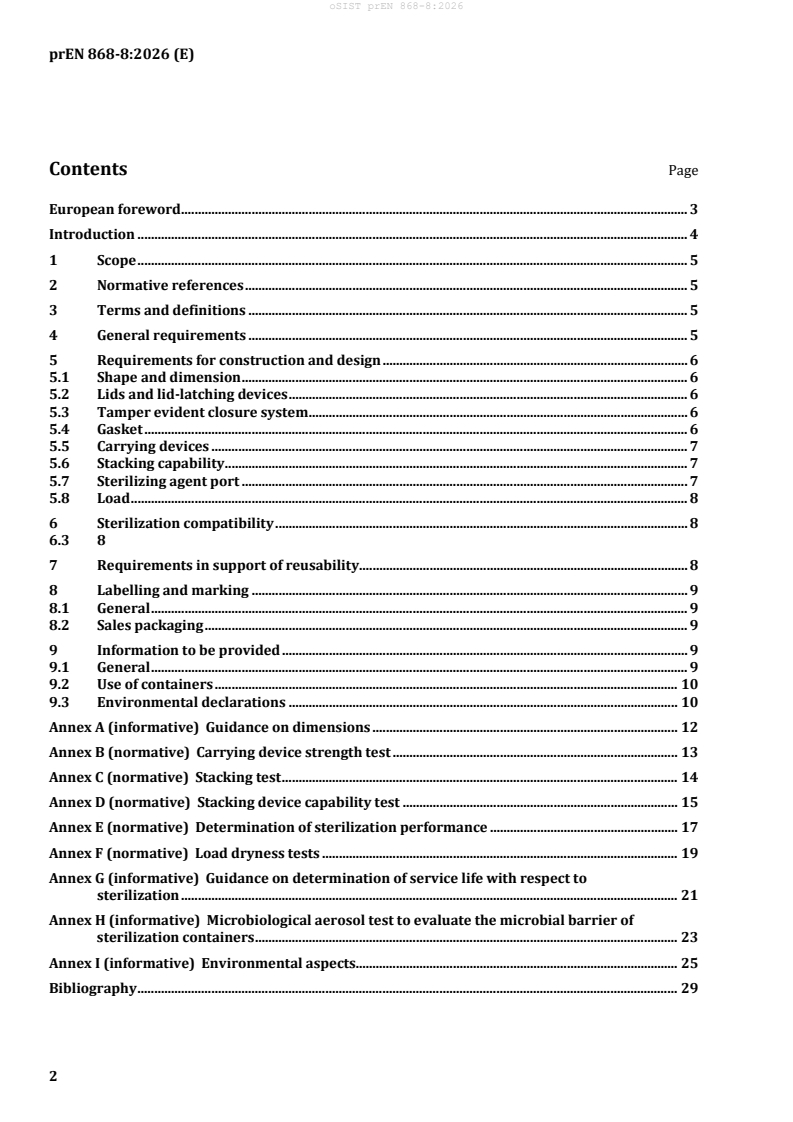
Contents Page
European foreword . 3
Introduction . 4
1 Scope . 5
2 Normative references . 5
3 Terms and definitions . 5
4 General requirements . 5
5 Requirements for construction and design . 6
5.1 Shape and dimension . 6
5.2 Lids and lid-latching devices . 6
5.3 Tamper evident closure system . 6
5.4 Gasket . 6
5.5 Carrying devices . 7
5.6 Stacking capability . 7
5.7 Sterilizing agent port . 7
5.8 Load . 8
6 Sterilization compatibility . 8
6.3 8
7 Requirements in support of reusability . 8
8 Labelling and marking . 9
8.1 General . 9
8.2 Sales packaging . 9
9 Information to be provided . 9
9.1 General . 9
9.2 Use of containers . 10
9.3 Environmental declarations . 10
Annex A (informative) Guidance on dimensions . 12
Annex B (normative) Carrying device strength test . 13
Annex C (normative) Stacking test . 14
Annex D (normative) Stacking device capability test . 15
Annex E (normative) Determination of sterilization performance . 17
Annex F (normative) Load dryness tests . 19
Annex G (informative) Guidance on determination of service life with respect to
sterilization . 21
Annex H (informative) Microbiological aerosol test to evaluate the microbial barrier of
sterilization containers . 23
Annex I (informative) Environmental aspects. 25
Bibliography . 29
European foreword
This document (prEN 868-8:2026) has been prepared by Technical Committee CEN/TC 102 “Sterilizers
and associated equipment for processing of medical devices”, the secretariat of which is held by DIN.
This document is currently submitted to the CEN Enquiry.
This document will supersede EN 868-8:2018.
a) Clause 4 “General requirements” was slightly revised for clarity and aligned with the other parts of
the EN 868 series, and a statement was added clarifying when acceptance criteria apply.
b) Clause 6 “Environmental declarations” was added and aligned with the other parts of EN 868 series.
c) The list of major changes was moved to the foreword, thus the Annex with “Details of significant
technical changes between this European Standard and the previous edition” (former Annex A) was
deleted.
d) New Clause “Environmental aspects for testing” was added to each test method in Annexes B, D, E, F
and G.
e) New Annex I regarding environmental aspects was added.
EN 868 series consists of the following parts, under the general title Packaging for terminally sterilized
medical devices:
— Part 2: Sterilization wrap — Requirements and test methods;
— Part 3: Paper for use in the manufacture of paper bags (specified in EN 868-4) and in the manufacture
of pouches and reels (specified in EN 868-5) — Requirements and test methods;
— Part 4: Paper bags — Requirements and test methods;
— Part 5: Sealable pouches and reels constructed of porous materials and plastic film — Requirements
and test methods;
— Part 6: Paper for low temperature sterilization processes — Requirements and test methods;
— Part 7: Adhesive coated paper for low temperature sterilization processes — Requirements and test
methods;
— Part 8: Re-usable sterilization containers for large steam sterilizers — Requirements and test methods;
— Part 9: Uncoated nonwoven materials of polyolefins — Requirements and test methods;
— Part 10: Adhesive coated nonwoven materials of polyolefins — Requirements and test methods.
Introduction
The EN ISO 11607 series of standards consists of two parts under the general title “Packaging for
terminally sterilized medical devices”. EN ISO 11607-1 specifies general requirements and test methods
for materials, preformed sterile barrier systems, sterile barrier systems and packaging systems that are
intended to maintain sterility of terminally sterilized medical devices to the point of use. EN ISO 11607-2
[2] specifies validation requirements for forming, sealing and assembly processes.
General requirements for all types of sterile barrier systems are provided by EN ISO 11607-1 and
EN ISO 11607-2.
The EN 868 series of standards have been developed mainly for materials and sterile barrier systems
used in health care facilities sterilization processes. The EN 868 series of standards can be used to
demonstrate compliance with one or more of the requirements specified in EN ISO 11607-1.
Considering CEN guide 4 [6] and the CEN environmental checklists, this revision has been complemented
with a new annex with guidance to encourage users to also include environmental aspects when applying
the EN 868 series of standards with the objective to minimize the environmental impact. Environmental
aspects have also been included into the description of test methods with the same objective.
1 Scope
This document specifies test methods and values for re-usable containers used as sterile barrier systems
for terminally sterilized medical devices. These containers are intended to be used in large steam
sterilizers as specified in EN 285.
Other than the general requirements as specified in EN ISO 11607-1 and EN ISO 11607-2, this part of
EN 868 series specifies materials, test methods and values that are specific to the products covered by
this document.
This document does not cover additional materials and/or accessories inside the sterile barrier system
in order to ease the organization, drying or aseptic presentation (e.g. inner wrap, indicators, packing lists,
mats, instrument organizer sets, tray liners or an additional envelope around the medical device).
2 Normative references
The following documents are referred to in the text in such a way that some or all of their content
constitutes requirements of this document. For dated references, only the edition cited applies. For
undated references, the latest edition of the referenced document (including any amendments) applies.
EN 285:2015+A1:2021, Sterilization - Steam sterilizers - Large sterilizers
EN 10088-1, Stainless steels - Part 1: List of stainless steels
EN ISO 11607-1:2020, Packaging for terminally sterilized medical devices - Part 1: Requirements for
materials, sterile barrier systems and packaging systems (ISO 11607-1:2019)
EN ISO 14021, Environmental labels and declarations - Self-declared environmental claims (Type II
environmental labelling) (ISO 14021)
EN ISO 14025, Environmental labels and declarations - Type III environmental declarations - Principles and
procedures (ISO 14025)
ISO 4582, Plastics — Determination of changes in colour and variations in properties after exposure to
glass-filtered solar radiation, natural weathering or laboratory radiation sources
3 Terms and definitions
For the purposes of this document, the terms and definitions given in EN ISO 11607-1 and EN 285 apply.
ISO and IEC maintain terminology databases for use in standardization at the following addresses:
— IEC Electropedia: available at https://www.electropedia.org/
— ISO Online browsing platform: available at https://www.iso.org/obp
4 General requirements
For any preformed sterile barrier system or sterile barrier system, the requirements of EN ISO 11607-1
shall apply.
NOTE 1 When additional materials are used inside the sterile barrier system in order to ease the organization,
drying or aseptic presentation (e.g. inner wrap, indicators, packing lists, mats, instrument organizer sets, tray liners
This document is impacted by amendment EN ISO 11607-1:2020/A1:2023 and EN ISO 11607-1:2020/A11:2022.
or an additional envelope around the medical device) then other requirements, including the determination of the
acceptability of these materials during validation activities, can apply.
This part of EN 868 series only introduces performance requirements and test methods that are specific
to the products covered by this part of EN 868 series but does not add or modify the general requirements
specified in EN ISO 11607-1.
NOTE 2 This document introduces test methods in Annexes B, D, E, F and G.
As such, the particular requirements in 4.2, 4.3 and 4.4 can be used to demonstrate compliance with one
or more but not all of the requirements of EN ISO 11607-1.
NOTE 3 Conformity with this document does not automatically mean conformity with EN ISO 11607-1.
A confirmation of compliance to this document shall contain a statement of whether EN ISO 11607-1 is
covered.
5 Requirements for construction and design
5.1 Shape and dimension
5.1.1 The container shall be in the general form of a parallelepipedal box.
NOTE Slight curvature or camber of the flat surfaces can be acceptable. Rounding of the corners is desirable.
5.1.2 The container including all connected parts, e.g. carrying devices shall fit within one sterilization
module (see EN 285).
NOTE 1 If the container does not fit within one sterilization module but complies with all other requirements of
this part of the standard, the manufacturer can claim compliance with EN ISO 11607-1, but not with EN 868-8.
NOTE 2 For guidance on dimensions, see informative Annex A.
5.1.3 For ease of cleaning all internal corners shall be radiused.
5.2 Lids and lid-latching devices
5.2.1 Access to the interior of the container shall be provided by a lid.
5.2.2 The lid shall be secured to the base during use by locking devices. The closure shall comply with
the requirements in EN ISO 11607-1:2020, 5.1.10 c).
5.3 Tamper evident closure system
5.3.1 A tamper evident closure system complying with EN ISO 11607-1:2020, 5.1.10 a) shall be
available.
5.3.2 If the 'tamper evident' closure system is not a single-use disposable item, i.e. does not irrevocably
break when opened, then a special tool, key, code or treatment shall be required to re-set the closure
system.
5.4 Gasket
5.4.1 The interface between the lid and base shall be provided with a closure gasket. The closure
formed by the gasket with the lid latched in position shall provide microbial barrier properties as
specified in EN ISO 11607-1:2020, 5.2 and 5.1.10 c).
5.4.2 The gasket shall be accessible for cleaning. Frequency and method of maintenance shall be
specified by the manufacturer (see Clause 5).
5.5 Carrying devices
5.5.1 Each container shall be provided with a suitable carrying device.
NOTE Containers that are small enough to be grabbed, held and carried safely can be without a carrying device.
5.5.2 The carrying devices, the means of their attachment to the container, and the container itself shall
be sufficiently robust to support the weight of the filled container without permanent
deformation > 1 mm when tested in accordance with Annex B. If a permanent deformation is measured,
performance characteristics of the container (in particular microbial barrier properties) shall be
demonstrated to remain unchanged.
5.6 Stacking capability
5.6.1 The top and base of each container shall be sufficiently strong to allow stacking and shall be fitted
with means to ensure that all containers of the same nominal size and of the same provenance shall stack
securely.
After the test in accordance with Annex C, the container shall show no permanent deformation > 1 mm
and shall have unchanged performance characteristics.
When tested in accordance with Annex D, the tested container shall remain stacked.
5.6.2 The containers shall be designed and constructed so that when stacked and loaded into the
sterilizer in the manner specified by the manufacturer they will allow free passage of steam and/or air
between containers.
Compliance shall be tested by the performance tests carried out as described in Annexes B to E.
5.7 Sterilizing agent port
5.7.1 Each container shall be provided with a sterilizing agent port in one or more of its principle
surfaces.
5.7.2 The sterilizing agent port shall be designed to meet the following requirements:
a) It shall permit the attainment of the specified sterilization conditions. Compliance shall be tested in
accordance with Annex E.
b) It shall permit adequate drying when processed in a sterilizer conforming to EN 285. Compliance
shall be tested in accordance with Annex F.
c) It shall permit microbial barrier properties during removal, transport and subsequent storage as
specified in EN ISO 11607-1:2020, 5.1.10 b). Compliance shall be tested in accordance with
applicable barrier tests (see EN ISO 11607-1:2020).
NOTE 1 Annex H includes a microbiological aerosol test to evaluate the microbial barrier of the sterilization
container design to support submissions to market access authorities.
NOTE 2 A condensate drain is considered to be a sterilizing agent port.
If filters are used as sterilizing agent port and are made of paper or non-woven materials, material should
comply as a minimum with the respective parts of EN 868 series, such as EN 868-2 and EN 868-3.
5.8 Load
A full-size container, i.e. of one sterilization module size, shall be designed and constructed to allow a
total internal load of up to 10 kg to be sterilized in a sterilizer conforming to EN 285.
Fractional sizes shall accommodate proportionally smaller loads.
NOTE National or regional legislation on occupational health and work safety can require a limitation or
restriction of the acceptable weight to carrying device.
6 Sterilization compatibility
6.1 The steam sterilization processes applicable to the sterilization containers under the scope of this
document shall be defined.
6.2 The steam sterilization compatibility of the sterilization containers shall be evaluated following the
requirements of EN ISO 11607-1. The effects shall be evaluated considering the intended sterilization
process(es) and intended number of cycles.
NOTE 1 Sterilization processes generally have an effect on material properties, therefore evaluation of
sterilization compatibility involves a risk-based assessment considering the characteristics of the material and its
application to define the properties to be evaluated, which typically include material strength properties and the
shape of the sterilization containers relevant for maintenance of sterility after sterilization.
NOTE 2 With regard to the verification of the material requirements no test is needed if historical evidence can
be documented or if there are bibliographic references for materials which have been previously used satisfactorily.
6.3 The container and its components shall be able to withstand (both chemical and physical) steam
sterilization in a sterilizer conforming to EN 285 without any adverse effects on the container or its
components.
Compliance with EN ISO 11607-1:2020, 5.3 shall be tested:
a) in a container which has been subjected to the stated number of reprocessing cycles; and
b) on a container which has been subjected to 5 use-cycles, stored under ambient conditions with the
lid closed for 6 months and then subjected to 5 further use-cycles.
7 Requirements in support of reusability
7.1 The container and its reusable components shall be able to withstand specified cleaning procedures
as indicated by the manufacturer without adverse effect to the container or its components.
Compliance with EN ISO 11607-1:2020, 5.1.10 and 5.1.12 shall be determined:
a) on a container which has been subjected to the stated number of cleaning procedures as indicated
by the manufacturer; and
b) on a container which has been subjected to 5 use-cycles, stored under ambient conditions with the
lid closed for 6 months and then subjected to 5 further use-cycles.
7.2 The container and its reusable components shall be made of materials which are light-stable under
the conditions of use. If plastic materials are used for containers, properties shall be evaluated after
exposure to environmental stresses according to ISO 4582.
7.3 If the container and/or its components are made from different materials, there shall be no negative
interaction (e.g. contact-corrosion) between the materials.
Compliance shall be deemed to be met if the performance test according to 4.4.1 and 4.4.2 has been
carried out successfully.
7.4 The material, design, construction and surface finish shall facilitate easy internal and external
cleaning and disinfection.
7.5 The sterilization container and its components shall, when processed in accordance with the
provided instructions for use, meet all requirements during its service life as it is stated by the
manufacturer.
NOTE 1 The manufacturer's instructions include also important information on service, cleaning procedures, the
manner of inspection and acceptance criteria, maintenance and replacement of components (see e.g. EN ISO 11607-
1:2017 and EN ISO 17664–1 [3]).
NOTE 2 500 cycles are considered a minimum as a service life for containers and 100 cycles as a minimum for
specific components like gaskets.
7.6 For demonstration of compliance, using accelerated aging protocols shall be regarded as sufficient
challenge until data from real-time aging studies are available.
NOTE For guidance on determination of service life with respect to sterilization, see Annex G. The stated
number of reprocessing cycles are not covered by Annex G.
8 Labelling and marking
8.1 General
8.1.1 The sales and inner packaging shall be labelled with the information necessary for its
identification to support traceability.
8.1.2 Where available, validated symbols in accordance with EN ISO 15223-1 [7] should be used.
NOTE Regulatory requirements, such as for example Regulation (EU) 2017/745 [5], apply to labelling and marking
and generally include aspects like name of the manufacturer, trade name, UDI etc.
8.2 Sales packaging
8.2.1 The sales packaging shall be legibly and durably labelled.
8.2.2 The label shall include at least the following information:
a) reference, stock, or catalogue number;
b) name or trade name and address of the manufacturer;
c) date of manufacture in accordance with ISO 8601-1;
d) lot or serial number as applicable.
9 Information to be provided
9.1 General
The following information should be supplied in addition to EN ISO 11607-1:2020, Clause 7:
a) the manufacturer's or supplier's or authorized representative's name or trade name, and address;
b) specification of the essential parts;
c) manner of inspection and maintenance and/or replacement;
d) service life of the container (reprocessing cycles);
e) service life of gasket;
f) service and cleaning procedures;
NOTE 1 Reprocessing instructions are contained in EN ISO 17664-1 [3].
g) maximum load of the container to be used for the determination of the sterilization performance and
load dryness tests
h) risk control measures to prevent deformations and enable sterilization performance such as
maximum loading height requirements or limitations related to stacking that need to be observed
NOTE 2 Depending on the design, such risk control measure can be necessary to prevent damages to the
systems.
i) measures and recommendations to enhance drying properties within the end user’s process.
NOTE 3 For requirements on information to be provided by the manufacturer national or regional legislation
can apply, see Regulation 2017/745, Annex I, Chapter III [5].
9.2 Use of containers
The following information should be supplied in addition to EN ISO 11607-1:2020, Clause 11:
a) recommendations for particular applications of containers (e.g. organizers, transport packaging,
packaging system);
b) the nature and extent of any identified risks associated with the use of the containers;
c) any information pertinent to the packaged medical device as may be required (see EN ISO 20417
[1]).
NOTE For requirements on information to be provided by the manufacturer, national or regional legislation
can apply, see in particular Regulation (EU) 2017/745, Annex I, Chapter 3, Section 23 [5].
9.3 Environmental declarations
9.3.1 Environmental labels and declarations, as applicable, shall be made in accordance with
EN ISO 14021 or EN ISO 14025.
NOTE Guidance on environmental aspects is provided in Annex I.
9.3.2 End-of-life treatment recommendations should be provided.
9.3.3 If an assessment of recyclability is performed, the following information shall be provided:
— information about the assessment methodology
— product reference under assessment
— standards and regulations used
— overall results and any additional information to be provided as required by the assessment
methodology.
Annex A
(informative)
Guidance on dimensions
Historical evidence demonstrates the dimensions shown in Figure A.1 allow adequate space for loading
and unloading of the sterilizer.
Containers with fractional sizes (e.g. 1/2 sterilization module, 1/4 sterilization module, etc.) should have
the same width as given in Figure A.1.
Dimensions in millimetres
Key
1 Loadable space
a Maximum outer height h = 270 mm.
max
Heights < 270 mm are recommended to be 210 mm, 160 mm, 140 mm and 110 mm.
The internal loadable height h should be minimum:
h – 50 mm in case of sterilizing agent ports in lid and bottom;
max
h – 30 mm in case of sterilizing agent ports in lid or bottom or neither lid nor bottom.
max
b These dimensions are given by the definition of a sterilization module.
Figure A.1 — Reusable sterile container dimensions
Annex B
(normative)
Carrying device strength test
B.1 Procedure
Distribute the weight of the test load equally inside the container, close the l
...
Questions, Comments and Discussion
Ask us and Technical Secretary will try to provide an answer. You can facilitate discussion about the standard in here.
Loading comments...