

EN 3537:2010
(Main)Aerospace series - Nuts, anchor, self-locking, fixed, two lug, with counterbore, in heat resisting steel, MoS2 lubricated - Classification: 1 100 MPa (at ambient temperature)/315 °C
- Abstract
This European Standard specifies the characteristics of two lug, counterbored fixed anchor nuts, with a self-locking feature achieved by forming the upper portion out-of-round, in heat resisting steel, MoS2 lubricated.
Classification: 1 100 MPa / 315 °C
- Status
- Published
- Publication Date
- 23-Feb-2010
- Withdrawal Date
- 30-Aug-2010
- Technical Committee
- ASD-STAN - Aerospace
- Drafting Committee
- ASD-STAN/D 3 - Mechanical
- Current Stage
- 6060 - Definitive text made available (DAV) - Publishing
- Start Date
- 24-Feb-2010
- Completion Date
- 24-Feb-2010

Overview
EN 3537:2010 - Aerospace series - specifies the characteristics of two-lug, counterbored fixed anchor nuts that are self‑locking (achieved by forming the upper portion out‑of‑round), manufactured in heat‑resisting steel and MoS2 (molybdenum disulphide) lubricated. The standard defines dimensional, material, surface and marking requirements for nuts classified 1100 MPa (at ambient temperature) / 315 °C. EN 3537:2010 is intended for aerospace fastener applications where high strength and elevated temperature performance are required.
Key topics and requirements
- Configuration & dimensions: Two‑lug, counterbored fixed anchor nut geometry with dimensions and tolerances referenced to ISO 3223; MJ thread limits per ISO 5855‑2.
- Self‑locking principle: Achieved by forming the upper portion of the nut out‑of‑round (tooling marks permitted in this area).
- Material: Heat‑resisting steels referenced via EN 2398, EN 2399, EN 3638, EN 3639 or TR 3791 (as applicable).
- Surface treatment / lubrication: MoS2 dry lubrication in accordance with EN 2491 (coating methods); surface finish and roughness requirements specified before coating.
- Mechanical classification: Strength class corresponds to associated bolt capacity - 1100 MPa at ambient temperature; maximum service exposure temperature 315 °C (maximum temperature after which original characteristics must be retained once returned to ambient, and is conditioned by surface treatment).
- Marking & designation: Marking style per EN 2424 and designation format defined (standard number, diameter code, options for rivet holes).
- Quality / approval: Manufacturer approval and product qualification referenced to EN 9100 and EN 9133 respectively.
Applications
- High‑temperature aerospace assemblies (engine hot‑sections, exhaust systems, and other elevated‑temperature structural joints).
- Situations needing vibration‑resistant, self‑locking anchor nuts secured by riveting or by fixed mounting.
- Replacement and procurement specifications for aerospace fasteners where traceability, material and coating controls are mandatory.
Who uses this standard
- Aerospace OEMs and suppliers specifying fasteners for airframe and propulsion systems.
- Fastener manufacturers and heat‑resistant steel processors producing MJ‑thread anchor nuts.
- Design, procurement and quality engineers responsible for component selection, inspection and certification.
- Maintenance and overhaul organizations verifying correct replacement parts and service limits.
Related standards (referenced)
- ISO 3223, ISO 5855‑2, ISO 8788 (dimensions/threads/tolerances)
- EN 2398 / EN 2399 / EN 3638 / EN 3639 / TR 3791 (materials)
- EN 2491 (MoS2 coatings)
- EN 2424 (marking), EN 9100 (quality systems), EN 9133 (qualification)
Keywords: EN 3537:2010, aerospace nuts, self‑locking anchor nuts, two lug counterbored nut, MoS2 lubricated, heat resisting steel, 1100 MPa / 315 °C.
Relations
- Effective Date
- 25-Aug-2026
- Effective Date
- 25-Aug-2026
- Effective Date
- 25-Aug-2026
- Effective Date
- 28-Jan-2026
- Effective Date
- 28-Jan-2026
- Effective Date
- 28-Jan-2026
- Effective Date
- 28-Jan-2026
- Effective Date
- 28-Jan-2026
- Effective Date
- 28-Jan-2026
- Effective Date
- 28-Jan-2026
- Effective Date
- 28-Jan-2026
- Effective Date
- 28-Jan-2026
Get Certified
Connect with accredited certification bodies for this standard

BUREAU VERITAS Certification Germany
Bureau Veritas certification in Germany.

Element Materials Technology
Materials testing and product certification.

AQMS Ltd.
AQMS provides ISO certification to SMEs across the UK.
Sponsored listings
Frequently Asked Questions
EN 3537:2010 is a standard published by the European Committee for Standardization (CEN). Its full title is "Aerospace series - Nuts, anchor, self-locking, fixed, two lug, with counterbore, in heat resisting steel, MoS2 lubricated - Classification: 1 100 MPa (at ambient temperature)/315 °C". This standard covers: This European Standard specifies the characteristics of two lug, counterbored fixed anchor nuts, with a self-locking feature achieved by forming the upper portion out-of-round, in heat resisting steel, MoS2 lubricated. Classification: 1 100 MPa / 315 °C
This European Standard specifies the characteristics of two lug, counterbored fixed anchor nuts, with a self-locking feature achieved by forming the upper portion out-of-round, in heat resisting steel, MoS2 lubricated. Classification: 1 100 MPa / 315 °C
EN 3537:2010 is classified under the following ICS (International Classification for Standards) categories: 49.030.30 - Nuts. The ICS classification helps identify the subject area and facilitates finding related standards.
EN 3537:2010 has the following relationships with other standards: It is inter standard links to ISO 5855-2:1999, ISO 8788:2000, ISO 3223:1998, EN 840-6:2004+A1:2008, EN 2491:2011, EN 12203:2003/AC:2006, EN 2398:2008, EN 3638:2025, EN 9133:2018, EN 2424:2008, EN 2399:2008, EN 9100:2018. Understanding these relationships helps ensure you are using the most current and applicable version of the standard.
EN 3537:2010 is available in PDF format for immediate download after purchase. The document can be added to your cart and obtained through the secure checkout process. Digital delivery ensures instant access to the complete standard document.
Standards Content (Sample)
2003-01.Slovenski inštitut za standardizacijo. Razmnoževanje celote ali delov tega standarda ni dovoljeno.Aeronavtika - Zakovne matice, samovarovalne, fiksne, dvostranske, z izvrtino za valjaste vijake, iz toplotnoodpornega jekla, mazane z MoS2 - Klasifikacija: 1100 MPa (pri temperaturi okolice)/315 °CLuft- und Raumfahrt - Annietmuttern, selbstsichernd, beiderseitiger Flansch, mit zylindrischer Aussenkung, aus hochwarmfestem Stahl, MoS2-geschmiert - Klasse: 1100 MPa (bei Raumtemperatur)/315 °CSérie aérospatiale - Écrous à river, à freinage interne, fixes, double patte, avec chambrage, en acier résistant à chaud, lubrifiés MoS2 - Classification: 1100 MPa (à température ambiante)/315 °CAerospace series - Nuts, anchor, self-locking, fixed, two lug, with counterbore, in heat resisting steel, MoS2 lubricated - Classification: 1100 MPa (at ambient temperature)/315 °C49.030.30MaticeNutsICS:Ta slovenski standard je istoveten z:EN 3537:2010SIST EN 3537:2010en,de01-april-2010SIST EN 3537:2010SLOVENSKI
STANDARD
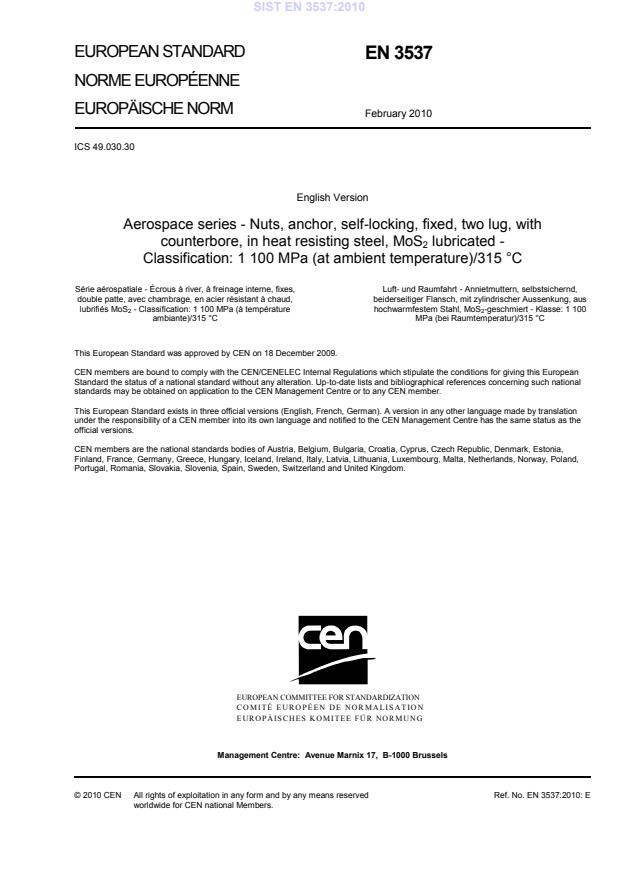
EUROPEAN STANDARD NORME EUROPÉENNE EUROPÄISCHE NORM
EN 3537
February 2010 ICS 49.030.30 English Version
Aerospace series - Nuts, anchor, self-locking, fixed, two lug, with counterbore, in heat resisting steel, MoS2 lubricated - Classification: 1 100 MPa (at ambient temperature)/315 °C
Série aérospatiale - Écrous à river, à freinage interne, fixes, double patte, avec chambrage, en acier résistant à chaud, lubrifiés MoS2 - Classification: 1 100 MPa (à température ambiante)/315 °C
Luft- und Raumfahrt - Annietmuttern, selbstsichernd, beiderseitiger Flansch, mit zylindrischer Aussenkung, aus hochwarmfestem Stahl, MoS2-geschmiert - Klasse: 1 100 MPa (bei Raumtemperatur)/315 °C This European Standard was approved by CEN on 18 December 2009.
CEN members are bound to comply with the CEN/CENELEC Internal Regulations which stipulate the conditions for giving this European Standard the status of a national standard without any alteration. Up-to-date lists and bibliographical references concerning such national standards may be obtained on application to the CEN Management Centre or to any CEN member.
This European Standard exists in three official versions (English, French, German). A version in any other language made by translation under the responsibility of a CEN member into its own language and notified to the CEN Management Centre has the same status as the official versions.
CEN members are the national standards bodies of Austria, Belgium, Bulgaria, Croatia, Cyprus, Czech Republic, Denmark, Estonia, Finland, France, Germany, Greece, Hungary, Iceland, Ireland, Italy, Latvia, Lithuania, Luxembourg, Malta, Netherlands, Norway, Poland, Portugal, Romania, Slovakia, Slovenia, Spain, Sweden, Switzerland and United Kingdom.
EUROPEAN COMMITTEE FOR STANDARDIZATION
COMITÉ EUROPÉEN DE NORMALISATION EUROPÄISCHES KOMITEE FÜR NORMUNG
Management Centre:
Avenue Marnix 17,
B-1000 Brussels © 2010 CEN All rights of exploitation in any form and by any means reserved worldwide for CEN national Members. Ref. No. EN 3537:2010: ESIST EN 3537:2010
...