

EN 15649-7:2009
(Main)Floating leisure articles for use on and in the water - Part 7: Additional specific safety requirements and test methods for class E devices
- Abstract
This European Standard is applicable for CLASS E floating leisure articles for use on or in water according to EN 15649-1 regardless whether the buoyancy is achieved by inflation or inherent buoyant material.
This document (EN 15649-7) is applicable with EN 15649-1 and EN 15649-2.
Class E devices are intended for use in bathing areas or in protected and safe shore zones.
NOTE 1 Typical products forming class E:
- inflatable boats for rowing or paddling of near oval shape with or without transom;
- canoes and kayaks;
- inflatable boats made from plastic sheets or from reinforced materials;
- motor kit/sail kit as additional option.
NOTE moving from A to B for pleasure purposes;
- staying on the water for relaxing;
- moving from shore to the main water craft, transportation of persons and load (tender boat).
- Status
- Withdrawn
- Publication Date
- 10-Nov-2009
- Withdrawal Date
- 06-Oct-2026
- Technical Committee
- CEN/TC 136 - Sports, playground and other recreational equipment
- Drafting Committee
- CEN/TC 136/WG 13 - Floating leisure articles for use on water
- Current Stage
- 9960 - Withdrawal effective - Withdrawal
- Start Date
- 11-Oct-2017
- Completion Date
- 07-Oct-2026
- Directive
- 2001/95/EC - General product safetyOJ Ref: C, C 254 OJ Date: 04-Sep-2013

Relations
- Effective Date
- 18-Oct-2017
- Effective Date
- 28-Jan-2026
- Effective Date
- 28-Jan-2026
- Effective Date
- 28-Jan-2026
Frequently Asked Questions
EN 15649-7:2009 is a standard published by the European Committee for Standardization (CEN). Its full title is "Floating leisure articles for use on and in the water - Part 7: Additional specific safety requirements and test methods for class E devices". This standard covers: This European Standard is applicable for CLASS E floating leisure articles for use on or in water according to EN 15649-1 regardless whether the buoyancy is achieved by inflation or inherent buoyant material. This document (EN 15649-7) is applicable with EN 15649-1 and EN 15649-2. Class E devices are intended for use in bathing areas or in protected and safe shore zones. NOTE 1 Typical products forming class E: - inflatable boats for rowing or paddling of near oval shape with or without transom; - canoes and kayaks; - inflatable boats made from plastic sheets or from reinforced materials; - motor kit/sail kit as additional option. NOTE moving from A to B for pleasure purposes; - staying on the water for relaxing; - moving from shore to the main water craft, transportation of persons and load (tender boat).
This European Standard is applicable for CLASS E floating leisure articles for use on or in water according to EN 15649-1 regardless whether the buoyancy is achieved by inflation or inherent buoyant material. This document (EN 15649-7) is applicable with EN 15649-1 and EN 15649-2. Class E devices are intended for use in bathing areas or in protected and safe shore zones. NOTE 1 Typical products forming class E: - inflatable boats for rowing or paddling of near oval shape with or without transom; - canoes and kayaks; - inflatable boats made from plastic sheets or from reinforced materials; - motor kit/sail kit as additional option. NOTE moving from A to B for pleasure purposes; - staying on the water for relaxing; - moving from shore to the main water craft, transportation of persons and load (tender boat).
EN 15649-7:2009 is classified under the following ICS (International Classification for Standards) categories: 97.200.50 - Toys. The ICS classification helps identify the subject area and facilitates finding related standards.
EN 15649-7:2009 has the following relationships with other standards: It is inter standard links to EN ISO 25649-7:2017, EN 15649-1:2009, EN ISO 8665:2017, EN ISO 25649-2:2024. Understanding these relationships helps ensure you are using the most current and applicable version of the standard.
EN 15649-7:2009 is associated with the following European legislation: EU Directives/Regulations: 2001/95/EC; Standardization Mandates: M/372. When a standard is cited in the Official Journal of the European Union, products manufactured in conformity with it benefit from a presumption of conformity with the essential requirements of the corresponding EU directive or regulation.
EN 15649-7:2009 is available in PDF format for immediate download after purchase. The document can be added to your cart and obtained through the secure checkout process. Digital delivery ensures instant access to the complete standard document.
Standards Content (Sample)
2003-01.Slovenski inštitut za standardizacijo. Razmnoževanje celote ali delov tega standarda ni dovoljeno.(Schwimmende Freizeitartikel zum Gebrauch auf und im Wasser - Teil 7: Zusätzliche spezifische sicherheitstechnische Anforderungen und Prüfverfahren für Klasse-E-GeräteArticles de loisirs flottants a utiliser sur ou dans l'eau - Teil 7: Exigences de sécurité et méthodes d'essai complémentaires propres aux dispositifs de Classe EFloating leisure articles for use on and in the water - Part 7: Additional specific safety requirements and test methods for class E devices97.220.40Oprema za športe na prostem in vodne športeOutdoor and water sports equipmentICS:Ta slovenski standard je istoveten z:EN 15649-7:2009SIST EN 15649-7:2010en,fr,de01-februar-2010SIST EN 15649-7:2010SLOVENSKI
STANDARD
EUROPEAN STANDARD NORME EUROPÉENNE EUROPÄISCHE NORM
EN 15649-7
November 2009 ICS 97.200.50 English Version
Floating leisure articles for use on and in the water - Part 7: Additional specific safety requirements and test methods for class E devices
Articles de loisirs flottants à utiliser sur ou dans l'eau - Partie 7: Exigences de sécurité et méthodes d'essai complémentaires propres aux dispositifs de Classe E
Schwimmende Freizeitartikel zum Gebrauch auf und im Wasser - Teil 7: Zusätzliche besondere sicherheitstechnische Anforderungen und Prüfverfahren für Artikel der Klasse E This European Standard was approved by CEN on 11 September 2009.
CEN members are bound to comply with the CEN/CENELEC Internal Regulations which stipulate the conditions for giving this European Standard the status of a national standard without any alteration. Up-to-date lists and bibliographical references concerning such national standards may be obtained on application to the CEN Management Centre or to any CEN member.
This European Standard exists in three official versions (English, French, German). A version in any other language made by translation under the responsibility of a CEN member into its own language and notified to the CEN Management Centre has the same status as the official versions.
CEN members are the national standards bodies of Austria, Belgium, Bulgaria, Cyprus, Czech Republic, Denmark, Estonia, Finland, France, Germany, Greece, Hungary, Iceland, Ireland, Italy, Latvia, Lithuania, Luxembourg, Malta, Netherlands, Norway, Poland, Portugal, Romania, Slovakia, Slovenia, Spain, Sweden, Switzerland and United Kingdom.
EUROPEAN COMMITTEE FOR STANDARDIZATION
COMITÉ EUROPÉEN DE NORMALISATION EUROPÄISCHES KOMITEE FÜR NORMUNG
Management Centre:
Avenue Marnix 17,
B-1000 Brussels © 2009 CEN All rights of exploitation in any form and by any means reserved worldwide for CEN national Members. Ref. No. EN 15649-7:2009: ESIST EN 15649-7:2010
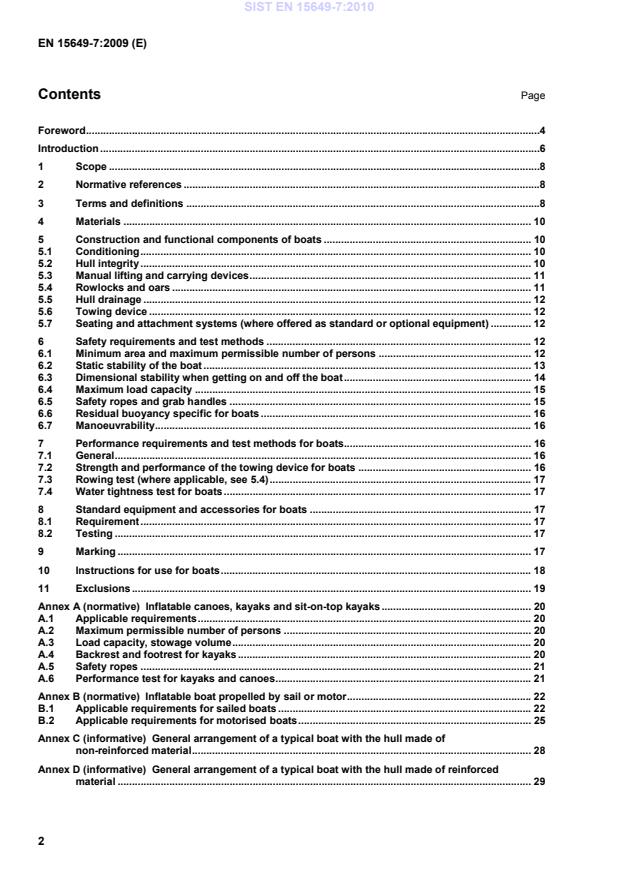
Inflatable canoes, kayaks and sit-on-top kayaks . 20A.1Applicable requirements . 20A.2Maximum permissible number of persons . 20A.3Load capacity, stowage volume . 20A.4Backrest and footrest for kayaks . 20A.5Safety ropes . 21A.6Performance test for kayaks and canoes . 21Annex B (normative)
Inflatable boat propelled by sail or motor . 22B.1Applicable requirements for sailed boats . 22B.2Applicable requirements for motorised boats . 25Annex C (informative)
General arrangement of a typical boat with the hull made of non-reinforced material . 28Annex D (informative)
General arrangement of a typical boat with the hull made of reinforced material . 29SIST EN 15649-7:2010
General arrangement of a typical paddle boat/kayak . 30Annex F (informative)
Examples of typical products forming Class E . 31Bibliography . 32
This European Standard is one of a series consisting of seven standards dealing with floating leisure articles for use on and in the water.
Compliance of a product to this standard requires that the requirements of the relevant specific part and, addi-tionally, the requirements of EN 15649-1 and EN 15649-2 have to be met. If a product includes multiple use related to several classes it has to meet the requirements of all these classes. Annex A and Annex B are normative. Annex C to Annex F are informative.
of usage Function; range of usage; target/age group Type of move-ment/propulsion Position of user in regard to the equipment,
elevation above water Predictable misuse Partial risk related to water environment Finalrisk Protection aims standard/ regulation E in work programme Adults and children's boats rowing boats of near oval shape with or without transom canoes, kay-aks, tender boats to yachts Pools; sea, shore/ close to shore; rivers; lakes Children, adults Paddling, rowing, sail, engine passive and active use by hand, drifting; third party (towing) . Inside the craft Overload; use by non-swimmers; wave riding Drifting away; capsizing; en-trapment; lack of supervision in case of child use . D R O W N I N G This EN stan-dard closes the gap between EN ISO 6185 and EN 71) SIST EN 15649-7:2010
Class E devices are intended for use in bathing areas or in protected and safe shore zones.
NOTE 1 Typical products forming class E: inflatable boats for rowing or paddling of near oval shape with or without transom; canoes and kayaks; inflatable boats made from plastic sheets or from reinforced materials; motor kit/sail kit as additional option. NOTE 2 Typical places for application of Class E devices: moving from A to B for pleasure purposes; staying on the water for relaxing; moving from shore to the main water craft, transportation of persons and load (tender boat). 2 Normative references The following referenced documents are indispensable for the application of this document. For dated refer-ences, only the edition cited applies. For undated references, the latest edition of the referenced document (including any amendments) applies. EN 15649-1:2009, Floating leisure articles for use on and in the water — Part 1: Classification, materials, general requirements and test methods EN 15649-2, Floating leisure articles for use on and in the water — Part 2: Consumer information EN ISO 8665, Small craft — Marine propulsion reciprocating internal combustion engines — Power meas-urements and declarations (ISO 8665:2006) 3 Terms and definitions For the purposes of this document, the terms and definitions given in EN 15649-1:2009 and the following ap-ply. 3.1 residual buoyancy provision of remaining buoyancy in case of a defect of any buoyancy chamber 3.2 inflatable boat buoyant structure (hull), achieving all or part of its intended shape and buoyancy by the medium of inflation and intended for the transportation of persons on the water; its design and shape give it the capability to with-stand forces and movements arising from various sea conditions SIST EN 15649-7:2010
NOTE They do not have the purpose of a working boat. 3.5 inherent buoyant material non-crosslinked (closed-cell) foam or other materials enclosed in (a) sealed compartment(s) in the hull which less than fresh water NOTE Boat made from inherent buoyant material is a buoyant structure (hull) achieving all or parts of its intended shape and buoyancy from soft foam, hard foam or sealed chambers filled with air, gas or granules. 3.6 inboard area internal surface area defined by a vertical plane tangential to the innermost side of the buoyancy tube and perpendicular to the deck 3.7 inboard length length of the cockpit, including the area below any spray cover, measured along the boat centreline between the innermost points of the bow and stern 3.8 usable seating area inboard area, including the area below any spray cover, available for the users to sit on 3.9 permissible rated load maximum loading of the boat by persons, propelling means and other items SIST EN 15649-7:2010
3.10 integrated transom rear part of the boat's cockpit normally made by a flat wooden board inseparably integrated in the boats hull on which the motor is clamped by clamp screws 3.11 motor mount transom small board attached to the rear part of the boat via a tube frame and hull fittings by means of separable fixa-tions for the purpose to clamp the motor to it 3.12 kayak boat which is propelled by means of double paddle(s) and user(s) sitting in line in a mid boat position NOTE The width/length–ratio of kayaks is above 1:3. Kayaks can be equipped with sail and motor. 3.13 canoe boat which is propelled by means of a single paddle(s) and user(s) are kneeling or sitting at bow and rear of the boat NOTE The width/length–ratio of canoes is above 1:3. Canoes can be equipped with sail and motor. 4 Materials Boats conforming to this standard shall meet the requirements set out in Clause 6 of EN 15649-1:2009. All materials shall be selected by the manufacturer according to the requirements for shape, dimensions, maximum load, etc. to which the boat is to be subjected and which are resulting from the intended service conditions. 5 Construction and functional components of boats 5.1 Conditioning All tests shall be performed at a temperature of (20 ± 3) °C. 5.2 Hull integrity
5.2.1 Requirements The materials and the method of construction used in the construction of a boat shall be compatible with that of the hull itself. Any load-bearing fittings attached to the boat shall not result in any impairment in air tightness or water integrity, when loaded as described in 5.2.2. 5.2.2 Test method Load-bearing fittings shall be loaded in any direction up to breaking point, but not exceeding 1 kN for leisure boats and 2 kN for tender boats (see 3.3). If maximum load is reached, this load shall be maintained for 1 min. Any cordage used for test purposes shall have a diameter of 8 mm. SIST EN 15649-7:2010
Rowlocks and oars 5.4.1 Requirements 5.4.1.1 General The provision of paddles, rowlocks and oars is not mandatory. The assembly system oar/rowlock shall comply with the requirements given in 5.4.1.2 to 5.4.1.5. 5.4.1.2 Abrasion damage The bearing surfaces of the oars and rowlocks shall be free from any roughness likely to cause excessive wear. All external surfaces of the rowlocks shall be smooth and free from sharp edges and corners. 5.4.1.3 Securing against loss Rowlocks shall be secured against unintended loosening. Means shall be provided for safe location of at least two oars or paddles when stowed away. 5.4.1.4 Strength of rowlocks There shall be no structural failure of the rowlocks and/or associated fittings when tested in accordance with 5.4.2.2. 5.4.1.5 Strength and performance of rowlocks and oars When tested in accordance with 7.4, there shall be no structural failure or permanent deformation of any com-ponent during the test and it shall be clearly demonstrated that the rowlock system is sufficiently rigid for effi-cient rowing. A minimum unrestricted movement of the oars 60° ahead and 60° astern shall be enabled. 5.4.2 Test methods 5.4.2.1 Abrasion damage and prevention of loosening Visual inspection and performance testing. SIST EN 15649-7:2010
Static stability of the boat 6.2.1 Requirement The boat equipped with the manufacturer's maximum rated motor (see B.2.4) shall not capsize when tested in accordance
...