

EN 17988-6:2024
(Main)Circular design of fishing gear and aquaculture equipment - Part 6: Requirements and guidelines for digitalization of information of components of fishing gear and aquaculture equipment.
- Abstract
This document specifies requirements and guidelines for the hardware and
software used for digitalization of product information of circular designed
fishing gear and aquaculture equipment containing plastics.
- Status
- Published
- Publication Date
- 26-Nov-2024
- Technical Committee
- CEN/TC 466 - Circularity and recyclability of fishing gear and aquaculture equipment
- Drafting Committee
- CEN/TC 466/WG 3 - Guidance on implementing CDFG
- Current Stage
- 6060 - Definitive text made available (DAV) - Publishing
- Start Date
- 27-Nov-2024
- Due Date
- 13-Mar-2024
- Completion Date
- 27-Nov-2024

Overview - EN 17988-6:2024 (CEN)
EN 17988-6:2024 sets requirements and guidance for the digitalization of product information for circularly designed fishing gear and aquaculture equipment containing plastics. Published by CEN as part of the EN 17988 series, this part focuses on the hardware, software and systems needed to capture, store and share product data that support recyclability, reuse and traceability across the value chain. It aligns digital product information with EU circular economy objectives (Digital Product Passports, Extended Producer Responsibility and related directives) and promotes interoperable, secure information flows for the fisheries and aquaculture sectors.
Key topics and technical requirements
- Digital Product Passports (DPP) master data
- DPPs as structured datasets describing materials, components and their properties (physical, chemical and regulatory). DPPs enable reuse, recycling and downstream processing.
- Unique identification
- Minimum requirements for a unique identifier for each piece of gear/equipment to support tracking and data linkage.
- Value‑chain material and information flows
- Guidance on recording and sharing material provenance and life‑cycle data to improve circularity.
- Labelling and marking
- Requirements for identifying ownership, capacity, position and material information; digitalized material declarations for gear, components and examples of marking approaches.
- Data exchange and traceability
- Options and requirements for secure, interoperable data exchange, including Automatic Identification and Data Capture (AIDC) recommendations.
- Development & implementation of digital solutions
- Principles on access to data, data ownership, handling IP‑sensitive information, interoperability, roles and responsibilities.
- Supporting guidance
- Annex A describes digitalization options for labelling and marking to help implementers choose appropriate technologies (IoT, AI, AIDC).
Practical applications and who uses this standard
- Manufacturers and product designers - to embed digital identifiers and create DPPs supporting recyclability and compliance with EPR and SUP rules.
- Aquaculture operators and fishers - to mark gear, register ownership and share operational data for maintenance, recovery and end‑of‑use processing.
- Recyclers and waste managers - to access material declarations and improve sorting/preparation for recycling.
- Supply‑chain IT vendors and system integrators - to design interoperable hardware/software solutions (DPP platforms, AIDC, IoT).
- Regulators and certification bodies - to monitor reporting obligations and collection/traceability targets under EU directives.
Related standards
- EN 17988-2 (User manuals and labelling)
- IEC 82474-1 (Material Declaration – Part 1: General Requirements)
- CEN/TS 18101 (Terms and definitions)
Keywords: EN 17988-6, Digital Product Passport, DPP, circular design, fishing gear, aquaculture equipment, digitalization, traceability, labelling, interoperability, IoT, AIDC, recyclability, CEN.
Relations
- Effective Date
- 28-Jan-2026
- Effective Date
- 28-Jan-2026
- Effective Date
- 28-Jan-2026
- Effective Date
- 28-Jan-2026
Get Certified
Connect with accredited certification bodies for this standard

BSI Group
BSI (British Standards Institution) is the business standards company that helps organizations make excellence a habit.

Bureau Veritas
Bureau Veritas is a world leader in laboratory testing, inspection and certification services.

DNV
DNV is an independent assurance and risk management provider.
Sponsored listings
Frequently Asked Questions
EN 17988-6:2024 is a standard published by the European Committee for Standardization (CEN). Its full title is "Circular design of fishing gear and aquaculture equipment - Part 6: Requirements and guidelines for digitalization of information of components of fishing gear and aquaculture equipment.". This standard covers: This document specifies requirements and guidelines for the hardware and software used for digitalization of product information of circular designed fishing gear and aquaculture equipment containing plastics.
This document specifies requirements and guidelines for the hardware and software used for digitalization of product information of circular designed fishing gear and aquaculture equipment containing plastics.
EN 17988-6:2024 is classified under the following ICS (International Classification for Standards) categories: 13.020.20 - Environmental economics. Sustainability; 65.150 - Fishing and fish breeding. The ICS classification helps identify the subject area and facilitates finding related standards.
EN 17988-6:2024 has the following relationships with other standards: It is inter standard links to EN 17988-2:2024, CEN/TS 18101:2024, EN 17988-5:2024, EN 17988-1:2024. Understanding these relationships helps ensure you are using the most current and applicable version of the standard.
EN 17988-6:2024 is associated with the following European legislation: EU Directives/Regulations: 2019/904; Standardization Mandates: M/574. When a standard is cited in the Official Journal of the European Union, products manufactured in conformity with it benefit from a presumption of conformity with the essential requirements of the corresponding EU directive or regulation.
EN 17988-6:2024 is available in PDF format for immediate download after purchase. The document can be added to your cart and obtained through the secure checkout process. Digital delivery ensures instant access to the complete standard document.
Standards Content (Sample)
SLOVENSKI STANDARD
01-februar-2025
Krožna zasnova ribolovnega orodja in opreme za akvakulturo - 6. del - Zahteve in
navodila za digitalizacijo informacij o orodju in komponentah
Circular design of fishing gear and aquaculture equipment - Part 6 - Requirements and
guidance for digitalization of information on gear and components
Kreislaufwirtschaft von Fischfanggeräten und Aquakulturausrüstungen - Teil 6:
Digitalisierung von Geräten und Komponenten
Circularité et recyclabilité des engins de pêche et des équipements d’aquaculture -
Partie 6 : Exigences et lignes directrices pour la dématérialisation des informations
relatives aux composants des engins de pêche et des équipements d’aquaculture
Ta slovenski standard je istoveten z: EN 17988-6:2024
ICS:
13.020.20 Okoljska ekonomija. Environmental economics.
Trajnostnost Sustainability
65.150 Ribolov in ribogojstvo Fishing and fish breeding
2003-01.Slovenski inštitut za standardizacijo. Razmnoževanje celote ali delov tega standarda ni dovoljeno.
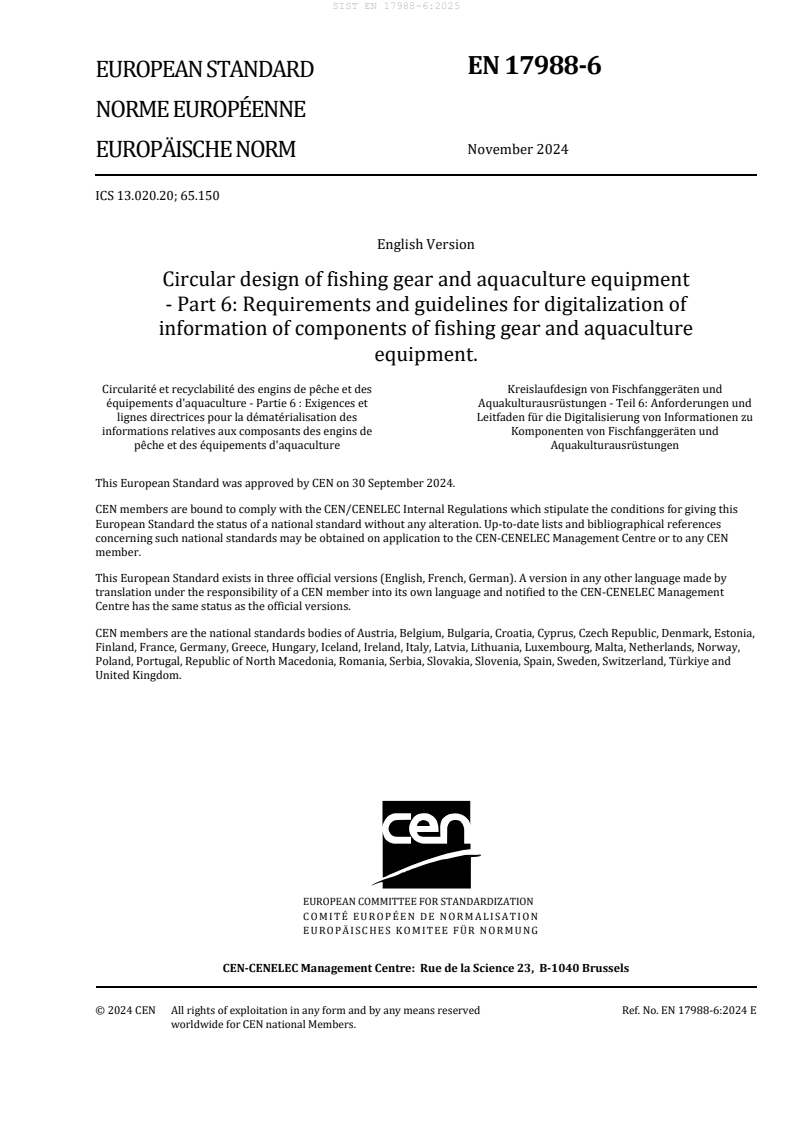
EN 17988-6
EUROPEAN STANDARD
NORME EUROPÉENNE
November 2024
EUROPÄISCHE NORM
ICS 13.020.20; 65.150
English Version
Circular design of fishing gear and aquaculture equipment
- Part 6: Requirements and guidelines for digitalization of
information of components of fishing gear and aquaculture
equipment.
Circularité et recyclabilité des engins de pêche et des Kreislaufdesign von Fischfanggeräten und
équipements d'aquaculture - Partie 6 : Exigences et Aquakulturausrüstungen - Teil 6: Anforderungen und
lignes directrices pour la dématérialisation des Leitfaden für die Digitalisierung von Informationen zu
informations relatives aux composants des engins de Komponenten von Fischfanggeräten und
pêche et des équipements d'aquaculture Aquakulturausrüstungen
This European Standard was approved by CEN on 30 September 2024.
CEN members are bound to comply with the CEN/CENELEC Internal Regulations which stipulate the conditions for giving this
European Standard the status of a national standard without any alteration. Up-to-date lists and bibliographical references
concerning such national standards may be obtained on application to the CEN-CENELEC Management Centre or to any CEN
member.
This European Standard exists in three official versions (English, French, German). A version in any other language made by
translation under the responsibility of a CEN member into its own language and notified to the CEN-CENELEC Management
Centre has the same status as the official versions.
CEN members are the national standards bodies of Austria, Belgium, Bulgaria, Croatia, Cyprus, Czech Republic, Denmark, Estonia,
Finland, France, Germany, Greece, Hungary, Iceland, Ireland, Italy, Latvia, Lithuania, Luxembourg, Malta, Netherlands, Norway,
Poland, Portugal, Republic of North Macedonia, Romania, Serbia, Slovakia, Slovenia, Spain, Sweden, Switzerland, Türkiye and
United Kingdom.
EUROPEAN COMMITTEE FOR STANDARDIZATION
COMITÉ EUROPÉEN DE NORMALISATION
EUROPÄISCHES KOMITEE FÜR NORMUNG
CEN-CENELEC Management Centre: Rue de la Science 23, B-1040 Brussels
© 2024 CEN All rights of exploitation in any form and by any means reserved Ref. No. EN 17988-6:2024 E
worldwide for CEN national Members.
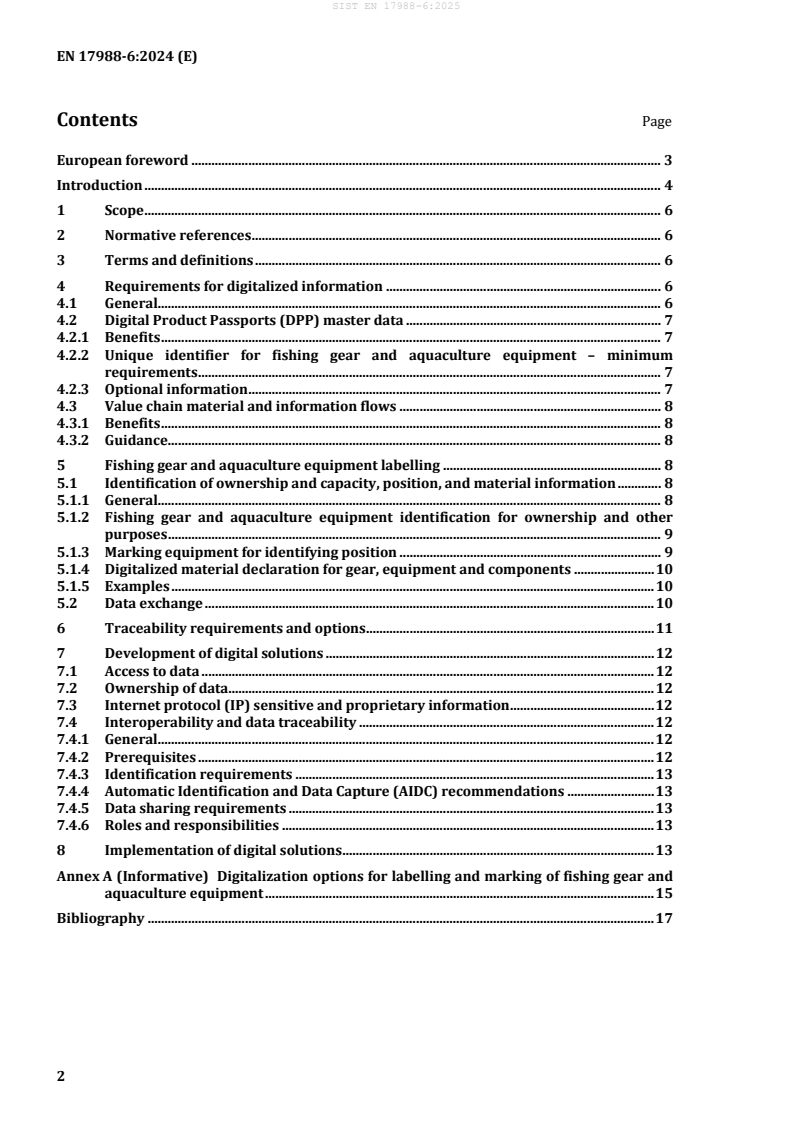
Contents Page
European foreword . 3
Introduction . 4
1 Scope . 6
2 Normative references . 6
3 Terms and definitions . 6
4 Requirements for digitalized information . 6
4.1 General. 6
4.2 Digital Product Passports (DPP) master data . 7
4.2.1 Benefits . 7
4.2.2 Unique identifier for fishing gear and aquaculture equipment – minimum
requirements . 7
4.2.3 Optional information . 7
4.3 Value chain material and information flows . 8
4.3.1 Benefits . 8
4.3.2 Guidance . 8
5 Fishing gear and aquaculture equipment labelling . 8
5.1 Identification of ownership and capacity, position, and material information . 8
5.1.1 General. 8
5.1.2 Fishing gear and aquaculture equipment identification for ownership and other
purposes . 9
5.1.3 Marking equipment for identifying position . 9
5.1.4 Digitalized material declaration for gear, equipment and components . 10
5.1.5 Examples . 10
5.2 Data exchange . 10
6 Traceability requirements and options . 11
7 Development of digital solutions . 12
7.1 Access to data . 12
7.2 Ownership of data . 12
7.3 Internet protocol (IP) sensitive and proprietary information . 12
7.4 Interoperability and data traceability . 12
7.4.1 General. 12
7.4.2 Prerequisites . 12
7.4.3 Identification requirements . 13
7.4.4 Automatic Identification and Data Capture (AIDC) recommendations . 13
7.4.5 Data sharing requirements . 13
7.4.6 Roles and responsibilities . 13
8 Implementation of digital solutions . 13
Annex A (Informative) Digitalization options for labelling and marking of fishing gear and
aquaculture equipment . 15
Bibliography . 17
European foreword
This document (EN 17988-6:2024) has been prepared by Technical Committee CEN/TC 466 “Circularity
and recyclability of fishing gear and aquaculture equipment”, the secretariat of which is held by NEN.
This European Standard shall be given the status of a national standard, either by publication of an
identical text or by endorsement, at the latest by May 2025, and conflicting national standards shall be
withdrawn at the latest by May 2025.
Attention is drawn to the possibility that some of the elements of this document may be the subject of
patent rights. CEN shall not be held responsible for identifying any or all such patent rights.
This document has been prepared under a standardization request addressed to CEN by the European
Commission (M/574). The Standing Committee of the EFTA States subsequently approves these requests
for its Member States.
This document is part of the EN 17988 series.
The EN 17988 series consists of the following parts, under the general title Circular design of fishing gear
and aquaculture equipment:
— Part 1: General requirements and guidelines
— Part 2: User manuals and labelling
— Part 3: Technical requirements and guidelines
— Part 4: Environmental and circularity requirements and guidelines
— Part 5: Circular business models
— Part 6: Requirements and guidelines for digitalization of information of components of fishing gear
and aquaculture equipment
Any feedback and questions on this document should be directed to the users’ national standards body.
A complete listing of these bodies can be found on the CEN website.
According to the CEN-CENELEC Internal Regulations, the national standards organisations of the
following countries are bound to implement this European Standard: Austria, Belgium, Bulgaria, Croatia,
Cyprus, Czech Republic, Denmark, Estonia, Finland, France, Germany, Greece, Hungary, Iceland, Ireland,
Italy, Latvia, Lithuania, Luxembourg, Malta, Netherlands, Norway, Poland, Portugal, Republic of North
Macedonia, Romania, Serbia, Slovakia, Slovenia, Spain, Sweden, Switzerland, Türkiye and the United
Kingdom.
Introduction
As part of the European Green Deal, launched in 2019, the European Commission introduced measures
to move to a climate neutral and circular economy, together with a digital transition. One of the targets
in the transition to a circular economy was to reduce the amount of waste released into the environment
by decreasing the amount of waste generated, increasing the amount of waste collected and re-
introducing the materials regenerated from waste into the production of new products.
Specifically, the accumulation of plastics in marine and other aquatic environments were addressed in
two directives:
— The revised Port Reception Facilities (PRF) Directive [1] encourages fishers and aquaculturists to
bring not only their own end-of-use gear but also bring ashore abandoned, lost or otherwise
discarded (ALD) fishing gear and aquaculture equipment, thus encouraging waste to be carried back
to port.
— The Single Use Plastics (SUP) Directive [2], which lays down rules concerning different plastic
products, including fishing gear and aquaculture equipment containing plastics, and sets
requirements to the Member States to establish Extended Producer Responsibility (EPR) schemes.
Concerning fishing gear, it also contains rules on minimum national annual collection rates, together
with reporting on fishing gear placed on the market and waste fishing gear collected in ports.
In 2021, the standardization request M/574 on the circular design of fishing gear [3] was passed by the
European Commission and the parliament and accepted by CEN, which forms the basis for this series of
documents (EN 17988 series). While the term ‘fishing gear’ is used predominantly in the SUP Directive
and M/574, both documents encompass aquaculture equipment.
The purpose of this series of documents is to provide stakeholders with requirements, recommendations
and guidelines to address the different aspects of circular design of fishing gear and aquaculture
equipment containing plastics, encourage preparing for reuse and facilitate recyclability at end-of-use.
These requirements are intended to be applied from the design phase across the entire life cycle of the
fishing gear and aquaculture equipment. This includes but is not limited to: manufacturing, use,
maintenance, repair, collection, sorting, preparation for recycling, reuse, remanufacture, disposal, uptake
of recycled content and recycling.
Although this document is written for fishing gear and aquaculture equipment containing plastics, the
requirements, recommendations and guidelines are also applicable to other materials.
This series of documents does not address other important design criteria such as fishing or farming
efficiency. When implementing the requirements, recommendations and guidelines provided in these
documents, balanced trade-offs between all relevant criteria need to be taken into account.
This series of documents aims to contribute to the following UN Sustainable Development Goals (SDGs)
[4]:
— 9 Industry, innovation, and infrastructure,
— 12 Responsible consumption and production,
— 14 Life below water, in particular target 14.1: ‘By 2025, prevent and significantly reduce marine
pollution of all kinds, in particular from land-based activities, including marine debris and nutrient
pollution.’
For a full outline of the parts of the standard, and how the parts relate to each other, see part 1.
This part addresses requirements for the hardware, software and systems for digitalization of product
information of circular designed fishing gear and aquaculture equipment. Marking, labelling and
information sharing are the key elements of digitalization. The availability and transparency of shared
information enables the interoperability across value network participants. Sharing accurate, real-time
operational information between the trading partners can lead to better use of assets such as fishing gear
and aquaculture equipment in the value network.
Note to the reader on normative language: In this document, the following verbal forms are used in
accordance with the CEN/CENELEC Internal Regulations Part 3, Clause 7:
— “shall” indicates a requirement;
— “should” indicates a recommendation;
— “may” indicates a permission;
— “can” indicates a possibility or a capability;
— “must” indicates an external constraint.
1 Scope
This document specifies requirements and guidelines for the hardware and software used for
digitalization of product information of circular designed fishing gear and aquaculture equipment
containing plastics.
2 Normative references
The following documents are referred to in the text in such a way that some or all of their content
constitutes requirements of this document. For dated references, only the edition cited applies. For
undated references, the latest edition of the referenced document (including any amendments) applies.
EN 17988-2, Circular design of fishing gear and aquaculture equipment – Part 2: User manuals and labelling
IEC 82474-1, Material Declaration – Part 1: General Requirements
CEN/TS 18101, Circular design of fishing gear and aquaculture equipment - Terms and definitions
3 Terms and definitions
For the purposes of this document, the terms and definitions in CEN/TS 18101 apply.
ISO and IEC maintain terminology databases for use in standardization at the following addresses:
— ISO Online browsing platform: available at https://www.iso.org/obp/
— IEC Electropedia: available at https://www.electropedia.org/
4 Requirements for digitalized information
4.1 General
The aim of this document is to align the digital transformation of the fishing and aquaculture sector with
the general digital transformation in the context of the transition towards a circular economy.
Marking, labelling and information sharing are the key elements of digitalization. The availability and
transparency of information sharing between different actors will improve the vertical integration across
the value chain. This can be achieved through a higher level of collaboration and access to appropriate
digitalization technology. The transparency of trace and track technology also requires a certain level of
interoperability across value chain participants. Sharing accurate, real-time operational information
between the trading partners can lead to better use of assets such as fishing gear and aquaculture
equipment in the value chain.
On the circular design of the fishing gear and aquaculture equipment, the most common way to
implement digital systems is monitoring digital options across the value chain. To make this possible,
data monitoring can be done by means of data digitalization, artificial intelligence (AI) or Internet of
Things (IoT). Digitalization of value chain operations is important in ensuring that the documentation of
fishing gear and aquaculture equipment is in good order.
Information on options for digitalizing information related to labelling is provided in Annex A. General
requirements for labelling of fishing gear and aquaculture equipment are covered by EN 17988-2 [5].
4.2 Digital Product Passports (DPP) master data
4.2.1 Benefits
According to the new Circular Economy Action Plan (CEAP), Digital Product Passports (DPP) allow
benefiting from digitalization for increasing sustainability and circularity of products [6]. DPPs can be
universally used for describing products and substances contained in them. A DPP is a structured set of
data about the components and materials that an individual product contains to enhance its use and
facilitate processing after the use phase has ended. Digital technologies allow the exchange and
integration of such data from multiple actors.
Information in DPPs can be structured on different hierarchy levels, starting with materials which are
then integrated into components, products and systems. For each material, a dataset describing its
physical, chemical and other properties shall be included, which shall cover all legislative requirements
for manufacturers, suppliers and importers. Examples are listing of Substances of Concern (SoC) and
other health and safety information.
4.2.2 Unique identifier for fishing gear and aquaculture equipment – minimum requirements
Introducing a unique identifier for each fishing gear or aquaculture equipment facilitates organizing,
displaying and exchanging data. It also enables the implementation of a global digitalized labelling system
with the opportunity to trace required and additional information. When establishing such a system the
minimum requirements are:
— compatibility between different systems shall be ensured, declarations and databases for material
information shall be in conformance with IEC 82474-1;
— the type of fishing gear or aquaculture equipment and the owner shall be identifiable;
— defining which parts of the gear and equipment shall be labelled, and on what places of the parts. All
labels on one gear or equipment shall contain the same unique identifier. (For requirements and
recommendations for placement of labels, see EN 17988-2 [5]).
The system should be simple to use and not increasing costs for the parties involved. It should be easy
for fishers and aquaculturists to update information on the gear and equipment, e.g. after repair, to retain
quality of the information.
EXAMPLE Using an identifier that conforms with international standards as a primary key is a quick way to
find attributes of fishing gear or aquaculture equipment in a database. The attributes of the fishing gear or
aquaculture equipment can be recorded and shared digitally using the identifier as the key to the information. The
type of information held in a database can, in addition to the owner and the type of fishing gear or aquaculture
equipment, also include optional information as described in 4.2.3.
NOTE Product identification can be simplified by consisting of the producer’s DUNS number (Data Universal
Numbering System, a unique nine-digit identification number that is free to obtain), followed by a sequential code.
This can avoid ID (identification number) duplication at an acceptable cost.
4.2.3 Optional information
Optional information can include a list of additional components or materials (for example for placement
or mounting), vessel ID and any auxiliaries attached to the gear or equipment. To facilitate repair,
remanufacturing or refurbishing information on suppliers of components and materials can be valuable.
NOTE This document only addresses information related to circularity. Information not related to circularity
can be included as well; here other documents can be consulted. The type of additional information relevant to the
fishing and aquaculture sector to be included depends on factors such as: the type and the characteristics of
materials, the size of the fishing gear or aquaculture equipment, the species being caught, the fishing and
aquaculture ground(s) and the conditions under which the fishing gear or aquaculture equipment is being operated,
the type, size and engine power of the vessel, the type of operation and the auxiliaries employed as well as on the
sector practises and traditions.
4.3 Value chain material and information flows
4.3.1 Benefits
Digital technologies are considered vital enablers to create circular economy business. Digitalization can
help close the material loops by providing accurate information on product availability, location and
condition. It can also enable more efficient processes and minimize waste. Digitalization can be applied
to all processes and workflows, including the administration of legal and other documents, but is most
important in the design stage, for the pre-sorting of the fishing gear and aquaculture equipment, and
when material is recycled based on material specifications for the gear or equipment.
4.3.2 Guidance
While the material flow process describes the movement of materials, there is in parallel also the
information flow which inform the stakeholders in each process about what actions to take. Typically,
material flows are one-directional while information flows are bi-directional. For further details on
different stakeholders’ involvement in the value chain, see EN 17988-1 [8].
Material recycled from fishing gear and aquaculture equipment will compete with the flows from
materials recycled from other products. Looking at the total available amount of recycled plastics the part
coming from fishing gear and aquaculture equipment is low and its relative cost can be high. It would
therefore be beneficial to merge plastics recycled from fishing gear and aquaculture equipment with
other recycle
...