

EN 15037-4:2010
(Main)Precast concrete products - Beam-and-block floor systems - Part 4: Expanded polystyrene blocks
- Abstract
This European Standard deals with the requirements and the basic performance criteria for blocks made in expanded polystyrene (EPS), used in conjunction with precast concrete beams in compliance with
EN 15037-1, with or without cast-in-situ concrete for the construction of beam-and-block floor systems.
EPS block may be totally made in EPS or combined with different materials such as plaster or wood wool.
If EPS is combined with other materials, these materials should not contribute to more than 50 % of the mechanical resistance of the block. If not, the block is covered by EN 15037-5, Precast concrete products - Beam-and-block floor systems - Part 5: Lightweight blocks for simple formwork.
Examples of typology of floor systems are given in Annex B of EN 15037-1:2008.
- Status
- Withdrawn
- Publication Date
- 26-Jan-2010
- Withdrawal Date
- 21-May-2013
- Technical Committee
- CEN/TC 229 - Precast concrete products
- Current Stage
- 9960 - Withdrawal effective - Withdrawal
- Start Date
- 22-May-2013
- Completion Date
- 22-May-2013
89/106/EEC - Construction productsOJ Ref: C, C 167 OJ Date: 25-Jun-2010

Relations
- Effective Date
- 27-Feb-2013
- Effective Date
- 28-Jan-2026
- Effective Date
- 28-Jan-2026
- Effective Date
- 28-Jan-2026
- Effective Date
- 28-Jan-2026
- Effective Date
- 28-Jan-2026
- Effective Date
- 28-Jan-2026
- Effective Date
- 28-Jan-2026
- Effective Date
- 28-Jan-2026
- Effective Date
- 28-Jan-2026
- Effective Date
- 28-Jan-2026
- Effective Date
- 28-May-2011
Get Certified
Connect with accredited certification bodies for this standard

DIBt (Deutsches Institut für Bautechnik)
German Institute for Building Technology.
DIN CERTCO
DIN Group product certification.

Aboma Certification B.V.
Specialized in construction, metal, and transport sectors.
Sponsored listings
Frequently Asked Questions
EN 15037-4:2010 is a standard published by the European Committee for Standardization (CEN). Its full title is "Precast concrete products - Beam-and-block floor systems - Part 4: Expanded polystyrene blocks". This standard covers: This European Standard deals with the requirements and the basic performance criteria for blocks made in expanded polystyrene (EPS), used in conjunction with precast concrete beams in compliance with EN 15037-1, with or without cast-in-situ concrete for the construction of beam-and-block floor systems. EPS block may be totally made in EPS or combined with different materials such as plaster or wood wool. If EPS is combined with other materials, these materials should not contribute to more than 50 % of the mechanical resistance of the block. If not, the block is covered by EN 15037-5, Precast concrete products - Beam-and-block floor systems - Part 5: Lightweight blocks for simple formwork. Examples of typology of floor systems are given in Annex B of EN 15037-1:2008.
This European Standard deals with the requirements and the basic performance criteria for blocks made in expanded polystyrene (EPS), used in conjunction with precast concrete beams in compliance with EN 15037-1, with or without cast-in-situ concrete for the construction of beam-and-block floor systems. EPS block may be totally made in EPS or combined with different materials such as plaster or wood wool. If EPS is combined with other materials, these materials should not contribute to more than 50 % of the mechanical resistance of the block. If not, the block is covered by EN 15037-5, Precast concrete products - Beam-and-block floor systems - Part 5: Lightweight blocks for simple formwork. Examples of typology of floor systems are given in Annex B of EN 15037-1:2008.
EN 15037-4:2010 is classified under the following ICS (International Classification for Standards) categories: 91.100.30 - Concrete and concrete products. The ICS classification helps identify the subject area and facilitates finding related standards.
EN 15037-4:2010 has the following relationships with other standards: It is inter standard links to EN 15037-4:2010+A1:2013, EN ISO 10211:2017, EN 12390-4:2000, EN 15037-1:2008, EN 13163:2008, EN ISO 29469:2022, EN 13501-1:2018, EN 13369:2004, EN 12667:2001, EN 1365-2:2014, EN 12281:2002, EN 15037-4:2010/FprA1. Understanding these relationships helps ensure you are using the most current and applicable version of the standard.
EN 15037-4:2010 is associated with the following European legislation: EU Directives/Regulations: 305/2011, 89/106/EEC; Standardization Mandates: M/100. When a standard is cited in the Official Journal of the European Union, products manufactured in conformity with it benefit from a presumption of conformity with the essential requirements of the corresponding EU directive or regulation.
EN 15037-4:2010 is available in PDF format for immediate download after purchase. The document can be added to your cart and obtained through the secure checkout process. Digital delivery ensures instant access to the complete standard document.
Standards Content (Sample)
2003-01.Slovenski inštitut za standardizacijo. Razmnoževanje celote ali delov tega standarda ni dovoljeno.Montažni betonski izdelki - Stropni sistemi iz nosilcev in polnil - 4. del: Polnila iz ekspandiranega polistirenaBetonfertigteile - Balkendecken mit Zwischenbauteilen - Teil 4: Zwischenbauteile aus gedehntem PolystyrolProduits préfabriqués en béton - Systèmes de planchers à poutrelles et entrevous - Partie 4: Entrevous en polystyrène expanséPrecast concrete products - Beam-and-block floor systems - Part 4: Expanded polystyrene blocks91.100.30Beton in betonski izdelkiConcrete and concrete products91.060.30Stropi. Tla. StopniceCeilings. Floors. StairsICS:Ta slovenski standard je istoveten z:EN 15037-4:2010SIST EN 15037-4:2010en,fr01-junij-2010SIST EN 15037-4:2010SLOVENSKI
STANDARD
EUROPEAN STANDARD NORME EUROPÉENNE EUROPÄISCHE NORM
EN 15037-4
January 2010 ICS 91.100.30 English Version
Precast concrete products - Beam-and-block floor systems - Part 4: Expanded polystyrene blocks
Produits préfabriqués en béton - Systèmes de planchers à poutrelles et entrevous - Partie 4: Entrevous en polystyrène expansé
Betonfertigteile - Balkendecken mit Zwischenbauteilen - Teil 4: Zwischenbauteile aus gedehntem Polystyrol This European Standard was approved by CEN on 1 November 2009.
CEN members are bound to comply with the CEN/CENELEC Internal Regulations which stipulate the conditions for giving this European Standard the status of a national standard without any alteration. Up-to-date lists and bibliographical references concerning such national standards may be obtained on application to the CEN Management Centre or to any CEN member.
This European Standard exists in three official versions (English, French, German). A version in any other language made by translation under the responsibility of a CEN member into its own language and notified to the CEN Management Centre has the same status as the official versions.
CEN members are the national standards bodies of Austria, Belgium, Bulgaria, Croatia, Cyprus, Czech Republic, Denmark, Estonia, Finland, France, Germany, Greece, Hungary, Iceland, Ireland, Italy, Latvia, Lithuania, Luxembourg, Malta, Netherlands, Norway, Poland, Portugal, Romania, Slovakia, Slovenia, Spain, Sweden, Switzerland and United Kingdom.
EUROPEAN COMMITTEE FOR STANDARDIZATION
COMITÉ EUROPÉEN DE NORMALISATION EUROPÄISCHES KOMITEE FÜR NORMUNG
Management Centre:
Avenue Marnix 17,
B-1000 Brussels © 2010 CEN All rights of exploitation in any form and by any means reserved worldwide for CEN national Members. Ref. No. EN 15037-4:2010: ESIST EN 15037-4:2010
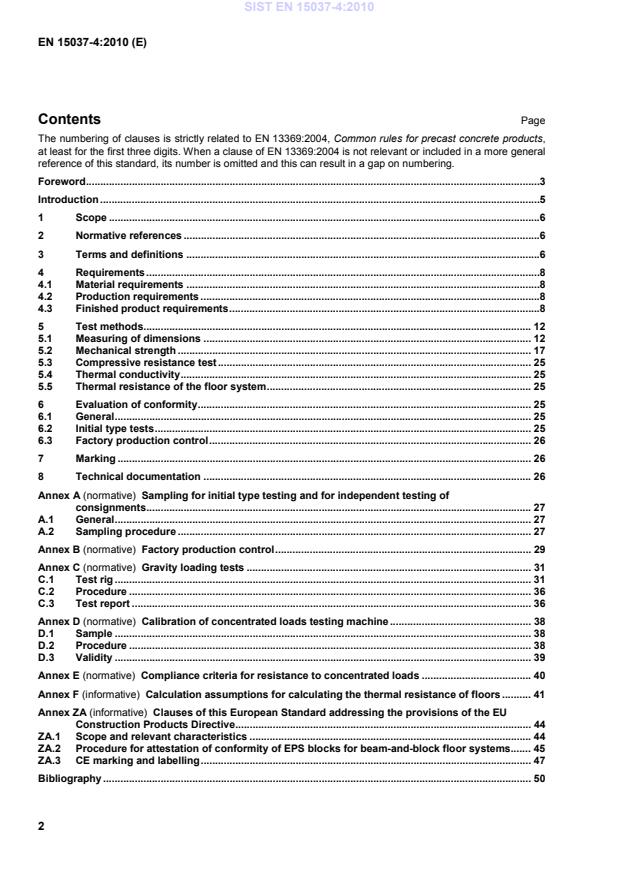
Sampling for initial type testing and for independent testing of consignments . 27A.1 General . 27A.2 Sampling procedure . 27Annex B (normative)
Factory production control . 29Annex C (normative)
Gravity loading tests . 31C.1 Test rig . 31C.2 Procedure . 36C.3 Test report . 36Annex D (normative)
Calibration of concentrated loads testing machine . 38D.1 Sample . 38D.2 Procedure . 38D.3 Validity . 39Annex E (normative)
Compliance criteria for resistance to concentrated loads . 40Annex F (informative)
Calculation assumptions for calculating the thermal resistance of floors . 41Annex ZA (informative)
Clauses of this European Standard addressing the provisions of the EU Construction Products Directive . 44ZA.1 Scope and relevant characteristics . 44ZA.2 Procedure for attestation of conformity of EPS blocks for beam-and-block floor systems. 45ZA.3 CE marking and labelling . 47Bibliography . 50 SIST EN 15037-4:2010
Beam-and-block floor systems, consists of five parts: Part 1: Beams Part 2: Concrete blocks Part 3: Clay blocks Part 4: Expanded polystyrene blocks Part 5: Lightweight blocks for simple formwork 1)
For common aspects of concrete products, reference is made to EN 13369, from which also the relevant requirements of the EN 206-1 are taken. The references to EN 13369 by CEN/TC 229 product standards are intended to make them homogeneous and to avoid repetitions of similar requirements. Eurocodes are taken as a common reference for design aspects. The installation of some structural precast concrete products is dealt with by ENV 13670-1. In all countries it may be accompanied by alternatives for national application and it should not be treated as a European Standard. The program of standards for structural precast concrete products comprises the following European Standards, in some cases consisting of several parts: EN 1168, Precast concrete products — Hollow core slabs EN 12794, Precast concrete products — Foundation piles EN 12843, Precast concrete products — Masts and poles EN 13224, Precast concrete products — Ribbed floor elements
1) To be developed. SIST EN 15037-4:2010
EN 15037-1, with or without cast-in-situ concrete for the construction of beam-and-block floor systems. EPS block may be totally made in EPS or combined with different materials such as plaster or wood wool. If EPS is combined with other materials, these materials should not contribute to more than 50 % of the mechanical resistance of the block. If not, the block is covered by EN 15037-5, Precast concrete products
Beam-and-block floor systems
Part 5: Lightweight blocks for simple formwork. Examples of typology of floor systems are given in Annex B of EN 15037-1:2008. 2 Normative references The following referenced documents are indispensable for the application of this document. For dated references, only the edition cited applies. For undated references, the latest edition of the referenced document (including any amendments) applies. EN 826, Thermal insulating products for building applications — Determination of compression behaviour EN 1365-2, Fire resistance tests for loadbearing elements — Part 2: Floors and roofs EN 12390-4:2000, Testing hardened concrete — Part 4: Compressive strength — Specification for testing machines EN 12667, Thermal performance of building materials and products — Determination of thermal resistance by means of guarded hot plate and heat flow meter methods — Products of high and medium thermal resistance EN 13163:2008, Thermal insulation products for buildings — Factory made products of expanded polystyrene (EPS) — Specification EN 13369:2004, Common rules for precast concrete products EN 15037-1:2008, Precast concrete products — Beam-and-block floor systems — Part 1: Beams EN 13501-1, Fire classification of construction products and buildings elements — Part 1: Classification using test data from reaction to fire tests EN ISO 10211, Thermal bridges in building construction — Heat flows and surface temperatures — Detailed calculations (ISO 10211:2007) 3 Terms and definitions For the purposes of this document, the following terms and definitions apply. 3.1 EPS block type R1 block with no mechanical function in the final floor system NOTE Its only mechanical function is that of formwork during the construction of the floor system. SIST EN 15037-4:2010
Figure 1 — Examples of EPS blocks type R1 3.2 EPS block type R2 block that contributes to the mechanical function of the final floor in conjunction with a timber deck or screed NOTE EPS blocks type R2 are generally used with self-bearing beams.
Figure 2 — Examples of EPS blocks type R2 3.3 cut block EPS block formed by cutting from EPS block 3.4 moulded block EPS block formed by moulding 3.5 family group of products for which the test results for one or more characteristics from any one product within the family are valid for all other products within the family 3.6 batch quantity of EPS blocks defined by: a same reference of raw material; similar parameters and conditions of expansion; similar parameters and conditions of moulding; an expanded volume which does not exceed 1 000 m3 SIST EN 15037-4:2010
The tolerances on the dimensions are given in Table 1. SIST EN 15037-4:2010
Key 1 block width l 7 height of the support nib hn 2 block height h 8 rebate width lr 3 height above beam support h1 9 rebate height hr 4 chamfer width lc 10 tongue width lt 5 chamfer height hc 11 tongue thickness ht 6 width of the support nib ln Figure 3 — Dimensions of the EPS block type R1
Key 1 block top width l 6 width of the support nib ln 1' block bottom width lb 7 height of the support nib hn 2 block height h 9 rebate height hr Figure 4 — Dimensions of the EPS block type R2 SIST EN 15037-4:2010
length of the block L ± max. [0,6 % ; 5 mm] ≤ 12 mm 4 - width of the chamfer lc ± 10 mm 5 - height of the chamfer hc ± 5 mm 6 - width of the support nib in upper part ln ± 3 mm 7 - height of the support nib hn [– 2 mm ; + 4 mm] 8 - width of the rebate lr ± 3 mm 9 - height of the rebate hr ± 3 mm 10 - width of the tongue lt ± 5 mm 11 - thickness of the tongue ht [– 3 mm ; + 7 mm] NOTE Lower tolerances may be declared by the manufacturer.
4.3.1.1.2 Straightness Straightness shall be verified according to 5.1.2. The tolerances are: ± 1/250 of the block length in the vertical plane; ± min. [1/250 of the block length ; 5 mm] in the horizontal plane. 4.3.1.1.3 Warping Warping shall be verified according to
5.1.3. The tolerance is ± 1/250 of the block length. 4.3.1.2 Minimum dimensions The actual width of EPS block rebate shall not be less than 20 mm. 4.3.1.3 Shape of blocks The following nominal dimensions (see Figures 5, 6 and 8) shall be declared: block width l; block height h; block length L; tongue thickness ht. SIST EN 15037-4:2010
EN 15037-1:2008 may be used (airborne and impact sound insulation). 4.3.7 Thermal properties The λ90,90 value (thermal conductivity) and the R value (thermal resistance) and the U value (thermal transmittance) of the specified floor shall be declared. The thermal conductivity (λ90,90) shall be measured in accordance with 5.4. For the calculation of the thermal resistance of the floor (R value / U value), the non rounded λ value may be used. A method is given in 5.5. Another method may be used, provided that the results are equivalent. NOTE The calculation assumptions for thermal resistance of floor which are given in Annex F should be used. 4.3.8 Durability The durability of blocks shall be consistent with the durability of beams used for the construction of the floor system. 5 Test methods 5.1 Measuring of dimensions 5.1.1 Block dimensions 5.1.1.1 General Check the following dimensions to the nearest 1,0 mm. 5.1.1.2 Procedure a) Block width l Measure the width of each end section as shown in Figure 5 (the larger width). SIST EN 15037-4:2010
Figure 5 — Measurement of the width of the block Calculate the width for the block as the mean of the two measurement values. The dimensions shall comply with the requirements of 4.3.1, and the values declared by the manufacturer, within the tolerances given in 4.3.1.1.1. NOTE For the blocks type R2, it is necessary to measure the two widths l and lb. b) Block height h Measure the height of each end section as shown in Figure 6.
Figure 6 — Measurement of the height of the block Calculate the height for the block as the mean of the two measurement values. The dimensions shall comply with the requirements of 4.3.1, and the values declared by the manufacturer, within the tolerances given in 4.3.1.1.1. c) Height above beam support h1 Measure the height above beam support of each end section as shown in Figure 7. SIST EN 15037-4:2010
Figure 7 — Measurement of the height above beam support Calculate the height above beam support for the block as the mean of the two measurement values. The dimensions shall comply with the requirements of 4.3.1, and the values declared by the manufacturer, within the tolerances given in 4.3.1.1.1. d) Block length L Measure the length of each side as shown in Figure 8.
Figure 8 — Measurement of the length of the block Calculate the length for the block as the mean of the two measurement values. The dimensions shall comply with the requirements of 4.3.1, and the values declared by the manufacturer, within the tolerances given in 4.3.1.1.1. e) Width lc and height hc of the chamfer Measure the width and the height of each chamfer in the vicinity of each end section as shown in Figure 9. SIST EN 15037-4:2010
Figure 9 — Measurement of the width and the height of the chamfer The tolerance defined in 4.3.1.1.1 applies to each measurement result (four measurement results for width, four measurement results for height). f) Width ln and height hn of the support nib Measure the width and the height of each support nib in the vicinity of each end section as shown in Figure 10.
Figure 10 — Measurement of the width and the height of the support nib The tolerance defined in 4.3.1.1.1 applies to each measurement result (four measurement results for width, four measurement results for height). g) Width lr and height hr of the rebate Measure the width and height of each rebate in the vicinity of each end section of the block as shown in Figure 11. SIST EN 15037-4:2010
Figure 11 — Measurement of the width and height of the rebate The minimum width specified in 4.3.1.2 and the tolerances defined in 4.3.1.1.1 apply to each measurement result (four measurement results for width, four measurement results for height). h) Width lt and thickness ht of the tongue Measure the thickness and the width of each end section as shown in Figure 12.
Figure 12 — Measurement of the thickness and width of the tongue The tolerance defined in 4.3.1.1.1 applies to each measurement result (two measurement results for width, two measurement results for height). 5.1.1.3 Test report All individual measurements of each specimen shall be noted. 5.1.2 Straightness Measure the straightness of each edge of the rebates to the nearest 0,5 mm over their entire length, in the two directions specified in Figure 13. The bow is the maximum distance between the edge and a reference straight line (ruler, stretched wire, etc.). SIST EN 15037-4:2010
Key 1 measurement direction in the horizontal plane 2 measurement direction in the vertical plane Figure 13 — Measurement of straightness The tolerance defined in 4.3.1.1.2 applies to each of the four measurement results. 5.1.3 Warping Measure the warping to the nearest 1 mm. With the block resting on two supports as shown in Figure 17, ensure that one of the rebates is in contact with the corresponding support over its entire length; the warping is measured by the maximum deviation between the other rebate and the other support. 5.1.4 Surface characteristics The surface appearance of blocks shall be inspected visually. Defective products shall be rejected. 5.2 Mechanical strength The test methods given in the next paragraphs shall apply to determine the resistance to concentrated loads of EPS blocks. 5.2.1 Equipment a) Testing machine 1) at least class 3 testing machine for applying forces according to EN 12390-4:2000; 2) frame sufficiently rigid to withstand the forces applied when loading the test specimen; 3) supports: the two supports representing beams. One support shall be fixed, the other adjustable. If continuous supports (forms) are mandatory in local regulations, they can be also used; NOTE The two supports may be covered with abrasive fabric (40 grains) or a system achieving equivalent roughness. The abrasive fabric covers the effective bearing length and adheres to the supports. It may be cleaned and replaced regularly, at the discretion of the manufacturer. 4) in addition, for tests on restrained block: SIST EN 15037-4:2010
a) Moulded block
b) Cut or moulded block Key 1 test piece Figure 14 — Longitudinal block restrained device ii) possibly, lateral block restrained device, if the manufacturer specifies in the technical documentation that lateral tightening of the beams is necessary: I) a load of (30 ± 5) N/ml is applied to the moving support by a reliable, manageable and traceable means; II) the device can simulate the effect produced by the beams moving laterally closer on contact with the block; III) the support spacing is a function of the block width. b) Loading device The loading device shall consist of a jack (electric or hydraulic), a rigid loading plate (e.g. wood, steel) of 100 mm × 300 mm × 25 mm (Figure 15), a ball joint and a load cell. The use of a loading device including a balls plate (Figure 16) to reduce the effect of horizontal strength is determined in 5.2.2. SIST EN 15037-4:2010
Key 1 position of the ball join Figure 15 — Rigid loading plate
Dimensions in millimetres
Transversal displacement > 25 mm
a) Balls plate just
before load application b) Balls plate under load
Figure 16 — Example of balls plate SIST EN 15037-4:2010
c)
d) Suspension axis Key 1 connection to the load cell 4 suspension axis 2 hardened surface of the plates 5 washer interdependent with the lower plate 3 ball Ø 8 mm and cage thrust assembly 6 connection of the ball join to the rigid loading plate Figure 16 (continued) — Example of balls plate The cage thrust assembly for balls shall have a diameter of minimum 80 mm. Just before the application of the load, the axis of the load cell shall be lined up with the axis of the ball join. During the load application, the balls plate shall allow transversal displacements of the rigid loading plate of minimum 25 mm in any direction. c) Measuring system 1) load cell: cylindrical shape and flat with a measuring range of 0,5 kN to 5 kN. It shall allow for class 3 of the testing machine in accordance with EN 12390-4:2000; 2) conditioner: display of minimum resolution 10 000 pixels, analogue output bandwidth ≥ 100 Hz. The reading of the maximum load is given by a conditioner with digital display of the maximum value reached; 3) display unit: i) digital screens or dials allowing display of the load value while complying with the required accuracy; ii) a system making it possible to read the maximum load reached at the end of the test, until resetting; SIST EN 15037-4:2010
of the central or lateral positions defined in Figure 17. SIST EN 15037-4:2010
End view End view
Plan view Plan view a) Axial positioning of the loading plate on the
block b) Lateral positioning of the loading plate on the
block
If l2 ≤ 100 mm, l1 = 150 mm and if l2 > 100 mm, l1 = (l2 + 50) mm. Key 1 fixed support 4 block width + 1 mm (without a lateral restrained) 2 adjustable support 5 longitudinal axis of the loading plate 3 loading plate 6 point of load application Figure 17 — Concentrated loads test on EPS blocks c) Loading The load, P, shall be applied gradually until the sample fails, with a loading rate equal to (100 ± 30) N/s. SIST EN 15037-4:2010
Figure 18 — Adjustment of support lines b) Positioning the rigid loading plate on the EPS block In accordance with 5.2.3. c) Loading In accordance with 5.2.3. d) Expression of results In accordance with 5.2.3. SIST EN 15037-4:2010
5.2.6 Test report The test report shall mention: a) the manufacturing plant; b) the class of blocks (class R1 a, R1 b or R2); c) the date of manufacture or some other code; d) the date of testing; e) the laboratory and the person in charge of testing; f) the type of test (individual blocks or restrained blocks, with or without lateral restrained); g) the individual resistance to concentrated loads Pi, to the nearest 10 N, multiplied by the calibration factor Cf; SIST EN 15037-4:2010
Sampling for initial type testing and for independent testing of consignments A.1 General This sampling procedure shall apply for initial type testing and in the event that there is a requirement for an assessment of product compliance. For independent testing representative of all parties shall have the opportunity to be present at the time of sampling. Only those properties declared by the manufacturer shall be assessed by this procedure. The required number of EPS blocks to determine compliance with specification shall be sampled from a consignment of up to 15 m3 or part thereof (see A.2.5). NOTE EPS blocks manufactured to this European Standard which have been the subject of third party inspection of their conformity control procedures are not normally subjected to independent testing of consignments after delivery. A.2 Sampling procedure A.2.1 General NOTE The choice of the method of sampling will normally be dictated by the physical form of the consignment in question. A.2.2 Random sampling Whenever possible, the random sampling method shall be used, in which every block in the consignment has an equal chance of being selected for the sample. The appropriate number of blocks shall be selected at random from positions throughout the consignment without any consideration being given to the condition or quality of those selected except that blocks damaged in transit shall not be selected. NOTE In practice, random sampling is normally only convenient either when the blocks forming the consignment are being moved in a loose (unpacked) form from one place to another or when they have been split into a large number of small stacks, e.g. on scaffolding awaiting laying. A.2.3 Representative sampling A.2.3.1 General When random sampling is impracticable or not convenient, e.g. when the blocks form a large stack or stacks with ready access to only a limited number, a representative sampling procedure shall be used. A.2.3.2 Sampling from a stack The consignment shall be divided into at least six real or imaginary sections, each of a similar size. An equal number of units shall be selected at random from within each section in order to give the required number of units without any consideration being given to the quality of those selected except that units damaged in transit shall not be selected. SIST EN 15037-4:2010
...