

EN ISO 21180:2025
(Main)Light conveyor belts - Determination of the maximum tensile strength (ISO 21180:2025)
- Abstract
This document specifies a test method for the determination of the maximum tensile strength of light conveyor belts, according to ISO 21183-1, or of other conveyor belts where ISO 283 is not applicable.
- Status
- Published
- Publication Date
- 11-Nov-2025
- Technical Committee
- CEN/TC 188 - Conveyor belts
- Current Stage
- 6060 - Definitive text made available (DAV) - Publishing
- Start Date
- 12-Nov-2025
- Completion Date
- 12-Nov-2025
Overview
EN ISO 21180:2025 - Light conveyor belts - Determination of the maximum tensile strength (ISO 21180:2025) specifies a standardized test method to determine the maximum tensile strength of light conveyor belts. It applies to belts covered by ISO 21183-1 and to other conveyor belts where ISO 283 is not applicable. This third edition replaces the 2013 version and provides updated procedural wording, environmental test-room requirements, and clarified test steps.
Key topics and technical requirements
- Scope and principle: Measure tensile force as a function of elongation on longitudinal full‑thickness test pieces and determine the maximum tensile strength from the force–elongation graph.
- Apparatus: Use a tensile testing machine (dynamometer) with force‑measurement in accordance with ISO 7500‑1, class 3 or better.
- Test pieces:
- Cut longitudinally from full belt thickness.
- Shape and dimensions as specified in the standard (narrow section width nominally 25 mm).
- Number: five test pieces selected per the distribution in the standard.
- Do not test earlier than five days after manufacture.
- Conditioning: Follow ISO 18573, typically Atmosphere B for 24 h; materials with high moisture absorption (e.g., cotton, polyamide) conditioned for 48 h.
- Test-room conditions: 23 °C ± 2 °C and 50 % ± 5 % relative humidity.
- Procedure:
- Free length between jaws: 220 mm ± 5 mm.
- Apply continuous tensile stress at (100 ± 10) mm/min.
- Prevent slippage (techniques such as rosin and emery cloth are described).
- If samples slip or break outside the central portion, discard and retest.
- Calculations:
- Read maximum force Fmax from the dynamometer graph.
- Compute tensile strength kmax = Fmax / 25 mm (expressed in N/mm).
- Optionally determine elongation at Fmax (percent) using prescribed reference lengths.
- Test report must record belt identification, reference to ISO 21180, test conditions, conditioning period and results.
Applications and users
This standard is essential for:
- Manufacturers of light conveyor belts for product specification and quality control.
- Independent testing laboratories performing conformity and acceptance tests.
- Procurement and maintenance teams specifying belts for packaging, logistics, light material handling and similar industries.
- R&D and material suppliers evaluating belt constructions and coatings.
Using EN ISO 21180:2025 ensures comparable, repeatable tensile-strength data for design verification, supplier qualification, contract testing, and failure analysis.
Related standards
- ISO 283 - Textile conveyor belts - full thickness tensile strength (alternative method)
- ISO 7500‑1 - Calibration and verification of force-measuring systems
- ISO 18573 - Conveyor belts - Test atmospheres and conditioning periods
- ISO 1421, ISO 13934‑1 - Alternative tensile test methods for specific belt/fabric types
Keywords: EN ISO 21180:2025, light conveyor belts, maximum tensile strength, tensile testing, conveyor belts testing, conditioning, ISO 21180.
Relations
- Effective Date
- 22-Nov-2023
- Effective Date
- 09-Feb-2026
- Effective Date
- 09-Feb-2026
- Consolidated By
ISO 21180:2025 - Light conveyor belts — Determination of the maximum tensile strength - Effective Date
- 12-Feb-2026
Frequently Asked Questions
EN ISO 21180:2025 is a standard published by the European Committee for Standardization (CEN). Its full title is "Light conveyor belts - Determination of the maximum tensile strength (ISO 21180:2025)". This standard covers: This document specifies a test method for the determination of the maximum tensile strength of light conveyor belts, according to ISO 21183-1, or of other conveyor belts where ISO 283 is not applicable.
This document specifies a test method for the determination of the maximum tensile strength of light conveyor belts, according to ISO 21183-1, or of other conveyor belts where ISO 283 is not applicable.
EN ISO 21180:2025 is classified under the following ICS (International Classification for Standards) categories: 53.040.20 - Components for conveyors. The ICS classification helps identify the subject area and facilitates finding related standards.
EN ISO 21180:2025 has the following relationships with other standards: It is inter standard links to EN ISO 21180:2013, ISO 18573:2024, ISO 7500-1:2018, ISO 21180:2025. Understanding these relationships helps ensure you are using the most current and applicable version of the standard.
EN ISO 21180:2025 is available in PDF format for immediate download after purchase. The document can be added to your cart and obtained through the secure checkout process. Digital delivery ensures instant access to the complete standard document.
Standards Content (Sample)
SLOVENSKI STANDARD
01-februar-2026
Naprave za kontinuirni transport - Lahki trakovi tračnih transporterjev -
Ugotavljanje največje natezne trdnosti (ISO 21180:2025)
Light conveyor belts - Determination of the maximum tensile strength (ISO 21180:2025)
Leichte Fördergurte - Bestimmung der maximalen Zugfestigkeit (ISO 21180:2025)
Courroies transporteuses légères - Détermination de la résistance maximale à la traction
(ISO 21180:2025)
Ta slovenski standard je istoveten z: EN ISO 21180:2025
ICS:
53.040.10 Transporterji Conveyors
53.040.20 Deli za transporterje Components for conveyors
2003-01.Slovenski inštitut za standardizacijo. Razmnoževanje celote ali delov tega standarda ni dovoljeno.
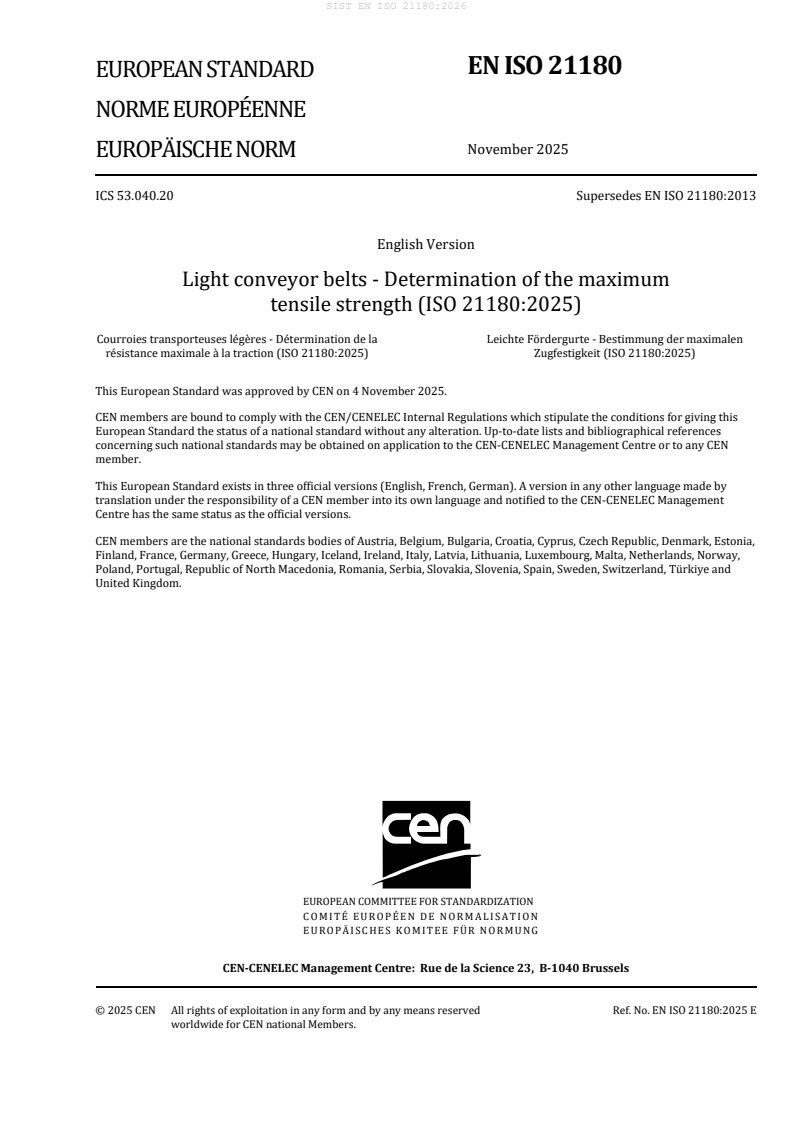
EN ISO 21180
EUROPEAN STANDARD
NORME EUROPÉENNE
November 2025
EUROPÄISCHE NORM
ICS 53.040.20 Supersedes EN ISO 21180:2013
English Version
Light conveyor belts - Determination of the maximum
tensile strength (ISO 21180:2025)
Courroies transporteuses légères - Détermination de la Leichte Fördergurte - Bestimmung der maximalen
résistance maximale à la traction (ISO 21180:2025) Zugfestigkeit (ISO 21180:2025)
This European Standard was approved by CEN on 4 November 2025.
CEN members are bound to comply with the CEN/CENELEC Internal Regulations which stipulate the conditions for giving this
European Standard the status of a national standard without any alteration. Up-to-date lists and bibliographical references
concerning such national standards may be obtained on application to the CEN-CENELEC Management Centre or to any CEN
member.
This European Standard exists in three official versions (English, French, German). A version in any other language made by
translation under the responsibility of a CEN member into its own language and notified to the CEN-CENELEC Management
Centre has the same status as the official versions.
CEN members are the national standards bodies of Austria, Belgium, Bulgaria, Croatia, Cyprus, Czech Republic, Denmark, Estonia,
Finland, France, Germany, Greece, Hungary, Iceland, Ireland, Italy, Latvia, Lithuania, Luxembourg, Malta, Netherlands, Norway,
Poland, Portugal, Republic of North Macedonia, Romania, Serbia, Slovakia, Slovenia, Spain, Sweden, Switzerland, Türkiye and
United Kingdom.
EUROPEAN COMMITTEE FOR STANDARDIZATION
COMITÉ EUROPÉEN DE NORMALISATION
EUROPÄISCHES KOMITEE FÜR NORMUNG
CEN-CENELEC Management Centre: Rue de la Science 23, B-1040 Brussels
© 2025 CEN All rights of exploitation in any form and by any means reserved Ref. No. EN ISO 21180:2025 E
worldwide for CEN national Members.
Contents Page
European foreword . 3
European foreword
This document (EN ISO 21180:2025) has been prepared by Technical Committee ISO/TC 41 "Pulleys
and belts (including veebelts)" in collaboration with Technical Committee CEN/TC 188 “Conveyor belts”
the secretariat of which is held by SNV.
This European Standard shall be given the status of a national standard, either by publication of an
identical text or by endorsement, at the latest by May 2026, and conflicting national standards shall be
withdrawn at the latest by May 2026.
Attention is drawn to the possibility that some of the elements of this document may be the subject of
patent rights. CEN shall not be held responsible for identifying any or all such patent rights.
This document supersedes EN ISO 21180:2013.
Any feedback and questions on this document should be directed to the users’ national standards
body/national committee. A complete listing of these bodies can be found on the CEN website.
According to the CEN-CENELEC Internal Regulations, the national standards organizations of the
following countries are bound to implement this European Standard: Austria, Belgium, Bulgaria,
Croatia, Cyprus, Czech Republic, Denmark, Estonia, Finland, France, Germany, Greece, Hungary, Iceland,
Ireland, Italy, Latvia, Lithuania, Luxembourg, Malta, Netherlands, Norway, Poland, Portugal, Republic of
North Macedonia, Romania, Serbia, Slovakia, Slovenia, Spain, Sweden, Switzerland, Türkiye and the
United Kingdom.
Endorsement notice
The text of ISO 21180:2025 has been approved by CEN as EN ISO 21180:2025 without any modification.
International
Standard
ISO 21180
Third edition
Light conveyor belts —
2025-11
Determination of the maximum
tensile strength
Courroies transporteuses légères — Détermination de la
résistance maximale à la traction
Reference number
ISO 21180:2025(en) © ISO 2025
ISO 21180:2025(en)
© ISO 2025
All rights reserved. Unless otherwise specified, or required in the context of its implementation, no part of this publication may
be reproduced or utilized otherwise in any form or by any means, electronic or mechanical, including photocopying, or posting on
the internet or an intranet, without prior written permission. Permission can be requested from either ISO at the address below
or ISO’s member body in the country of the requester.
ISO copyright office
CP 401 • Ch. de Blandonnet 8
CH-1214 Vernier, Geneva
Phone: +41 22 749 01 11
Email: copyright@iso.org
Website: www.iso.org
Published in Switzerland
ii
ISO 21180:2025(en)
Contents Page
Foreword .iv
1 Scope . 1
2 Normative references . 1
3 Terms and definitions . 1
4 Symbols . 1
5 Principle . 2
6 Apparatus . 2
7 Test pieces . 3
7.1 Shape and dimensions .3
7.2 Number and selection .3
7.3 Conditioning.4
7.4 Preparation .4
8 Test method . 4
8.1 Test room condition .4
8.2 Procedure .4
9 Calculation and expression of results . 5
10 Test report . 5
Bibliography . 6
iii
ISO 21180:2025(en)
Foreword
ISO (the International Organization for Standardization) is a worldwide federation of national standards
bodies (ISO member bodies). The work of preparing International Standards is normally carried out through
ISO technical committees. Each member body interested in a subject for which a technical committee
has been established has the right to be represented on that committee. International organizations,
governmental and non-governmental, in liaison with ISO, also take part in the work. ISO collaborates closely
with the International Electrotechnical Commission (IEC) on all matters of electrotechnical standardization.
The procedures used to develop this document and those intended for its further maintenance are described
in the ISO/IEC Directives, Part 1. In particular, the different approval criteria needed
...