

FprEN 16579
(Main)Playing field equipment - Portable and permanent socketed goals - Functional, safety requirements and test methods
- Abstract
This document is applicable to rugby, Gaelic football, hurling, camogie goals used for competition, training or recreational play, indoor and outdoor areas including educational establishments and public recreational areas.
It specifies the functional and safety requirements and test methods for all types of portable and permanent socketed goals having a total weight greater than 10 kg.
- Status
- Not Published
- Publication Date
- 01-Dec-2026
- Technical Committee
- CEN/TC 136 - Sports, playground and other recreational equipment
- Drafting Committee
- CEN/TC 136/WG 22 - Gymnastic and playing field equipment
- Current Stage
- 5060 - Closure of Vote - Formal Approval
- Start Date
- 24-Sep-2026
- Due Date
- 27-Aug-2027
- Completion Date
- 24-Sep-2026


FprEN 16579 is a CEN draft European Standard for portable and permanent socketed goals used in rugby, Gaelic football, hurling and camogie. It specifies the functional and safety requirements, classification, and test methods for goals used in competition, training or recreational play. It is aimed at manufacturers, suppliers, testers, installers, and operators who need to choose, install, inspect, maintain, or assess this equipment.
What does FprEN 16579 specify?
FprEN 16579 applies to portable and permanent socketed goals with a total weight greater than 10 kg, for indoor and outdoor use, including educational establishments and public recreational areas. The standard covers the whole goal as a complete unit, including fitted parts such as nets, anchors, stabilizers, sockets and transport systems where present.
The document is organized into clauses for scope, normative references, terms and definitions, general provisions, measurements, categorization and classification, requirements, test methods, test reports, assembly/storage/transport/inspection/maintenance, and marking. It also includes six annexes that provide test methods, foundation guidance, typical goal examples, material guidance, inspection guidance, and moving/storage advice.
| Annex | What it covers |
|---|---|
| Annex A | Normative test methods for head, neck, and finger entrapment |
| Annex B | Informative guidance on foundations, sockets, and capping |
| Annex C | Informative selection guidance and examples of typical goals by category |
| Annex D | Informative recommendations for material selection |
| Annex E | Informative inspection and maintenance guidance |
| Annex F | Informative guidance on moving and storage |
What are the key requirements of FprEN 16579?
Classification, use and materials
FprEN 16579 classifies goals by size, weight, and whether they are socketed or portable. This matters because the required strength and stability depend on the category, and buyers need to match the goal to the sport, the users, and the site.
A goal is to be used as a complete unit, not as isolated parts. That means the frame, net, net fixings, anchors, stabilizers and any other required accessories need to be considered together when selecting and checking the product.
Clause 5 requires materials to comply with the appropriate European Standards, and it advises that materials should be selected to avoid hazards from direct skin contact. In practice, this pushes attention toward the full structure and its finish, not only the main frame.
Strength and stability
Clause 6 requires the goal frame of all classes and types to survive the strength test without cracks, fractures, collapse, or detached components. The clause also limits crossbar deformation, so a goal has to stay structurally sound after loading, not only look intact.
Type 2 goals have an additional post-test check after disassembly and re-assembly. That is relevant for portable equipment that will be taken down and put back into service many times.
Stability is tested separately, and the goal must not fall over or keep excessive permanent deflection from the vertical. Socketed goals and portable goals are tested differently because the risk mechanisms are different - one depends on the foundation, the other on anchorage or ballast.
A notable point in the document is that socketed goals must meet the highest strength and stability requirements for their class regardless of weight. This reflects the higher consequence of misuse for semi-permanently installed equipment.
Entrapment, net fixings and net performance
FprEN 16579 requires the goal to be designed so that users are not exposed to crushing, shearing, or entrapment hazards during use, transport, and storage. The assessment uses EN 913:2018+A1:2021, Annex A, together with the additional checks in Annex A of this standard.
Openings in the goal frame are checked for head, neck and finger entrapment, especially when the opening is fully bounded and its lower edge is more than 600 mm above the ground. The standard also controls rope overlap and other non-rigid parts if they create hazardous apertures.
Net fixings must not fracture, deform permanently, or dislodge under test. Metal cup hooks and metal spring cup hooks are not allowed as a means of fixing the net, and the spacing of fixings must not let the intended ball pass through or create an entrapment risk.
The net itself must have a minimum yarn, woven or knitted diameter of 2 mm, and mesh size must suit the intended sport. For Gaelic Football, Camogie and Hurling, the mesh size is limited so that the ball cannot pass through and the mesh cannot create finger, head or neck entrapment. Net strength is checked against EN ISO 1806.
Surface finish, transport, instructions and marking
Clause 6 also requires the surface finish to meet the general safety requirements of EN 913, and any fitted transport system must not release parts unintentionally. In practice, this is about avoiding sharp, loose, or unexpectedly moving parts during handling.
Clauses 9 and 10 focus on safe use over the full life of the goal. The manufacturer must provide written instructions for assembly, installation, transport, storage and maintenance, and portable goals need specific guidance on anchoring, storage, and safe use on the intended surface.
Goals must also carry a durable warning label and product identification, and portable goals must be clearly marked with anchoring-system mounting positions. That supports safe setup, traceability, and routine inspection on site.
What terms does FprEN 16579 define?
- Goal - the target opening or area for ball games, usually formed by two uprights and one crossbar, including permanently fitted parts such as nets, sockets, wheels and handles.
- Portable goal - a goal that is stabilized by a specific anchorage or weight system when erected, and that may also be called a movable or free standing goal.
- Socketed goal - a goal inserted into a permanently fixed foundation so that the combined structure can withstand the required design and test loads.
- Goal frame - the crossbar and uprights that form the goal opening.
- Anchoring system - the system that prevents a portable goal from tipping over, sliding, or moving.
- Entrapment - a situation where a body, body part, or clothing can become trapped and the person cannot free themselves without injury.
- Transport system - the means used to move the goal.
Who uses FprEN 16579?
FprEN 16579 is used by manufacturers, designers, suppliers, test laboratories, installers, and maintenance personnel working with rugby, Gaelic Football, Hurling and Camogie goals. It also supports buyers, facility operators, schools, clubs, and public-site managers who need to choose the right goal, install it correctly, inspect it, store it safely, and keep records.
Annex C is especially relevant for procurement and sport-specific selection, while Annex E and Clause 9 support inspection and maintenance planning. Annex F is useful for anyone responsible for moving goals between locations or storing them out of use.
What changed in FprEN 16579 from the previous edition?
FprEN 16579 supersedes EN 16579:2018+AC:2019. The foreword states these main changes:
- the scope was changed to cover Rugby, Gaelic Football, Hurling and Camogie goals
- the earlier exception for certain large goals covered by EN 748 was removed
- Clause 6 was revised and the specific chapter for Type 2 goals was deleted
- former goal category A was deleted and former category B was renamed as the new category A
- Annex A was updated
- former B.1.3 on net support was deleted
- former C.2.1 to C.2.4, covering Youth football, Small-sided football, Futsal and Mini-football, were deleted
- the document was editorially revised
Which standards are used with FprEN 16579?
FprEN 16579 names two normative references and also states that it is intended to be used with EN 913.
- EN 913:2018+A1:2021 - provides general safety requirements and test methods for gymnastic equipment; FprEN 16579 uses it for entrapment assessment and links to its general safety provisions.
- EN ISO 1806 - gives the method for determining the mesh breaking force of netting; FprEN 16579 uses it to verify net strength.
- EN 913 - the document states that FprEN 16579 is intended to be used in conjunction with EN 913, so the two standards work together for safety-related checks.
What does the FprEN 16579 document contain?
FprEN 16579 contains classification figures and tables for goal types and sizes, including the category system used to identify socketed and portable goals. It also includes a strength test procedure, a stability test procedure, a net-fixing strength test, and a method for measuring net yarn, woven or knitted diameter.
The annexes provide detailed support material for real-world work: Annex A gives probe-based entrapment tests, Annex B gives foundation and socket guidance, and Annex F explains how goals should be moved and stored safely. Annex E adds practical inspection content, including routine checks, operational inspection, main inspection, and record keeping.
The document is therefore useful not only for design and testing, but also for installation, procurement, inspection planning, and safe operation of goals over their service life.
Relations
- Effective Date
- 16-Jul-2025
Frequently Asked Questions
FprEN 16579 is a draft published by the European Committee for Standardization (CEN). Its full title is "Playing field equipment - Portable and permanent socketed goals - Functional, safety requirements and test methods". This standard covers: This document is applicable to rugby, Gaelic football, hurling, camogie goals used for competition, training or recreational play, indoor and outdoor areas including educational establishments and public recreational areas. It specifies the functional and safety requirements and test methods for all types of portable and permanent socketed goals having a total weight greater than 10 kg.
This document is applicable to rugby, Gaelic football, hurling, camogie goals used for competition, training or recreational play, indoor and outdoor areas including educational establishments and public recreational areas. It specifies the functional and safety requirements and test methods for all types of portable and permanent socketed goals having a total weight greater than 10 kg.
FprEN 16579 is classified under the following ICS (International Classification for Standards) categories: 97.220.40 - Outdoor and water sports equipment. The ICS classification helps identify the subject area and facilitates finding related standards.
FprEN 16579 has the following relationships with other standards: It is inter standard links to EN 16579:2018+AC:2019. Understanding these relationships helps ensure you are using the most current and applicable version of the standard.
FprEN 16579 is available in PDF format for immediate download after purchase. The document can be added to your cart and obtained through the secure checkout process. Digital delivery ensures instant access to the complete standard document.
Standards Content (Sample)
SLOVENSKI STANDARD
oSIST prEN 16579:2025
01-december-2025
Oprema športnih igrišč - Premična in nepremična nogometna vrata - Funkcionalne
in varnostne zahteve ter preskusne metode
Playing field equipment - Portable and permanent socketed goals - Functional, safety
requirements and test methods
Spielfeldgeräte - Ortsveränderliche und standortgebundene Tore - Funktionale und
sicherheitstechnische Anforderungen und Prüfverfahren
Équipements de jeux - Buts mobiles et fixes - Exigences fonctionnelles et de sécurité,
méthodes d'essai
Ta slovenski standard je istoveten z: prEN 16579
ICS:
97.220.30 Oprema za dvoranske športe Indoor sports equipment
97.220.40 Oprema za športe na Outdoor and water sports
prostem in vodne športe equipment
oSIST prEN 16579:2025 en,fr,de
2003-01.Slovenski inštitut za standardizacijo. Razmnoževanje celote ali delov tega standarda ni dovoljeno.
oSIST prEN 16579:2025
oSIST prEN 16579:2025
DRAFT
EUROPEAN STANDARD
prEN 16579
NORME EUROPÉENNE
EUROPÄISCHE NORM
October 2025
ICS 97.220.40 Will supersede EN 16579:2018+AC:2019
English Version
Playing field equipment - Portable and permanent
socketed goals - Functional, safety requirements and test
methods
Équipements de jeux - Buts mobiles et fixes - Exigences Spielfeldgeräte - Ortsveränderliche und
fonctionnelles et de sécurité, méthodes d'essai standortgebundene Tore - Funktionale und
sicherheitstechnische Anforderungen und
Prüfverfahren
This draft European Standard is submitted to CEN members for enquiry. It has been drawn up by the Technical Committee
CEN/TC 136.
If this draft becomes a European Standard, CEN members are bound to comply with the CEN/CENELEC Internal Regulations
which stipulate the conditions for giving this European Standard the status of a national standard without any alteration.
This draft European Standard was established by CEN in three official versions (English, French, German). A version in any other
language made by translation under the responsibility of a CEN member into its own language and notified to the CEN-CENELEC
Management Centre has the same status as the official versions.
CEN members are the national standards bodies of Austria, Belgium, Bulgaria, Croatia, Cyprus, Czech Republic, Denmark, Estonia,
Finland, France, Germany, Greece, Hungary, Iceland, Ireland, Italy, Latvia, Lithuania, Luxembourg, Malta, Netherlands, Norway,
Poland, Portugal, Republic of North Macedonia, Romania, Serbia, Slovakia, Slovenia, Spain, Sweden, Switzerland, Türkiye and
United Kingdom.
Recipients of this draft are invited to submit, with their comments, notification of any relevant patent rights of which they are
aware and to provide supporting documentation.
Warning : This document is not a European Standard. It is distributed for review and comments. It is subject to change without
notice and shall not be referred to as a European Standard.
EUROPEAN COMMITTEE FOR STANDARDIZATION
COMITÉ EUROPÉEN DE NORMALISATION
EUROPÄISCHES KOMITEE FÜR NORMUNG
CEN-CENELEC Management Centre: Rue de la Science 23, B-1040 Brussels
© 2025 CEN All rights of exploitation in any form and by any means reserved Ref. No. prEN 16579:2025 E
worldwide for CEN national Members.
oSIST prEN 16579:2025
prEN 16579:2025 (E)
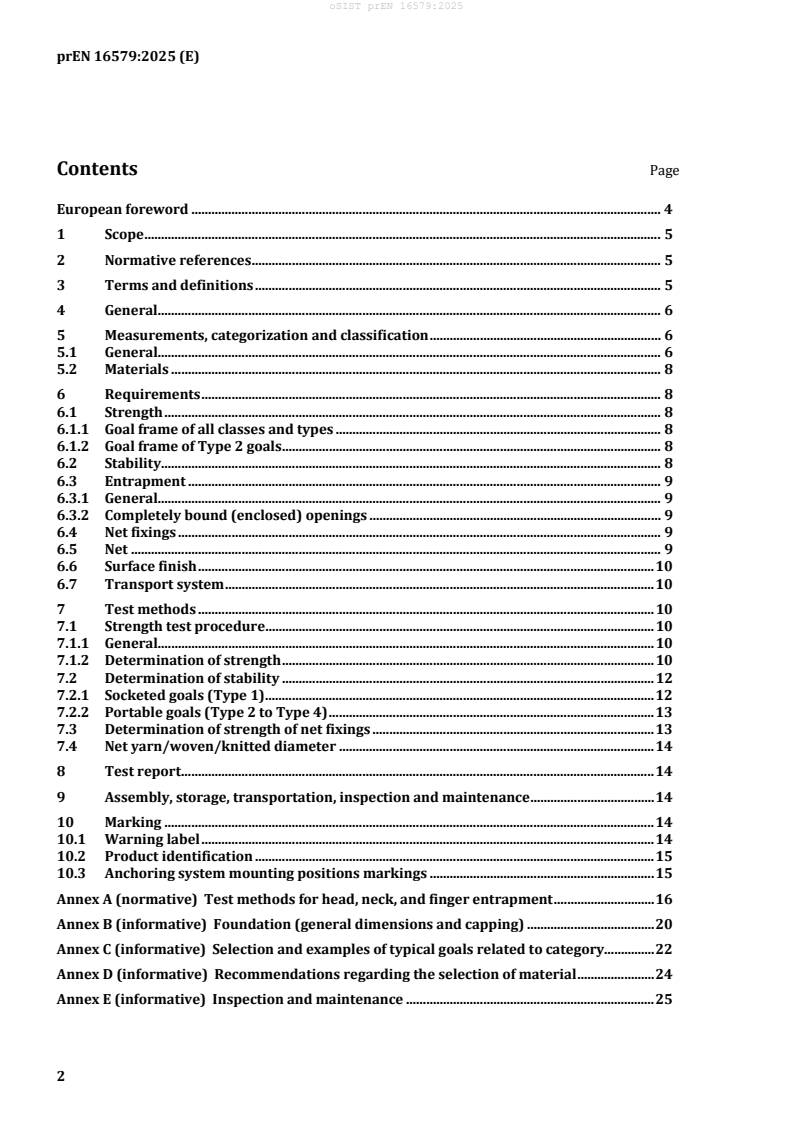
Contents Page
European foreword . 4
1 Scope . 5
2 Normative references . 5
3 Terms and definitions . 5
4 General. 6
5 Measurements, categorization and classification . 6
5.1 General. 6
5.2 Materials . 8
6 Requirements . 8
6.1 Strength . 8
6.1.1 Goal frame of all classes and types . 8
6.1.2 Goal frame of Type 2 goals . 8
6.2 Stability . 8
6.3 Entrapment . 9
6.3.1 General. 9
6.3.2 Completely bound (enclosed) openings . 9
6.4 Net fixings . 9
6.5 Net . 9
6.6 Surface finish . 10
6.7 Transport system . 10
7 Test methods . 10
7.1 Strength test procedure . 10
7.1.1 General. 10
7.1.2 Determination of strength . 10
7.2 Determination of stability . 12
7.2.1 Socketed goals (Type 1) . 12
7.2.2 Portable goals (Type 2 to Type 4) . 13
7.3 Determination of strength of net fixings . 13
7.4 Net yarn/woven/knitted diameter . 14
8 Test report . 14
9 Assembly, storage, transportation, inspection and maintenance . 14
10 Marking . 14
10.1 Warning label . 14
10.2 Product identification . 15
10.3 Anchoring system mounting positions markings . 15
Annex A (normative) Test methods for head, neck, and finger entrapment . 16
Annex B (informative) Foundation (general dimensions and capping) . 20
Annex C (informative) Selection and examples of typical goals related to category . 22
Annex D (informative) Recommendations regarding the selection of material . 24
Annex E (informative) Inspection and maintenance . 25
oSIST prEN 16579:2025
prEN 16579:2025 (E)
Annex F (informative) Moving and storage of goal . 31
Bibliography . 32
oSIST prEN 16579:2025
prEN 16579:2025 (E)
European foreword
This document (prEN 16579:2025) has been prepared by Technical Committee CEN/TC 136 “Sports,
playground and other recreational facilities and equipment”, the secretariat of which is held by DIN.
This document is currently submitted to the CEN Enquiry.
This document will supersede EN 16579:2018+AC:2019.
prEN 16579:2025 includes the following significant technical changes with respect to
EN 16579:2018+AC:2019:
— change of scope: this document is applicable to Rugby, Gaelic Football, Hurling, Camogie goals,
deletion of exception of goals with a size of 5,00 m × 2,00 m and 7,32 m × 2,44 m with a weight
of > 42 kg, which are covered by EN 748 (see Table 1, Footnote b and c);
— change in Clause 6, Requirements: deletion of specific chapter for Type 2 goals;
— deleting former goal category A and rename former goal category B into new category A;
— update of Annex A;
— Deletion of B.1.3, Net support;
— Deletion of C.2.1, Youth football, C.2.2, Small-sided football, C.2.3, Futsal, C.2.4 Mini-football;
— document has been editorial revised.
This document is intended to be used in conjunction with EN 913.
oSIST prEN 16579:2025
prEN 16579:2025 (E)
1 Scope
This document is applicable to Rugby, Gaelic Football, Hurling, Camogie goals used for competition,
training or recreational play, indoor and outdoor areas including educational establishments and public
recreational areas.
It specifies the functional and safety requirements and test methods for all types of portable and
permanent socketed goals having a total weight greater than 10 kg.
2 Normative references
The following documents are referred to in the text in such a way that some or all of their content
constitutes requirements of this document. For dated references, only the edition cited applies. For
undated references, the latest edition of the referenced document (including any amendments) applies.
EN 913:2018+A1:2021, Gymnastic equipment - General safety requirements and test methods
EN ISO 1806, Fishing nets - Determination of mesh breaking force of netting (ISO 1806)
3 Terms and definitions
For the purposes of this document, the following terms and definitions apply.
ISO and IEC maintain terminology databases for use in standardization at the following addresses:
— IEC Electropedia: available at https://www.electropedia.org/
— ISO Online browsing platform: available at https://www.iso.org/obp
3.1
goal
opening or area which forms the target for ball games, usually comprising two uprights and one crossbar
Note 1 to entry: Includes any other parts such as net, net support, net fixing, socket(s), anchoring system(s), wheels
and handles, which are permanently fitted to the goal.
3.2
portable goal
goal structure which, when erected or assembled is stabilised by means of a specific anchorage or weight
system which enables the structure to withstand the required design and test loads
Note 1 to entry: Portable goals can be referred to as movable goals or free standing goals.
Note 2 to entry: See Annex B for more information on portable goals.
3.3
socketed goal
goal structure which is set in a suitably-sized permanent fixed foundation in such a way as to enable the
combined structure to withstand the required design and test loads
Note 1 to entry: See Annex B for foundation information.
3.4
goal frame
crossbar and uprights which form the goal opening
oSIST prEN 16579:2025
prEN 16579:2025 (E)
3.5
net support
attachment which may be fixed to the goal frame for supporting the net
3.6
frame support
framework comprising the side frame and back frame that may support the goal frame
3.7
anchoring system
system for ensuring that a portable goal cannot tip over, slide or displace
3.8
in use
period commencing with the erection of the goals on the field of play and their subsequent use for training
or play
3.9
intended use
purpose for which the goal has been designed and manufactured
3.10
not in use
period commencing with the dismantling of the goal, the subsequent movement and storage after use and
any subsequent period when they are not available for their intended use
3.13
entrapment
hazard presented by the situation in which a body, or part of a body, or clothing can become trapped
Note 1 to entry: EN 16579 only considers certain types of entrapment where the user is not able to free him/herself
and injury is caused by the entrapment.
[SOURCE: EN 913:2018+A1:2021, Annex A modified — The note to entry has been adapted to this
document.]
3.14
transport system
means of moving the goal
4 General
A goal should be used as a complete unit (e.g. goal, net, back bar, anchors, stabilizers, etc.) together with
any other accessories that may be required.
NOTE 1 Sport governing bodies specify additional requirements of a goal within their rules.
NOTE 2 The net is optional.
5 Measurements, categorization and classification
5.1 General
The categories are shown in Figures 1 and 2 and Table 1.
oSIST prEN 16579:2025
prEN 16579:2025 (E)
NOTE See Annex C for examples.
Figure 1 — Goal frame category A
Table 1 — Goal sizes — Category A (height to crossbar/height to top of the crossbar)
Categor Type Class Total weight Size ranges
y
Height to Overall height of
m Width
crossbar uprights
(including net, w H (Gaelic) H
1 2
net fixing and
any
(internal) (to top of the
permanently
crossbar
attached
(Rugby)
anchoring or
stabilizing
system)
kg m m m
A1 1 Socketed — 2,50 ≤ w < 3,0 1,50 ≤ h 1,85 4,50 ± 0,05
a
2 Portable 10,0 < m ≤ 20,0
3 Portable 20,0 < m ≤ 42,0
4 Portable m > 42,0
A2 1 Socketed — 3,00 ≤ w < 4,6 1,85 ≤ h < 2,20 4,50 ± 0,05
a
2 Portable 10,0 < m ≤ 20,0
3 Portable 20,0 < m ≤ 42,0
4 Portable m > 42,0
A3 1 Socketed — 4,60 ≤ w < 6,5 2,20 ≤ h ≤ 2,50 8,50 ± 0,05
a 0
2 Portable 10,0 < m ≤ 20,0
3 Portable 20,0 < m ≤ 42,0
4 Portable m > 42,0
A4 1 Socketed — 4,55 ≤ w < 4,6 2,20 ≤ h ≤ 2,50 6,00 ≤ h ≤ 10,00
1 2
a 5
2 Portable 10,0 < m ≤ 20,0
3 Portable 20,0 < m ≤ 42,0
4 Portable m > 42,0
oSIST prEN 16579:2025
prEN 16579:2025 (E)
A5 1 Socketed — 6,45 ≤ w < 6,5 2,39 ≤ h ≤ 2,49 11,00 ± 0,05
a 5
A6 1 Socketed — 5,50 ≤ w < 6,5 2,44 ≤ h ≤ 3,10 3,40 ≤ h ≤ 16,0
1 2
b 0
b
a
As socketed goals can be left on a playing field they need to satisfy the highest stability and strength
requirements for their Class irrespective of their weight, to minimize the risk of injury in case of misuse.
b
The laws of the game of Rugby Union do not specify any maximum value (see [1]). The maximum value is given
as guidance.
Figure 2 — Dimensions of goal frame category A
5.2 Materials
The selection of materials and their use shall be in accordance with the appropriate European Standards.
Further information for the selection of material is given in Annex D.
The materials should be selected so that potential hazards through direct contact with the skin can be
avoided.
6 Requirements
6.1 Strength
6.1.1 Goal frame of all classes and types
When tested in accordance with 7.1.2 the goal frame of all classes shall not show:
a) visible signs of cracks/fractures or collapse and no frame component shall become detached;
b) a measured deflection (or permanent deformation) d (see Formula (1)) of the crossbar of > 10 mm.
6.1.2 Goal frame of Type 2 goals
When tested in accordance with 7.1.2 the goal frame of Type 2 goals shall not show:
c) a measured deflection (or permanent deformation) d (see Formula (1)) of the crossbar of > 50 mm
after disassembly and re-assembly.
6.2 Stability
When tested in accordance with 7.2, the goal frame of all classes and types of goals shall not fall over,
shall have no permanent deflection from the vertical of 100 mm or greater.
oSIST prEN 16579:2025
prEN 16579:2025 (E)
6.3 Entrapment
6.3.1 General
Goals shall be designed and constructed so that during use, transportation, and storage (if applicable)
there shall be no crushing or shearing hazards between moving parts and/or fixed parts or risk of
entrapment of finger, head and neck when assessed in accordance with the procedure given in
EN 913:2018+A1:2021, Annex A and with the additional requirements according to Annex A of this
document.
6.3.2 Completely bound (enclosed) openings
Openings with a lower edge more than 600 mm above ground shall be tested in accordance with A.2 (goal
frame).
For goal frame probe C shall not pass through any opening unless it also allows the passage of large
probe D.
Non-rigid parts (e.g. ropes) shall not overlap if this creates apertures that are not in accordance with the
above.
6.4 Net fixings
When tested according to 7.3 no visible fracture and/or permanent deformation shall occur at the net
fixings and the net fixing shall not dislodge.
Any opening in the net fixing outside the profile of the goal frame shall not result in entrapment when
tested in accordance with 6.3.
Metal cup hooks and metal spring cup hooks shall not be used as a means of fixing the net to the goal
frame.
The spacing between net fixings shall not allow a ball for which the goal is intended to be used to pass
and shall not create any entrapment in accordance with 6.3.
6.5 Net
Net yarn/woven/knitted shall have a minimum diameter of 2 mm to reduce the risk of cutting, when
tested according to 7.4.
Net dimensions shall comply with the requirements of goal frame dimensions and the associated goal
frame net supports, for which it is intended to be used.
Mesh sizes shall be:
— ≤ 50 mm for Gaelic Football, Camogie and Hurling;
The mesh size shall not allow a ball for which the goal is intended to be used to pass through nor create
any finger, head and neck entrapment when tested in accordance with 6.3.2.
The net shall meet at least the requirement for mesh breaking strength according to Table 2.
oSIST prEN 16579:2025
prEN 16579:2025 (E)
Table 2 — Mesh breaking strength
Minimum Force Test method
N
a EN ISO 1806
792 (660)
a
This corresponds to the breaking strength of the net yarn, tested in accordance with EN ISO 2062.
6.6 Surface finish
The requirements of EN 913:2018+A1:2021, 5.2, shall be met, when assessed by visual inspection and
measurement.
6.7 Transport system
When a transport system is fitted no part of the goal shall disengage or drop unintentionally.
The transport system shall not result in entrapment in accordance with EN 913.
7 Test methods
7.1 Strength test procedure
7.1.1 General
Condition the goal frame for a minimum of 1 h at a temperature of (20 ± 15) °C. This shall be recorded.
Assemble and install the goal ready for use in accordance with the manufacturer's instructions.
7.1.2 Determination of strength
It shall be taken into account that the loadings during the strength test may cause localized settlement of
the uprights. The following procedure shall apply to take this into account:
a) Apply a vertical force at centre of the crossbar using strap of 50 mm nominal width. Apply the vertical
force equal to 80 % of value as defined in Table 3 to allow for bedding in joints, sockets and uprights
+10 s
etc. Hold the force for 1 min . Then remove the force. Ensure the uprights are vertical. If the
0 s
uprights are not vertical adjust them.
b) Measure dimensions a, b, c (defined in Figure 3). These dimensions are called a , b and c ,
1 1 1
respectively.
c) Apply the force to the appropriate value as defined in Table 4 at the centre of the crossbar using a
+10 s
strap of 50 mm nominal width for 1 min . Then remove the force. Note any fracture or other
0 s
damage to the goal.
+1 min
d) After 30 min measure dimensions a, b, c. again. These dimensions are called a , b and c ,
2 2 2
0 min
respectively.
e) Determine the deflection (or deformation) of the centre of the crossbar (d) as follows:
a − a +−bb
( ) ( )
1 2 12
dc= −−c (1)
( )
1 2
oSIST prEN 16579:2025
prEN 16579:2025 (E)
where
a is the internal height of the crossbar at the junction of the left upright before loading;
a is the internal height of the crossbar at the junction of the left upright after loading;
b is the internal height of the crossbar at the junction of the right upright before loading;
b is the internal height of the crossbar at the junction of the right upright after loading;
c is the internal height of the middle crossbar before loading;
c is the internal height of the middle crossbar after loading;
d is the deflection measured at the middle of the crossbar after the release of the loading.
Key
1 centre of crossbar
2 ground
a internal height of the crossbar at the junction of the left upright
b internal height of the crossbar at the junction of the right upright
c internal height of the middle crossbar
F applied load
Figure 3 — Strength Test
oSIST prEN 16579:2025
prEN 16579:2025 (E)
Table 3 — Vertical and horizontal test loadings
Category Type Strength Testing Vertical Stability Testing
Loading Horizontal Loading
N N
A1 1 700 ± 50 700 ± 50
2 300 ± 15 300 ± 15
3 600 ± 30 700 ± 50
4 1 500 ± 50 1 100 ± 50
a2 1 700 ± 50 700 ± 50
2 300 ± 15 300 ± 15
3 600 ± 30 700 ± 50
4 1 500 ± 50 1 100 ± 50
A3 1 2 000 ± 50 1 250 ± 50
2 300 ± 15 300 ± 15
3 600 ± 30 700 ± 50
4 2 000 ± 50 1 250 ± 50
A4 1 1 500 ± 50 1 100 ± 50
2 300 ± 15 300 ± 15
3 600 ± 30 700 ± 50
4 1 500 ± 50 1 100 ± 50
A5 1 2 000 ± 50 1 100 ± 50
A6 1 a a
2 000 ± 50 1 100 ± 50
a
The maximum value of 16,0 m as given in Table 1 is the basis for this loading.
7.2 Determination of stability
7.2.1 Socketed goals (Type 1)
Install the goal and its socket in accordance with the manufacturer's instructions.
Measure the total movement of the upright at the height of the crossbar or 2 m above the ground
(whichever is greater) in forward and backward directions (in the axis of the test direction) when no
external force is being applied.
Record this movement, if any.
Apply a forward horizontal force for the goal size being tested as defined in Table 3 at the top of the centre
+10 s
of the crossbar for 1 min , by means of a strap of 50 mm nominal width and of not less than 5,0 m in
0 s
length.
Measure and record the movement of the upright again as specified above.
Record any falling of the goal and any permanent deformation further as the recorded movement
between socket and upright before the test. If the goal is not vertical after the test measure the deflection
from the vertical at the crossbar height or 2 m above the ground (whichever is greater).
oSIST prEN 16579:2025
prEN 16579:2025 (E)
7.2.2 Portable goals (Type 2 to Type 4)
Install the goal in its normal position of use in accordance with the manufacturer's instructions.
Apply a forward horizontal force for the goal size being tested as defined in Table 3 at the top of the centre
+10 s
of the crossbar for 1 min , by means of a strap of 50 mm nominal width and of not less than 5,0 m in
0 s
length.
For goals fitted with counterweights — stop the goal from sliding with max. 20 mm high blocks before
applying force.
Record any falling of the goal and any permanent deformation.
If the goal is not vertical after the test measure the deflection from the vertical at the crossbar height or
2 m above the ground (whichever is greater).
Repeat the test using, in turn, each of the anchoring systems with which the goal can be supplied and in
each case with the goal anchored on the corresponding playing surface. The test methodology should be
designed in a way that takes into account the possibility of failure and the resultant danger to persons
carrying out the test.
7.3 Determination of strength of net fixings
Secure the goal to prevent movement.
Take a rigid circular disc (400 ± 10) mm in diameter, with rounded edges, with a mass of ≤ 50 N and with
a metal ring at its centre.
Place the disc against the inside face of the net at the point of loading with the ring through the net (see
Figure 4). The disc shall be located at the centre of the net.
Figure 4 — Determination of the strength of the net fixings
Apply the horizontal force to the disc from the outside of the net.
+10
Apply a horizontal force of (800 ± 50) N to the disc at a height of mm in the middle of the goal,
1 000
excluding goals of category A1.
A goal of category A1 shall be tested with a horizontal force of (800 ± 50) N to the disc at a height of
+10
mm in the middle of the goal.
+1
s. Remove the force, note and record the following:
Apply the force for 10
a) any visible fracture and/or permanent deformation to the goal or net fixings;
b) any net fixings that have dislodged.
oSIST prEN 16579:2025
prEN 16579:2025 (E)
7.4 Net yarn/woven/knitted diameter
The diameter shall be measured without applying pressure to the net yarn/woven/knitted.
8 Test report
Test reports shall include at least the following:
— date, name of tester;
— the reference to this document, i.e. EN 16579;
— details of the test conditions (e.g. temperature, surface on which the tests are made);
— details of the goal tested (e.g. classification, type if any);
— details of the condition of the goal included any defects observed before the tests;
— details of any change in the condition of the goal observed after the tests;
— test results.
9 Assembly, storage, transportation, inspection and maintenance
The manufacturer shall provide written instructions for the safe assembly, installation, transportation,
storage and maintenance in the appropriate language(s) of the country in which the goal is to be installed
and used.
For a p
...