

EN 3825:2014
(Main)Aerospace series - Fluorosilicone rubber (FVMQ) - Hardness 60 IRHD
- Abstract
This European Standard specifies the properties of fluorosilicone rubber (FVMQ) ), hardness 60 IRHD, for aerospace applications.
- Status
- Published
- Publication Date
- 16-Dec-2014
- Withdrawal Date
- 29-Jun-2015
- Technical Committee
- ASD-STAN - Aerospace
- Drafting Committee
- ASD-STAN/D 4 - Metallic
- Current Stage
- 9093 - Decision to confirm - Review Enquiry
- Start Date
- 21-Jan-2025
- Completion Date
- 07-Oct-2026



Overview
EN 3825:2014 is a European aerospace standard that specifies the required properties for fluorosilicone rubber (FVMQ) with hardness 60 IRHD intended for aerospace applications. It defines material performance, test methods and acceptance/qualification criteria for FVMQ used in components such as seals, O‑rings and gaskets that must resist aviation fuels, hydraulic fluids and other aerospace service media.
Key topics
- Material and designation
- Applies to fluorosilicone rubber (symbol FVMQ per ISO 1629) with nominal 60 IRHD hardness.
- Service temperature
- Continuous service: −55 °C to 180 °C
- Intermittent service: −55 °C to 200 °C
- Typical compatibility
- Suitable for contact with petroleum‑based fluids: aviation fuels, hydraulic fluids, lubricants, greases, silicone oil and some ester‑based fluids (excluding phosphate esters).
- Mechanical and physical requirements
- Tensile strength: minimum ~5 MPa (qualification level)
- Elongation at break: minimum ~150%
- Compression set: ≤ 25% after 70 h at 150 °C
- Low temperature resistance (TR10): ≤ −55 °C
- Density: batch values must closely match qualification (tolerance ~0.02 Mg/m3)
- Aging and media exposure tests
- Defined exposure regimes (examples from the standard): air 70 h/200 °C, liquid B 70 h/23 °C and Fluid 101 70 h/150 °C (ISO 1817 conditions).
- Permitted property variations after exposure (examples): volume increase, tensile and elongation reductions are limited (e.g., tensile −30% to −40% depending on medium).
- Testing approach
- All tests required for qualification; a subset (marked in the standard) required for batch acceptance.
Applications
- Use EN 3825:2014 when specifying FVMQ parts for:
- Aircraft fuel systems, hydraulic systems and engine compartments
- Sealing elements exposed to aviation fuels, lubricants and silicone oils
- Environmental conditions requiring wide temperature stability and fuel/chemical resistance
Who uses this standard
- Aerospace OEMs, tier suppliers and procurement teams specifying elastomer parts
- Material engineers and designers selecting elastomers for sealing solutions
- Quality, testing and certification staff for production acceptance and qualification
- Rubber compounders and test laboratories performing EN/ISO tests
Related standards
- ISO 1629 (rubber nomenclature)
- ISO 1817 (effect of liquids on vulcanized rubber)
- EN 3207 (Aerospace series - Rubber compounds - Technical specification)
Keywords: EN 3825:2014, fluorosilicone rubber, FVMQ, hardness 60 IRHD, aerospace seals, temperature range, ISO 1817, EN 3207.
Relations
- Effective Date
- 09-Feb-2026
- Effective Date
- 09-Feb-2026
- Effective Date
- 28-Jan-2026
Get Certified
Connect with accredited certification bodies for this standard

BUREAU VERITAS Certification Germany
Bureau Veritas certification in Germany.

Element Materials Technology
Materials testing and product certification.

AQMS Ltd.
AQMS provides ISO certification to SMEs across the UK.
Sponsored listings
Frequently Asked Questions
EN 3825:2014 is a standard published by the European Committee for Standardization (CEN). Its full title is "Aerospace series - Fluorosilicone rubber (FVMQ) - Hardness 60 IRHD". This standard covers: This European Standard specifies the properties of fluorosilicone rubber (FVMQ) ), hardness 60 IRHD, for aerospace applications.
This European Standard specifies the properties of fluorosilicone rubber (FVMQ) ), hardness 60 IRHD, for aerospace applications.
EN 3825:2014 is classified under the following ICS (International Classification for Standards) categories: 49.025.40 - Rubber and plastics. The ICS classification helps identify the subject area and facilitates finding related standards.
EN 3825:2014 has the following relationships with other standards: It is inter standard links to ISO 1629:2013, ISO 1817:2011, EN 3207:1998. Understanding these relationships helps ensure you are using the most current and applicable version of the standard.
EN 3825:2014 is available in PDF format for immediate download after purchase. The document can be added to your cart and obtained through the secure checkout process. Digital delivery ensures instant access to the complete standard document.
Standards Content (Sample)
2003-01.Slovenski inštitut za standardizacijo. Razmnoževanje celote ali delov tega standarda ni dovoljeno.Aeronavtika - Fluorosilikonska guma (FVMQ) - Trdota 60 IRHDLuft- und Raumfahrt - Fluorsilikon - Elastomer (FVMQ) - Härte 60 IRHDSérie aérospatiale - Élastomère fluorosilicone (FVMQ) - Dureté 60 DIDCAerospace series - Fluorosilicone rubber (FVMQ) - Hardness 60 IRHD49.025.40Guma in polimerni materialiRubber and plasticsICS:Ta slovenski standard je istoveten z:EN 3825:2014SIST EN 3825:2015en,fr,de01-marec-2015SIST EN 3825:2015SLOVENSKI
STANDARD
EUROPEAN STANDARD NORME EUROPÉENNE EUROPÄISCHE NORM
EN 3825
December 2014 ICS 49.025.40 English Version
Aerospace series - Fluorosilicone rubber (FVMQ) - Hardness 60 IRHD
Série aérospatiale - Élastomère fluorosilicone (FVMQ) - Dureté 60 DIDC
Luft- und Raumfahrt - Fluorsilikon - Elastomer (FVMQ) - Härte 60 IRHD This European Standard was approved by CEN on 21 June 2014.
CEN members are bound to comply with the CEN/CENELEC Internal Regulations which stipulate the conditions for giving this European Standard the status of a national standard without any alteration. Up-to-date lists and bibliographical references concerning such national standards may be obtained on application to the CEN-CENELEC Management Centre or to any CEN member.
This European Standard exists in three official versions (English, French, German). A version in any other language made by translation under the responsibility of a CEN member into its own language and notified to the CEN-CENELEC Management Centre has the same status as the official versions.
CEN members are the national standards bodies of Austria, Belgium, Bulgaria, Croatia, Cyprus, Czech Republic, Denmark, Estonia, Finland, Former Yugoslav Republic of Macedonia, France, Germany, Greece, Hungary, Iceland, Ireland, Italy, Latvia, Lithuania, Luxembourg, Malta, Netherlands, Norway, Poland, Portugal, Romania, Slovakia, Slovenia, Spain, Sweden, Switzerland, Turkey and United Kingdom.
EUROPEAN COMMITTEE FOR STANDARDIZATION
COMITÉ EUROPÉEN DE NORMALISATION EUROPÄISCHES KOMITEE FÜR NORMUNG
CEN-CENELEC Management Centre:
Avenue Marnix 17,
B-1000 Brussels © 2014 CEN All rights of exploitation in any form and by any means reserved worldwide for CEN national Members. Ref. No. EN 3825:2014 ESIST EN 3825:2015
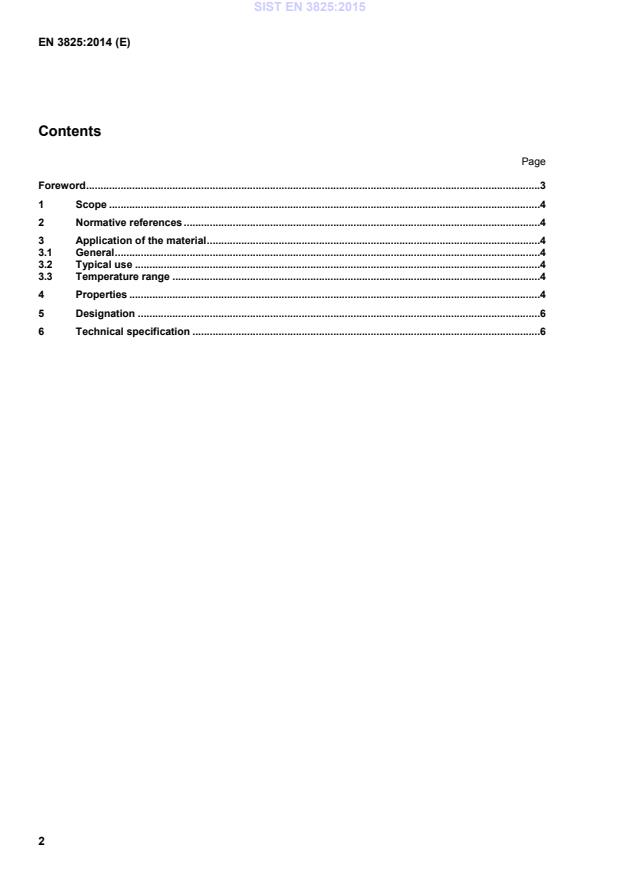
Page Foreword .3 1 Scope .4 2 Normative references .4 3 Application of the material .4 3.1 General .4 3.2 Typical use .4 3.3 Temperature range .4 4 Properties .4 5 Designation .6 6 Technical specification .6
...