


prEN 15475
(Main)Inorganic fertilizers - Titrimetric determination of ammoniacal nitrogen
General Information
- Abstract
This document specifies a method for the titrimetric determination of the ammoniacal nitrogen content in inorganic fertilizers (including compound fertilizers), in which nitrogen is found exclusively either in the form of ammonium salts or ammonium salts together with nitrates.
This document is applicable to the fertilizing products blends where a blend is a mix of at least two of the following components: fertilizers, liming materials, soil improvers, growing media, inhibitors, plant biostimulants and where the following category: inorganic fertilizers is the highest % in the blend by mass or volume, or in the case of liquid form by dry mass. If inorganic fertilizers are not the highest % in the blend, the European Standard for the highest % of the blend applies. In case a fertilizing product blend is composed of components in equal quantity, the user decides which standard to apply. Variations in analytical methods for fertilizing product blends can lead to differing results as some components or matrix interactions can affect the outcome. Validation procedures have shown that developed standard methods are robust and reliable across diverse product compositions, but possible interferences and unexpected results when analysing fertilizing product blends are possible.
In the case of application to ammonium nitrate fertilizers of high nitrogen content, this document is not applicable to fertilizer product blends.
This document is not applicable to fertilizers or fertilizer product blends containing urea, cyanamide, nutrient polymers or other organic nitrogenous compounds.
- Status
- Not Published
- Publication Date
- 13-Jan-2027
- Technical Committee
- CEN/TC 260 - Fertilizers and liming materials
- Drafting Committee
- CEN/TC 260/WG 7 - Chemical analysis
- Current Stage
- 4599 - Dispatch of FV draft to CMC - Finalization for Vote
- Start Date
- 16-Jul-2026
- Due Date
- 24-Apr-2027
- Completion Date
- 16-Jul-2026

Overview
prEN 15475 is a draft European Standard developed by CEN (European Committee for Standardization) that specifies a titrimetric method for determining ammoniacal nitrogen in inorganic fertilizers. This method is designed for use with fertilizers where nitrogen is present exclusively as ammonium salts or as ammonium salts combined with nitrates. The standard is applicable to both straight and compound inorganic fertilizers and their blends, provided inorganic fertilizer is the main component by mass or volume.
This standard aims to ensure accuracy, consistency, and reliability in the analysis of ammoniacal nitrogen, supporting compliance with regulatory requirements and enhancing quality control in fertilizer production and trade across Europe.
Key Topics
Scope of Application:
- Applies to inorganic fertilizers and blends where inorganic fertilizers constitute the highest percentage.
- Not applicable to fertilizers or blends containing organic nitrogen forms such as urea, cyanamide, nutrient polymers, or other organic nitrogenous compounds.
- Excludes high-nitrogen ammonium nitrate fertilizers in blends.
Analytical Procedure:
- Uses titrimetric determination through ammonia distillation and titration.
- Conversion of ammoniacal nitrogen to ammonia, followed by distillation and back-titration with standard solutions.
Sampling and Sample Preparation:
- Requires representative sampling and preparation in line with EN 1482 standards.
- Details are provided for weighing, dilution, and control tests to ensure accuracy.
Precision and Reliability:
- Developed through inter-laboratory validation, ensuring method robustness and high reliability across various fertilizer compositions.
- Includes guidance on repeatability, reproducibility, and how to handle potential matrix effects and interferences, especially in blended products.
Reporting and Documentation:
- Specifies the necessary information for test reports to ensure transparency and traceability, including method references, sample identification, and detailed results.
Applications
The titrimetric method described in prEN 15475 provides essential tools for:
- Fertilizer Manufacturers: To certify the ammoniacal nitrogen content in their inorganic fertilizer products for regulatory compliance and labelling.
- Quality Control Laboratories: To perform standardized, comparable analyses on different types of inorganic fertilizers and blends where ammoniacal nitrogen determination is critical.
- Agricultural Testing Facilities: When analyzing fertilizer blends used in crop production, ensuring that nutrient inputs are accurately quantified for optimal field management.
- Regulatory Bodies: To enforce fertilizer regulations by harmonizing analytical methodologies across European member states, fostering fair trade and consumer protection.
- R&D and Product Development: For developing new fertilizer formulations and evaluating their chemical characteristics.
Related Standards
prEN 15475 is part of a suite of European and international standards for fertilizer analysis and quality assurance, including:
- EN 1482 (Parts 1, 2, 3) - Fertilizers, liming materials and inhibitors - Sampling and sample preparation
- EN 12944-1 & EN 12944-2 - Vocabulary for fertilizers and liming materials
- ISO 5725-1 - Accuracy (trueness and precision) of measurement methods and results
These related documents provide definitions, sampling protocols, and analytical principles that support and complement the use of prEN 15475 in the fertilizer industry.
By following prEN 15475, stakeholders in the fertilizer sector can perform accurate, reliable, and harmonized titrimetric determinations of ammoniacal nitrogen in inorganic fertilizers, supporting both product quality and regulatory compliance.
Relations
- Effective Date
- 23-Jul-2025
Get Certified
Connect with accredited certification bodies for this standard

Control Union Certifications
Global certification for agriculture and sustainability.

ECOCERT
Organic and sustainability certification.

FSC International
Forest Stewardship Council certification.
Sponsored listings
Frequently Asked Questions
prEN 15475 is a draft published by the European Committee for Standardization (CEN). Its full title is "Inorganic fertilizers - Titrimetric determination of ammoniacal nitrogen". This standard covers: This document specifies a method for the titrimetric determination of the ammoniacal nitrogen content in inorganic fertilizers (including compound fertilizers), in which nitrogen is found exclusively either in the form of ammonium salts or ammonium salts together with nitrates. This document is applicable to the fertilizing products blends where a blend is a mix of at least two of the following components: fertilizers, liming materials, soil improvers, growing media, inhibitors, plant biostimulants and where the following category: inorganic fertilizers is the highest % in the blend by mass or volume, or in the case of liquid form by dry mass. If inorganic fertilizers are not the highest % in the blend, the European Standard for the highest % of the blend applies. In case a fertilizing product blend is composed of components in equal quantity, the user decides which standard to apply. Variations in analytical methods for fertilizing product blends can lead to differing results as some components or matrix interactions can affect the outcome. Validation procedures have shown that developed standard methods are robust and reliable across diverse product compositions, but possible interferences and unexpected results when analysing fertilizing product blends are possible. In the case of application to ammonium nitrate fertilizers of high nitrogen content, this document is not applicable to fertilizer product blends. This document is not applicable to fertilizers or fertilizer product blends containing urea, cyanamide, nutrient polymers or other organic nitrogenous compounds.
This document specifies a method for the titrimetric determination of the ammoniacal nitrogen content in inorganic fertilizers (including compound fertilizers), in which nitrogen is found exclusively either in the form of ammonium salts or ammonium salts together with nitrates. This document is applicable to the fertilizing products blends where a blend is a mix of at least two of the following components: fertilizers, liming materials, soil improvers, growing media, inhibitors, plant biostimulants and where the following category: inorganic fertilizers is the highest % in the blend by mass or volume, or in the case of liquid form by dry mass. If inorganic fertilizers are not the highest % in the blend, the European Standard for the highest % of the blend applies. In case a fertilizing product blend is composed of components in equal quantity, the user decides which standard to apply. Variations in analytical methods for fertilizing product blends can lead to differing results as some components or matrix interactions can affect the outcome. Validation procedures have shown that developed standard methods are robust and reliable across diverse product compositions, but possible interferences and unexpected results when analysing fertilizing product blends are possible. In the case of application to ammonium nitrate fertilizers of high nitrogen content, this document is not applicable to fertilizer product blends. This document is not applicable to fertilizers or fertilizer product blends containing urea, cyanamide, nutrient polymers or other organic nitrogenous compounds.
prEN 15475 is classified under the following ICS (International Classification for Standards) categories: 65.080 - Fertilizers. The ICS classification helps identify the subject area and facilitates finding related standards.
prEN 15475 has the following relationships with other standards: It is inter standard links to EN 15475:2009. Understanding these relationships helps ensure you are using the most current and applicable version of the standard.
prEN 15475 is associated with the following European legislation: EU Directives/Regulations: 2019/1009; Standardization Mandates: M/564, M/564 AMD 1, M/564 AMD 2. When a standard is cited in the Official Journal of the European Union, products manufactured in conformity with it benefit from a presumption of conformity with the essential requirements of the corresponding EU directive or regulation.
prEN 15475 is available in PDF format for immediate download after purchase. The document can be added to your cart and obtained through the secure checkout process. Digital delivery ensures instant access to the complete standard document.
Standards Content (Sample)
SLOVENSKI STANDARD
01-marec-2026
Anorganska gnojila - Titrimetrijsko določanje amonijevega dušika
Inorganic fertilizers - Titrimetric determination of ammoniacal nitrogen
Anorganische Düngemittel - Titrimetrische Bestimmung von Ammoniumstickstoff
Engrais inorganiques - Dosage titrimétrique de l’azote ammoniacal
Ta slovenski standard je istoveten z: prEN 15475
ICS:
65.080 Gnojila Fertilizers
2003-01.Slovenski inštitut za standardizacijo. Razmnoževanje celote ali delov tega standarda ni dovoljeno.
DRAFT
EUROPEAN STANDARD
NORME EUROPÉENNE
EUROPÄISCHE NORM
January 2026
ICS 65.080 Will supersede EN 15475:2009
English Version
Inorganic fertilizers - Titrimetric determination of
ammoniacal nitrogen
Engrais inorganiques - Dosage titrimétrique de l'azote Anorganische Düngemittel - Titrimetrische
ammoniacal Bestimmung von Ammoniumstickstoff
This draft European Standard is submitted to CEN members for enquiry. It has been drawn up by the Technical Committee
CEN/TC 260.
If this draft becomes a European Standard, CEN members are bound to comply with the CEN/CENELEC Internal Regulations
which stipulate the conditions for giving this European Standard the status of a national standard without any alteration.
This draft European Standard was established by CEN in three official versions (English, French, German). A version in any other
language made by translation under the responsibility of a CEN member into its own language and notified to the CEN-CENELEC
Management Centre has the same status as the official versions.
CEN members are the national standards bodies of Austria, Belgium, Bulgaria, Croatia, Cyprus, Czech Republic, Denmark, Estonia,
Finland, France, Germany, Greece, Hungary, Iceland, Ireland, Italy, Latvia, Lithuania, Luxembourg, Malta, Netherlands, Norway,
Poland, Portugal, Republic of North Macedonia, Romania, Serbia, Slovakia, Slovenia, Spain, Sweden, Switzerland, Türkiye and
United Kingdom.
Recipients of this draft are invited to submit, with their comments, notification of any relevant patent rights of which they are
aware and to provide supporting documentation.
Warning : This document is not a European Standard. It is distributed for review and comments. It is subject to change without
notice and shall not be referred to as a European Standard.
EUROPEAN COMMITTEE FOR STANDARDIZATION
COMITÉ EUROPÉEN DE NORMALISATION
EUROPÄISCHES KOMITEE FÜR NORMUNG
CEN-CENELEC Management Centre: Rue de la Science 23, B-1040 Brussels
© 2026 CEN All rights of exploitation in any form and by any means reserved Ref. No. prEN 15475:2026 E
worldwide for CEN national Members.
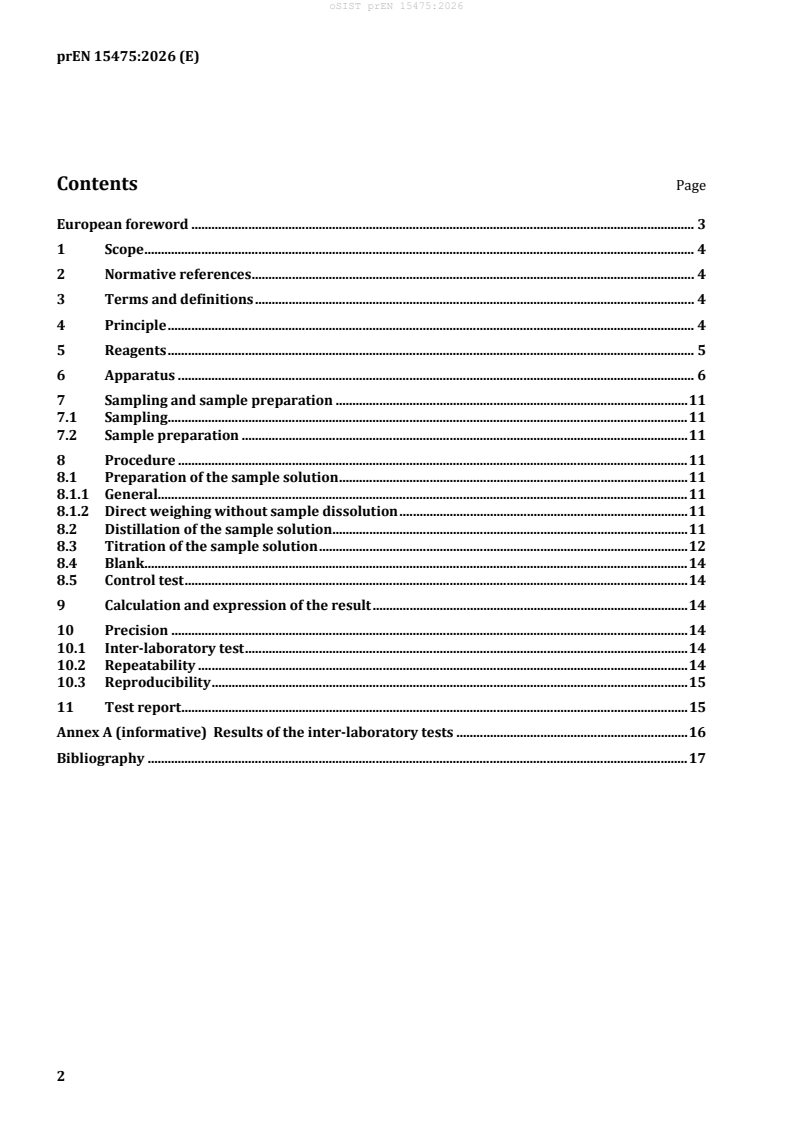
Contents Page
European foreword . 3
1 Scope . 4
2 Normative references . 4
3 Terms and definitions . 4
4 Principle . 4
5 Reagents . 5
6 Apparatus . 6
7 Sampling and sample preparation . 11
7.1 Sampling . 11
7.2 Sample preparation . 11
8 Procedure . 11
8.1 Preparation of the sample solution . 11
8.1.1 General. 11
8.1.2 Direct weighing without sample dissolution . 11
8.2 Distillation of the sample solution. 11
8.3 Titration of the sample solution . 12
8.4 Blank . 14
8.5 Control test . 14
9 Calculation and expression of the result . 14
10 Precision . 14
10.1 Inter-laboratory test . 14
10.2 Repeatability . 14
10.3 Reproducibility . 15
11 Test report . 15
Annex A (informative) Results of the inter-laboratory tests . 16
Bibliography . 17
European foreword
This document (prEN 15475:2026) has been prepared by Technical Committee CEN/TC 260 “Fertilizers
and liming materials”, the secretariat of which is held by DIN.
This document is currently submitted to CEN Enquiry.
This document will supersede EN 15475:2009.
a) measurement principle added to title;
b) normative references revised;
c) references to Regulation (EC) No 2003/2003 removed;
d) specifications for water revised;
e) reagents and apparatus revised;
f) explanatory notes added.
This document has been prepared under a Standardization Request addressed to CEN by the European
Commission. The Standing Committee of the EFTA States subsequently approves these requests for its
Member States.
1 Scope
This document specifies a method for the titrimetric determination of the ammoniacal nitrogen content
in inorganic fertilizers (including compound fertilizers), in which nitrogen is found exclusively either in
the form of ammonium salts or ammonium salts together with nitrates.
This document is applicable to the fertilizing products blends where a blend is a mix of at least two of the
following components: fertilizers, liming materials, soil improvers, growing media, inhibitors, plant
biostimulants and where the following category: inorganic fertilizers is the highest % in the blend by
mass or volume, or in the case of liquid form by dry mass. If inorganic fertilizers are not the highest % in
the blend, the European Standard for the highest % of the blend applies. In case a fertilizing product blend
is composed of components in equal quantity, the user decides which standard to apply. Variations in
analytical methods for fertilizing product blends can lead to differing results as some components or
matrix interactions can affect the outcome. Validation procedures have shown that developed standard
methods are robust and reliable across diverse product compositions, but possible interferences and
unexpected results when analysing fertilizing product blends are possible.
In the case of application to ammonium nitrate fertilizers of high nitrogen content, this document is not
applicable to fertilizer product blends.
This document is not applicable to fertilizers or fertilizer product blends containing urea, cyanamide,
nutrient polymers or other organic nitrogenous compounds.
2 Normative references
The following documents are referred to in the text in such a way that some or all of their content
constitutes requirements of this document. For dated references, only the edition cited applies. For
undated references, the latest edition of the referenced document (including any amendments) applies.
EN 1482-2, Fertilizers, liming materials and inhibitors — Sampling and sample preparation — Part 2:
General sample preparation provisions
EN 12944-1, Fertilizers and liming materials — Vocabulary — Part 1: General terms
EN 12944-2, Fertilizers and liming materials — Vocabulary — Part 2: Terms relating to fertilizers
3 Terms and definitions
For the purposes of this document, the terms and definitions given in EN 12944-1 and EN 12944-2 apply.
ISO and IEC maintain terminology databases for use in standardization at the following addresses:
— ISO Online browsing platform: available at https://www.iso.org/obp
— IEC Electropedia: available at https://www.electropedia.org/
4 Principle
An excess of sodium hydroxide solution is added to the sample. This converts the ammoniacal nitrogen
contained into ammonia, which is transferred into a known volume of sulphuric acid standard solution
by distillation. The excess acid is determined by titration with sodium hydroxide or potassium hydroxide
standard solution.
5 Reagents
Use only reagents of recognized analytical grade.
5.1 Water. The electrical conductivity of distilled or demineralized water used in the analysis shall at
least be < 0,5 mS/m (at 25 °C).
5.2 Hydrochloric acid, c = 12 mol/l, w = 37 %, ρ20 °C = 1,18 g/ml.
°C = 1,10 g/ml.
5.3 Hydrochloric acid solution, c = 6 mol/l, w = 20 %, ρ20
In a fume cupboard, transfer 500 mL of hydrochloric acid (5.2) into a 1000 mL volumetric flask and dilute
to the mark with water.
5.4 Sulfuric acid standard solution, c = 0,05 mol/l.
For variant a, see 8.3.
5.5 Sodium or potassium hydroxide standard solution, c = 0,1 mol/l, carbonate free.
For variant a, see 8.3.
5.6 Sulfuric acid standard solution, c = 0,1 mol/l.
For variant b, see 8.3.
5.7 Sodium or potassium hydroxide standard solution, c = 0,2 mol/l, carbonate free.
For variant b, see 8.3.
5.8 Sulfuric acid standard solution, c = 0,25 mol/l.
For variant c, see 8.3.
5.9 Sodium or potassium hydroxide standard solution, c = 0,5 mol/l, carbonate free.
For variant c, see 8.3.
5.10 Concentrated sodium hydroxide solution, c = 10 mol/l, w = 30 %, ρ °C = 1,33 g/ml, ammonia
free.
5.11 Methyl red.
5.12 Methylene blue.
5.13 Ethanol, φ = 95 %.
5.14 Indicator solutions.
5.14.1 Mixed indicator.
Solution A: Dissolve 1 g of methyl red (5.11) in 37 ml of sodium hydroxide solution (5.5) and make up
to 1 l with water.
Solution B: Dissolve 1 g of methylene blue (5.12) in water and make up to 1 l.
Mix one volume of A with two volumes of B.
This indicator is violet in acid solution, grey in neutral solution and green in alkaline solution. Use 0,5 ml
(10 drops) of this indicator solution.
5.14.2 Methyl red indicator solution.
Dissolve 0,1 g of methyl red (5.11) in 50 ml of ethanol (5.13). Make up to 100 ml with water and filter if
necessary. This indicator may be used (4 to 5 drops) instead of the preceding one. This indicator is red in
acid solution and yellow in alkaline solution.
5.15 Ammonium sulfate.
6 Apparatus
6.1 Balance, with a readability of ≤ 0,001 g.
6.2 Graduated flasks, capacity 500 ml.
6.3 Pipettes, capacity of 10 ml, 20 ml, 25 ml, 50 ml, 100 ml and 200 ml.
6.4 Rotary shaker, 35 to 40 r/min.
6.5 Filter, free of nitrogen, e.g. 100 % cellulose
6.6 Distillation apparatus.
Consisting of a round-bottomed flask of suitable capacity connected to a condenser by means of a splash
head. The equipment is made of borosilicate glass.
Figures 1 to 4 show possible different types of equipment for this determination via non-automated
distillation, including all construction features.
Alternatively, automated distillation and/or titration apparatuses equipped with sensors for photometric
determination or with pH electrodes for potentiometric determination may be used. The operator shall
demonstrate, by means of statistically equivalent results, that the automated devices comply with the
precision criteria specified in Annex A. The operation shall comply with the necessary safety precautions
and the corresponding user manuals, including the precautions required to avoid ammonia loss.
6.7 Anti-bump granules, i.e. pumice stone, glass pearls, washed in hydrochloric acid and calcined.
Dimensions in millimetres
Key
1 round-bottomed, long-necked flask of 1 000 ml capacity
2 distillation tube with a splash head, connected to the condenser by means of a spherical joint (No 18) (the
spherical joint for the connection to the condenser may be replaced by an appropriate rubber connection)
3 funnel with a polytetrafluoroethylene (PTFE) tap (6) for the addition of sodium hydroxide
4 six-bulb condenser with spherical joint (No 18) at the entrance, and joined at the issue to a glass extension
tube by means of a small rubber connection (when the connection to the distillation tube is effected by means of a
rubber tube, the spherical joint may be replaced by a suitable rubber bung)
5 500-ml-flask in which the distillate is collected
6 PTFE-tap (the tap may l
...