

prEN 13857-3
(Main)Explosives for civil uses - Part 3: Information to be provided by the manufacturer or his authorized representative to the user
- Abstract
This document specifies information to be provided by a manufacturer of explosives for civil uses, or his authorized representative, to the notified body and the user.
- Status
- Not Published
- Publication Date
- 28-Nov-2022
- Technical Committee
- CEN/TC 321 - Explosives for civil uses
- Drafting Committee
- CEN/TC 321/WG 6 - Explosives and propellants
- Current Stage
- 4098 - Decision to abandon - Enquiry
- Start Date
- 09-Nov-2022
- Completion Date
- 07-Oct-2026

Overview
prEN 13857-3 (CEN) - Explosives for civil uses - Part 3: Information to be provided by the manufacturer or his authorised representative to the user - defines the information that manufacturers or their authorised representatives must supply to both the notified body and the user. The draft standard updates and expands earlier editions to align with legislative requirements (Directive 2014/28/EU) and technical developments in civil explosives, detonators, detonating cords, propellants and electronic initiation systems.
Key Topics and Requirements
- Scope and parties: Applies to manufacturers and authorised representatives who market explosives for civil uses; information is provided to notified bodies and end users.
- Use-by date: Manufacturers must state a clear use-by date and supply supporting background data (e.g., ageing tests or storage evidence) to justify the period.
- Chemical purity: For single-compound explosives, the analytical method used to determine purity and methods for quantifying impurities must be declared.
- General product information: Mandatory details include suitability for specific conditions (e.g., underground, dusty atmospheres, wet conditions, underwater use and hydrostatic pressure), recommended pressure ranges, and any restrictions (e.g., above-ground use only).
- Temperature and storage: The operational temperature range and the storage temperature/humidity requirements necessary to guarantee safety up to the use-by date must be specified.
- Disposal guidance: Safe handling and disposal procedures for unused explosives or product beyond the use-by date are required.
- Product-specific data: Additional information is required for product groups such as detonators, detonating cords, propellants and electronic initiation systems - including initiation capability, delay characteristics, electrical parameters (for electric detonators), and resistance to dynamic pressure.
- Supporting technical annexes: Informative annexes provide methods and guidance for detonation calculations, sample calculations, theoretical verification, toxic gas measurement, and delay accuracy presentation.
Applications and Who Uses It
- Manufacturers / authorised representatives: To prepare compliant technical documentation, labels and safety instructions.
- Notified bodies and conformity assessors: To evaluate safety data and compliance with EU requirements.
- End users and procurement teams: For safe selection, storage, handling and disposal of explosives in mining, construction, demolition and fireworks sectors.
- Safety managers and testing labs: For risk assessment, ageing tests, purity analysis and toxic-gas measurement.
Related Standards
- prEN 13857-1 (Terminology)
- prEN 13631-1 and prEN 13631-10 (Explosives - requirements and initiation verification)
- Directive 2014/28/EU (relationship and essential safety requirements)
Keywords: explosives for civil uses, manufacturer information, use-by date, chemical purity, storage, disposal, detonators, electronic initiation, CEN, prEN 13857-3.
Relations
- Effective Date
- 23-Oct-2019
Get Certified
Connect with accredited certification bodies for this standard

ECOCERT
Organic and sustainability certification.

Eurofins Food Testing Global
Global leader in food, environment, and pharmaceutical product testing.

Intertek Bangladesh
Intertek certification and testing services in Bangladesh.
Sponsored listings
Frequently Asked Questions
prEN 13857-3 is a draft published by the European Committee for Standardization (CEN). Its full title is "Explosives for civil uses - Part 3: Information to be provided by the manufacturer or his authorized representative to the user". This standard covers: This document specifies information to be provided by a manufacturer of explosives for civil uses, or his authorized representative, to the notified body and the user.
This document specifies information to be provided by a manufacturer of explosives for civil uses, or his authorized representative, to the notified body and the user.
prEN 13857-3 is classified under the following ICS (International Classification for Standards) categories: 71.100.30 - Explosives. Pyrotechnics and fireworks. The ICS classification helps identify the subject area and facilitates finding related standards.
prEN 13857-3 has the following relationships with other standards: It is inter standard links to EN 13857-3:2002. Understanding these relationships helps ensure you are using the most current and applicable version of the standard.
prEN 13857-3 is associated with the following European legislation: EU Directives/Regulations: 2014/28/EU; Standardization Mandates: M/055, M/562. When a standard is cited in the Official Journal of the European Union, products manufactured in conformity with it benefit from a presumption of conformity with the essential requirements of the corresponding EU directive or regulation.
prEN 13857-3 is available in PDF format for immediate download after purchase. The document can be added to your cart and obtained through the secure checkout process. Digital delivery ensures instant access to the complete standard document.
Standards Content (Sample)
SLOVENSKI STANDARD
01-julij-2021
Eksplozivi za civilno uporabo - 3. del: Informacije, ki jih mora proizvajalec ali
njegov pooblaščeni predstavnik posredovati uporabniku
Explosives for civil uses - Part 3: Information to be provided by the manufacturer or his
authorised representative to the user
Explosivstoffe für zivile Zwecke - Teil 3: Informationen, die vom Hersteller oder seinem
Bevollmächtigten dem Verwender zur Verfügung zu stellen sind
Explosifs à usage civil - Partie 3: Informations à fournir par le fabricant ou par son
représentant à l'utilisateur
Ta slovenski standard je istoveten z: prEN 13857-3
ICS:
71.100.30 Eksplozivi. Pirotehnika in Explosives. Pyrotechnics and
ognjemeti fireworks
2003-01.Slovenski inštitut za standardizacijo. Razmnoževanje celote ali delov tega standarda ni dovoljeno.
DRAFT
EUROPEAN STANDARD
NORME EUROPÉENNE
EUROPÄISCHE NORM
July 2021
ICS 71.100.30 Will supersede EN 13857-3:2002
English Version
Explosives for civil uses - Part 3: Information to be
provided by the manufacturer or his authorised
representative to the user
Explosifs à usage civil - Partie 3: Informations à fournir Explosivstoffe für zivile Zwecke - Teil 3: Informationen,
par le fabricant ou par son représentant à l'utilisateur die vom Hersteller oder seinem Bevollmächtigten dem
Verwender zur Verfügung zu stellen sind
This draft European Standard is submitted to CEN members for enquiry. It has been drawn up by the Technical Committee
CEN/TC 321.
If this draft becomes a European Standard, CEN members are bound to comply with the CEN/CENELEC Internal Regulations
which stipulate the conditions for giving this European Standard the status of a national standard without any alteration.
This draft European Standard was established by CEN in three official versions (English, French, German). A version in any other
language made by translation under the responsibility of a CEN member into its own language and notified to the CEN-CENELEC
Management Centre has the same status as the official versions.
CEN members are the national standards bodies of Austria, Belgium, Bulgaria, Croatia, Cyprus, Czech Republic, Denmark, Estonia,
Finland, France, Germany, Greece, Hungary, Iceland, Ireland, Italy, Latvia, Lithuania, Luxembourg, Malta, Netherlands, Norway,
Poland, Portugal, Republic of North Macedonia, Romania, Serbia, Slovakia, Slovenia, Spain, Sweden, Switzerland, Turkey and
United Kingdom.
Recipients of this draft are invited to submit, with their comments, notification of any relevant patent rights of which they are
aware and to provide supporting documentation.
Warning : This document is not a European Standard. It is distributed for review and comments. It is subject to change without
notice and shall not be referred to as a European Standard.
EUROPEAN COMMITTEE FOR STANDARDIZATION
COMITÉ EUROPÉEN DE NORMALISATION
EUROPÄISCHES KOMITEE FÜR NORMUNG
CEN-CENELEC Management Centre: Rue de la Science 23, B-1040 Brussels
© 2021 CEN All rights of exploitation in any form and by any means reserved Ref. No. prEN 13857-3:2021 E
worldwide for CEN national Members.
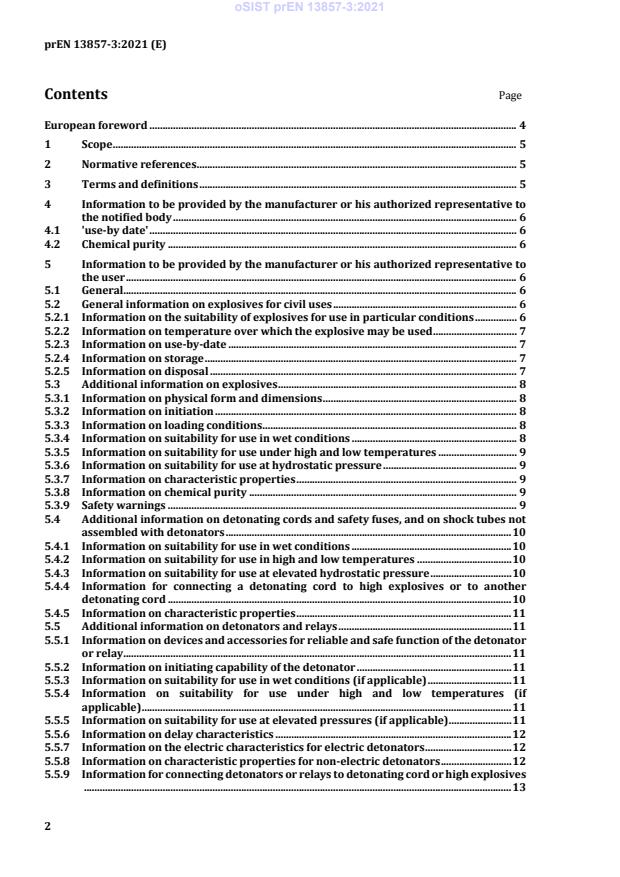
Contents Page
European foreword . 4
1 Scope . 5
2 Normative references . 5
3 Terms and definitions . 5
4 Information to be provided by the manufacturer or his authorized representative to
the notified body . 6
4.1 'use-by date' . 6
4.2 Chemical purity . 6
5 Information to be provided by the manufacturer or his authorized representative to
the user . 6
5.1 General. 6
5.2 General information on explosives for civil uses . 6
5.2.1 Information on the suitability of explosives for use in particular conditions . 6
5.2.2 Information on temperature over which the explosive may be used . 7
5.2.3 Information on use-by-date . 7
5.2.4 Information on storage . 7
5.2.5 Information on disposal . 7
5.3 Additional information on explosives . 8
5.3.1 Information on physical form and dimensions . 8
5.3.2 Information on initiation . 8
5.3.3 Information on loading conditions . 8
5.3.4 Information on suitability for use in wet conditions . 8
5.3.5 Information on suitability for use under high and low temperatures . 9
5.3.6 Information on suitability for use at hydrostatic pressure . 9
5.3.7 Information on characteristic properties . 9
5.3.8 Information on chemical purity . 9
5.3.9 Safety warnings . 9
5.4 Additional information on detonating cords and safety fuses, and on shock tubes not
assembled with detonators . 10
5.4.1 Information on suitability for use in wet conditions . 10
5.4.2 Information on suitability for use in high and low temperatures . 10
5.4.3 Information on suitability for use at elevated hydrostatic pressure . 10
5.4.4 Information for connecting a detonating cord to high explosives or to another
detonating cord . 10
5.4.5 Information on characteristic properties . 11
5.5 Additional information on detonators and relays . 11
5.5.1 Information on devices and accessories for reliable and safe function of the detonator
or relay. 11
5.5.2 Information on initiating capability of the detonator . 11
5.5.3 Information on suitability for use in wet conditions (if applicable) . 11
5.5.4 Information on suitability for use under high and low temperatures (if
applicable) . 11
5.5.5 Information on suitability for use at elevated pressures (if applicable) . 11
5.5.6 Information on delay characteristics . 12
5.5.7 Information on the electric characteristics for electric detonators . 12
5.5.8 Information on characteristic properties for non-electric detonators . 12
5.5.9 Information for connecting detonators or relays to detonating cord or high explosives
................................................................................................................................................................... 13
5.6 Additional information on propellants . 13
5.7 Additional information on electronic initiation systems . 13
5.7.1 Information on resistance to dynamic pressure for electronic initiation systems . 13
Annex A (informative) Calculation method for the detonation characteristics at the constant-
volume explosion state . 14
Annex B (informative) Sample calculations . 25
Annex C (informative) Guidance for theoretical verification . 28
Annex D (informative) Measurement of toxic gases . 33
Annex E (informative) Examples of delay accuracy presentation . 35
Annex ZA (informative) Relationship between this European Standard and the essential
safety requirements of Directive 2014/28/EU relating to the making available on the
market and supervision of explosives for civil uses aimed to be covered . 37
Bibliography . 38
European foreword
This document (prEN 13857-3:2021) has been prepared by Technical Committee CEN/TC 321
“Explosives for civil uses”, the secretariat of which is held by UNE.
This document is currently submitted to the CEN Enquiry.
This document will supersede EN 13857-3:2002.
In comparison with the previous edition, the following technical modifications have been made:
a) Clause 1 has been updated;
b) Clause 2 has been updated;
c) terms 3.2, 3.3, 3.4 and 3.6 have been added to Clause 3, terms 3.1 and 3.5 have been revised;
d) Clause 4 has been added;
e) Clause 5 has been updated and enlarged;
f) Annexes A, B, C, D and E have been added;
g) Annex ZA has been updated.
This document has been prepared under a Standardization Request (M/562) annexed to the Commission
Implementing Decision C(2019)6634 final as regards Explosives for civil uses given to CEN by the
European Commission and the European Free Trade Association, and supports essential safety
requirements of Directive 2014/28/EU.
For relationship with Directive 2014/28/EU, see informative Annex ZA, which is an integral part of this
document.
EN 13857, Explosives for civil uses, is currently composed of the following parts:
— Part 1: Terminology
— Part 3: Information to be provided by the manufacturer or his authorized representative to the user
1 Scope
This document specifies information to be provided by a manufacturer of explosives for civil uses, or his
authorized representative, to the notified body and the user.
2 Normative references
The following documents are referred to in the text in such a way that some or all of their content
constitutes requirements of this document. For dated references, only the edition cited applies. For
undated references, the latest edition of the referenced document (including any amendments) applies.
prEN 13631-1:2021, Explosives for civil uses — Explosives — Part 1: Requirements
prEN 13631-10:2021, Explosives for civil uses — Explosives — Part 10: Method for the verification of the
means of initiation of explosives
prEN 13857-1:2021, Explosives for civil uses — Part 1: Terminology
3 Terms and definitions
For the purposes of this document, the terms and definitions given in prEN 13857-1:2021 and the
following apply.
3.1
authorized representative
any natural or legal person established within the Union who has received a written mandate from a
manufacturer to act on his behalf in relation to specified tasks
3.2
constant-volume explosion state
detonation point of theoretical nature in which the specific volume of the detonation products is that of
the unreacted explosive
3.3
gas volume
volume occupied by the detonation product gases, as calculated from the chemical equilibrium
composition in the constant-volume explosion state, at a specified condition of temperature and pressure
Note 1 to entry: It is usually given per mass of explosive.
3.4
heat of explosion
energy released in the chemical reaction of the explosive when the composition of the reaction products
is that of the constant-volume explosion state
Note 1 to entry: It is usually given per mass of explosive.
3.5
manufacturer
any natural or legal person who manufactures an explosive or has an explosive designed or
manufactured, and markets that explosive under his name or trademark or uses it for his own purposes
3.6
specific force
pressure exerted by the detonation gases for a theoretical specific volume of one and assuming that the
gases behaved as ideal gas
Note 1 to entry: This is calculated as the result nRT, n being the number of moles of detonation product gases per
unit volume, R the universal gas constant and T the temperature of explosion.
3.7
user
person or company that obtains explosives from another person or company for further distribution,
supply, or use
4 Information to be provided by the manufacturer or his authorized
representative to the notified body
4.1 'use-by date'
The manufacturer shall provide a “use-by date” in accordance with 5.2.3.
The manufacturer shall supply background information on the given “use-by date” supporting the time
period. Such background information can be scientific evidence, results from accelerated ageing of the
explosive, or actual storage of the explosive for the given period and testing done to demonstrate safety
and reliability until the end of the storage period.
4.2 Chemical purity
For explosives, which consist of a single chemical compound and are foreseen to be used as such one, the
manufacturer shall inform which analytical method has been used to determine the relative content of
the compound and by which method the remaining substances can be quantified.
5 Information to be provided by the manufacturer or his authorized
representative to the user
5.1 General
The information to be provided by the manufacturer or his authorized representative to the user shall
comprise:
— general information on explosives for civil uses (see 5.2); and
— additional information for each product group (see 5.3 to 5.6).
NOTE Other information can also be required under national regulations.
5.2 General information on explosives for civil uses
5.2.1 Information on the suitability of explosives for use in particular conditions
Where the explosive may be used in particular conditions (e.g. underground mines, fire damp, coal dust),
or may only be used in particular conditions, this shall be indicated.
The following shall be considered and indicated as applicable:
— whether the explosive is recommended for use above ground only;
— whether the explosive is suitable for use in locations where there may be a flammable dust cloud
and/or flammable gas hazard;
— the range of pressures over which the explosive may be used;
— whether the explosive is suitable for use in a moist atmosphere or humid conditions;
— whether the explosive is suitable for use under water, and the hydrostatic pressure, if applicable;
— whether the explosive is designed for further processing only.
Toxic fumes as reaction products of explosives can be determined under laboratory conditions in a
standardized test setup. These results may assist the assessment of the suitability of an explosive for use
in a confined area (e.g. underground mine). A method allowing reproducible and comparable
determination of reaction products is given in Annex D.
NOTE National regulations can require additional authorization by a national authority for use of a particular
product in certain conditions.
5.2.2 Information on temperature over which the explosive may be used
The range of temperature over which the explosive may be used shall be indicated.
5.2.3 Information on use-by-date
A statement indicating the use-by-date of the explosive (the date up to which the explosive may be used).
5.2.4 Information on storage
The temperature range for storage, which is necessary to observe in order to guarantee safety and
reliability of the explosive during the period until the use-by date, shall be indicated.
Examples for the wording of information on storage are as follows:
— “Do not store at temperatures above (below) . °C“;
— “Do not store in a relative humidity above .%“;
— “Store at a range of temperature and/or humidity of …”.
5.2.5 Information on disposal
The manufacturer shall provide information how to handle unused explosives, explosives stored beyond
the use-by date, or how to achieve safe disposal of the explosive.
Examples of information on disposal of explosives are as follows:
— "Burn explosive substances in small quantities of … g in an open fire in a suitably designated burning
ground."
— "Return unused explosive to the manufacturer."
NOTE National regulations can apply specific provisions for disposal of explosives.
5.3 Additional information on explosives
5.3.1 Information on physical form and dimensions
For bulk explosives or explosives with a foreseen use as substance the manufacturer shall specify physical
form as solid or liquid. The physical form may further be specified e.g. as past-like, granular, powder form
or consolidated.
For bulk explosives, or for explosives foreseen to be used as substance other than for further processing,
the manufacturer shall specify dimensions which need to be met for safe functioning as follows:
— the minimum diameter of the explosive, in millimetres, or
— the minimum thickness of the explosives’ layer, in millimetres.
5.3.2 Information on initiation
The manufacturer shall specify a means of initiation, which is needed to safely initiate the explosive,
unless the explosive has been designed or defined by the manufacturer to be used only for further
processing, where such information is not required.
Examples of information on initiation are as follows:
— “For reliable initiation a detonator with minimum equivalent initiating capability of … has to be
used”;
— “For reliable initiation detonating cord of minimum equivalent initiating capability of … has to be
used”;
— “For reliable initiation a booster of minimum equivalent initiating capability of … has to be used”.
5.3.3 Information on loading conditions
If the explosive is designed for mechanical loading, this shall be indicated, and the applicable conditions
shall be given as limiting values.
Examples of information on loading conditions are as follows:
— a recommended method or procedure for safe loading or pumping of the explosives;
— the maximum pressure for pneumatic loading/pumping of the explosive in MPa (for bulk explosives
only).
5.3.4 Information on suitability for use in wet conditions
If the explosive is designed for use in wet or humid conditions in accordance with prEN 13631-1:2021,
4.4, this shall be indicated.
Examples of information on suitability for use in wet conditions are as follows:
— “suitable for use in a moist atmosphere for . h“;
— “suitable for use under water up to a water depth of 20 cm for . h“.
5.3.5 Information on suitability for use under high and low temperatures
1)
If the explosive is designed for use under extreme temperatures this shall be indicated. Where period
during which the explosive may be used at a certain temperature is limited, this information shall also be
given, if necessary, for different temperature values.
Examples of information on suitability for use under high and low temperatures are as follows:
— “suitable for use up to a maximum temperature of . °C for . min (or h or d)“;
— “suitable for use down to a minimum temperature of . °C for . min (or h or d)“.
5.3.6 Information on suitability for use at hydrostatic pressure
If the explosive is designed for use under hydrostatic pressure in accordance with prEN 13631-1:2021,
4.5, this shall be indicated.
An example of information on suitability for use at hydrostatic pressure is as follows:
— “suitable for use up to a maximum hydrostatic pressure of . MPa for . min (or h or d)“.
5.3.7 Information on characteristic properties
Bulk explosives shall be characterized by the following information:
— the density, when the explosive is ready for use, or a range for the density;
— the velocity of detonation.
The explosive may, in addition, be characterized by:
— calculation of detonation characteristics and thermodynamic properties. A method for these
calculations is proposed in Annex A. A sample calculation is given in Annex B.
5.3.8 Information on chemical purity
Explosives, which are a single chemical compound and with a foreseen use as substance, shall bear
information on the relative content of this compound and have information on what constitutes the
remaining material.
Examples of such information are:
— “minimum 95 % TNT, rest residues of RDX and HMX”;
— “99,5 % RDX, 0,5 % flowing agent (inert)”.
5.3.9 Safety warnings
Where the sensitivity to friction and impact are below the values given in prEN 13631-1:2021, 4.2 and
4.3 a safety warning shall be provided by the manufacturer or his authorized representative to the user.
Examples of such information are:
— “WARNING: Friction sensitive explosive; avoid friction during all steps of handling - where this is not
possible require unmanned operations and take provisions for a possible reaction.”
1)
See also definition in prEN 13857-1:2021.
— “WARNING: Impact sensitive explosive; avoid impact and mechanical forces during all steps of
handling – where this is not possible require unmanned operations and take provisions for a possible
reaction.”
5.4 Additional information on detonating cords and safety fuses, and on shock tubes not
assembled with detonators
5.4.1 Information on suitability for use in wet conditions
If the explosive is designed for use in wet or humid conditions, this shall be indicated.
Examples of information on suitability for use in wet conditions are as follows:
— “suitable for use under water up to a maximum hydrostatic pressure of . MPa for . h”;
— “suitable for use in wet spaces to be filled with the explosive, if open ends of the cord/fuse in the
water are protected against the ingress of water”.
5.4.2 Information on suitability for use in high and low temperatures
1)
If the explosive is designed for use under extreme temperatures this shall be indicated. Where period
during which the explosive may be used at a certain temperature is limited, this information shall also be
given, if necessary, for different temperature values.
Examples of information on suitability for use in high and low temperatures are as follows:
— “suitable for use up to a maximum temperature of . °C for . min (or h or d)“;
— “suitable for use down to a minimum temperature of . °C for . min (or h or d)“.
5.4.3 Information on suitability for use at elevated hydrostatic pressure
If the explosive is designed for use under hydrostatic pressure this shall be indicated.
An example of information on the suitability for use at elevated pressure is as follows:
— “suitable for use up to a maximum static pressure of . MPa for .min (or h or d)“.
5.4.4 Information for connecting a detonating cord to high explosives or to another detonating
cord
If the manufacturer does not foresee connecting a detonating cord to other explosives, this shall be
indicated. In the opposite case, the manufacturer shall indicate the conditions, under which the
detonating cord may be connected to a high explosive or another detonating cord.
Examples of information for connecting a detonating cord to high explosives or to another detonating
cord are as follows:
— the minimum connecting length of different pieces of detonating cord, in millimetres;
— the minimum distance between each branch line, in metres.
Further examples of information for special use detonating cords are:
— information on the use of detonating cords with a low explosives weight in g/m when they are
intended as signal conductors only;
— information on the use of detonating cords with a high explosives weight in g/m when they are
intended to act as a blasting explosive.
5.4.5 Information on characteristic properties
Properties of the detonating cord, safety fuse, or shock tube, which are of interest to the user for specific
application cases shall be given.
Examples of information on characteristic properties are as follows:
— the nominal explosives weight in grams per metre (detonating cords only);
— the nominal velocity of detonation in metres per second (detonating cords only);
— the nominal duration of burning in seconds per metre (safety fuses only);
— the nominal shock wave velocity in metres per second (shock tubes only).
5.5 Additional information on detonators and relays
5.5.1 Information on devices and accessories for reliable and safe function of the detonator or
relay
Information on devices and accessories for reliable and safe function of the detonator or relay shall be
indicated.
An example of information on devices and accessories for reliable and safe function of the detonator or
relay is as follows:
— the type and capacity of all devices and accessories which are essential for reliable and safe function.
5.5.2 Information on initiating capability of the detonator
Information on initiating capability of the detonator shall be indicated.
An example of information on initiating capability of the detonator is as follows:
— “initiating capability equivalent to that of standard reference detonator no. ….”
5.5.3 Information on suitability for use in wet conditions (if applicable)
Information on suitability for use in wet conditions shall be indicated.
An example of information on suitability for use in wet conditions is as follows:
— “suitable for use under water up to a maximum hydrostatic pressure of . MPa for . h“.
5.5.4 Information on suitability for use under high and low temperatures (if applicable)
Information on suitability for use under high and low temperatures shall be indicated.
Examples of information on suitability for use under high and low temperatures are as follows:
— “suitable for use up to a maximum temperature of .°C for .min (or h or d)“;
— “suitable for use down to a minimum temperature of .°C for .min (or h or d)“.
5.5.5 Information on suitability for use at elevated pressures (if applicable)
Information on suitability for use at elevated pressures shall be indicated.
An example of information on suitability for use at elevated pressures is as follows:
— “suitable for use up to a maximum static pressure of . MPa for . min (or h or d)“.
5.5.6 Information on delay characteristics
Information on delay characteristics shall be given.
An example of information on delay characteristics for electric detonators, non-electric detonators,
surface connectors and detonating cord relays with pyrotechnic delay elements is as follows:
— “the delay number and the nominal delay time in milliseconds”.
Information on theoretical verification of surface delay systems is given in Annex C.
For electronic initiation systems the information about delay accuracy shall be given in accordance with
Table 1. See examples in Annex E.
Table 1 — Information delay accuracy electronic initiation systems
Possible
Delay Recommended Delay Temperature
system Calibration
range step size accuracy range
step size
[ms] [ms] [ms] [°C]
5.5.7 Information on the electric characteristics for electric detonators
Information on the electric characteristics for electric detonators shall be given.
Examples of information on the electric characteristics for electric detonators are as follows:
— the series firing current in amperes;
— the firing pulse (all-fire) in millijoules per ohm;
— the no-fire current in amperes;
— the firing pulse (no-fire) in millijoules per ohm;
— the total resistance in ohms including the leading wires;
— the resistance of the bridge wire in ohms;
— the maximum voltage to be applied to the firing circuit.
5.5.8 Information on characteristic properties for non-electric detonators
Information on characteristic properties for non-electric detonators shall be given.
Examples of information on characteristic properties for non-electric detonators are as follows:
— the length of the shock tube in metres;
— the nominal delay time in milliseconds;
— the maximum deviation from nominal delay time in milliseconds;
— the nominal velocity of reaction of the shock tube in metres per second.
5.5.9 Information for connecting detonators or relays to detonating cord or high explosives
Information for connecting detonators or relays to detonating cord or high explosives shall be given.
Examples of information for connecting detonators or relays to detonating cord or high explosives are as
follows:
— the minimum length of connection between the detonator and detonating cord, in millimetres;
— the maximum number of shock tubes that may be connected in the surface connector.
NOTE This information is only required if the means of connection has an influence on the safe function of the
system.
5.6 Additional information on propellants
Examples of additional information on propellants are as follows:
— the type of propellant;
— the shape;
— the grain size;
— the bulk density;
— the burning rate at ambient conditions and the velocity of reaction.
5.7 Additional information on electronic initiation systems
5.7.1 Information on resistance to dynamic pressure for electronic initiation systems
The manufacturer shall provide information on resistance to dynamic pressure.
An example on information on dynamic pressure is as follows:
— Using a reference detonator #4 detonator as donor the detonator X remains functional when tested
under water at a distance of … mm in dynamic pressure testing according to CEN/TS 13763-27:2003.
Annex A
(informative)
Calculation method for the detonation characteristics at the constant-
volume explosion state
A.1 General
This Annex specifies a method to calculate the detonation characteristics at the constant-volume
explosion state and some parameters derived thereof.
A.2 Calculation procedure
A.2.1 Thermodynamic Data and functions
A.2.1.1 General
The thermodynamic properties needed relate to both explosive components and detonation products.
A.2.1.2 Explosive components
For each component the following data are required:
— molecular or empirical formula;
— energy of formation.
Table A.1 shows these values for some explosive components. Whenever the explosive composition
includes any component not included in such table, the relevant values should be obtained elsewhere,
e.g. from a thermochemical data source. In this case, the values used, and the source should be reported.
Table A.1 — Explosives components
Molecular or
Name Abbreviation empirical ∆E Reference
f
formula
[kJ/kg]
Aluminium Al Al 0 -
Ammonium chloride ClH N –5 739 [1]
Ammonium nitrate AN H N O –4 428 [1]
4 2 3
Ammonium perchlorate AP ClH NO –2 412 [1]
4 4
Calcium carbonate CCaO –12 022 [1]
Calcium nitrate CaN O –5 657 [1]
2 6
Calcium stearate C H CaO –4 416 [1]
36 70 4
Carbon, Graphite C 0 -
Cellulose C H O –5 670 [2]
6 10 5
Dinitrotoluene 2,4 DNT 2,4 C H N O –292,8 [1]
7 6 2 4
Dinitrotoluene 2,6 DNT 2,6 C H N O –159,5 [1]
7 6 2 4
Ethylene diamine
EDDN C H N O –3 378 [1]
2 10 4 6
dinitrate
Glycol C H O –7 177 [1]
2 6 2
Guar gum C H O –6 900 [1]
37,26 55,89 31,05
Hexanitrostilbene HNS C14H6N6O12 239,8 [1]
Hexogene, Cyclonite RDX C H N O 401,8 [1]
3 6 6 6
Methylamine nitrate MAN CH N O –3 604 [1]
6 2 3
Nitrocellulose 11,5 % N NC11,5 C H N O –2 793 [1]
6000 7890 2111 9222
Nitrocellulose 12,0 % N NC12,0 C H N O –2 663 [1]
6000 7739 2261 9520
Nitrocellulose 12,5 % N NC12,5 C H N O –2 534 [1]
6000 7579 2416 9833
Nitroglycerine NG C H N O –1 540 [1]
3 5 3 9
Nitroglycol EGDN C H N O –1 499 [1]
2 4 2 6
Nitroguanidine NQ CH N O –773,0 [1]
4 4 2
Nitromethane NM CH NO –1 731 [1]
3 2
Octogen HMX C H N O 353,6 [1]
4 8 8 8
Oil; fuel oil, diesel oil C16H34 −1 828 [3]
Paraffin, solid; wax C H –2 094 [1]
71 148
Pentaerithrytol
PETN C H N O –1 611 [1]
5 8 4 12
tetranitrate
Polyisobutylene PIB CH –1 386 [1]
Molecular or
∆E
Name Abbreviation empirical Reference
f
formula
[kJ/kg]
Potassium chlorate ClKO –3 205 [3]
Potassium nitrate KNO3 –4 841 [1]
Potassium sulfate K O S –8 222 [3]
2 4
Sodium chlorate ClNaO –3 390 [3]
Sodium chloride ClNa –7 013 [4]
Sodium nitrate NNaO –5 447 [1]
Sodium perchlorate ClNaO –3 080 [3]
Trinitrophenil methyl
Tetryl C H N O 147,6 [1]
7 5 5 8
nitramine
Trinitrotoluene TNT C H N O –219,0 [1]
7 5 3 6
Urea CH N O –5 403 [1]
4 2
Water (liquid) H O –15 660 [4]
Wood dust, plant meal C H O –4 564 [1]
41,7 60,4 27,4
NOTE References are listed in the Bibliography. In many cases, internal energies of formation have
been worked out from enthalpy of formation values.
A.2.2 Detonation products
Detonation calculations require, in all cases, the following knowledge on detonation products:
— formula;
298 298
— internal energy or enthalpy of formation at a reference temperature, e.g. 298 K (ΔE , ΔH ).
f f
Table A.2 shows these data for some detonation products. Data for other products may be obtained
elsewhere. In this case, values used, and the source should be reported.
Table A.2 — Detonation products
298 298
∆E ∆H
Name Formula Reference
f f
[kJ/mol] [kJ/mol]
Ammonia H N –43,42 –45,90 [4]
Aluminium oxide (l) Al O (l) –1 617 –1 621 [4]
2 3
Aluminium oxide (s) Al O (s) –1 672 –1 676 [4]
2 3
Calcium chloride (l) CaCl (l) –771,6 –774,1 [4]
Calcium chloride (g) CaCl (g) –471,5 –471,5 [4]
Calcium oxide (s) CaO (s) –633,8 –635,1 [4]
Carbon (s) C 0 0 -
298 298
∆E ∆H
Name Formula Reference
f f
[kJ/mol] [kJ/mol]
Carbon dioxide CO –393,8 –393,8 [1]
Carbon monoxide CO –111,9 –110,6 [1]
Chlorine Cl 0 0 -
Hydrogen H 0 0 -
Hydrogen chloride ClH –92,4 –92,4 [1]
Iron (III) oxide (s) Fe O (s) –821,8 –825,5 [4]
2 3
Magnesium oxide (g) MgO (g) 56,9 58,2 [4]
Magnesium oxide (l) MgO (l) –531,4 –532,6 [4]
Magnesium oxide (s) MgO (s) –600,0 –601,2 [4]
Methane CH –72,4 –74,9 [4]
Nitrogen N 0 0 -
Nitrogen monoxide NO 90,3 90,3 [1]
Oxygen O 0 0 -
Potassium carbonate (l) CK2O3 (l) –1 127 –1 131 [4]
Potassium carbonate (s) CK O (s) –1 146 –1 150 [4]
2 3
Potassium chloride (g) ClK (g) –215,9 –214,7 [4]
Potassium chloride (l) ClK (l) –420,6 –421,8 [4]
Potassium chloride (s) ClK (s) –435,4 –436,7 [4]
Silicon dioxide (l) O Si (l) –900,2 –902,7 [4]
Silicon dioxide (s) O Si (s) –908,4 –910,9 [4]
Sodium carbonate (l) CNa O (l) –1 105 –1 109 [4]
2 3
Sodium carbonate (s) CNa O (s) –1 127 –1 131 [4]
2 3
Sodium chloride (g) ClNa (g) –182,7 –181,4 [4]
Sodium chloride (l) ClNa (l) –384,7 –385,9 [4]
Sodium sulfate (s) Na O S (s) – 1 382 −1 387 [3]
2 4
Water (g) H O (g) –240,6 –241,8 [4]
NOTE 1 (g), (l) and (s) indicate gaseous, liquid and solid state respectively. Where no state is indicated, data are
for the gas.
NOTE 2 References are listed in the Bibliography. In many cases, internal energies of formation have been worked
out from enthalpy of formation values.
— Internal energy or enthalpy as a function of temperature; the data can be obtained from [1], [4] and
other sources; polynomial fits are customarily used; the source of the data used should be reported.
As a minimum, the detonation products listed in Table A.2 should be considered, as required, depending
on the composition elements. Others may also be included. The detonation products used should be
reported.
For the calculation of the equilibrium composition by means of minimization of the free energy of the
products, the following is also required to build a chemical potential:
— Entropy constant, or entropy at one temperature.
With these basic data, the following ideal thermodynamic functions can be formed; reference state is
taken that of the elements in their stable state at 298 K and atmospheric pressure:
Internal energy
For gases,
ET ∆E +
( )
i fi
where
T is the absolute temperature
For condensed species,
ET ∆H+
( )
i fi
Chemical potential:
0 298
µ T ∆H+
( )
i fi
Entropy:
c
pi
S T =∫+dT S
( )
i ci
T
where
S is the integration constant for entropy, a data.
ci
T 298
The molar heats (H –H ) are usually given as polynomials of T or calculated by integration of the heat
i
capacities c (also given as polynomials of T).
pi
A.2.3 Equations of state
A.2.3.1 Gases
A.2.3.1.1 General
A suitable equation of state (EOS) for the detonation products is required to calculate the thermodynamic
functions.
The following EOS can be used:
— BKW;
=
=
=
— H9.
A.2.3.1.2 BKW Equation of state
The BKW EOS has the following form:
Pv
β X
σ X 1+ Xe
( )
RT
where
β is a constant
κ ∑ xk
ii
X
is given by X =
v
where
v is the molar gas volume
κ, α and θ are empirical constants
k is the co-volume of i-th species and x its mole fraction
i i
Table A.3 shows BKW constants and co-volumes for several gas species, extracted from [5]. Additional
data may be obtained from [6].
Other values of the parameters may be used, in which case they shall be reported.
= =
Table A.3 — KW and H9 equations of state parameters and co-volumes
a
BKW H9
Constants
α 0,5
β 0,298
ϴ [K] 6 620
3 α
κ [cm K /mol] 10,50
−5
κ 6,35 × 10
Co-volumes
Ammonia H N 418 0
Calcium chloride Cl Ca 3 180
Carbon dioxide CO 663 12,5
Carbon monoxide CO 614 6
Chlorine Cl 872
Hydrogen H 153 0,6
Hydrogen chloride ClH 570
Magnesium oxide MgO 938
Methane CH 493
Nitrogen N 376 8,7
Nitrogen monoxide NO 394 6
Oxygen O 316 9,9
Potassium chloride ClK 1 810
Sodium chloride ClNa 2 070 5
Water H O 376 6,5
a
BKW-S parameter set
A.2.3.1.3 H9 Equation of state
The H9 equation of state has the following form:
dXΦ
( )
Pv
σ XX1+
( )
RT dX
where
2 3 4 5
X XX X
Φ XX=++0,,625 0 287 − 0,093 + 0,0014
( )
2 34 5
= =
so,
Pv
2 3 4 5
=σ XX=1++ 0,625X + 0,,287X − 0 093X + 0,0014X
( )
RT
with
13/
N ε
Ω
0 3 i
l 2,5736⋅⋅ σ
X =
ii
0.33 κ k
Ωκ∑ xl
vT ii
; ;
where
−5
κ
is constant κ 6,35× 10
x is mole fraction of species i
i
3 1/3 –1
l
is co-volume of species i (m K mol )
i
N
is Avogadro’s number
σ (m)
is molecular diameter
i
ε / k
is molecular potential well depth (K)
i
Table A.3 shows the values of κ and of the co-volumes for some species.
A.2.3.2 Condensed phases
Explosives for civil uses are generally near oxygen-balanced, so that small amounts of graphite are
formed in detonation states. If the amount of condensed species is not too high, they can be treated as
incompressible without much error.
If an equation of state is used for condensed products, it should be reported in the test result.
A.2.3.3 Equilibrium calculations
A minimization of the total free energy of the products should be used for the determination of product
composition. The equilibrium composition of a system with specified temperature and volume is so that
it minimizes the total Helmholtz free energy.
If incompressible condensed phases are considered, the total free energy is:
RT
F n µµ− RT+ RT n lnn+ n RTln+ F+ n (1)
( )
i i i i g imp i i
∑∑ ∑
Pv
igas igas icond
where
ni is moles of the i-th species per kilogram of mixture
ng is total moles of gases per kilogram of mixture
μi is chemical potential of species i
R is Universal gas constant
T is Absolute temperature
P is reference pressure (P = 10 Pa = 1 bar)
0 0
=
=
=
=
V is specific volume of the gas phase
F is the imperfection term
imp
If BKW EOS is used:
β X
e − 1
F = n RT
( )
imp g
BKW
β
If H9 EOS is used:
2 3 4 5
X XX X
F =n RT X++0,,625 0 287− 0,093+ 0,0014
( )
imp g
H 9
2 34 5
If chemical species are assumed to appear either in the gas phase or condensed, but not in both, no phase
equilibrium conditions are needed. The minimum of (1), restricted to the conservation of atomic species,
gives the equilibrium composition of the mixture, i.e. n .
i
The equilibrium calculation is a nonlinear problem with equality (atom balances) and inequality
constraints (non-negative mole numbers). Minimization of the free energy function may be done using
nonlinear optimization with linear restrictions techn
...