


EN ISO 3630-4:2023
(Main)Dentistry - Endodontic instruments - Part 4: Auxiliary instruments (ISO 3630-4:2023)
Dentistry - Endodontic instruments - Part 4: Auxiliary instruments (ISO 3630-4:2023)
This document specifies requirements and test methods for hand-held or mechanically operated auxiliary instruments for performing root canal procedures such as barbed broaches, paste carriers, explorers, cotton broaches and cannulae. This document specifies requirements for size, product designation, safety considerations, instructions and labelling.
Zahnheilkunde - Wurzelkanalinstrumente - Teil 4: Hilfsinstrumente (ISO 3630-4:2023)
Dieses Dokument legt Anforderungen und Prüfverfahren für handgehaltene oder mechanisch betriebene Hilfsinstrumente zur Durchführung von Wurzelkanalverfahren wie Exstirpationsnadeln, Wurzelfüller, Wattenadeln und Kanülen fest. Dieses Dokument legt Anforderungen an Größe, Produktbezeichnung, Sicherheitsüberlegungen sowie Gebrauchsanweisung und Kennzeichnung fest.
Médecine bucco-dentaire - Instruments d'endodontie - Partie 4: Instruments auxiliaires (ISO 3630-4:2023)
Le présent document spécifie les exigences et les méthodes d’essai relatives aux instruments auxiliaires à main ou mécaniques servant aux interventions sur les canaux radiculaires, tels que les broches barbelées, les bourre-pâtes, les sondes exploratrices, les broches porte-coton et les canules. Le présent document spécifie les exigences relatives à la taille, à la désignation du produit, aux considérations de sécurité, aux instructions ainsi qu’à l’étiquetage.
Zobozdravstvo - Endodontski instrumenti - 4. del: Pomožni instrumenti (ISO 3630-4:2023)
Ta dokument določa zahteve in preskusne metode za ročne ali mehansko upravljane pomožne instrumente za izvajanje posegov na koreninskih kanalih, kot so živčne igle, nosilci za paste, raziskovalni pripomočki, igle za vato in kanile.
Ta dokument določa zahteve za velikost, namembnost izdelka, varnostne vidike, navodila in etiketiranje.
General Information
- Status
- Published
- Publication Date
- 22-Aug-2023
- Technical Committee
- CEN/TC 55 - Dentistry
- Drafting Committee
- CEN/TC 55 - Dentistry
- Current Stage
- 6060 - Definitive text made available (DAV) - Publishing
- Start Date
- 23-Aug-2023
- Completion Date
- 23-Aug-2023
Relations
- Effective Date
- 18-Jan-2023
Overview
EN ISO 3630-4:2023 (Dentistry - Endodontic instruments - Part 4: Auxiliary instruments) is a CEN-endorsed European adoption of ISO 3630-4:2023. It defines requirements and test methods for hand-held and mechanically operated auxiliary endodontic instruments used in root canal procedures - including barbed broaches, paste carriers, explorers, cotton broaches and cannulae. The standard covers product designation, sizing, safety, instructions, labelling and relevant mechanical and sterilization performance criteria.
Key topics and requirements
- Scope and definitions: Clear terminology for auxiliary instruments (barbed broach, paste carrier, cannula, explorer, cotton broach) to standardize communication across manufacturing and clinical contexts.
- Materials and dimensions: Requirements for materials and dimensional characteristics (core diameter, barb height, size marking and colour rings) to ensure consistency and interchangeability.
- Mechanical performance tests:
- Resistance to fracture by twisting (torque) and angular deflection for barbed broaches and explorers.
- Stiffness and resistance to bending.
- Handle/shank security tests for secure attachment.
- Cyclic fatigue testing for paste carriers (added in the 2023 revision).
- Resistance to breakage/cracking for cannulae (normative Annex A) and corrosion resistance testing (Annex B).
- Sterilization and reprocessing: Requirements and guidance for single-use (supplied non-sterile) and multi-use instruments including heat effects of sterilization.
- Product information: Mandatory marking, labelling, packaging and instructions for use to support safe clinical application and regulatory compliance.
- Sampling and testing methods: Defined procedures for sampling and verifying conformity to the standard.
Applications
- Standardizes design and manufacturing tolerances for auxiliary endodontic instruments used in root canal therapy.
- Provides test methods manufacturers use to validate product safety, durability and sterility handling.
- Supports procurement specifications for dental clinics and hospitals selecting compliant endodontic tools.
- Informs clinical users about expected product markings, sizing and safe usage instructions.
Who should use this standard
- Dental device manufacturers and design engineers (product development, quality control).
- Regulatory and compliance teams preparing CE/market access documentation.
- Dental procurement officers and clinical risk managers specifying instruments.
- Test laboratories performing mechanical, fatigue and corrosion testing for endodontic instruments.
Related standards
- ISO 3630-1:2019 - General requirements for endodontic instruments
- ISO 1797 - Shanks for rotary and oscillating instruments
- ISO 1942 - Dentistry vocabulary
Using EN ISO 3630-4:2023 helps ensure that auxiliary endodontic instruments meet harmonized safety, performance and labelling expectations for modern root canal practice.


Frequently Asked Questions
EN ISO 3630-4:2023 is a standard published by the European Committee for Standardization (CEN). Its full title is "Dentistry - Endodontic instruments - Part 4: Auxiliary instruments (ISO 3630-4:2023)". This standard covers: This document specifies requirements and test methods for hand-held or mechanically operated auxiliary instruments for performing root canal procedures such as barbed broaches, paste carriers, explorers, cotton broaches and cannulae. This document specifies requirements for size, product designation, safety considerations, instructions and labelling.
This document specifies requirements and test methods for hand-held or mechanically operated auxiliary instruments for performing root canal procedures such as barbed broaches, paste carriers, explorers, cotton broaches and cannulae. This document specifies requirements for size, product designation, safety considerations, instructions and labelling.
EN ISO 3630-4:2023 is classified under the following ICS (International Classification for Standards) categories: 11.060.20 - Dental equipment. The ICS classification helps identify the subject area and facilitates finding related standards.
EN ISO 3630-4:2023 has the following relationships with other standards: It is inter standard links to EN ISO 3630-4:2009. Understanding these relationships helps ensure you are using the most current and applicable version of the standard.
You can purchase EN ISO 3630-4:2023 directly from iTeh Standards. The document is available in PDF format and is delivered instantly after payment. Add the standard to your cart and complete the secure checkout process. iTeh Standards is an authorized distributor of CEN standards.
Standards Content (Sample)
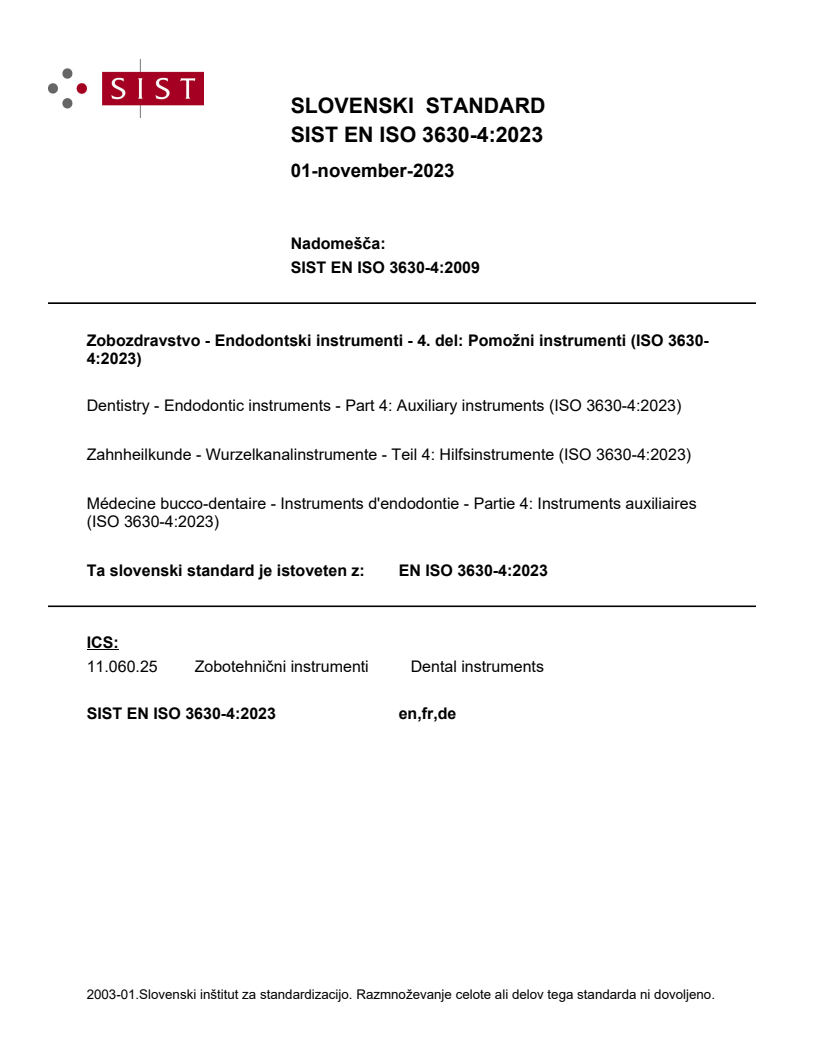
SLOVENSKI STANDARD
01-november-2023
Nadomešča:
SIST EN ISO 3630-4:2009
Zobozdravstvo - Endodontski instrumenti - 4. del: Pomožni instrumenti (ISO 3630-
4:2023)
Dentistry - Endodontic instruments - Part 4: Auxiliary instruments (ISO 3630-4:2023)
Zahnheilkunde - Wurzelkanalinstrumente - Teil 4: Hilfsinstrumente (ISO 3630-4:2023)
Médecine bucco-dentaire - Instruments d'endodontie - Partie 4: Instruments auxiliaires
(ISO 3630-4:2023)
Ta slovenski standard je istoveten z: EN ISO 3630-4:2023
ICS:
11.060.25 Zobotehnični instrumenti Dental instruments
2003-01.Slovenski inštitut za standardizacijo. Razmnoževanje celote ali delov tega standarda ni dovoljeno.
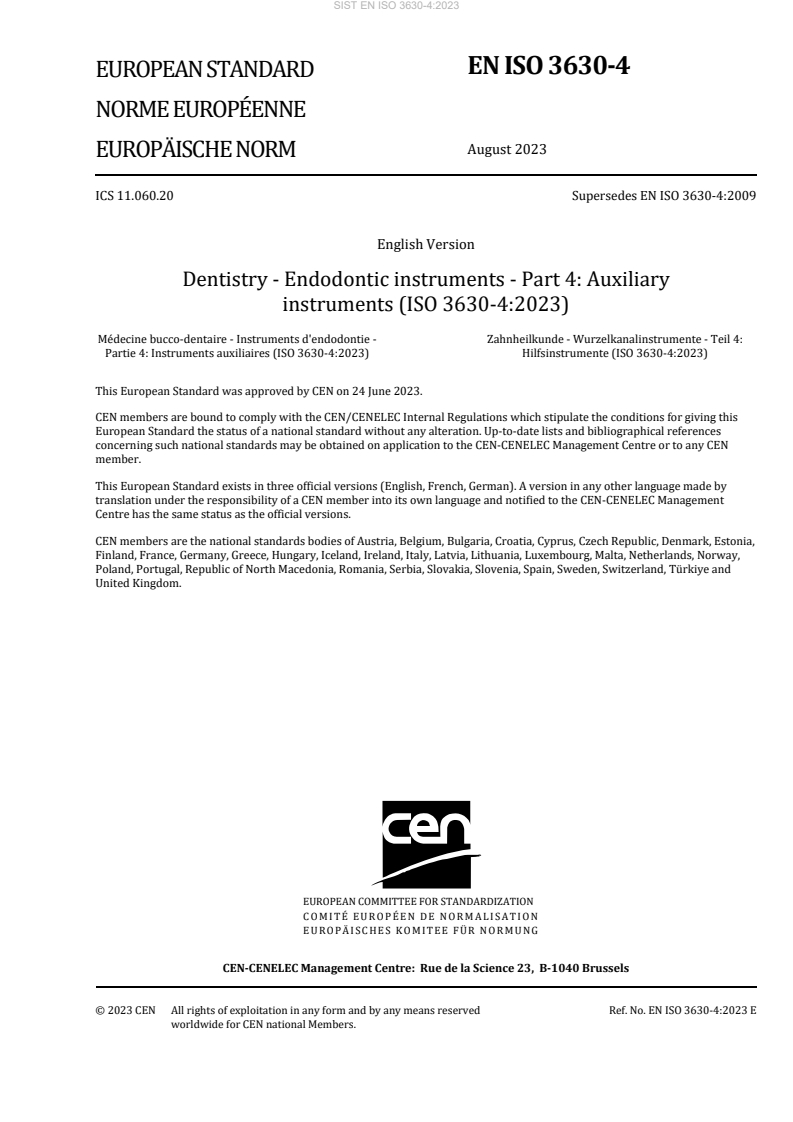
EN ISO 3630-4
EUROPEAN STANDARD
NORME EUROPÉENNE
August 2023
EUROPÄISCHE NORM
ICS 11.060.20 Supersedes EN ISO 3630-4:2009
English Version
Dentistry - Endodontic instruments - Part 4: Auxiliary
instruments (ISO 3630-4:2023)
Médecine bucco-dentaire - Instruments d'endodontie - Zahnheilkunde - Wurzelkanalinstrumente - Teil 4:
Partie 4: Instruments auxiliaires (ISO 3630-4:2023) Hilfsinstrumente (ISO 3630-4:2023)
This European Standard was approved by CEN on 24 June 2023.
CEN members are bound to comply with the CEN/CENELEC Internal Regulations which stipulate the conditions for giving this
European Standard the status of a national standard without any alteration. Up-to-date lists and bibliographical references
concerning such national standards may be obtained on application to the CEN-CENELEC Management Centre or to any CEN
member.
This European Standard exists in three official versions (English, French, German). A version in any other language made by
translation under the responsibility of a CEN member into its own language and notified to the CEN-CENELEC Management
Centre has the same status as the official versions.
CEN members are the national standards bodies of Austria, Belgium, Bulgaria, Croatia, Cyprus, Czech Republic, Denmark, Estonia,
Finland, France, Germany, Greece, Hungary, Iceland, Ireland, Italy, Latvia, Lithuania, Luxembourg, Malta, Netherlands, Norway,
Poland, Portugal, Republic of North Macedonia, Romania, Serbia, Slovakia, Slovenia, Spain, Sweden, Switzerland, Türkiye and
United Kingdom.
EUROPEAN COMMITTEE FOR STANDARDIZATION
COMITÉ EUROPÉEN DE NORMALISATION
EUROPÄISCHES KOMITEE FÜR NORMUNG
CEN-CENELEC Management Centre: Rue de la Science 23, B-1040 Brussels
© 2023 CEN All rights of exploitation in any form and by any means reserved Ref. No. EN ISO 3630-4:2023 E
worldwide for CEN national Members.
Contents Page
European foreword . 3
European foreword
This document (EN ISO 3630-4:2023) has been prepared by Technical Committee ISO/TC 106
"Dentistry" in collaboration with Technical Committee CEN/TC 55 “Dentistry” the secretariat of which
is held by DIN.
This European Standard shall be given the status of a national standard, either by publication of an
identical text or by endorsement, at the latest by February 2024, and conflicting national standards
shall be withdrawn at the latest by February 2024.
Attention is drawn to the possibility that some of the elements of this document may be the subject of
patent rights. CEN shall not be held responsible for identifying any or all such patent rights.
This document supersedes EN ISO 3630-4:2009.
Any feedback and questions on this document should be directed to the users’ national standards
body/national committee. A complete listing of these bodies can be found on the CEN website.
According to the CEN-CENELEC Internal Regulations, the national standards organizations of the
following countries are bound to implement this European Standard: Austria, Belgium, Bulgaria,
Croatia, Cyprus, Czech Republic, Denmark, Estonia, Finland, France, Germany, Greece, Hungary, Iceland,
Ireland, Italy, Latvia, Lithuania, Luxembourg, Malta, Netherlands, Norway, Poland, Portugal, Republic of
North Macedonia, Romania, Serbia, Slovakia, Slovenia, Spain, Sweden, Switzerland, Türkiye and the
United Kingdom.
Endorsement notice
The text of ISO 3630-4:2023 has been approved by CEN as EN ISO 3630-4:2023 without any
modification.
INTERNATIONAL ISO
STANDARD 3630-4
Second edition
2023-08
Dentistry — Endodontic
instruments —
Part 4:
Auxiliary instruments
Médecine bucco-dentaire — Instruments d'endodontie —
Partie 4: Instruments auxiliaires
Reference number
ISO 3630-4:2023(E)
ISO 3630-4:2023(E)
© ISO 2023
All rights reserved. Unless otherwise specified, or required in the context of its implementation, no part of this publication may
be reproduced or utilized otherwise in any form or by any means, electronic or mechanical, including photocopying, or posting on
the internet or an intranet, without prior written permission. Permission can be requested from either ISO at the address below
or ISO’s member body in the country of the requester.
ISO copyright office
CP 401 • Ch. de Blandonnet 8
CH-1214 Vernier, Geneva
Phone: +41 22 749 01 11
Email: copyright@iso.org
Website: www.iso.org
Published in Switzerland
ii
ISO 3630-4:2023(E)
Contents Page
Foreword .iv
1 Scope . 1
2 Normative references . 1
3 Terms and definitions . 1
4 Classification and symbols . 2
4.1 Classification . 2
4.2 Symbols . 2
5 Requirements . 3
5.1 Material . 3
5.2 Dimensions . 3
5.2.1 General . 3
5.2.2 Barbed broaches — Type 1 instruments . 3
5.2.3 Paste carriers — Type 2 instruments . 4
5.2.4 Explorers and cotton broaches — Type 3 instruments . 5
5.2.5 Cannulae — Type 4 instruments . 6
5.3 Colour designation and size marking with rings . 7
5.4 Mechanical requirements . 7
5.4.1 Resistance to fracture by twisting (torque) and angular deflection —
Types 1 and 3 . 7
5.4.2 Stiffness — Resistance to bending — Types 1 and 3 . 8
5.4.3 Handle or shank security — Types 1, 2 and 3 instruments . 8
5.4.4 Resistance to fatigue — Type 2 . 8
5.4.5 Resistance to breakage or cracking — Type 4. 9
5.5 Reprocessing . 9
5.6 Heat effects of sterilization . 9
5.6.1 General . 9
5.6.2 Single-use instruments (supplied non-sterile) . 9
5.6.3 Multi-use instruments . 9
6 Sampling . 9
7 Testing.10
7.1 General . 10
7.2 Dimensions . 10
7.2.1 General . 10
7.2.2 Barbed broaches . 10
7.2.3 Paste carriers — Type 2 instruments . 11
8 Product information .11
8.1 Marking . 11
8.2 Labelling . 12
8.3 Packaging .12
8.4 Instructions for use .12
Annex A (normative) Test method for resistance of cannula to breakage or cracking .13
Annex B (normative) Test method for resistance of cannula to corrosion .18
Bibliography .19
iii
ISO 3630-4:2023(E)
Foreword
ISO (the International Organization for Standardization) is a worldwide federation of national standards
bodies (ISO member bodies). The work of preparing International Standards is normally carried out
through ISO technical committees. Each member body interested in a subject for which a technical
committee has been established has the right to be represented on that committee. International
organizations, governmental and non-governmental, in liaison with ISO, also take part in the work.
ISO collaborates closely with the International Electrotechnical Commission (IEC) on all matters of
electrotechnical standardization.
The procedures used to develop this document and those intended for its further maintenance are
described in the ISO/IEC Directives, Part 1. In particular, the different approval criteria needed for the
different types of ISO document should be noted. This document was drafted in accordance with the
editorial rules of the ISO/IEC Directives, Part 2 (see www.iso.org/directives).
ISO draws attention to the possibility that the implementation of this document may involve the use
of (a) patent(s). ISO takes no position concerning the evidence, validity or applicability of any claimed
patent rights in respect thereof. As of the date of publication of this document, ISO had not received
notice of (a) patent(s) which may be required to implement this document. However, implementers are
cautioned that this may not represent the latest information, which may be obtained from the patent
database available at www.iso.org/patents. ISO shall not be held responsible for identifying any or all
such patent rights.
Any trade name used in this document is information given for the convenience of users and does not
constitute an endorsement.
For an explanation of the voluntary nature of standards, the meaning of ISO specific terms and
expressions related to conformity assessment, as well as information about ISO's adherence to
the World Trade Organization (WTO) principles in the Technical Barriers to Trade (TBT), see
www.iso.org/iso/foreword.html.
This document was prepared by Technical Committee ISO/TC 106, Dentistry, Subcommittee SC 4,
Dental instruments, in collaboration with the European Committee for Standardization (CEN) Technical
Committee CEN/TC 55, Dentistry, in accordance with the Agreement on technical cooperation between
ISO and CEN (Vienna Agreement).
This second edition cancels and replaces the first edition (ISO 3630-4:2009), which has been technically
revised.
The main changes are as follows:
— rasps requirements have been removed;
— a cyclic fatigue test of paste carriers has been added;
— the term cannula has been added;
— the cannula symbol has changed;
— Annexes A and B have been added.
A list of all parts in the ISO 3630 series can be found on the ISO website.
Any feedback or questions on this document should be directed to the user’s national standards body. A
complete listing of these bodies can be found at www.iso.org/members.html.
iv
INTERNATIONAL STANDARD ISO 3630-4:2023(E)
Dentistry — Endodontic instruments —
Part 4:
Auxiliary instruments
1 Scope
This document specifies requirements and test methods for hand-held or mechanically operated
auxiliary instruments for performing root canal procedures such as barbed broaches, paste carriers,
explorers, cotton broaches and cannulae. This document specifies requirements for size, product
designation, safety considerations, instructions and labelling.
2 Normative references
The following documents are referred to in the text in such a way that some or all of their content
constitutes requirements of this document. For dated references, only the edition cited applies. For
undated references, the latest edition of the referenced document (including any amendments) applies.
ISO 1797, Dentistry — Shanks for rotary and oscillating instruments
ISO 1942, Dentistry — Vocabulary
ISO 3630-1:2019, Dentistry — Endodontic instruments — Part 1: General requirements
3 Terms and definitions
For the purposes of this document, the terms and definitions given in ISO 1942, ISO 3630-1 and the
following apply.
ISO and IEC maintain terminology databases for use in standardization at the following addresses:
— ISO Online browsing platform: available at https:// www .iso .org/ obp
— IEC Electropedia: available at https:// www .electropedia .org/
3.1
barbed broach
endodontic instrument with barbs designed for removing the pulp tissue
3.2
paste carrier
endodontic instrument designed for conveying filling material or medicaments into a root canal system
3.3
explorer
endodontic instrument designed for exploring the root canal system
3.4
cotton broach
endodontic instrument used with cotton for drying root canals or placing medicaments
3.5
instrument core
portion of endodontic instrument that is the centre of the working part
ISO 3630-4:2023(E)
3.6
core diameter of the instrument
diameter of the solid portion of a barbed broach (3.1)
3.7
height of barb
height measured perpendicularly from the outside of the instrument core to the tip of the barb of a
barbed broach (3.1)
3.8
thermoplastic delivery device
powered endodontic instrument designed for placing thermoplastic obturation material into a root
canal system
3.9
cannula
tube, connected to a thermoplastic delivery device (3.8) to deliver the thermoplastic obturation material
into a root canal system
4 Classification and symbols
4.1 Classification
For the purposes of this document, endodontic instruments are grouped according to the shape and
intended endodontic application of the instrument as follows:
— type 1: barbed broaches;
— type 2: paste carriers;
— type 3: explorers and cotton broaches;
— type 4: cannulae.
4.2 Symbols
For the purposes of this document, the following symbols apply.
D core diameter of the instrument (projected core for paste carriers) measured at the tip
d core diameter of the instrument or working part measured from the tip at length l
m m
d core diameter of the instrument or working part measured from the tip at length l
n n
d core diameter of the instrument or operative part at length l
op op
d core diameter of the instrument or working part measured from the tip at length l
w w
h height of barb
l tip length, measured from the tip of t
...
SIST EN ISO 3630-4:2023は、歯科医療分野におけるエンドodontic手順のための補助器具に関連する重要な基準を提供します。この文書の範囲は、手動または機械的に操作される補助器具の要件と試験方法に関するものであり、特に根管処置に使用されるバーブブローチ、ペーストキャリア、エクスプローラー、コットンブローチ、およびカニューレに焦点を当てています。 この標準の強みは、製品のサイズ、名称、安心・安全に関する考慮事項、使用説明書およびラベルに関する具体的な要件を明確に定めている点です。これにより、医療従事者が補助器具を選択するときの指針となり、患者の安全を確保するためのながれを整えることができます。また、標準が提供する試験方法により、製品の性能や安全性を客観的に確認することができ、これにより市場における質の一貫性が促進されます。 さらに、SIST EN ISO 3630-4:2023は、補助器具の設計と製造における国際的な基準を確立し、歯科業界における革新を支援します。国際規格との整合性により、製品がさまざまな市場で承認されやすくなり、使用される全体のエンドユーザーに対する信頼性向上にも寄与します。これは、特に根管治療に関与する歯科医師にとって重要な側面です。 このように、SIST EN ISO 3630-4:2023は、エンドodontic手順における補助器具の基準を包括的に示すものであり、医療現場での適正使用と安全性の維持、さらには業界全体の品質向上に寄与する重要な文書です。
The EN ISO 3630-4:2023 standard provides comprehensive requirements and test methods specifically focused on auxiliary instruments used in endodontic procedures within dentistry. The scope of this standard covers a range of hand-held and mechanically operated instruments that are essential for performing root canal treatments, including barbed broaches, paste carriers, explorers, cotton broaches, and cannulae. One of the significant strengths of the EN ISO 3630-4:2023 standard is its thorough examination of size, product designation, safety considerations, and labeling requirements. This ensures that the auxiliary instruments meet high safety and efficacy standards, ultimately enhancing patient care and professional practice in endodontics. The inclusion of detailed test methods also bolsters the reliability and consistency of these instruments in clinical settings, making it easier for dental professionals to choose the right tools for their procedures. Moreover, the relevance of this standard cannot be overstated, as it addresses critical aspects of dental instrument design and operation that directly impact treatment outcomes. By standardizing requirements, the EN ISO 3630-4:2023 standard aids in fostering uniformity across the industry, promoting best practices and reducing the variability often associated with endodontic treatments. This standard serves not only as a guideline for manufacturers but also as a reference for practitioners to ensure they are utilizing instruments that are safe, effective, and compliant with current best practices in dentistry.
Die Norm EN ISO 3630-4:2023 befasst sich mit zahnärztlichen endodontischen Instrumenten und legt die Anforderungen sowie die Prüfmethoden für Hand- oder mechanisch betriebene Hilfsinstrumente fest, die bei Wurzelkanalbehandlungen zum Einsatz kommen. In diesem Zusammenhang betrachtet die Norm spezifische Instrumente wie gezahnte Broachen, Paste-Träger, Exploratoren, Baumwollbroachen und Kanülen. Der Umfang dieser Norm ist von entscheidender Bedeutung, da sie klare Anforderungen an die Größe, die Produktbezeichnung, die Sicherheitsaspekte, die Benutzungsanleitungen und die Kennzeichnung definiert. Dies stellt sicher, dass die verwendeten Hilfsinstrumente sowohl effektiv als auch sicher für die Patienten sind. Gerade in der Endodontie, wo Präzision und Sicherheit höchste Priorität haben, bietet diese Norm eine wertvolle Grundlage für die Qualitätssicherung. Ein wesentlicher Stärke der EN ISO 3630-4:2023 liegt in ihrer international anerkannten Struktur. Durch die Standardisierung der Anforderungen wird eine einheitliche Qualität der Endodontie-Hilfsinstrumente gewährleistet, was die Vergleichbarkeit und Akzeptanz in unterschiedlichen Märkten und Praxen fördert. Dies ist besonders wichtig für zahnärztliche Fachkräfte, die Geräte verwenden, die möglicherweise aus verschiedenen Ländern stammen. Darüber hinaus behandelt die Norm nicht nur technische Details, sondern auch sicherheitsrelevante Aspekte. Diese umfassende Berücksichtigung von Sicherheitsfaktoren ist für die Entwicklung von endodontischen Instrumenten von enormer Relevanz, da sie dazu beiträgt, potenzielle Risiken zu identifizieren und zu minimieren. Insgesamt zeigt die EN ISO 3630-4:2023 durch ihre klare Struktur, ihre internationalen Anforderungen und ihre umfangreiche Behandlung sicherheitsrelevanter Aspekte eine hohe Relevanz für die moderne Zahnmedizin, insbesondere im Bereich der Endodontie. Sie bietet einen wertvollen Rahmen für Hersteller und Anwender und fördert die Sicherheit und Effizienz in der zahnärztlichen Praxis.
SIST EN ISO 3630-4:2023 표준 문서는 치과 분야에서의 보조 기구에 대한 요건과 시험 방법을 규정하고 있습니다. 이 표준은 루트 캔들 시술을 수행하기 위한 핸드 헬드 또는 기계적으로 작동하는 보조 기구들, 예를 들어 바브 브로치, 페이스트 캐리어, 탐침기, 면봉 브로치 및 카뉼라와 같은 제품들에 대한 내용이 포함되어 있습니다. 이 표준의 주요 강점은 기구의 크기, 제품 지정, 안전 고려사항, 사용 지침 및 라벨링에 대한 명확한 요구 사항을 포함하고 있다는 점입니다. 이를 통해 치과 의사들은 안전하고 효과적인 루트 캔들 시술을 보장할 수 있으며, 환자에게도 보다 나은 치료 결과를 제공할 수 있습니다. SIST EN ISO 3630-4:2023은 치과 분야의 최신 기술 및 요구 사항을 반영하여 보조 기구의 유효성과 신뢰성을 높이는 데 기여하고 있습니다. 이러한 표준화 문서는 품질 관리 및 안전성을 확보하는 데 필수적이며, 치과 기구 생산자들에게도 명확한 지침을 제공합니다. 결론적으로, EN ISO 3630-4:2023 표준은 치과 산업에서 보조 기구의 사용 및 개발에 있어 매우 중요한 참고 문서로 기능하고 있으며, 관련 전문가들에게 실질적인 도움이 될 수 있는 기준을 제시합니다.
La norme EN ISO 3630-4:2023, intitulée "Dentisterie - Instruments endodontiques - Partie 4 : Instruments auxiliaires", établit des exigences précises et des méthodes d'essai pour les instruments auxiliaires utilisés dans les procédures de traitement des canaux radiculaires. Cette norme couvre des instruments tels que les broches à barbes, les transporteurs de pâte, les explorateurs, les broches en coton et les canules, témoignant ainsi de son champ d'application étendu. Une des forces majeures de cette norme est sa capacité à spécifier les exigences de taille et de désignation des produits, garantissant ainsi cohérence et uniformité dans la fabrication d'instruments endodontiques. De plus, l'inclusion de considérations de sécurité dans le document renforce la protection des patients et des praticiens, un aspect crucial dans le domaine de la dentisterie. La norme aborde également les instructions et l'étiquetage des instruments, ce qui assure que les utilisateurs disposent des informations nécessaires pour une utilisation appropriée, minimisant ainsi le risque d'erreurs. Ce niveau de détail et d'exigence rend la norme EN ISO 3630-4:2023 particulièrement pertinente dans un environnement où la précision et la sécurité sont primordiales. En somme, cette norme représente une avancée significative pour les professionnels de la dentisterie, en fournissant des directives claires et des exigences rigoureuses qui favorisent la qualité et la sécurité des instruments endodontiques auxiliaires. Son adoption peut contribuer à améliorer les pratiques cliniques et à garantir des résultats optimaux pour les traitements endodontiques.
Questions, Comments and Discussion
Ask us and Technical Secretary will try to provide an answer. You can facilitate discussion about the standard in here.
Loading comments...