

FprEN 14188-2
(Main)Joint fillers and sealants - Part 2: Specifications for cold applied sealants
- Abstract
This European Standard specifies the requirements for cold applied normal and fuel resistant joint sealants for concrete pavements to be used in roads, bridges, fuel stations, airfields and other trafficked areas.
- Status
- Not Published
- Technical Committee
- CEN/TC 227 - Road materials
- Current Stage
- 5098 - Decision to abandon - Formal Approval
- Start Date
- 26-Mar-2021
- Completion Date
- 14-Oct-2026

Overview
FprEN 14188-2 - "Joint fillers and sealants - Part 2: Specifications for cold applied sealants" (CEN draft) defines performance and testing requirements for cold applied normal, chemical- and fuel‑resistant joint sealants used in concrete pavements for roads, bridges, parking decks, fuel stations, airfields and other trafficked areas. The standard establishes classification, required test methods and manufacturer declarations to ensure durable, safe sealant performance in trafficked and fuel-exposed environments.
Key topics and technical requirements
- Scope and classification
- Covers single‑component (S) and multi‑component (M) systems; self-levelling (sl) and non-sag (ns) types.
- Exposure classes A–D address chemical contact, including fuels (Test fuel I/II) and defrosting chemicals.
- Movement capability classes for joints: 25% and 35% (sub‑classes A–D by exposure).
- Performance and test methods
- Uses a suite of referenced test standards (EN 14187 series, EN ISO standards) for: rate of cure, tack free time, extrudability, self‑levelling, resistance to flow, loss of volume, change in mass/volume after immersion in fuels/chemicals, hydrolysis resistance, cohesion, bonding strength, adhesion/cohesion after immersion, artificial UV weathering (1 000 h) and resistance to flame.
- Sampling rule: if one of three specimens fails a test it is repeated; more than one failure, or one failure on repeat, means the sample fails.
- Conditioning, test parameters and special provisions for cold‑climate areas are specified.
- Manufacturer obligations
- Declare manufacturer’s declared values (MDV) and limiting values (MLV).
- Provide installation recommendations and state whether a primer is required.
- Conform to Factory Production Control and Assessment and Verification of Constancy of Performance (AVCP) procedures.
- Safety and regulatory
- Addresses dangerous substances and relation to EU Construction Products Regulation (Annex ZA).
Applications and users
- Practical applications: sealing expansion/construction joints in roads, bridges, airfields, parking decks, fuel stations and other trafficked surfaces where mechanical movement, fuels or de‑icing chemicals are present.
- Primary users:
- Pavement and bridge engineers specifying joint systems
- Sealant manufacturers and R&D teams
- Construction contractors and installers
- Materials testing laboratories and conformity assessment bodies
- Asset owners and facility managers managing maintenance programs
Related standards
- EN 14188-1 (hot applied sealants), EN 14188-3 (preformed joint seals), EN 14188-4 (primers)
- EN 14187 series (cold applied sealant test methods) and relevant EN ISO test methods referenced for mechanical and chemical performance.
Keywords: FprEN 14188-2, cold applied sealants, joint fillers, concrete pavements, fuel resistant sealants, EN 14187, extrudability, movement capability, road materials, CEN standard.
Relations
- Revised
EN 14188-2:2004 - Joint fillers and sealants - Part 2: Specifications for cold applied sealants - Effective Date
- 11-Dec-2010
Get Certified
Connect with accredited certification bodies for this standard

Zavod za gradbeništvo Slovenije (ZAG) - Inšpekcija
ZAG inspection body for construction products, structures, and materials.
Sponsored listings
Frequently Asked Questions
FprEN 14188-2 is a draft published by the European Committee for Standardization (CEN). Its full title is "Joint fillers and sealants - Part 2: Specifications for cold applied sealants". This standard covers: This European Standard specifies the requirements for cold applied normal and fuel resistant joint sealants for concrete pavements to be used in roads, bridges, fuel stations, airfields and other trafficked areas.
This European Standard specifies the requirements for cold applied normal and fuel resistant joint sealants for concrete pavements to be used in roads, bridges, fuel stations, airfields and other trafficked areas.
FprEN 14188-2 is classified under the following ICS (International Classification for Standards) categories: 93.080.20 - Road construction materials. The ICS classification helps identify the subject area and facilitates finding related standards.
FprEN 14188-2 has the following relationships with other standards: It is inter standard links to EN 14188-2:2004. Understanding these relationships helps ensure you are using the most current and applicable version of the standard.
FprEN 14188-2 is associated with the following European legislation: EU Directives/Regulations: 305/2011; Standardization Mandates: M/124. When a standard is cited in the Official Journal of the European Union, products manufactured in conformity with it benefit from a presumption of conformity with the essential requirements of the corresponding EU directive or regulation.
FprEN 14188-2 is available in PDF format for immediate download after purchase. The document can be added to your cart and obtained through the secure checkout process. Digital delivery ensures instant access to the complete standard document.
Standards Content (Sample)
SLOVENSKI STANDARD
oSIST prEN 14188-2:2014
01-december-2014
Polnilne in tesnilne mase za stike - 2. del: Specifikacije za tesnilne mase, ki se
vgrajujejo po hladnem postopku
Joint fillers and sealants - Part 2: Specifications for cold applied sealants
Fugeneinlagen und Fugenmassen - Teil 2: Anforderungen an kalt verarbeitbare
Fugenmassen
Produits d'obturation et de scellements de joints - Partie 2: Spécifications pour produits
de scellement appliqués à froid
Ta slovenski standard je istoveten z: prEN 14188-2
ICS:
91.100.50 Veziva. Tesnilni materiali Binders. Sealing materials
93.080.20 Materiali za gradnjo cest Road construction materials
oSIST prEN 14188-2:2014 en,fr,de
2003-01.Slovenski inštitut za standardizacijo. Razmnoževanje celote ali delov tega standarda ni dovoljeno.
oSIST prEN 14188-2:2014
oSIST prEN 14188-2:2014
EUROPEAN STANDARD
DRAFT
prEN 14188-2
NORME EUROPÉENNE
EUROPÄISCHE NORM
October 2014
ICS 93.080.20 Will supersede EN 14188-2:2004
English Version
Joint fillers and sealants - Part 2: Specifications for cold applied
sealants
Produits d'obturation et de scellements de joints - Partie 2: Fugeneinlagen und Fugenmassen - Teil 2: Anforderungen
Spécifications pour produits de scellement appliqués à froid an kalt verarbeitbare Fugenmassen
This draft European Standard is submitted to CEN members for enquiry. It has been drawn up by the Technical Committee CEN/TC 227.
If this draft becomes a European Standard, CEN members are bound to comply with the CEN/CENELEC Internal Regulations which
stipulate the conditions for giving this European Standard the status of a national standard without any alteration.
This draft European Standard was established by CEN in three official versions (English, French, German). A version in any other language
made by translation under the responsibility of a CEN member into its own language and notified to the CEN-CENELEC Management
Centre has the same status as the official versions.
CEN members are the national standards bodies of Austria, Belgium, Bulgaria, Croatia, Cyprus, Czech Republic, Denmark, Estonia,
Finland, Former Yugoslav Republic of Macedonia, France, Germany, Greece, Hungary, Iceland, Ireland, Italy, Latvia, Lithuania,
Luxembourg, Malta, Netherlands, Norway, Poland, Portugal, Romania, Slovakia, Slovenia, Spain, Sweden, Switzerland, Turkey and United
Kingdom.
Recipients of this draft are invited to submit, with their comments, notification of any relevant patent rights of which they are aware and to
provide supporting documentation.
Warning : This document is not a European Standard. It is distributed for review and comments. It is subject to change without notice and
shall not be referred to as a European Standard.
EUROPEAN COMMITTEE FOR STANDARDIZATION
COMITÉ EUROPÉEN DE NORMALISATION
EUROPÄISCHES KOMITEE FÜR NORMUNG
CEN-CENELEC Management Centre: Avenue Marnix 17, B-1000 Brussels
© 2014 CEN All rights of exploitation in any form and by any means reserved Ref. No. prEN 14188-2:2014 E
worldwide for CEN national Members.
oSIST prEN 14188-2:2014
prEN 14188-2:2014 (E)
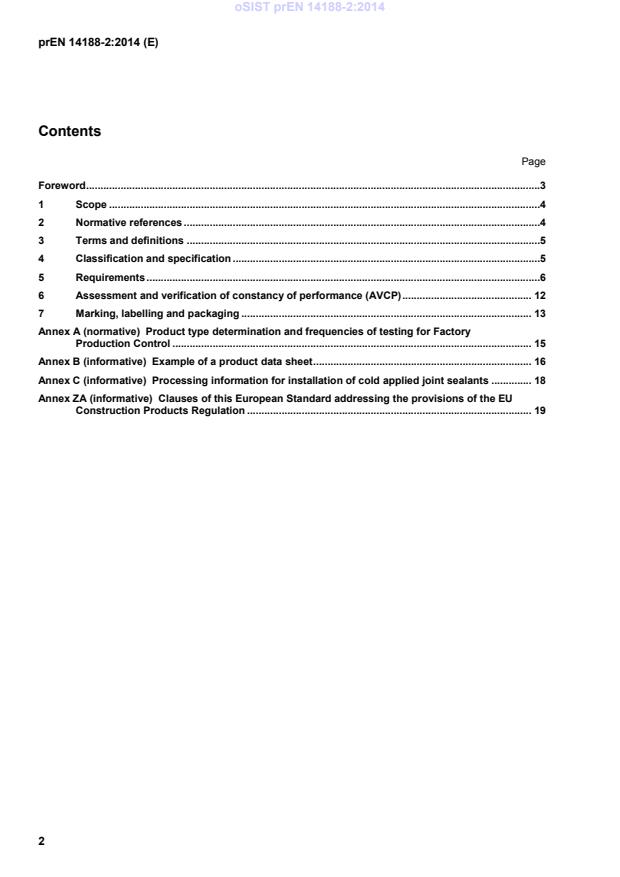
Contents
Page
Foreword .3
1 Scope .4
2 Normative references .4
3 Terms and definitions .5
4 Classification and specification .5
5 Requirements .6
6 Assessment and verification of constancy of performance (AVCP) . 12
7 Marking, labelling and packaging . 13
Annex A (normative) Product type determination and frequencies of testing for Factory
Production Control . 15
Annex B (informative) Example of a product data sheet . 16
Annex C (informative) Processing information for installation of cold applied joint sealants . 18
Annex ZA (informative) Clauses of this European Standard addressing the provisions of the EU
Construction Products Regulation . 19
oSIST prEN 14188-2:2014
prEN 14188-2:2014 (E)
Foreword
This document (prEN 14188-2:2014) has been prepared by Technical Committee CEN/TC 227 “Road
materials”, the secretariat of which is held by DIN.
This document is currently submitted to the CEN Enquiry.
This document will supersede EN 14188-2:2004.
This document has been prepared under a mandate given to CEN by the European Commission and the
European Free Trade Association, and supports essential requirements of EU Directive(s).
For relationship with EU Directive(s), see informative Annex ZA, which is an integral part of this document.
This document is one of a series of standards as listed below.
EN 14188-1, Joint fillers and sealants — Part 1: Specifications for hot applied sealants.
EN 14188-2, Joint fillers and sealants — Part 2: Specifications for cold applied sealants.
EN 14188-3, Joint fillers and sealants — Part 3: Specifications for preformed joint seals.
EN 14188-4, Joint fillers and sealants — Part 4: Specifications for primers to be used with joint sealants.
oSIST prEN 14188-2:2014
prEN 14188-2:2014 (E)
1 Scope
This document specifies the requirements for cold applied normal, chemical and fuel resistant joint sealants
for concrete pavements to be used in roads, bridges, parking decks, fuel stations, airfields and other trafficked
areas.
2 Normative references
The following documents, in whole or in part, are normatively referenced in this document and are
indispensable for its application. For dated references, only the edition cited applies. For undated references,
the latest edition of the referenced document (including any amendments) applies.
EN 13238, Reaction to fire tests for building products — Conditioning procedures and general rules for
selection of substrates
EN 13501-1:2007+A1, Fire classification of construction products and building elements — Part 1:
Classification using data from reaction to fire tests
EN ISO 11925-2, Reaction to fire tests — Ignitability of products subjected to direct impingement of flame —
Part 2: Single-flame source test (ISO 11925-2)
EN 14187-1, Cold applied joint sealants — Test methods — Part 1: Determination of rate of cure
EN 14187-2, Cold applied joint sealants — Test methods — Part 2: Determination of tack free time
EN 14187-3, Cold applied joint sealants — Test methods — Part 3: Determination of self-levelling properties
EN 14187-4, Cold applied joint sealants — Test methods — Part 4: Determination of the change in mass and
volume after immersion in test fuels and liquid chemicals
EN 14187-5, Cold applied joint sealants — Test methods — Part 5: Determination of the resistance to
hydrolysis
EN 14187-6, Cold applied joint sealants — Test methods — Part 6: Determination of the adhesion/cohesion
properties after immersion in test fuels and liquid chemicals
EN 14187-7, Cold applied joint sealants — Test methods — Part 7: Determination of the resistance to flame
EN 14187-8, Cold applied joint sealants — Test methods — Part 8: Determination of the artificial weathering
by UV-irradiation
EN 14187-9, Cold applied joint sealants — Test methods — Part 9: Function testing of joint sealants
EN ISO 6927, Buildings and civil engineering works — Sealants — Vocabulary (ISO 6927)
EN ISO 8339, Building construction — Sealants — Determination of tensile properties (Extension to break)
(ISO 8339)
EN ISO 8340, Building construction — Sealants — Determination of tensile properties at maintained extension
(ISO 8340)
EN ISO 8394-1, Building construction — Jointing products — Part 1: Determination of extrudability of sealants
(ISO 8394-1)
EN ISO 8394-2, Building construction — Jointing products — Part 2: Determination of extrudability of sealants
using standardized apparatus (ISO 8394-2)
oSIST prEN 14188-2:2014
prEN 14188-2:2014 (E)
EN ISO 7389, Building construction — Jointing products — Determination of elastic recovery of sealants
(ISO 7389)
EN ISO 7390, Building construction — Jointing products — Determination of resistance to flow of sealants
(ISO 7390)
EN ISO 9001, Quality management systems — Requirements (ISO 9001)
EN ISO 9047, Building construction — Jointing products — Determination of adhesion/cohesion properties of
sealants at variable temperatures (ISO 9047)
EN ISO 10563, Building construction — Sealants — Determination of change in mass and volume
(ISO 10563)
3 Terms and definitions
For the purposes of this document, the terms and definitions given in EN ISO 6927 and the following apply.
3.1
manufacturer’s limiting value MLV
manufacturer’s stated minimum or maximum value to be met during testing according to the requirements of
this document
3.2
manufacturer’s declared value MDV
value declared by the manufacturer accompanied by a declared tolerance
3.3
cold climate area
areas in which the temperature can go below –25 ºC and the opening of the joint can exceed 35 %
4 Classification and specification
4.1 Cold applied sealant
According to the field of their application, cold applied joint sealants for joints in concrete pavements have to
fulfil different requirements.
Depending on their chemical base and their compositions sealants are available as single or multi-component
systems. To make identification easy they shall be designated by the following symbols:
Table 1 — Systems of cold applied joint sealants
Material System
Single component system S
Multi components system M
Table 2 — Types of cold applied joint sealants
Material Type
Self levelling type sl
Non sag type ns
oSIST prEN 14188-2:2014
prEN 14188-2:2014 (E)
Table 3 — Exposure of cold applied joint sealants
Material Exposure Test liquid
No requirements of chemical resistance A No test
Used in contact with gasoline, diesel B (includes A) Test fuel I
C (includes B) Test fuel I,
Used in contact with jet fuel and
Test fuel II
defrosting chemicals (DC)
DC ground and DC aircraft
Liquid chemicals as required D As required
Depending on their elasticity and modulus sealants are available with different level of movement capability.
For joints in trafficed areas classes are sub-classified in accordance with their movement capability:
Table 4 — Movement capability and classes of cold applied sealants
Movement capability Class
25 % 25 A 25 B 25 C 25 D
35 % 35 A 35 B 35 C 35 D
4.2 Primer
Where a primer is recommended by the manufacturer of the joint sealant, the manufacturer’s directions for its
use shall be followed. Where a primer is part of the system recommended by the manufacturer, then
specimens prepared for the appropriate performance tests shall include a primer.
The manufacturer shall always specify whether a primer is required or not.
5 Requirements
5.1 General
For testing a cold applied sealant, the uniform method of conditioning (EN ISO 8340, Method B) shall be
applied for test procedures where this conditioning method is stipulated by choice.
A test specimen fails the test if, after the test extension, the sum of adhesive and cohesive failures exceeds
5 %. Test specimens, which pass the first extension, fails the test if in subsequent extensions if the sum of
additional adhesive or cohesive failures exceeds 10 %.
If one of the three test specimens fails, the test shall be repeated once. If more than one test specimen fails or
if one specimen fails in the repeated test, the sample shall be reported as failing the test.
The manufacturer shall provide installation recommendations. Guidance is provided in Annex C.
Cold applied joint sealants can have different movement capabilities (extension, compression, sharing) in
accordance with the declaration of the manufacturer and are classified with 25 % and 35 % movement
capability. The level of extension and the amplitude of cycling for the tests of the functional properties are
given in the Table 5.
oSIST prEN 14188-2:2014
prEN 14188-2:2014 (E)
Table 5 — Cold applied joint sealants — Special test conditions of functional tests
Movement Capability
Line Property Test in accordance with
25 % 35 %
1 3 4 5
(table 6)
extension/ extension/
compression compression
1 Cohesion 10.1 EN ISO 9047
± 25 % ± 35 %
Cohesion (for cold
2 10.2 EN 14187-9 in accordance with cycling method
climate areas)
extension extension
3 Bonding strength 11 EN ISO 8340
(100 ± 2) % (140 ± 2) %
extension extension
4 Elastic recovery 12 EN ISO 7389
(100 ± 2) % (140 ± 2) %
Artificial weathering by extension extension
5 13 EN 14187-8
UV irradiation (100 ± 2) % (140 ± 2) %
Adhesion/cohesion
properties after EN 14187-6 extension extension
6 14
immersion in test fuels class B, C, D (100 ± 2) % (140 ± 2) %
and liquid chemicals
5.2 Extrudability
5.2.1 Single component sealants
The extrudability of single component sealants, Type ns, shall be determined in accordance with
EN ISO 8394-1 and the result shall conform to the relevant value given in Table 6, line 1.1.
The quantity of extruded material shall be determined using an orifice of (5,0 ± 0,3) mm.
5.2.2 Multicomponent sealants
The extrudability of multi-component sealants, Type ns, shall be determined at (23 ± 2) ºC in accordance with
EN ISO 8394-2 and the result shall conform to the relevant value given in Table 6, line 1.2.
5.3 Rate of cure
The rate of cure shall be determined in accordance with EN 14187-1 to measure the time to reach at least
80 % of rate of cure. The manufacturer shall declare the rate of cure and the result shall conform to the
relevant value given in Table 6, line 2.
5.4 Tack free time
The tack free time shall be determined in accordance with EN 14187-2. The manufacturer shall declare the
tack free time and the result shall conform to the relevant value given in Table 6, line 3.
5.5 Self levelling properties
The self levelling properties of cold applied sealants, Type sl, shall be determined in accordance with
EN 14187-3. The manufacturer shall declare the self levelling properties and the result shall conform to the
relevant value given in Table 6, line 4.
oSIST prEN 14188-2:2014
prEN 14188-2:2014 (E)
5.6 Resistance to flow
The resistance to flow of cold applied sealants, Type ns, shall be determined in accordance with EN ISO 7390
and the result shall conform to the relevant value given in Table 6, line 5.
The following test conditions shall be applied:
U-profile with a nominal width of 20 mm and a nominal depth of 10 mm;
test temperatures of (50 ± 2) ºC and (5 ± 2) ºC.
5.7 Loss of volume
The loss of volume shall be determined in accordance with EN ISO 10563 and the result shall conform to the
relevant value given in Table 6, line 6.
The following test conditions shall be applied:
Test procedure C: (24,0 ± 0,5) h at (23 ± 2) ºC and (50 ± 5) % relative humidity, followed by procedure B,
7 days at (70 ± 2) ºC.
5.8 Change in mass and volume after immersion in fuels and liquid chemicals
The change in mass and volume after immersion in fuels and liquid chemicals shall be determined in
accordance with EN 14187-4 and the result shall conform to the relevant value given in Table 6, line 7, after a
storage time in liquid chemicals of (72 ± 0,5) h at (23 ± 2) ºC except in the case of defrosting chemicals. For
defrosting chemicals the time of immersion is 21 days at (23 ± 2) ºC.
Test liquids in accordance with table 3.
5.9 Resistance to hydrolysis
The resistance to hydrolysis shall be determined in accordance with EN 14187-5 and the result shall conform
to the relevant value given in Table 6, line 8.
The following test conditions shall be applied:
14 days at (70 ± 2) ºC.
5.10 Cohesion
The cohesion properties at variable temperatures shall be determined in accordance with table 5 and the
result shall conform to the relevant value given in Table 6, line 10.1.
Any failures in adhesion or cohesion are recorded.
For cold climate areas:
The cohesion properties shall be determined in accordance with EN 14187-9 with concrete and asphalt test
specimens in accordance with EN 13880-12 and EN 13880-11 respectively. The results shall conform to the
relevant values in Table 6, line 10.2.
5.11 Bonding strength
The bonding strength shall be determined in accordance with EN ISO 8339 and EN ISO 8340 and the test
parameter of table 5 and the results shall conform to the relevant values given in Table 6, line 11.
oSIST prEN 14188-2:2014
prEN 14188-2:2014 (E)
5.12 Adhesion/cohesion properties at maintained extension after immersion in test fuels and
liquid chemicals
The adhesion/cohesion properties at maintained extension after immersion in test fuels and liquid chemicals
shall be determined in accordance with EN 14187-6 and the test parameter of Table 5. The results shall
conform to the relevant values in Table 6, line 14.
The following test conditions shall be applied:
Storage time of (72,0 ± 0,5) h at (23 ± 2) ºC except in the case of defrosting chemicals. For defrosting
chemicals the time of immersion is 21 days at (23 ± 2) ºC.
Test liquids in accordance with table 3.
5.13 Resistance to artificial weathering
The resistance to artificial weathering by UV-irradiation shall be determined in accordance with EN 14187-8
with a time of irradiation of 1000 hours. The test parameters of Table 5 shall be applied. The result shall
conform to the relevant value given in Table 6, line 13.
5.14 Elastic recovery
The elastic recovery shall be determined in accordance with EN ISO 7389 and Table 5. The result shall
conform to the relevant value given in Table 6, line 12. The applied extension shall be in accordance with
Table 5, line 4.
5.15 Resistance to flame
The resistance to flame shall be determined in accordance with EN 14187-7 and the result shall conform to
the relevant value given in Table 6, line 9.
5.16 Dangerous substances
"National regulations on dangerous substances may require verification and declaration on release, and
sometimes content, when construction products covered by this standard are placed on those markets.
In the absence of European harmonized test methods, verification and declaration on release/content should
be done taking into account national provisions in the place of use.
NOTE An informative database covering European and national provisions on dangerous substances is available at
the Construction web site on EUROPA accessed through: http://ec.europa.eu/enterprise/construction/cpd-ds/."
5.17 Reaction to fire
5.17.1 General
Products shall be classified in accordance with EN 13501-1:2007+A1. The appropriate reaction to fire class
shall be declared.
5.17.2 Mounting and fixing conditions for test samples
Mounting and fixing conditions for the test samples of the reaction to fire performance shall be as follows for
the following reaction to fire classes:
a) Class A2, B, C or D
Design of specimen:
1) substrate: calcium silicate panel
oSIST prEN 14188-2:2014
prEN 14188-2:2014 (E)
b) Class E
Design of specimen:
1) substrate: beech wood, mean bulk density about 720 kg/m , or calcium silicate panel
according to EN 13238
2) joint dimension: 20 mm × 10 mm × 250 mm (width × depth × length), see Figure X
3) conditioning: 28 days at (23 ± 2) ºC and (50 ± 5) % relative humidity (according to EN 13238)
4) number of specimens: 6 (according to EN ISO 11925-2)
5) fire test: impingement of flame in centre to the bottom edge (according to EN 11925-2)
The substrates are not standard-substrates according to EN 13238. They serve only to prepare a
standardised sample according to EN ISO 11925-2.
Furthermore, the defined joint dimension is not a classification parameter with respect to the dimension of the
tested product. If the product meets the test requirements, it should be classified independently from its
dimensions.
Dimensions in millimeters
Key
1 substrate
2 sealant
Figure 1 – Test specimen
oSIST prEN 14188-2:2014
prEN 14188-2:2014 (E)
5.18 Summary of requirements
Table 6 — Requirements and test methods for cold applied joint sealants
Column 1 2 3
Line Properties Test method Requirements
Application properties
1 Extrudability
1.1 Single-component sealant EN 8394-1 ≥ 70 ml/min
1.2 Multi-component sealant EN 8394-2 ≥ 70 ml/min
2 Rate of cure EN 14187-1 Declared value
3 Tack free time EN 14187-2 Declared value
4 Self levelling properties, Type sl EN 14187-3 Declared value
Vertical slope ≤ 2 mm
5 Resistance to flow, Type ns EN ISO 7390
horizontal slope ≤ 2 mm
Material properties
6 Loss of volume EN ISO 10563 ≤ 5 % by volume
Change in mass and volume after EN 14187-4 ≤ – 25 % by mass, no increase
immersion in liquid chemicals exposure B, C, D
≤ 30 % by volume
Change of hardness
8 Resistance to hydrolysis EN 14187-5
Shore A ≤ 50 %
No flow, cracking, flaking,
9.1 Resistance to flame EN 14187-7
hardening, ignition
9.2 Reaction to fire EN ISO 11925-2 Class E
Functional properties
10.1 Cohesion EN ISO 9047 No failure
No failure
10.2 Cohesion (for cold climate areas) EN 14187-9 at –30 ºC ≤ 1,0 MPa (concrete)
≤ 0,3 MPa (asphalt)
Class 25 100 % Extension
EN ISO 8340 Class 35 140 % Extension
No failure
11 Bonding strength
Tensile modulus at 100 %
extension
EN ISO 8339
at 23 ºC ≥ 0,15 MPa
at – 20 ºC ≤ 0,6 MPa
12 Elastic recovery EN ISO 7389 ≥ 70 %
No failure
Artificial weathering by UV
Change of tensile modulus at
13 EN 14187-8
irradiation
100 % extension ≤ 20 %
Change of tensile modulus at
Adhesion/cohesion properties after EN 14187-6
14 100 % extension
immersion in liquid chemicals exposure B, C, D
≤ 20 %
oSIST prEN 14188-2:2014
prEN 14188-2:2014 (E)
6 Assessment and verification of constancy of performance (AVCP)
6.1 General
The compliance of the product with the requirements of this document and with the performances declared by
the manufacturer in the DoP shall be demonstrated by:
determination of the product type;
Factory Production Control by the manufacturer, including product assessment.
The characteristics indicated in Clause 5 shall be determined within 3 months of the date of delivery from the
manufacturer.
For the purposes of testing, the products varying only within very small limits as colour or viscosity may be
grouped into families, where it is considered that the selected property is common to all products within that
family.
6.2 Type Testing
6.2.1 Product type determination
Product type determinations shall be performed to show conformity with this document. Tests previously
performed in accordance with the provisions of this document (same product, same characteristic(s), test
method, sampling procedure, System of Attestation of Conformity, etc.) may be taken into account. In
addition, product type det
...