

EN 13138-3:2007
(Main)Buoyant aids for swimming instruction - Part 3: Safety requirements and test methods for swim seats to be worn
- Abstract
This European Standard specifies safety requirements for design, sizing, materials, strength and in water performance as well as provisions for marking and the information supplied by the manufacturer for swim seats to be worn. It also specifies the relevant test methods.
This European Standard covers class A buoyancy devices in which children are seated. These devices are only intended for children aged up to 36 months with a body mass less than or equal to 18 kg.
- Status
- Withdrawn
- Publication Date
- 16-Oct-2007
- Withdrawal Date
- 06-Oct-2026
- Technical Committee
- CEN/TC 162 - Protective clothing including hand and arm protection and lifejackets
- Drafting Committee
- CEN/TC 162/WG 10 - Buoyant aids for swimming instruction
- Current Stage
- 9960 - Withdrawal effective - Withdrawal
- Start Date
- 03-Dec-2014
- Completion Date
- 07-Oct-2026

Relations
- Effective Date
- 22-Dec-2008
- Effective Date
- 31-Oct-2009
- Effective Date
- 04-Feb-2026
- Effective Date
- 28-Jan-2026
- Effective Date
- 28-Jan-2026
- Effective Date
- 28-Jan-2026
- Effective Date
- 28-Jan-2026
- Effective Date
- 28-Jan-2026
- Effective Date
- 28-Jan-2026
- Effective Date
- 28-Jan-2026
- Effective Date
- 28-Jan-2026
- Effective Date
- 28-Jan-2026
- Effective Date
- 28-Jan-2026
- Effective Date
- 28-Jan-2026
- Effective Date
- 28-Jan-2026
Get Certified
Connect with accredited certification bodies for this standard

CIS Institut d.o.o.
Personal Protective Equipment (PPE) certification body. Notified Body NB-2890 for EU Regulation 2016/425 PPE.

Kiwa BDA Testing
Building and construction product certification.
Kmetijski inštitut Slovenije
Agricultural Institute of Slovenia. Soil testing, plant health, agricultural product analysis.
Sponsored listings
Frequently Asked Questions
EN 13138-3:2007 is a standard published by the European Committee for Standardization (CEN). Its full title is "Buoyant aids for swimming instruction - Part 3: Safety requirements and test methods for swim seats to be worn". This standard covers: This European Standard specifies safety requirements for design, sizing, materials, strength and in water performance as well as provisions for marking and the information supplied by the manufacturer for swim seats to be worn. It also specifies the relevant test methods. This European Standard covers class A buoyancy devices in which children are seated. These devices are only intended for children aged up to 36 months with a body mass less than or equal to 18 kg.
This European Standard specifies safety requirements for design, sizing, materials, strength and in water performance as well as provisions for marking and the information supplied by the manufacturer for swim seats to be worn. It also specifies the relevant test methods. This European Standard covers class A buoyancy devices in which children are seated. These devices are only intended for children aged up to 36 months with a body mass less than or equal to 18 kg.
EN 13138-3:2007 is classified under the following ICS (International Classification for Standards) categories: 13.340.70 - Lifejackets, buoyancy aids and floating devices; 97.220.40 - Outdoor and water sports equipment. The ICS classification helps identify the subject area and facilitates finding related standards.
EN 13138-3:2007 has the following relationships with other standards: It is inter standard links to EN 13138-3:2003, EN 13138-3:2014, EN 71-1:2026, EN ISO 105-E03:1996, EN 20105-A02:1994, EN ISO 105-X12:2016, EN ISO 12402-9:2020, EN ISO 105-E04:2013, EN ISO 3696:1995, EN ISO 12402-7:2020, EN 71-3:2019+A2:2024, EN 71-1:2014+A1:2018, EN 15649-6:2009, EN 15649-6:2009+A1:2013, EN 15649-4:2010+A1:2012. Understanding these relationships helps ensure you are using the most current and applicable version of the standard.
EN 13138-3:2007 is associated with the following European legislation: EU Directives/Regulations: 89/686/EEC; Standardization Mandates: M/031. When a standard is cited in the Official Journal of the European Union, products manufactured in conformity with it benefit from a presumption of conformity with the essential requirements of the corresponding EU directive or regulation.
EN 13138-3:2007 is available in PDF format for immediate download after purchase. The document can be added to your cart and obtained through the secure checkout process. Digital delivery ensures instant access to the complete standard document.
Standards Content (Sample)
2003-01.Slovenski inštitut za standardizacijo. Razmnoževanje celote ali delov tega standarda ni dovoljeno.Buoyant aids for swimming instruction - Part 3: Safety requirements and test methods for swim seats to be wornAides a la flottabilité pour l'apprentissage de la natation - Partie 3 : Exigences de sécurité et méthodes d'essai relatives aux dispositifs dans lesquels l'enfant est placé : Sieges flottantsAuftriebshilfen für das Schwimmenlernen - Teil 3: Sicherheitstechnische Anforderungen und Prüfverfahren für Schwimmsitze, die am Körper getragen werdenTa slovenski standard je istoveten z:EN 13138-3:2007SIST EN 13138-3:2007en,de13.340.70SULSRPRþNLLifejackets, buoyancy aids and floating devicesICS:SIST EN 13138-3:20031DGRPHãþDSLOVENSKI
STANDARDSIST EN 13138-3:200701-december-2007
EUROPEAN STANDARDNORME EUROPÉENNEEUROPÄISCHE NORMEN 13138-3October 2007ICS 13.340.70Supersedes EN 13138-3:2003
English VersionBuoyant aids for swimming instruction - Part 3: Safetyrequirements and test methods for swim seats to be wornAides à la flottabilité pour l'apprentissage de la natation -Partie 3: Exigences de sécurité et méthodes d'essairelatives aux dispositifs dans lesquels l'enfant est placé,sièges flottantsAuftriebshilfen für das Schwimmenlernen - Teil 3:Sicherheitstechnische Anforderungen und Prüfverfahren fürSchwimmsitze, die am Körper getragen werdenThis European Standard was approved by CEN on 1 September 2007.CEN members are bound to comply with the CEN/CENELEC Internal Regulations which stipulate the conditions for giving this EuropeanStandard the status of a national standard without any alteration. Up-to-date lists and bibliographical references concerning such nationalstandards may be obtained on application to the CEN Management Centre or to any CEN member.This European Standard exists in three official versions (English, French, German). A version in any other language made by translationunder the responsibility of a CEN member into its own language and notified to the CEN Management Centre has the same status as theofficial versions.CEN members are the national standards bodies of Austria, Belgium, Bulgaria, Cyprus, Czech Republic, Denmark, Estonia, Finland,France, Germany, Greece, Hungary, Iceland, Ireland, Italy, Latvia, Lithuania, Luxembourg, Malta, Netherlands, Norway, Poland, Portugal,Romania, Slovakia, Slovenia, Spain, Sweden, Switzerland and United Kingdom.EUROPEAN COMMITTEE FOR STANDARDIZATIONCOMITÉ EUROPÉEN DE NORMALISATIONEUROPÄISCHES KOMITEE FÜR NORMUNGManagement Centre: rue de Stassart, 36
B-1050 Brussels© 2007 CENAll rights of exploitation in any form and by any means reservedworldwide for CEN national Members.Ref. No. EN 13138-3:2007: E
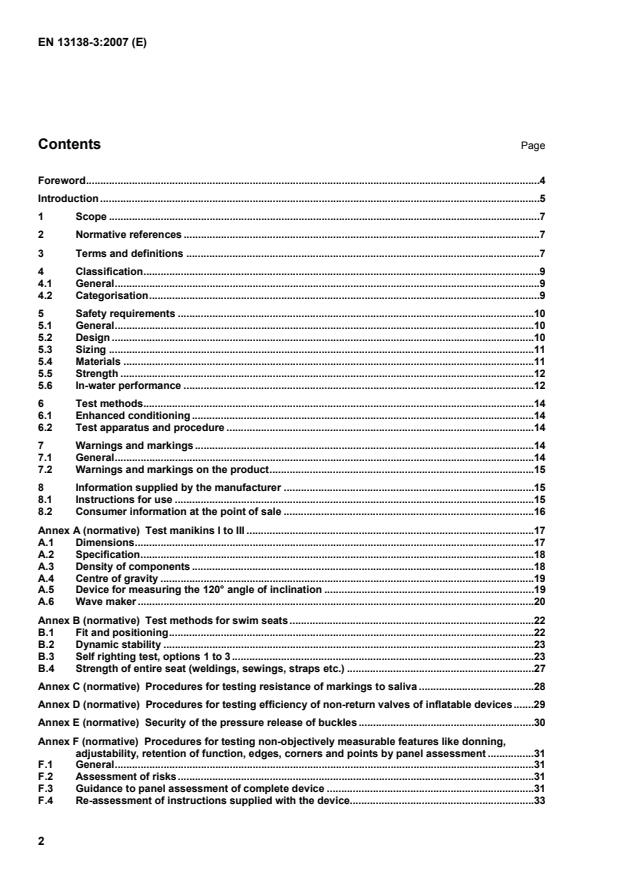
Test manikins I to III.17 A.1 Dimensions.17 A.2 Specification.18 A.3 Density of components.18 A.4 Centre of gravity.19 A.5 Device for measuring the 120° angle of inclination.19 A.6 Wave maker.20 Annex B (normative)
Test methods for swim seats.22 B.1 Fit and positioning.22 B.2 Dynamic stability.23 B.3 Self righting test, options 1 to 3.23 B.4 Strength of entire seat (weldings, sewings, straps etc.).27 Annex C (normative)
Procedures for testing resistance of markings to saliva.28 Annex D (normative)
Procedures for testing efficiency of non-return valves of inflatable devices.29 Annex E (normative)
Security of the pressure release of buckles.30 Annex F (normative)
Procedures for testing non-objectively measurable features like donning, adjustability, retention of function, edges, corners and points by panel assessment.31 F.1 General.31 F.2 Assessment of risks.31 F.3 Guidance to panel assessment of complete device.31 F.4 Re-assessment of instructions supplied with the device.33
Test procedures for seam strength and durability of inflatable devices.34 Annex H (normative)
Test procedures for determining the puncture resistance of inflatable devices.35 Annex I (normative)
Test procedure for size of leg holes.36 Annex J (informative)
Graphical symbols for consumer information.37 Annex K (informative) Significant technical changes between this document and the previous edition EN 13138-3:2003.38 Bibliography.39
The use of swim seats does however not replicate any form of a correct swimming stroke.
Swim seats complying with this standard improve the in-water stability and minimise the entrapment risk in case of capsizing. Children in swim seats do however require very close parental supervision. Overload beyond specified body weight, breaking waves and violent external forces are remaining risks that can cause capsizing. Shallow water is likely increase the risk of capsizing and to hinder or block the escape from the seat in case of emergency.
EN ISO 12402– 7:2006, Personal flotation devices — Part 7: Materials and components — Safety requirements and test methods (ISO 12402-7:2006) EN ISO 12402-9:2006, Personal flotation devices — Part 9: Test methods (ISO 12402-9:2006) 3 Terms and definitions For the purposes of this document, the following terms and definitions apply.
3.1 buoyancy resultant upthrust of a swimming device when totally submerged in fresh water with its uppermost part just below the water surface 3.2 inherent buoyancy upthrust provided by material which is less dense than water or by sealed chambers filled with air or gas 3.3 buoyant swimming device garment or device which when worn or held correctly will provide the buoyancy required to become familiar with movement through the water, assist with learning to swim or to improve swimming strokes
3.12 component sub group of the entire device which contributes to either buoyancy, function or safety 3.13 swim seat buoyant device intended to introduce the user to the aquatic environment and to build water confidence as a pre-requisite to learning to swim.
Swim seats provide safety for the user but do not guarantee protection against drowning
NOTE Swim seats are learning aids and should not be mistaken with aquatic toys as defined in EN 71-1. 3.14 swim seat system integrated components (parts) of a swim seat which contribute to stable floating conditions and to safety during normal use or after an emergency capsizing
3.16 assessment panel group of three people from an accredited and notified test house, all of whom are experienced in assessing buoyant swimming devices 3.17 kick board buoyant device designed to be held in the hands or by the arms in order to support the body in a horizontal and stable position in the water to assist the user to improve swimming techniques 3.18 pull buoy buoyant device to be held between the legs to maintain the legs in a horizontal position in the water to assist the user to improve swimming techniques 4 Classification 4.1 General Buoyant swimming devices shall be classified according to Table 1: Table 1 — Classification of buoyant devices Class Description A Device in which the child is in contact with the water positioned inside the buoyant structure. This device is intended to allow the user to become familiar with the water environment and movement through it. The device will keep the passive user in a stable floating position so that the base of the chin is at or above the surface of the water. B Buoyant swimming device intended to be securely attached to the body and to introduce the active user to the range of swimming strokes. C Device intended to be held in the hands, by the body or between the legs and to assist with swimming strokes and/or improving specific elements associated with swimming techniques. 4.2 Categorisation The requirements given in Table 2 were chosen to ensure compliance between swim seat sizes and manikin in all relevant test procedures. Table 2 — Values for categorisation Age
years Mass (equivalent to age)a Minimum buoyancy
N Manikin ≤ 1 ≤ 11 kg 100 I > 1 to 2 > 11 to 15 kg 120 II > 2 to 3 > 15 to 18 kg 140 III a For categorisation, marking and use priority shall be given to the values representing the body mass, age groups have been
added for rough orientation (See 8.2, Figure 1).
The size of the leg holes, when tested in accordance with Annex I, shall not allow the probe to pass through. 5.4 Materials 5.4.1 Thread To sew load bearing components, only threads manufactured from synthetic materials whose properties correspond to polyester or polyamide fibres shall be used.
5.4.2 Resistance to puncturing Where buoyant swimming devices incorporate air filled buoyancy chambers, the chambers shall remain airtight when tested in accordance with the procedures given in Annex H. 5.4.3 Resistance of foam and other inherent buoyant material to water absorption
When tested in accordance with the procedures given in 5.5.5 of EN ISO 12402-9:2006, the material sample shall lose no more than 10 % of its original buoyancy. The materials shall be tested using a new and conditioned sample of the inherent buoyant material. 5.4.4 Resistance of foam and other inherent buoyant materials to compression
Buoyant swimming devices manufactured from foam or other inherently buoyant materials shall be capable of withstanding compression and other movements in normal use without sustaining permanent loss of buoyancy. When tested in accordance with 4.8 of EN ISO 12402-7:2006, a new and conditioned sample of the buoyant material not used in other tests shall not lose more than 10 % of its buoyancy.
5.4.5 Migration of certain elements
Swimming devices shall conform to the requirements given in EN 71-3. A new and unconditioned complete device shall be tested.
5.4.6 Resistance to chlorinated salt water
After the complete enhanced conditioning according to the procedures in 6.1, the entire deflated device shall be tested for change in colour and damage. The change in colour shall be tested according to EN 20105-A02
When tested in accordance with the procedures in Annex C, the change in colour of the markings on the grey scale shall be 3 or better when assessed according to EN 20105-A02. 5.4.7.3 Resistance of the markings to perspiration
When tested in accordance with EN ISO 105-E04 the change of colour of the markings on the grey scale shall be 3 or better when assessed according to EN 20105-A02. 5.4.7.4 Adhesion of markings When tested in accordance with the procedures in EN ISO 105-X12 (wet and dry, 100 cycles) the markings shall not be damaged and shall remain legible in all details when assessed by the assessment panel. 5.5 Strength 5.5.
...