

EN 556-2:2024
(Main)Sterilization of medical devices - Requirements for medical devices to be designated "STERILE" - Part 2: Requirements for aseptically processed medical devices
General Information
- Abstract
This document specifies the requirements for an aseptically processed medical device to be designated “STERILE”.
- Status
- Published
- Publication Date
- 05-Nov-2024
- Technical Committee
- CEN/TC 204 - Sterilization of medical devices
- Drafting Committee
- CEN/TC 204/WG 6 - Microbiological quality of processed medical devices
- Current Stage
- 6060 - Definitive text made available (DAV) - Publishing
- Start Date
- 06-Nov-2024
- Due Date
- 06-Sep-2024
- Completion Date
- 06-Nov-2024
- Directive
- 2017/745 - Regulation (EU) 2017/745 of the European Parliament and of the Council of 5 April 2017 on medical devices, amending Directive 2001/83/EC, Regulation (EC) No 178/2002 and Regulation (EC) No 1223/2009 and repealing Council Directives 90/385/EEC and 93/42/EECOJ Ref: 2025/681, OJ, OJ L, OJ L, 2025/681 OJ Date: 09-Apr-2025
2017/746 - Regulation (EU) 2017/746 of the European Parliament and of the Council of 5 April 2017 on in vitro diagnostic medical devices and repealing Directive 98/79/EC and Commission Decision 2010/227/EUOJ Ref: 2025/679, OJ, OJ L, OJ L, 2025/679 OJ Date: 10-Apr-2025

Overview
EN 556-2:2024 – "Sterilization of medical devices - Requirements for medical devices to be designated 'STERILE' - Part 2" specifies the requirements that an aseptically processed medical device must meet to be labeled STERILE. It updates and supersedes EN 556-2:2015, aligns definitions with EN ISO 11139, and clarifies relationships to EU medical device regulations (via informative Annexes ZA and ZB).
Key Topics
- Scope & definitions
- Covers aseptic processing (handling of sterile product/components in a controlled environment) and terms such as bioburden, sterility, terminal sterilization, validation, process simulation.
- Validation and routine control
- Manufacturing environment must be specified and monitored.
- Sterilization of product/components/packaging must be validated and routinely controlled using applicable sterilization standards (e.g., EN ISO 11135, EN ISO 11137-1, EN ISO 17665, EN ISO 14160, EN ISO 14937, ISO 22441).
- Typical sterility assurance level guidance (commonly a probability of viable microorganism survival of 10^-6) is referenced where applicable.
- Personnel competence & interventions
- Requirements for training, competence records, identification and documentation of permitted interventions, and logging of interventions during aseptic processing.
- Process simulation & sterility testing
- Media fills / process simulations required for performance qualification and at defined frequencies thereafter; acceptance criteria tied to EN/Pharmacopoeial guidance.
- Sterility testing of product post-aseptic processing, with interpretation against the European Pharmacopoeia.
- Documentation
- Records for validation, routine control, training, interventions, process simulations and sterility tests must be maintained.
Applications
- For medical device manufacturers designing aseptic production lines and seeking to designate products as STERILE.
- For quality assurance / regulatory affairs teams preparing technical documentation for CE marking under the MDR (EU 2017/745) or IVDR (EU 2017/746).
- For contract sterilization providers, process engineers, and auditors to verify compliance with aseptic processing requirements.
- Useful when selecting appropriate sterilization routes for components, planning media fills, and establishing routine monitoring and requalification schedules.
Related Standards
- EN 556-1 (terminal sterilization)
- EN ISO 13408-1 (aseptic processing requirements)
- EN ISO 11135, EN ISO 11137-1, EN ISO 17665, EN ISO 14937, EN ISO 14160, EN ISO 25424, ISO 22441 (sterilization method standards)
- EN ISO 13485 (medical device QMS)
- European Pharmacopoeia (sterility test requirements)
Keywords: EN 556-2:2024, aseptically processed medical devices, sterile, validation, process simulation, sterility test, bioburden, ISO 13408, medical device sterilization.
Relations
- Effective Date
- 08-Jun-2022
- Effective Date
- 09-Feb-2026
- Effective Date
- 28-Jan-2026
- Effective Date
- 28-Jan-2026
- Effective Date
- 28-Jan-2026
- Effective Date
- 28-Jan-2026
- Effective Date
- 28-Jan-2026
- Effective Date
- 28-Jan-2026
- Effective Date
- 28-Jan-2026
- Effective Date
- 28-Jan-2026
- Effective Date
- 28-Jan-2026
- Effective Date
- 28-Jan-2026
- Effective Date
- 28-Jan-2026
- Effective Date
- 28-Jan-2026
- Effective Date
- 28-Jan-2026
Get Certified
Connect with accredited certification bodies for this standard

BSI Group
BSI (British Standards Institution) is the business standards company that helps organizations make excellence a habit.

TÜV Rheinland
TÜV Rheinland is a leading international provider of technical services.

TÜV SÜD
TÜV SÜD is a trusted partner of choice for safety, security and sustainability solutions.
Sponsored listings
Frequently Asked Questions
EN 556-2:2024 is a standard published by the European Committee for Standardization (CEN). Its full title is "Sterilization of medical devices - Requirements for medical devices to be designated "STERILE" - Part 2: Requirements for aseptically processed medical devices". This standard covers: This document specifies the requirements for an aseptically processed medical device to be designated “STERILE”.
This document specifies the requirements for an aseptically processed medical device to be designated “STERILE”.
EN 556-2:2024 is classified under the following ICS (International Classification for Standards) categories: 11.080.01 - Sterilization and disinfection in general. The ICS classification helps identify the subject area and facilitates finding related standards.
EN 556-2:2024 has the following relationships with other standards: It is inter standard links to EN 556-2:2015, ISO 22441:2022, EN ISO 13485:2016/A11:2021, EN ISO 11135:2014, EN ISO 14937:2009, EN ISO 20857:2013, EN ISO 13408-2:2018, EN ISO 11135:2014/A1:2019, EN ISO 11137-1:2015/A2:2019, EN ISO 17665:2024, EN ISO 14160:2021, EN ISO 13408-5:2011, EN ISO 25424:2019/A1:2022, EN ISO 25424:2019, EN ISO 11137-1:2015. Understanding these relationships helps ensure you are using the most current and applicable version of the standard.
EN 556-2:2024 is associated with the following European legislation: EU Directives/Regulations: 2017/745, 2017/746; Standardization Mandates: M/575, M/575 Amd 2. When a standard is cited in the Official Journal of the European Union, products manufactured in conformity with it benefit from a presumption of conformity with the essential requirements of the corresponding EU directive or regulation.
EN 556-2:2024 is available in PDF format for immediate download after purchase. The document can be added to your cart and obtained through the secure checkout process. Digital delivery ensures instant access to the complete standard document.
Standards Content (Sample)
SLOVENSKI STANDARD
01-januar-2025
Nadomešča:
SIST EN 556-2:2015
Sterilizacija medicinskih pripomočkov - Zahteve za medicinske pripomočke, ki
morajo biti označeni s "STERILNO" - 2. del: Zahteve za medicinske pripomočke,
izdelane v aseptičnem okolju
Sterilization of medical devices - Requirements for medical devices to be designated
''STERILE" - Part 2: Requirements for aseptically processed medical devices
Sterilisation von Medizinprodukten - Anforderungen an Medizinprodukte, die als
''STERIL'' gekennzeichnet werden - Teil 2: Anforderungen an aseptisch hergestellte
Medizinprodukte
Stérilisation des dispositifs médicaux - Exigences relatives aux dispositifs médicaux en
vue d'obtenir l'étiquetage « STÉRILE » - Partie 2 : Exigences relatives aux dispositifs
médicaux soumis à un traitement aseptique
Ta slovenski standard je istoveten z: EN 556-2:2024
ICS:
11.080.01 Sterilizacija in dezinfekcija na Sterilization and disinfection
splošno in general
2003-01.Slovenski inštitut za standardizacijo. Razmnoževanje celote ali delov tega standarda ni dovoljeno.
EN 556-2
EUROPEAN STANDARD
NORME EUROPÉENNE
November 2024
EUROPÄISCHE NORM
ICS 11.080.01 Supersedes EN 556-2:2015
English Version
Sterilization of medical devices - Requirements for medical
devices to be designated "STERILE" - Part 2: Requirements
for aseptically processed medical devices
Stérilisation des dispositifs médicaux - Exigences Sterilisation von Medizinprodukten - Anforderungen
relatives aux dispositifs médicaux en vue d'obtenir an Medizinprodukte, die als "STERIL" gekennzeichnet
l'étiquetage " STÉRILE " - Partie 2 : Exigences relatives werden - Teil 2: Anforderungen an aseptisch
aux dispositifs médicaux soumis à un traitement hergestellte Medizinprodukte
aseptique
This European Standard was approved by CEN on 12 August 2024.
CEN members are bound to comply with the CEN/CENELEC Internal Regulations which stipulate the conditions for giving this
European Standard the status of a national standard without any alteration. Up-to-date lists and bibliographical references
concerning such national standards may be obtained on application to the CEN-CENELEC Management Centre or to any CEN
member.
This European Standard exists in three official versions (English, French, German). A version in any other language made by
translation under the responsibility of a CEN member into its own language and notified to the CEN-CENELEC Management
Centre has the same status as the official versions.
CEN members are the national standards bodies of Austria, Belgium, Bulgaria, Croatia, Cyprus, Czech Republic, Denmark, Estonia,
Finland, France, Germany, Greece, Hungary, Iceland, Ireland, Italy, Latvia, Lithuania, Luxembourg, Malta, Netherlands, Norway,
Poland, Portugal, Republic of North Macedonia, Romania, Serbia, Slovakia, Slovenia, Spain, Sweden, Switzerland, Türkiye and
United Kingdom.
EUROPEAN COMMITTEE FOR STANDARDIZATION
COMITÉ EUROPÉEN DE NORMALISATION
EUROPÄISCHES KOMITEE FÜR NORMUNG
CEN-CENELEC Management Centre: Rue de la Science 23, B-1040 Brussels
© 2024 CEN All rights of exploitation in any form and by any means reserved Ref. No. EN 556-2:2024 E
worldwide for CEN national Members.
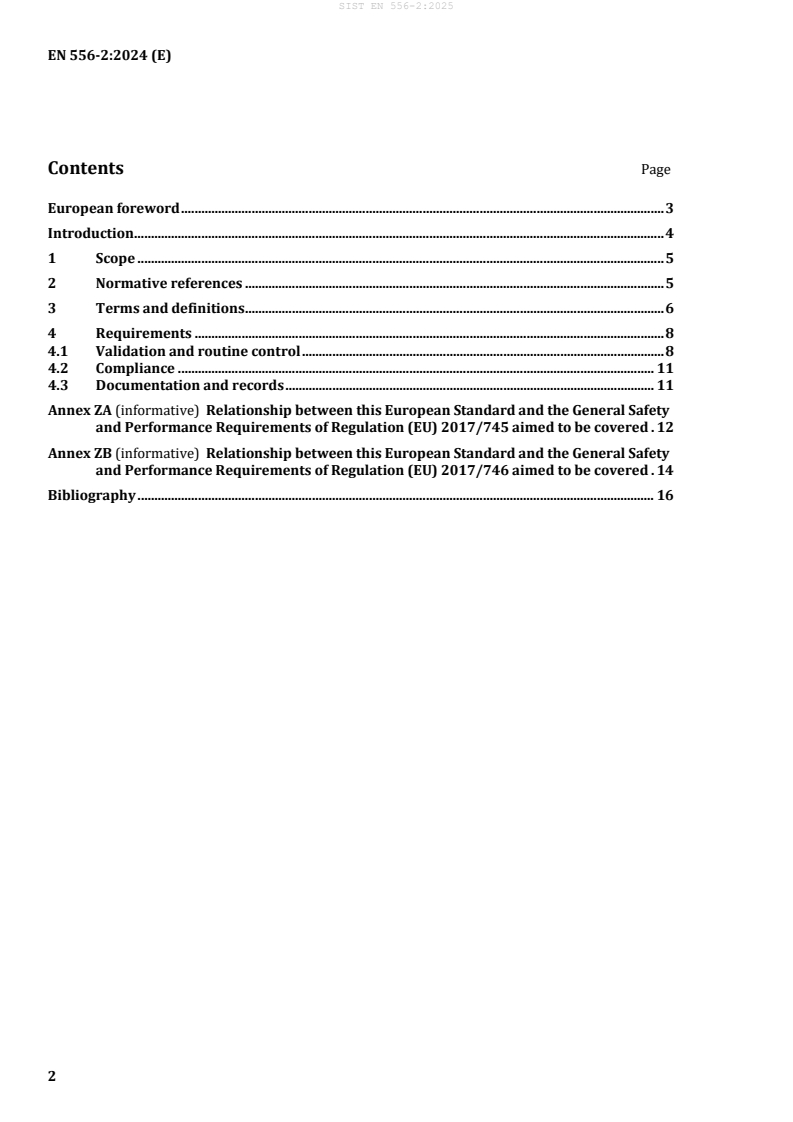
Contents Page
European foreword . 3
Introduction . 4
1 Scope . 5
2 Normative references . 5
3 Terms and definitions . 6
4 Requirements . 8
4.1 Validation and routine control . 8
4.2 Compliance . 11
4.3 Documentation and records . 11
Annex ZA (informative) Relationship between this European Standard and the General Safety
and Performance Requirements of Regulation (EU) 2017/745 aimed to be covered . 12
Annex ZB (informative) Relationship between this European Standard and the General Safety
and Performance Requirements of Regulation (EU) 2017/746 aimed to be covered . 14
Bibliography . 16
European foreword
This document (EN 556-2:2024) has been prepared by Technical Committee CEN/TC 204 “Sterilization of
medical devices”, the secretariat of which is held by BSI.
This European Standard shall be given the status of a national standard, either by publication of an identical
text or by endorsement, at the latest by May 2025, and conflicting national standards shall be withdrawn
at the latest by May 2025.
Attention is drawn to the possibility that some of the elements of this document may be the subject of
patent rights. CEN shall not be held responsible for identifying any or all such patent rights.
This document supersedes EN 556-2:2015.
This document has been prepared under a standardization request M/575 of 14.4.2021 given to CEN by
the European Commission. The Standing Committee of the EFTA States subsequently approves these
requests for its Member States.
For the relationship with EU Regulation, see informative Annexes ZA and ZB, which are an integral part of
this document.
EN 556, Sterilization of medical devices — Requirements for medical devices to be designated “STERILE”, is
currently composed with the following parts:
— Part 1: Requirements for terminally sterilized medical devices;
— Part 2: Requirements for aseptically processed medical devices.
• definitions have been aligned with EN ISO 11139;
• the normative references have been updated to the latest editions;
• informative Annex ZA has been replaced with Informative Annexes ZA and ZB giving the relationship
with the European Regulations for medical devices and in vitro diagnostic medical devices
respectively;
• the Bibliography has been updated.
Any feedback and questions on this document should be directed to the users’ national standards body. A
complete listing of these bodies can be found on the CEN website.
According to the CEN-CENELEC Internal Regulations, the national standards organisations of the following
countries are bound to implement this European Standard: Austria, Belgium, Bulgaria, Croatia, Cyprus,
Czech Republic, Denmark, Estonia, Finland, France, Germany, Greece, Hungary, Iceland, Ireland, Italy,
Latvia, Lithuania, Luxembourg, Malta, Netherlands, Norway, Poland, Portugal, Republic of North
Macedonia, Romania, Serbia, Slovakia, Slovenia, Spain, Sweden, Switzerland, Türkiye and the United
Kingdom.
Introduction
Medical devices designated “STERILE” are prepared using appropriate and validated methods. Whenever
possible, sterile medical devices are terminally-sterilized using a properly validated and controlled
sterilization process (see EN 556-1, EN ISO 11135, EN ISO 11137-1, EN ISO 14160, EN ISO 14937,
EN ISO 17665, EN ISO 20857 and EN ISO 25424). When a medical device is intended to be sterile but
cannot be terminally sterilized, aseptic processing is the method of manufacture (see EN ISO 13408-1).
Aseptic processing necessitates that either:
a) the entire product is sterilized and then introduced into a sterilized package; or
b) components of the product are sterilized, then further processed/assembled, and the final product
packed into a sterilized package.
Processing/assembly and packaging are carried out in a manner that minimizes the opportunity for items
to become re-contaminated by carrying out these operations in a controlled environment in which
microbial and particulate levels are maintained at or below defined limits and human intervention is
minimized.
NOTE EN ISO 15223-1 specifies the label applied to aseptically processed medical devices as
Figure 1
1 Scope
This document specifies the requirements for an aseptically processed medical device to be designated
“STERILE”.
2 Normative references
The following documents are referred to in the text in such a way that some or all of their content
constitutes requirements of this document. For dated references, only the edition cited applies. For
undated references, the latest edition of the referenced document (including any amendments) applies.
EN ISO 11135:2014, Sterilization of health-care products — Ethylene oxide — Requirements for the
development, validation and routine control of a sterilization process for medical devices — Amendment 1:
Revision of Annex E, Single batch release (ISO 11135:2014)
EN ISO 11137-1:2015, Sterilization of health care products — Radiation — Part 1: Requirements for
development, validation and routine control of a sterilization process for medical devices — Amendment 2:
Revision to 4.3.4 and 11.2 (ISO 11137-1:2006)
EN ISO 13408-2:2018, Aseptic processing of health care products — Part 2: Sterilizing filtration (ISO 13408-
2:2018)
EN ISO 13408-5:2011, Aseptic processing of health care products — Part 5: Sterilization in place (ISO 13408-
5:2006)
Medical devices — Quality management systems — Requirements for regulatory
EN ISO 13485:2016,
purposes (ISO 13485:2016)
EN ISO 14160:2021, Sterilization of health care products — Liquid chemical sterilizing agents for single-use
medical devices utilizing animal tissues and their derivatives — Requirements for characterization,
development, validation and routine control of a sterilization process for medical devices (ISO 14160:2020)
EN ISO 14937:2009, Sterilization of health care products — General requirements for characterization of a
sterilizing agent and the development, validation and routine control of a sterilization process for medical
devices (ISO 14937:2009)
EN ISO 17665:2024, Sterilization of health care products — Moist heat — Requirements for the development,
validation and routine control of a sterilization process for medical devices (ISO 17665:2024)
EN ISO 20857:2013, Sterilization of health care products — Dry heat — Requirements for the development,
validation and routine control of a sterilization process for medical devices (ISO 20857:2010)
EN ISO 25424:2019, Sterilization of medical devices — Low temperature steam and formaldehyde —
Requirements for development, validation and routine control of a sterilization process for medical devices
(ISO 25424:2018)
ISO 22441:2022, Sterilization of health care products — Low temperature vaporized hydrogen peroxide —
Requirements for the development, validation and routine control of a sterilization process for medical devices
As impacted by EN ISO 11135:2014/A1:2019.
As impacted by EN ISO 11137-1:2015/A2:2019.
As impacted by EN ISO 13485:2016/A11:2021.
As impacted by EN ISO 25424:2019/A1:2022.
3 Terms and definitions
For the purposes of this document, the following terms and definitions apply.
ISO and IEC maintain terminology databases for use in standardization at the following addresses:
— ISO Online browsing platform: available at https://www.iso.org/obp/
— IEC Electropedia: available at https://www.electropedia.org/
3.1
aseptic processing
handling of sterile product, containers and/or devices in a controlled environment, in which the air supply,
materials, equipment and personnel are regulated to maintain sterility
[SOURCE: EN ISO 13408-1:2024, 3.5]
3.2
bioburden
population of viable microorganisms on or in product and/or sterile barrier system
[SOURCE: EN ISO 11139:2018, 3.23]
3.3
medical device
instrument, apparatus, implement, machine, appliance, implant, reagent for in vitro use, or software
material, or other similar or related article, intended by the manufacturer to be used, alone or in
combination, for human beings, for one or more of the specific medical purpose(s) of:
— diagnosis, prevention, monitoring, treatment, or alleviation of disease;
— diagnosis, monitoring, treatment, alleviation of, or compensation for an injury;
— investigation, replacement, modification, or support of the anatomy, or of a physiological process;
— supporting or sustaining life;
— control of conception;
— disinfection of medical devices;
— providing information by means of in vitro examination of specimens derived from the human body;
and does not achieve its primary intended action by pharmacological, immunological, or metabolic means,
but which may be assisted in its intended function by such means
Note 1 to entry: Products which may be considered to be medical devices in some jurisdictions, but not in others
include:
— items specifically intended for cleaning or sterilization of medical devices;
— pouches, reel goods, sterilization wrap, and reusable containers for packaging of medical devices for sterilization;
— disinfection substances;
— aids for persons with disabilities;
— devices incorporating animal and/or human tissues;
— devices for in vitro fertilization or assisted reproduction technologies.
[SOURCE: EN ISO 13485:2016 , 3.11, modified – The first two list items in Note 1 to entry have been
added.]
3.4
performance qualification
PQ
process of establishing by objective evidence that the process, under anticipated conditions, consistently
produces a product which meets all predetermined requirements
[SOURCE: EN ISO 11139:2018, 3.220.4]
3.5
process simulation
exercise that mimics the manufacturing process or portions of the process in order to demonstrate the
capability of that process
Note 1 to entry: Other terms for process simulation include media fill, simulated process fill, simulated filling
operation, broth trial, broth fill.
[SOURCE: EN ISO 11139:2018, 3.212, modified – Note 1 to entry has been added]
3.6
requalification
repetition of part or all of validation for the purpose of confirming the continued acceptability of a specified
process
[SOURCE: EN ISO 11139:2018, 3.220.5]
3.7
sterility
state of being free from viable micro-organisms
[SOURCE: EN ISO 11139:2018, 3.274, modified – Note 1 to entry has been deleted]
3.8
sterile
free from viable microorganisms
[SOURCE: EN ISO 11139:2018, 3.271]
3.9
terminally sterilized
condition of a product that has been exposed to a sterilization process in its sterilized barrier system
[SOURCE: EN ISO 11139:2018, 3.296]
3.10
test for sterility
technical operation specified in a pharmacopoeia performed on product following an aseptic process or
exposure to a sterilization process
Note 1 to entry: For the purpose of this document, the Pharmacopoeia that applies is the European Pharmacopoeia.
[SOURCE: EN ISO 11139:2018, 3.298, modified – Note 1 to entry has been added]
3.11
validation
confirmation process, through the provision of objective evidence, that the requirements for a specific
intended use or application have been fulfilled
Note 1 to entry: The objective evidence needed for a validation is the result of a test or other form of determination
such as performing alternative calculations or reviewing documents.
Note 2 to entry: The word “validated” is used to designate the corresponding status.
Note 3 to entry: The use conditions for validation can be real or simulated.
[SOURCE: EN ISO 11139:2018, 3.313.]
4 Requirements
4.1 Validation and routine control
4.1.1 For an aseptically processed medical device, the following shall apply:
a) the manufacturing environment in which the aseptic process is conducted is specified and records
demonstrating compliance with the specification throughout the conduct of the process are prepared
and maintained;
b) the processes employed to sterilize product, components, equipment and packaging are validated and
1 2
routinely controlled in compliance with EN ISO 11135:2014 , EN ISO 11137-1:2015 ,
EN ISO 14160:2021, EN ISO 13408-2:2018, EN ISO 13408-5:2011, EN ISO 14937:2009,
EN ISO 17665:2024, EN ISO 20857:2013, EN ISO 25424:2019 , or ISO 22441:2022, as applicable;
NOTE 1 Usually such sterilization processes are validated and routinely controlled to achieve a probability of a
−6
viable microorganism surviving on a sterilized item of 10 or less.
c) the requirements for the competence of personnel and methods for their training are specified and
records demonstrating that the specified competence has been achieved are prepared and maintained;
d) the interventions that are permitted to occur in the aseptic process are identified, documented and
qualified;
e) recor
...