

EN 12697-39:2012
(Main)Bituminous mixtures - Test methods for hot mix asphalt - Part 39: Binder content by ignition
- Abstract
This document describes a test method for the determination of the binder content of samples of bituminous mixtures by ignition. As such, it is an alternative to the more traditional method of extracting the binder using solvents. The method can be used for evaluation of mixture composition because the remaining aggregate can be used for determining aggregate gradation and density, provided excessive breakdown of the aggregate particles does not occur at the temperature reached. The results can be used for process control or checks on the compliance of mixtures. However, the need for calibration of a mixture, either on the complete mixture or on each of its component materials separately, before an analysis can be carried out makes this method easier to use with regularly used mixtures rather than with an extensive range of different mixtures from different aggregate sources. The test method is equally suitable for the analysis of mixtures containing unmodified or modified binders because the method has to be calibrated for each mixture being checked when calibration on mixtures is used. In case of doubt/dispute, the determination of the calibration value based on laboratory-prepared bituminous mixtures (see A.1 and A.2) is the reference method.
- Status
- Withdrawn
- Publication Date
- 05-Jun-2012
- Withdrawal Date
- 06-Oct-2026
- Technical Committee
- CEN/TC 227 - Road materials
- Drafting Committee
- CEN/TC 227/WG 1 - Bituminous mixtures
- Current Stage
- 9960 - Withdrawal effective - Withdrawal
- Start Date
- 26-Feb-2020
- Completion Date
- 07-Oct-2026


Relations
- Effective Date
- 11-Dec-2010
- Replaced By
EN 12697-39:2020 - Bituminous mixtures - Test methods - Part 39: Binder content by ignition - Effective Date
- 04-Mar-2020
- Effective Date
- 28-Jan-2026
- Effective Date
- 28-Jan-2026
- Effective Date
- 28-Jan-2026
- Effective Date
- 28-Jan-2026
- Effective Date
- 28-Jan-2026
Get Certified
Connect with accredited certification bodies for this standard

Zavod za gradbeništvo Slovenije (ZAG) - Inšpekcija
ZAG inspection body for construction products, structures, and materials.
Sponsored listings
Frequently Asked Questions
EN 12697-39:2012 is a standard published by the European Committee for Standardization (CEN). Its full title is "Bituminous mixtures - Test methods for hot mix asphalt - Part 39: Binder content by ignition". This standard covers: This document describes a test method for the determination of the binder content of samples of bituminous mixtures by ignition. As such, it is an alternative to the more traditional method of extracting the binder using solvents. The method can be used for evaluation of mixture composition because the remaining aggregate can be used for determining aggregate gradation and density, provided excessive breakdown of the aggregate particles does not occur at the temperature reached. The results can be used for process control or checks on the compliance of mixtures. However, the need for calibration of a mixture, either on the complete mixture or on each of its component materials separately, before an analysis can be carried out makes this method easier to use with regularly used mixtures rather than with an extensive range of different mixtures from different aggregate sources. The test method is equally suitable for the analysis of mixtures containing unmodified or modified binders because the method has to be calibrated for each mixture being checked when calibration on mixtures is used. In case of doubt/dispute, the determination of the calibration value based on laboratory-prepared bituminous mixtures (see A.1 and A.2) is the reference method.
This document describes a test method for the determination of the binder content of samples of bituminous mixtures by ignition. As such, it is an alternative to the more traditional method of extracting the binder using solvents. The method can be used for evaluation of mixture composition because the remaining aggregate can be used for determining aggregate gradation and density, provided excessive breakdown of the aggregate particles does not occur at the temperature reached. The results can be used for process control or checks on the compliance of mixtures. However, the need for calibration of a mixture, either on the complete mixture or on each of its component materials separately, before an analysis can be carried out makes this method easier to use with regularly used mixtures rather than with an extensive range of different mixtures from different aggregate sources. The test method is equally suitable for the analysis of mixtures containing unmodified or modified binders because the method has to be calibrated for each mixture being checked when calibration on mixtures is used. In case of doubt/dispute, the determination of the calibration value based on laboratory-prepared bituminous mixtures (see A.1 and A.2) is the reference method.
EN 12697-39:2012 is classified under the following ICS (International Classification for Standards) categories: 93.080.20 - Road construction materials. The ICS classification helps identify the subject area and facilitates finding related standards.
EN 12697-39:2012 has the following relationships with other standards: It is inter standard links to EN 12697-39:2004, EN 12697-39:2020, EN 12697-27:2017, EN 12697-28:2020, EN 12597:2024, EN 12697-14:2020, EN 12697-1:2020. Understanding these relationships helps ensure you are using the most current and applicable version of the standard.
EN 12697-39:2012 is available in PDF format for immediate download after purchase. The document can be added to your cart and obtained through the secure checkout process. Digital delivery ensures instant access to the complete standard document.
Standards Content (Sample)
2003-01.Slovenski inštitut za standardizacijo. Razmnoževanje celote ali delov tega standarda ni dovoljeno.Asphalt - Prüfverfahren für Heißasphalt - Teil 39: Bindemittelgehalt durch ThermoanalyseMélanges bitumineux - Méthodes d'essai pour mélange hydrocarboné à chaud - Partie 39: Détermination de la teneur en liant par calcinationBituminous mixtures - Test methods for hot mix asphalt - Part 39: Binder content by ignition93.080.20Materiali za gradnjo cestRoad construction materialsICS:Ta slovenski standard je istoveten z:EN 12697-39:2012SIST EN 12697-39:2012en,fr,de01-september-2012SIST EN 12697-39:2012SLOVENSKI
STANDARDSIST EN 12697-39:20051DGRPHãþD
EUROPEAN STANDARD NORME EUROPÉENNE EUROPÄISCHE NORM
EN 12697-39
June 2012 ICS 93.080.20 Supersedes EN 12697-39:2004English Version
Bituminous mixtures - Test methods for hot mix asphalt - Part 39: Binder content by ignition
Mélanges bitumineux - Méthodes d'essai pour mélange hydrocarboné à chaud - Partie 39: Détermination de la teneur en liant par calcination
Asphalt - Prüfverfahren für Heißasphalt - Teil 39: Bindemittelgehalt durch Thermoanalyse This European Standard was approved by CEN on 28 April 2012.
CEN members are bound to comply with the CEN/CENELEC Internal Regulations which stipulate the conditions for giving this European Standard the status of a national standard without any alteration. Up-to-date lists and bibliographical references concerning such national standards may be obtained on application to the CEN-CENELEC Management Centre or to any CEN member.
This European Standard exists in three official versions (English, French, German). A version in any other language made by translation under the responsibility of a CEN member into its own language and notified to the CEN-CENELEC Management Centre has the same status as the official versions.
CEN members are the national standards bodies of Austria, Belgium, Bulgaria, Croatia, Cyprus, Czech Republic, Denmark, Estonia, Finland, France, Germany, Greece, Hungary, Iceland, Ireland, Italy, Latvia, Lithuania, Luxembourg, Malta, Netherlands, Norway, Poland, Portugal, Romania, Slovakia, Slovenia, Spain, Sweden, Switzerland, Turkey and United Kingdom.
EUROPEAN COMMITTEE FOR STANDARDIZATION
COMITÉ EUROPÉEN DE NORMALISATION EUROPÄISCHES KOMITEE FÜR NORMUNG
Management Centre:
Avenue Marnix 17,
B-1000 Brussels © 2012 CEN All rights of exploitation in any form and by any means reserved worldwide for CEN national Members. Ref. No. EN 12697-39:2012: ESIST EN 12697-39:2012
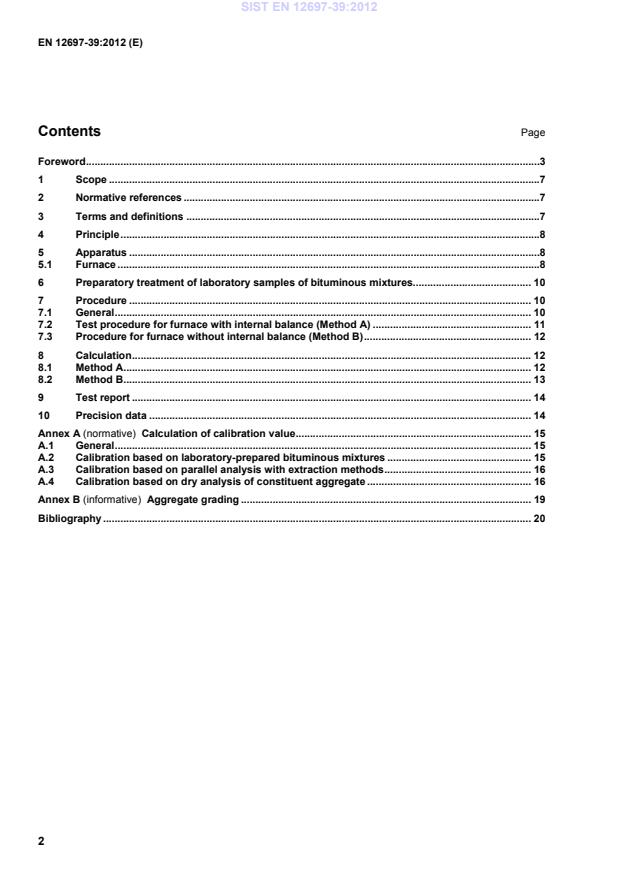
Calculation of calibration value . 15A.1 General . 15A.2 Calibration based on laboratory-prepared bituminous mixtures . 15A.3 Calibration based on parallel analysis with extraction methods . 16A.4 Calibration based on dry analysis of constituent aggregate . 16Annex B (informative)
Aggregate grading . 19Bibliography . 20 SIST EN 12697-39:2012
WARNING — The temperature of the oven and the different accessories is extremely high during the ignition method. Special care shall be taken when handling the equipment and the samples baskets etc. should be placed, shielded and marked in a way that helps ensure any unpremeditated contact is avoided. According to the CEN/CENELEC Internal Regulations, the national standards organizations of the following countries are bound to implement this European Standard: Austria, Belgium, Bulgaria, Croatia, Cyprus, Czech Republic, Denmark, Estonia, Finland, France, Germany, Greece, Hungary, Iceland, Ireland, Italy, Latvia, Lithuania, Luxembourg, Malta, Netherlands, Norway, Poland, Portugal, Romania, Slovakia, Slovenia, Spain, Sweden, Switzerland, Turkey and the United Kingdom.
1) In preparation. SIST EN 12697-39:2012
3 to entry: Methods for determining the calibration values are given in Annex A (normative). 3.4 target temperature temperature to which the furnace would raise the sample in the test without the rise in temperature due to the exothermic reaction of burning the binder Note 1 to entry: The target temperature (usually 540 °C) is determined during the calibration. 3.5 test completion time time from when the temperature in the furnace returns to the target temperature, after the initial rise above that temperature, to when the test is completed with the sample having nominally reached constant mass Note 1 to entry: If a furnace with an internal balance is used, the completion time is when the loss of mass between individual readings taken at 1 min intervals for three consecutive minutes is less than a constant mass limit. If a furnace without an internal balance is used, the completion time is when the change in the mass of the sample after further ignition for 15 min is less than a constant mass limit. 4 Principle The test method determines the binder content of bituminous mixtures by ignition of the mixture in a furnace. The corrected binder content is obtained by a calculation that includes a calibration term. Calibration terms are determined for particular asphalt mixtures or aggregates. Two test methods are described: Method A utilises a furnace with an internal balance; Method B permits the use of a furnace and external balance. Re-determination (re-calibration or re-calculation depending on the calibration method chosen from Annex A) shall be undertaken for each significant change in the mixture, including changes in the constituent materials or their proportions. NOTE 1 The ignition process should have a controlled rise in temperature in order to avoid excessive heating of the mineral aggregate which can break down the aggregate particles depending on the petrographic composition. NOTE 2 The calculation of the calibration value based on parallel analysis with extraction methods (A.1 and A.3) is appropriate for mixtures for which the intended proportions of the constituent materials are not known. 5 Apparatus 5.1 Furnace. 5.1.1 Furnace, capable of burning all the binder with the features detailed in 5.1.2 to 5.1.6 for Method A and 5.1.2 to 5.1.4 for Method B. NOTE 1 The temperature required to burn all the binder will depend on the technology used and is determined as part of the calibration procedure (see Annex A). NOTE 2 The furnace should not have to operate at its maximum capacity in order to allow flexibility and to ensure long service. 5.1.2 Sample chamber, having an internal capacity capable of taking the sample without touching the sides and with the maximum dimensions not greater than twice the minimum dimensions. NOTE Larger chamber sizes may expedite testing by allowing larger sample basket(s) (and thus the material to be tested can be placed in thinner layers). 5.1.3 Automatic lock, that shall not allow the door to be opened until the completion of the test procedure, and a warning system to indicate the end of the pre-programmed temperature cycle. SIST EN 12697-39:2012
The furnace shall have a fan with the capability to pull sufficient air through the furnace to expedite the test and to reduce the escape of smoke into the laboratory. NOTE 1 The method for reducing furnace emissions can comprise a filter and a post combustion chamber that is designed to eliminate the toxic residues produced by burning the binder. NOTE 2 If mechanical ventilation is used, the air flow should be adjusted so as not to affect the operation of the equipment (e.g. a forced air extraction system may result in a loss of fines and the generation of fumes from the furnace). 5.1.5 Internal balance, capable of detecting mass variations of ± 0,1 g in the sample within the baskets.
The balance shall be thermally isolated from the furnace chamber. 5.1.6 Data collection system and a warning system, which shall be capable of being set to a value such that the loss in mass between individual readings taken at 1 min intervals for three consecutive minutes at end of the pre-programmed temperature cycle is not higher than the values stated in Table 1. 5.2 Metal baskets, manufactured from perforated sheet of tempered stainless steel or other suitable material that permits adequate air flow through the sample and retains the majority of the sample throughout the test.
The dimensions shall be specified by the furnace manufacturer to provide the maximum surface area for the sample while still providing sufficient room to safely load and unload the sample. The baskets shall be capable of being nested. 5.3 Catch pan, made of stainless steel with dimensions sized to accommodate the metal baskets specified in 5.2. 5.4 Oven, with convection or forced draft, capable of maintaining a temperature of (110 ± 5) °C in the vicinity of the samples. 5.5 External balance, capable of weighing the mass of trays plus the catch pan and the test sample according to Table 1 to ± 0,1 g. 5.6 Safety equipment, including safety glasses or face shield, high temperature gloves, and long sleeved jacket. 5.7 Heat-resistant surface, capable of withstanding 650 °C and able to act as a heat sink that can speed the cooling of the sample baskets, and protective cage, capable of completely surrounding the sample baskets and preventing accidental physical contact with them. NOTE An appropriate sign warning of the danger of ‘Very Hot Surfaces’ should be attached to the protective cage. 5.8 Pan, larger than the sample basket(s), for transferri
...